CK5
Register an account today to become a member! Once signed in, you'll be able to participate on this site by adding your own topics and posts, as well as connect with other members.
Yeah something isn't adding up Greg, I've tried 65A with Tig on stainless tube and still didn't just blow through. Also, when I use the pulse I usually end up turning the A up some because otherwise the weld ends up too slow and I end up putting too much heat into the stainless with time.

If you can get zero gap on your fitup, I like to weld without filler, turns out beautiful.
 
Yeah something isn't adding up Greg, I've tried 65A with Tig on stainless tube and still didn't just blow through. Also, when I use the pulse I usually end up turning the A up some because otherwise the weld ends up too slow and I end up putting too much heat into the stainless with time.

If you can get zero gap on your fitup, I like to weld without filler, turns out beautiful.

Heath,

My "dwell" time at full-pedal is something like 3 - 4 seconds when I'm trying to get a tack weld to flow-out and melt the two parts together. I hold the tungsten right in the center of the seam and don't really weave it around at all.....maybe I should try gently blending across the seam to help initiate the "melt" a little??

Anyway... the pulse seems to help a lot and I can even use the 1 second pulse as a metronome to help teach me when to add rod (something I wasn't even trying to incorporate previously). My gaps are USUALLY tight all the way around each tube but since I'm freehanding all the cuts and generally just flapwheeling the cut ends to clear the burrs I sometimes get low spots that create about a 1/16" gap between the parts.


-G
 
2015.09.17 - UDPATE! - 24 TUBING SEGMENTS COMPLETE!!!


Finally.

I'm getting back in the groove with the header build...after being pulled away for several weeks on house-related projects. It makes it a lot harder to get back, especially when trying to learn a new skill like TIG. The last couple of days felt just like starting from scratch, with all the frustrations and lack-of-progress that you'd expect when fumbling around awkwardly with an unfamiliar task. :doah:

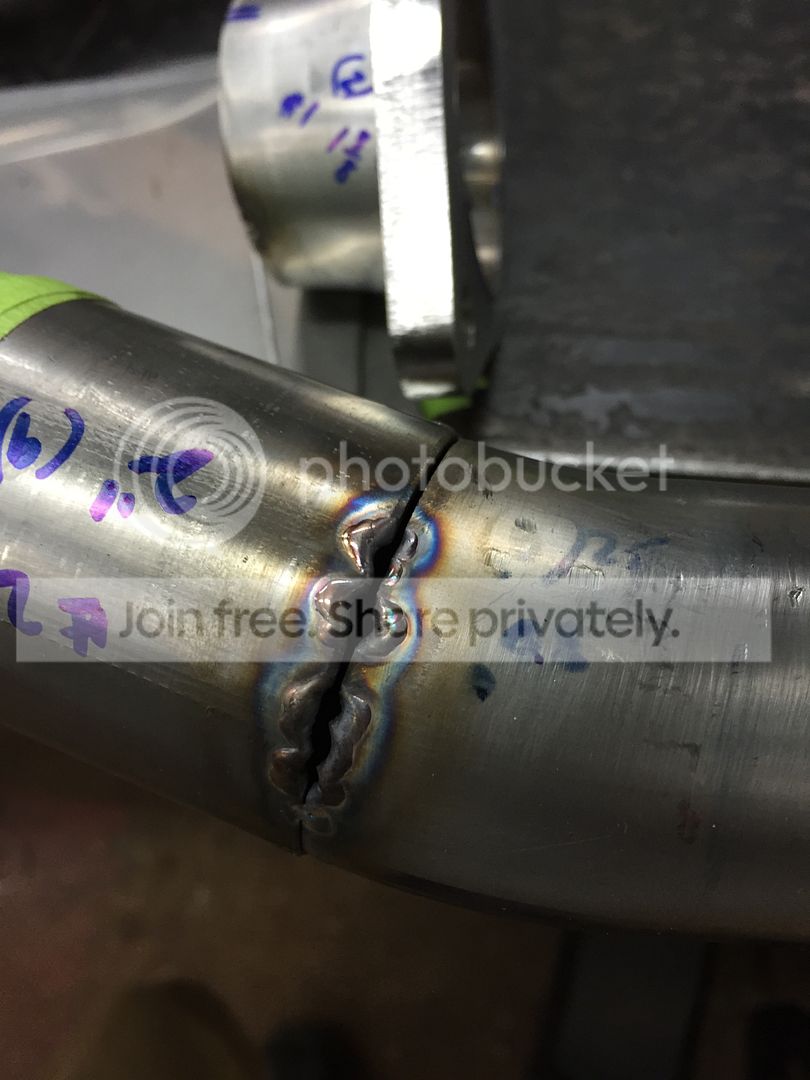
That task was trying to fit-up the primary tube for cylinder #2. Despite my best efforts and tightest fitments, I just kept melting through on my tack welds....

IMG_6619_1.jpg


This one seems to have bad fitment, but that's only because I finally got a decent tack weld on the opposite side and the shrinking pulled this side open a bit. I have a feeling that I am simply taking TOO long to get the tack weld established (several seconds) and the heat soaking into the part just blows a hole into it and the metal starts flowing away from the heat. I tried 60A initially, then backed it down to 45A.... I even went down as low as 30A, but I think that it just causes me to dwell even LONGER trying to get some kind of "wetting" of the metal and even the low amperage settings end up overheating the part. :dunno:

Anyway, as BARRAZA suggested last night (THANKS! :bow:) I fiddled around with the pulse settings which I normally leave turned off, and with a 1 PPS setting, 60A of current, 40% peak time and 15A (background amperage) I was able to get a much more predictable result and get tack welds that stuck and didn't blow-through. The sound of the pulse gives a great cadence and really helped me on those occasions where I was trying to time the addition of filler rod into the puddle..... zap....fill....zap...fill...zap...fill. Kind of like dancing, but with molten metal instead of people. :haha:

Anyway... enough with the "Zen of TIG", I'm sure people just want to see some sort of ACTUAL progress on the headers themselves.

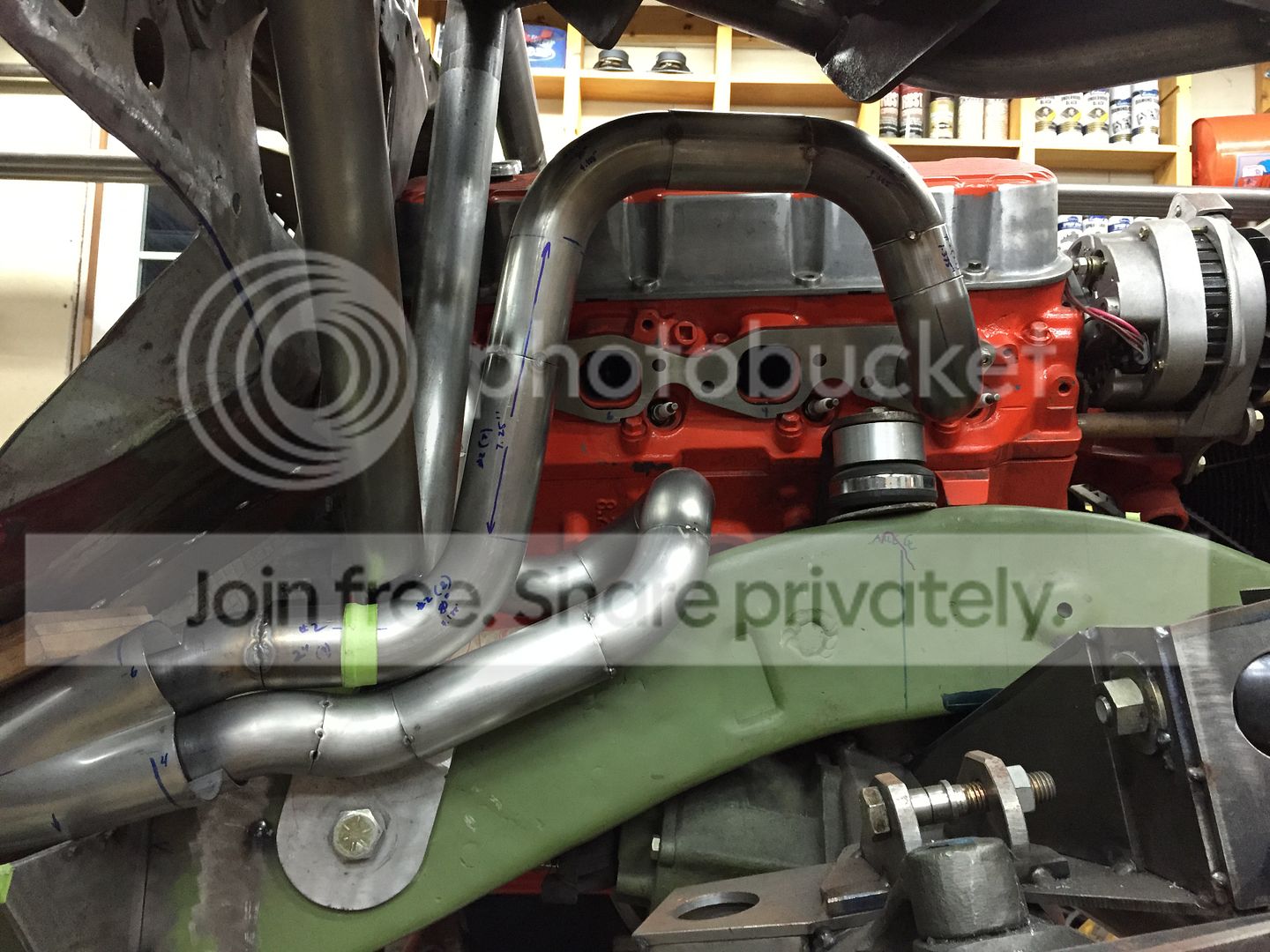
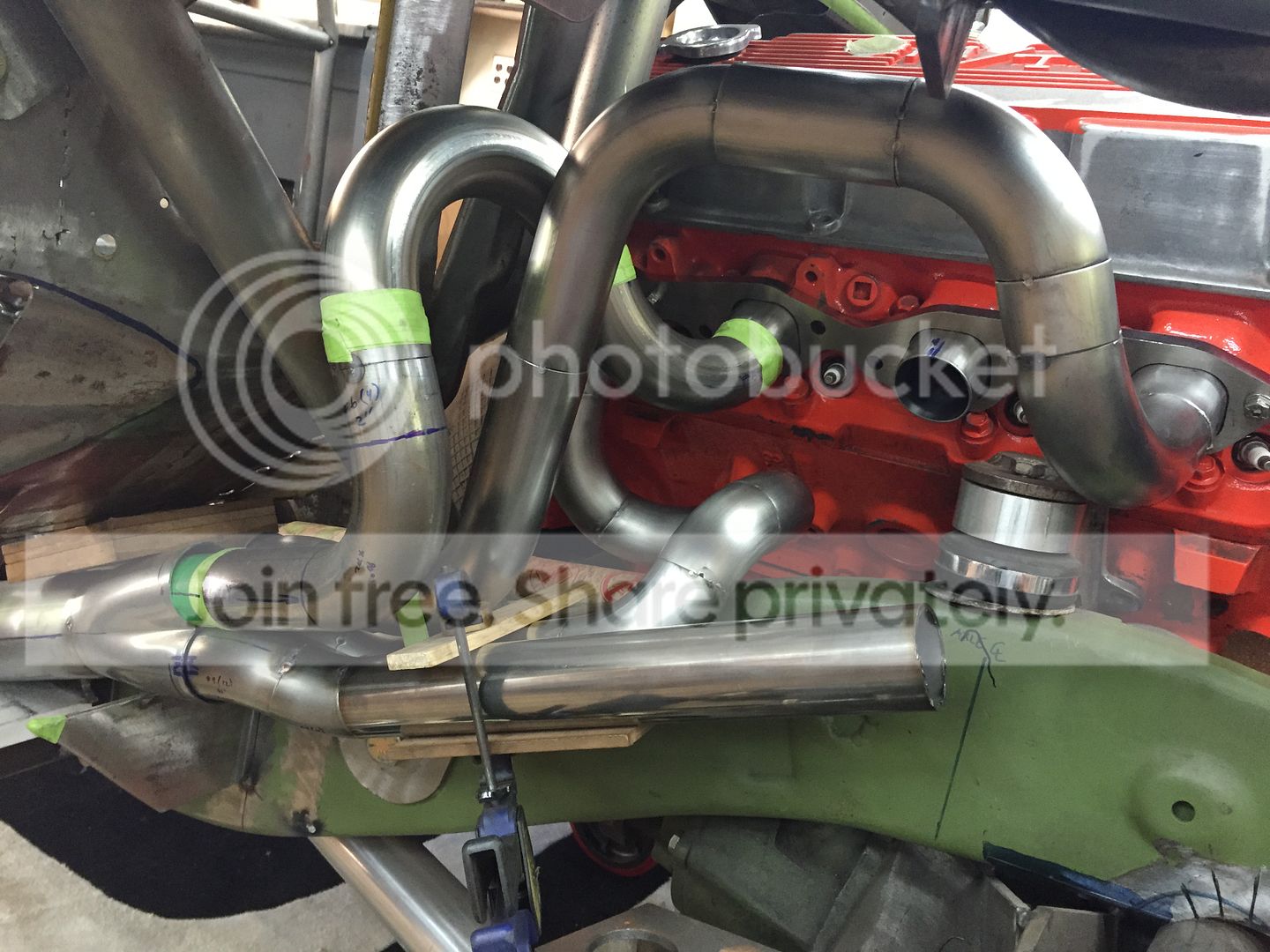
So here you go, the almost-final assembly tacked and still covered in Sharpie notes (only one 3M green-tape weld left to remove!):

IMG_6621.jpg


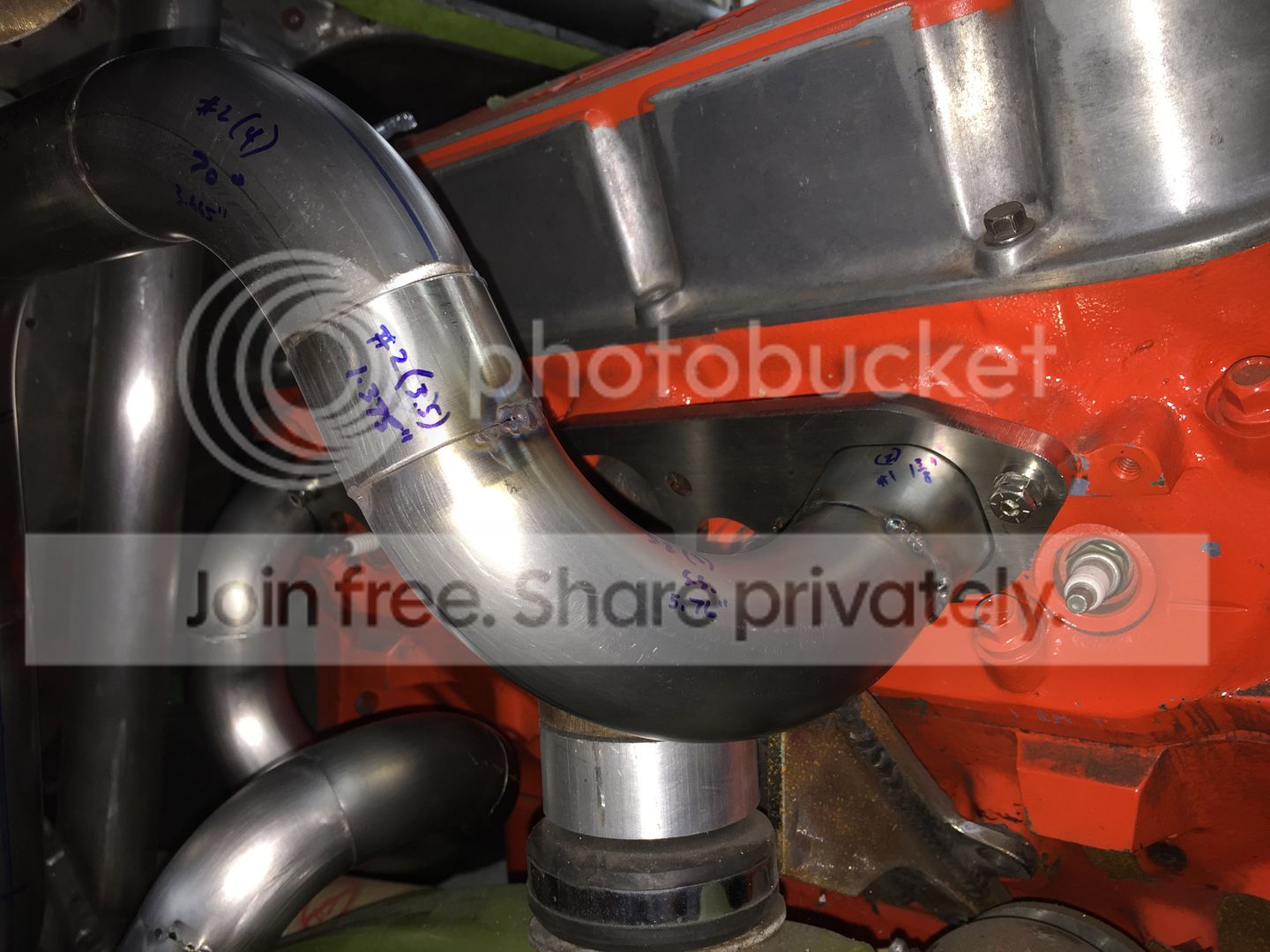
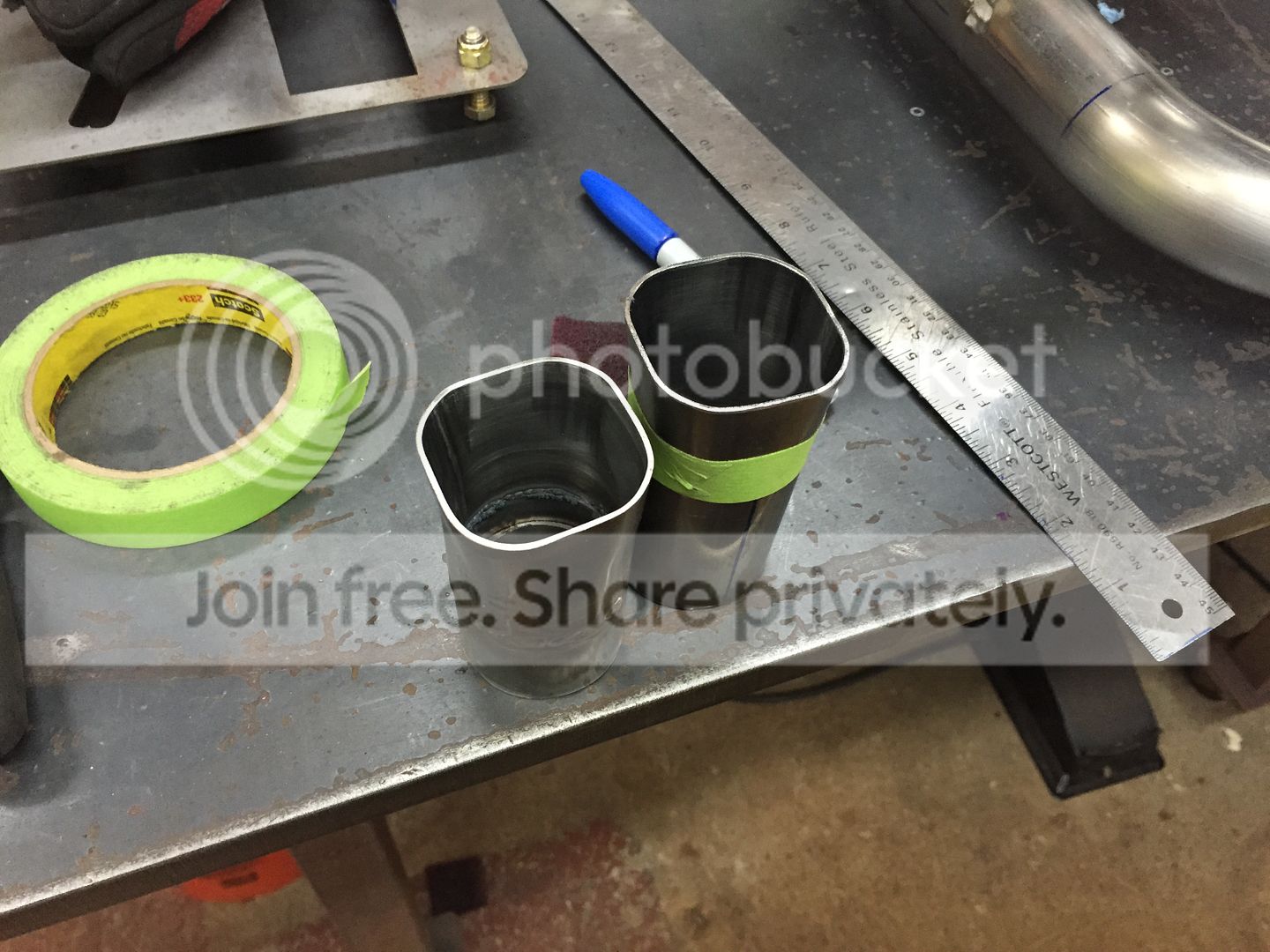
Here's a shot from that swaged #2 head flange area....converting the first tube from square to round over a fairly short 1-3/8" distance.

IMG_6629.jpg


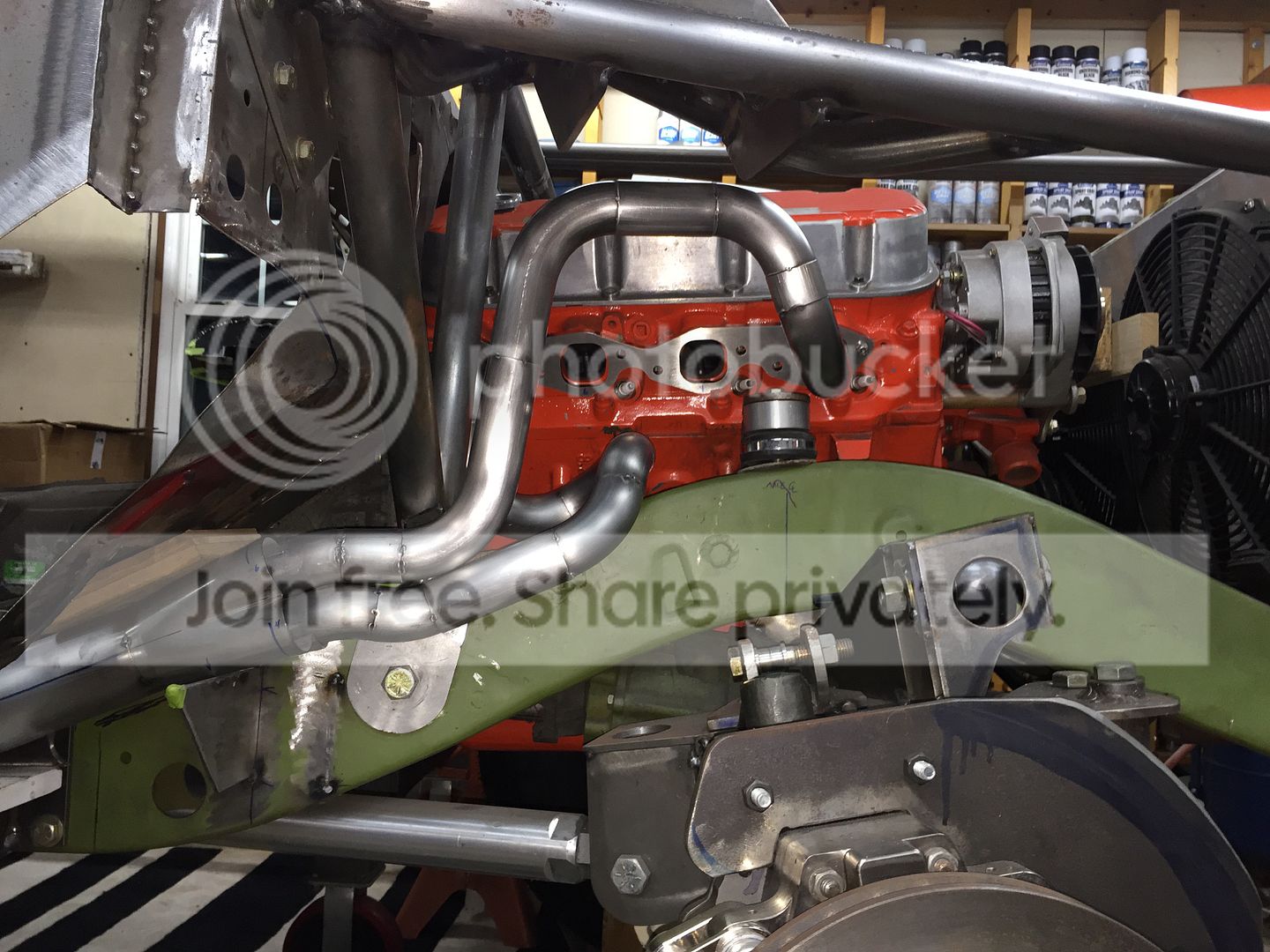
After a little ScotchBrite love, the whole thing looks a lot more professional and integrated.

IMG_6636.jpg


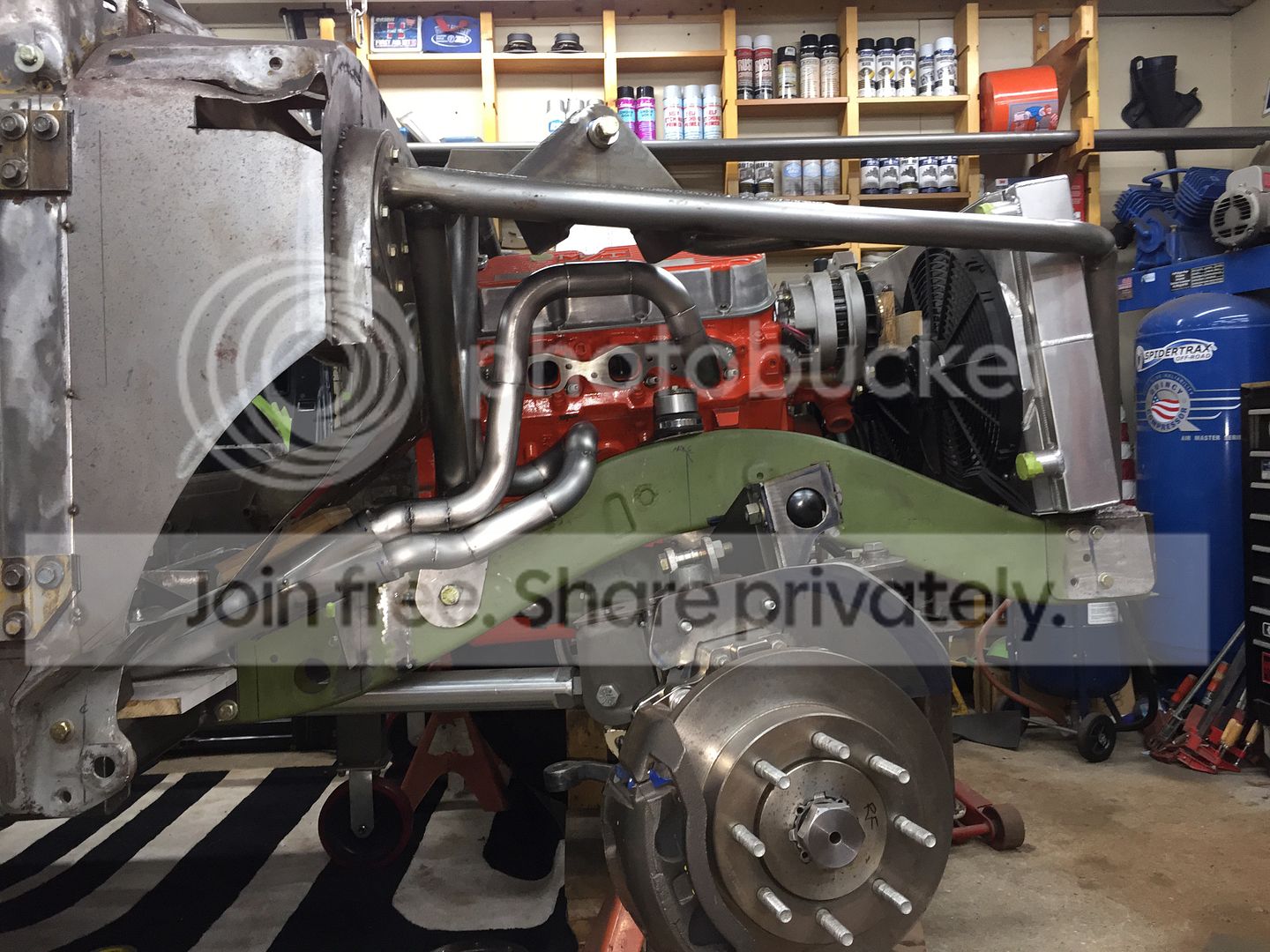
....and the parting shot for the night from a bit further back in the shop to give you an overall sense of size and scale.

IMG_6643.jpg


Interesting note: Now that I've created an .XLS spreadsheet called "CLR Tubing Calculator" it's pretty simple for me to plug in my final cuts and straight segments for each primary tube and get a final length....accurate to the thousandth-of-an-inch! :waytogo:

Results so far (ideal target value is 36" per tube):

Cylinder #8 = 32.496"
Cylinder #2 = 35.748"


Not bad.

I'm debating going back to Cylinder #8 and lengthening a couple of the straight horizontal segments by 1.5" (one inside the framerail, and one outside the framerail) to effectively "stretch" that big U-shape out. I can get a lot closer to 36" without too much effort, but I'm waiting to see if the remaining two cylinders are going to be close as well. If they miss the mark by several inches, there won't be much point in optimizing #8 any further.


-G
 
I don't think you will ever see a noticeable or even repeatably measurable increase by lenthening that tube 2 inches. I wouldn't waste your time. It looks good so far.
 
Dude try going with a thoriated tungsten. Im no, o you should be using this with that text book master tig guy yet but Ive been welding stainless for the last two days at work. 1/8 material 85 amps for an initial punch and then welding around 60amps with a 3/32 thoriated tungsten.

The other day I was welding a 18ga piece of SS restaurant equipment with the same setup but down around 60 amps.
 
It cant hurt to try thoriated but I use 2% lanthanated all the time and on stainless too and I don't get burn through like that. I think something else is going on.
 
It cant hurt to try thoriated but I use 2% lanthanated all the time and on stainless too and I don't get burn through like that. I think something else is going on.

What do you think of my "dwell time" hypothesis???

How quickly do you guys lay down a tack weld with TIG? Is it literally like a 1-2 second, full-throttle and done process..... or do you ease into the throttle over a longer period of time and dwell longer to wet out the puddle and blend the two halves together??? :dunno:

I don't have any thoriated tungstens. I got scared by all the radioactive talk, and Jody over at WeldingTipsandTricks.com suggested that the 2% lanthinated is a great all-around tungsten to use.


-G
 
What do you think of my "dwell time" hypothesis???

How quickly do you guys lay down a tack weld with TIG? Is it literally like a 1-2 second, full-throttle and done process..... or do you ease into the throttle over a longer period of time and dwell longer to wet out the puddle and blend the two halves together??? :dunno:

I don't have any thoriated tungstens. I got scared by all the radioactive talk, and Jody over at WeldingTipsandTricks.com suggested that the 2% lanthinated is a great all-around tungsten to use.


-G

Is thoriated the radioactive one? In that case maybe it can hurt to try it. :doah: I just stick with 2% lanthanated and I haven't had a problem with DC, AC, or pulse on chromemoly, stainless, or aluminum.

My tacks on steel and stainless are pretty quick. More of a floor it and then back off type deal, 2 -3 seconds is probably a good guess. However, on aluminum, especially thicker aluminum it takes a little more time because the AL conducts the heat away so quickly.
 
Heath,

... I hold the tungsten right in the center of the seam and don't really weave it around at all.....maybe I should try gently blending across the seam to help initiate the "melt" a little??....
-G

Moving the tip around a little can be a good thing to warm up a cold piece. As you are moving down a joint, it is easy to see the puddle and do what you need to adjust it with travel speed and amps. On a tack, it is all unknown until it melts, and for a novice it is easy to blow through. It takes practice, and more practice, then a little more practice. Once you get the hang of it, it is like a light bulb turning on, you will wonder how it was ever so hard.

Something else to consider is that the puddle is affected by surface tension just like a water drop. If you stick the tip right in the middle of the joint, but the sides of your tubes aren't touching, they will draw back away from each other. Instant blow through. Try melting a little rod first and use it to bridge the gap (and act like flux on a solder joint) and allow the puddle to form across the gap. That will allow you to put the heat into the metal to form the puddle and minimize a blow through.

Always think - Where is the heat going?
 
...the puddle is affected by surface tension just like a water drop. If you stick the tip right in the middle of the joint, but the sides of your tubes aren't touching, they will draw back away from each other. Instant blow through....


I have definitely experienced this one.

:whistle:


Made contact with my local uber-TIG welder today and he has generously offered to come over during one of my evening workshop sessions next week. :bow::waytogo:

I have a feeling that my "lightbulb" is going to come on in a hurry with someone like that looking over my shoulder.

:D

-G
 
I have definitely experienced this one.

:whistle:


Made contact with my local uber-TIG welder today and he has generously offered to come over during one of my evening workshop sessions next week. :bow::waytogo:

I have a feeling that my "lightbulb" is going to come on in a hurry with someone like that looking over my shoulder.

:D

-G

Yes I believe thoriated is slightly radio active. Its so minute though and will only affect you if you're huffing it while pointing up the tungsten grinding it. I like the way it tastes :haha:


Yes I come on full blast when I tack something. Torch angle can help push the puddle over the slight gap too. In fact I never ease heat in when I tig at all. I find I get much less heat soak to just blast it at first to wet the puddle then back down to just enough heat to click the filler rod in. Said approach is important with chromo.
 
Made contact with my local uber-TIG welder today and he has generously offered to come over during one of my evening workshop sessions next week. :bow::waytogo:
Do him a favor, and prepare a bunch of cut pipe sections that are ready to tack and weld. Have plenty because it might take him a couple of goes to get used to your machine and the material if he usually welds something vastly different.
 
2015.09.21 - UDPATE! - CANT BUTTERCUP THIS UPDATE...!!!!


As a now-famous Craigslister said recently, there is just no way to "buttercup" this update... Time to throw some parts in the scrap pile and start over (for about the 3rd time)

The effort started out innocently enough. It was time to lay up the tubing for cylinders #4 and #6 so that the passenger side header would be ready to go into final welding.

I pressed out a couple of header flanges in preparation for a good progress day:

IMG_6647.jpg


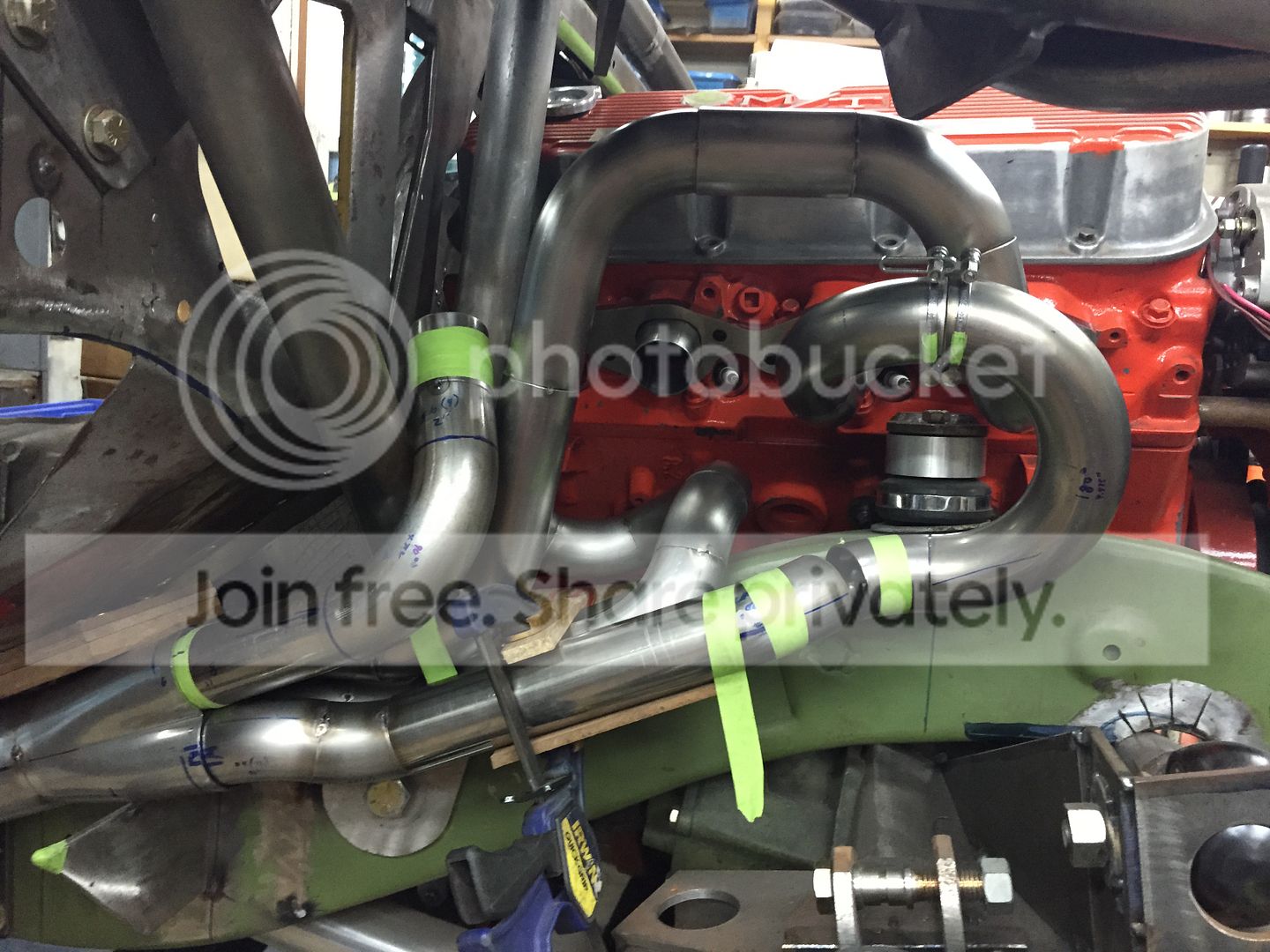
Then I mapped-out what looked like a good start to the new primary tube locations. The #2 primary tube ended up a bit more "square" at the top than in my original rendering, but nothing that was expected to cause too many difficulties for the remaining tubes. The #6 cylinder took a cool vertical path over the top of #2 & #8 before bending back around to the header flange, and #4 seemed like it would just sweep along the framerail and then curl up toward the engine as well.

IMG_6650.jpg


I had taken the ORI out so that I'd have more room to work, and I kept looking to make sure that I wasn't building anything that would run through the center of that space... Since #4 seemed like the most challenging primary left, I decided to tackle that one first and was making good progress. I found a great location that seemed to optimize the length of the tube to around 36" total and everything seemed great.

IMG_6655.jpg


Unfortunately, when I put the ORI back into place to do some verification, the clearance between the strut body and that newest primary tube was only around 1/4"!!!! :doah: I'm building at "full stuff" but as most of you know by now, the struts swing a little bit from side-to-side under certain combinations of wheel articulation..... and it just seemed like I was asking for trouble by trying to put that big curve so close to the strut area.
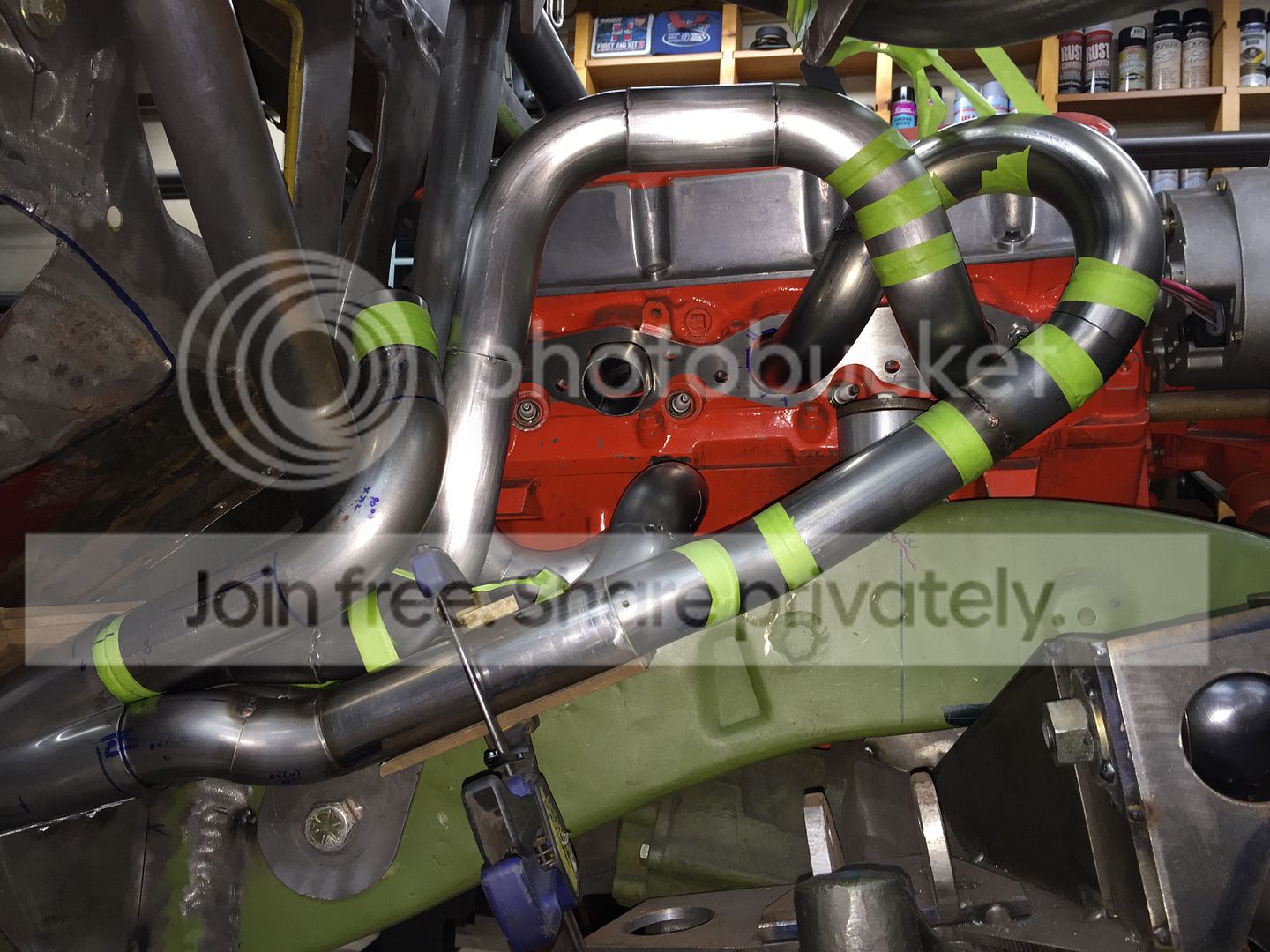

I briefly toyed with the idea of just running a much more direct path along the framerail and then up to the head flange, but the overall length of the tube was around 26".... I'm not necessarily trying for "perfect" tuned primary lengths... but that felt like a number that was simply TOO far out of the ballpark.

The next idea was to try to move that "curl" a bit further away from the strut before trying to loop it back to the flange. With only a 6" CLR, it's really hard to do tight direction changes... and it became obvious when I finally got this one rendered.... :eek1:

IMG_6662.jpg


WOW!!!!....... I'm not going to butter cup it, that looks pretty awful. And to add insult to injury it ended up being a full 39" long as well!!!

I decided it was time to call it a night so I could spend some time reflecting on things. That always seems to help, and it did. As of this morning, I think the winning strategy will be to go back and do a modified version of my 1st design, but shorten-up that 8" straight section (running along the framerail) and pull the whole curly pig-tail in so that it's more "centered" under the tall #2 primary. I think that will allow it to sit back toward the engine/framerail more tightly and give me more strut clearance... :thinking: I guess I'll find out tonight.

On a side note:

I think I finally figured out why I was having such a hard time sorting out my mild-steel vs 304SS tubing bends. It seemed like magnet would work, but it wasn't sticking well to the mild steel stuff either. It turns out that whomever shipped my original mild-steel order must have screwed up and mixed in a combination of mild and 304 tubes in my order. Some of the parts are now slightly rusty (and VERY magnetic) while other parts are still perfect, shiny and not at all magnetic. :D I thought I was losing my mind, but now it's obvious how to tell them apart and it seems like I have a LOT more stainless tubing to work with than I was expecting. :waytogo:


-G
 
Can you not just mimic the #2 primary? It looks like it would work perfectly if you just followed it along.
 
Can you not just mimic the #2 primary? It looks like it would work perfectly if you just followed it along.

It's hard to notice the "depth" of the headers in these photos, but the #2 tube is as far forward (out toward the strut) as I can go before things interfere. The #4 that I built actually has a "jog" in the tubing to move it closer to the framerail to maximize the clearance around the strut but up where the loop is, I just couldn't push it any closer to the engine because it was right up against the #2 primary.


-G
 
Wow that is some winding road you are working on.....

I am not going to butter cup it, but your attemps at this still looks better than a $3000 dollar bumper. I see where your having the issues, all structural and aerodynamic engineering aside (not licenced just been doing it for years) if you can get the primary tubs all to within an 1/8 of an inch then your fuel milage will go up, but only if you use 89 Octane, not so much around town but you should at least see like 200 miles to 3 gals on the highway. Less than that 1/8 inch and in may only be 9 miles to the gal.

I hope this helps bro....:haha:
 
I'm not going to buttercup this. You should have done the driver's side frist since there is a steering shaft for more difficulty. You may have a completely different set up that is not going to look uniform to the passengers side.
 
I'm not going to buttercup this. You should have done the driver's side frist since there is a steering shaft for more difficulty. You may have a completely different set up that is not going to look uniform to the passengers side.

So many buttercups! :haha:

Yes, the drivers side will be different... The steering shaft adds complexity, but IIRC, cylinder #7 is actually further forward than #8 is, so at least there will be a little more room between the collector and the exhaust ports. Hopefully that translates to straighter primary runs with fewer crazy loop-de-loops!! :D

-G
 
Yeah, well, my friends and family complain I'm too negative, saying bad things and being oblivious about it. I was biting my tongue about the order on how the headers should be made. The buttercup comments gave me an in for being a humorous jackass.
I have never built headers before but I've stayed at a shady motel once and it made me much wiser to the world.

Build the headers however you want.
 

Latest Posts

Top Bottom