
CK5
Register an account today to become a member! Once signed in, you'll be able to participate on this site by adding your own topics and posts, as well as connect with other members.
Can you do this?


Yeah, that's the 26" primary I was trying to explain earlier.... It's just too direct and doesn't use enough tube.

IF that blue line was moved down closer to the clamp in the photo, I might have more room to put a curve in there on the way to #4.

Last night I actually worked on #6 just to make sure that I knew what was going to happen there first...it looks like I have a decent solution worked out (I'll post photos in a couple hours!) :waytogo: so tonight I can get back to #4 and see if my latest idea will work or not. :thinking:


-G
 
Can you not just mimic the #2 primary? It looks like it would work perfectly if you just followed it along.
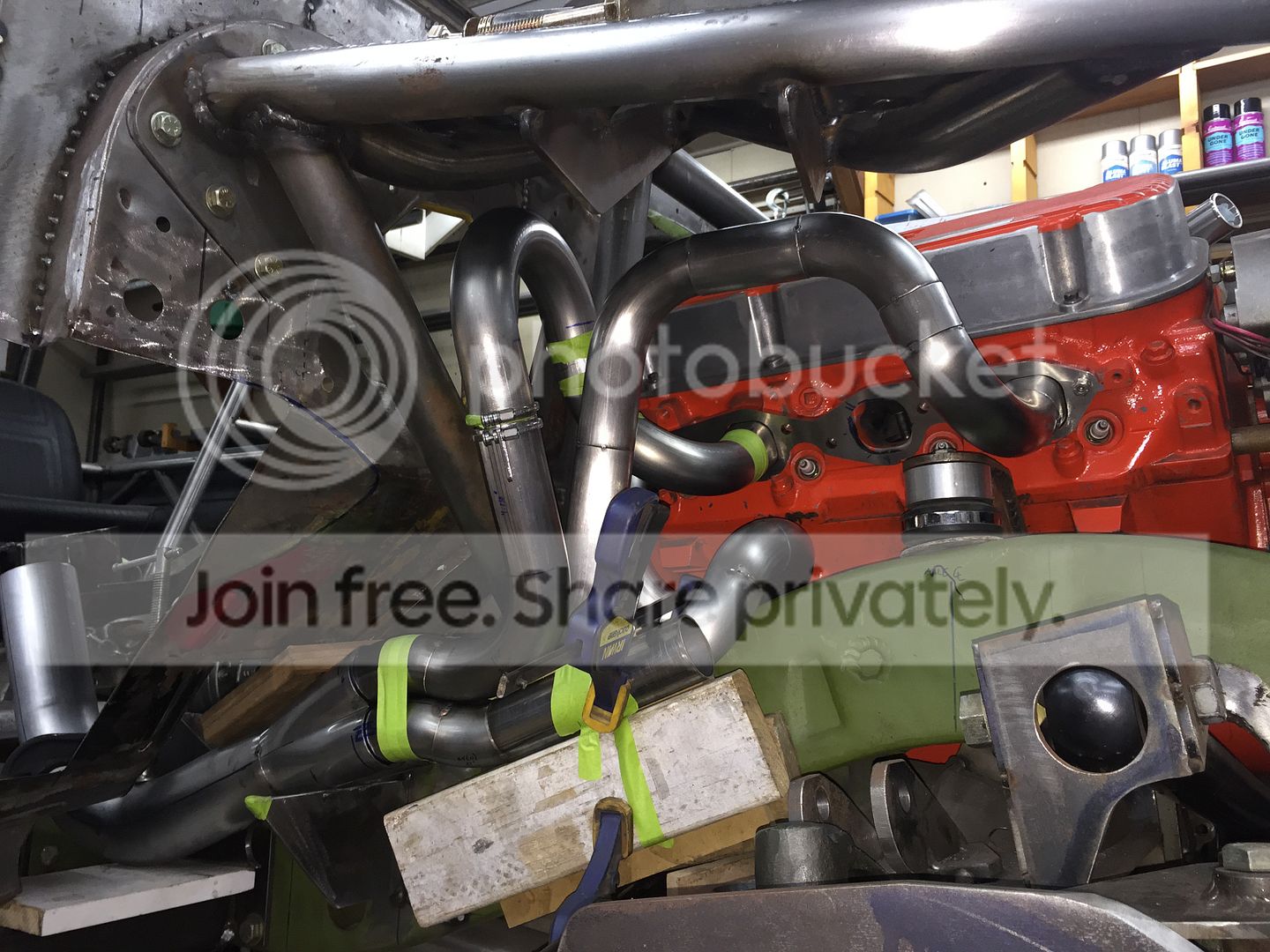
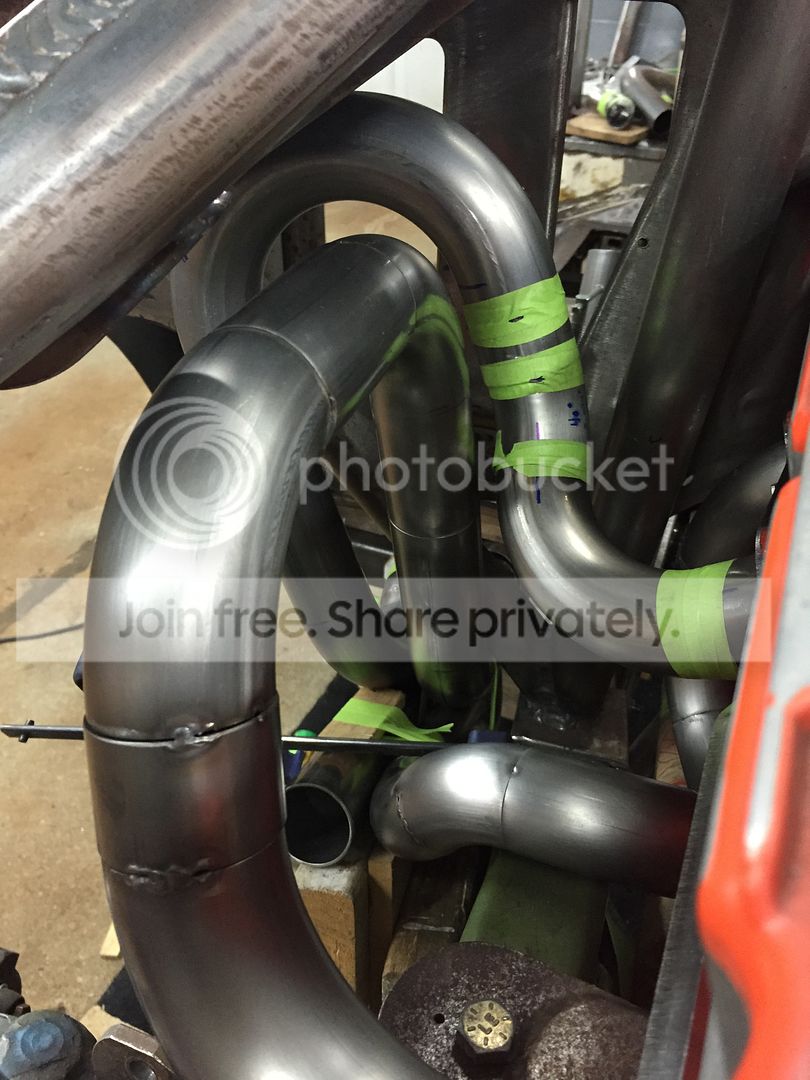
I went back after a few hours of consideration to play around with Mitchell's idea.... :waytogo:

It's a little harder to get another "matched" set of tubes underneath the #2 design but I think there's a way to finesse it in there if I work at it. In the meantime, I wanted to make 100% sure that I had a workable solution for the #6 cylinder since I would probably be stealing all the remaining real estate from that big open center area for the #4 primary.

It seemed like a tall hoop would be the way to add a lot of length quickly, and it felt like I'd still have enough clearance behind #2 to make the final turn and land on the header flange.... so I cut, and fussed and fiddled around with angles for a few hours until I had this:

IMG_6682.jpg


It leans a little bit outward, but I don't think that is an area where the tire ends up under full-lock right turns. The major interference was lower (at the collector area) last time I checked...so I "think" I'm good here... :waytogo:

Here's a view of that #6 primary tube from the front, peeking down through the "hood" area:

IMG_6686.jpg


I'm trying not to obsess about the lengths (it's not easy! :haha:) so I'm only keeping track for purposes of knowing that I'm within a couple of inches of each other. That will have to be "close enough" in this case. For those keeping track, the lengths so far are:

#2 - 35.748"
#8 - 32.496"
#6 - 34.222"
#4 - TBD

And here's the worksheet that keeps it all organized:

fc073bff-fe07-44b0-a3f3-db7eec68b389.jpg


Looking forward to getting out into the shop tonight. The #6 isn't fully tack-welded and there is still a small amount of fussing and rotating of segments to get it perfect and complete, but for now it's 99% done and it's location isn't going to change more than maybe 1/8" in any direction so it won't make any difference as I try to get the #4 tube routed later on today.


-G
 
Last edited:
Out of left field question here, but what is the difference in performance between the long tube headers you are creating and something shorter that made a more direct connection to the collector, and could that performance have been gained elsewhere?

Not trying to be a killjoy here but tubes running all over the place trying to get length is a little weird looking to me. Maybe I'm the odd one though. :dunno:
 
My gaps are USUALLY tight all the way around each tube but since I'm freehanding all the cuts and generally just flapwheeling the cut ends to clear the burrs I sometimes get low spots that create about a 1/16" gap between the parts.


-G

1/16" is a large gap on a header tube Greg, that's the thickness of hte material, thats like having a 1/4" gap on an axle bracket weld. Can't you use your big disc sander or a belt sander with some 120 grit or something to debur the end and make it perfectly flat to mate to the next tube?

Try melting a little rod first and use it to bridge the gap (and act like flux on a solder joint) and allow the puddle to form across the gap. That will allow you to put the heat into the metal to form the puddle and minimize a blow through.

Always think - Where is the heat going?

That is an excellent tip, I was going to suggest the same thing. Sometimes when bridging a gap it may even help to start the arc on the filler rod and melt some in right off the bat so you don't blow through.

I'm trying not to obsess about the lengths (it's not easy! :haha:) so I'm only keeping track for purposes of knowing that I'm within a couple of inches of each other. That will have to be "close enough" in this case. For those keeping track, the lengths so far are:

#2 - 35.748"
#8 - 32.496"
#6 - 34.222"
#4 - TBD

And here's the worksheet that keeps it all organized:

-G

I think you are obsessing too much about the lengths Greg. My engine machinist did a dyno test on a ~600 hp truck pull big block and he ran back to back with the Hooker Comps and then super comps which had equal length runners and 1/8" bigger tubes, and the super comps picked up 15 hp only in a 200 hp window, everywhere else the power was virtually the same and you are not going to feel that. You may be able to measure it at the track if you have a lenco transmission and 8 gears to keep it in that window, but most normal trans have a 1500 - 2500 rpm drop between shifts in the upper rpm range. I wouldn't worry about making the tubes within 2" of each other, just run the tube where it needs to go, and keep it the correct diameter, and you will be good. Now, don't go running shorty headers or manifolds with little collectors, that will kill it. The most important thing is to keep the headers primaries the correct diameter, and a decent length(mid length or better) with the proper collector diameter, and it will run very well.
 
Out of left field question here, but what is the difference in performance between the long tube headers you are creating and something shorter that made a more direct connection to the collector, and could that performance have been gained elsewhere?

Not trying to be a killjoy here but tubes running all over the place trying to get length is a little weird looking to me. Maybe I'm the odd one though. :dunno:


I'm not sure what length qualifies as "shorty" vs. "mid-length" vs. "long tube"... hopefully Heath can clarify. :waytogo: All I know is that the GM documents for the 502BBC call for a 36" primary tube (1-7/8" diameter) into a 3" exhaust... so that's what I'm shooting for! :D

One of the less-obvious explanations for why the primary tubes are looking so bizarre (I prefer "interesting") is the location that I'm forced to place the 4-to-1 collector. Normally that part would be substantially further down the framerail toward the back of the truck... but since I'm passing the exhaust under the floorboards and above the rockslider, there is a VERY limited amount of room to work with. Ideally I'd have just run all 4 primary tubes through that area where the #1 cab support is, but there isn't enough space to get them all fished-through there. The 3" collector barely fits as it is.... :eek1:


1/16" is a large gap on a header tube Greg, that's the thickness of hte material, thats like having a 1/4" gap on an axle bracket weld. Can't you use your big disc sander or a belt sander with some 120 grit or something to debur the end and make it perfectly flat to mate to the next tube?

Perhaps that was an overstated gap... The gaps I have are narrow enough that if I lay a piece of .030" filler rod on them it fills the gap and sits slightly above the seam.... so in reality, we're a talking closer to 1/32". I know, I know....it's a difference of 1/32" but can't we all just get along? :haha:


I think you are obsessing too much about the lengths Greg....


Do you know the fable about the scorpion and the frog? :thinking: I feel like I am the scorpion and you are the frog that wants to believe that there is a way to change my nature!!! :haha: I feel like I'm going pretty good by looking the other way at a 3" variation between primary tubes... it's giving me the shakes a little bit, but I'm working through it.

In all seriousness though.... at what point (length) does a primary tube qualify as a mid-length vs. a long-tube? 30"? 24"? 20"? Maybe having a clearer sense of that would help talk me down from the ledge. :D


-G
 
Maybe I missed something but isn't this a crawler? I understand optimizing the exhaust but to what end? The arrangement you have is going to make it extremely hard to get at the side of the motor?? I would understand the fight if you were building race motor? Or trying to make this a 180 degree header because then the scavenge might help more or over scavenge the motor but if you never run it up that high why?? Just because?? Not hating at all just trying to better understand.
 
Maybe I missed something but isn't this a crawler? I understand optimizing the exhaust but to what end? The arrangement you have is going to make it extremely hard to get at the side of the motor?? I would understand the fight if you were building race motor? Or trying to make this a 180 degree header because then the scavenge might help more or over scavenge the motor but if you never run it up that high why?? Just because?? Not hating at all just trying to better understand.


Actually, one of the things I'm constantly checking as I do these mock-ups is access to the header bolts and spark plugs....

One of the nice side-effects of an outboarded header is that you move the tubing AWAY from the block instead of trying to jam them down immediately to fit inside the tiny gap between the frame and the engine block.... and THAT is typically where you start blocking access to plugs and header bolts.

Beyond that.... you're just watching my neurotic behavior play out. As Heath already mentioned, it's stupid to try for such similar tube lengths but I really just can't help myself... I'm not taking any meds for my condition, but perhaps I should! :D


-G
 
I'm not sure what length qualifies as "shorty" vs. "mid-length" vs. "long tube"... hopefully Heath can clarify. :waytogo: All I know is that the GM documents for the 502BBC call for a 36" primary tube (1-7/8" diameter) into a 3" exhaust... so that's what I'm shooting for! :D
-G
I guess that is the thing. You've mentioned already that you can't make them they way they are typically made because of other design choices, so how much are you really gaining by trying to do it anyway? I guess smarter people than me will have to clarify. :rolleyes:

Of course if you just like the tubes like that then carry on! :thumb:
 
I guess that is the thing. You've mentioned already that you can't make them they way they are typically made because of other design choices, so how much are you really gaining by trying to do it anyway? I guess smarter people than me will have to clarify. :rolleyes:

Of course if you just like the tubes like that then carry on! :thumb:


I know from my research that for almost any BBC motor, switching from a set of factory manifolds to headers picks up about 50HP/50LbFt... it's just about the cheapest, simplest thing you can do to add real power to a BBC engine.

As Heath is pointing out though, you don't have to go all "mental-patient crazy" doing full-length headers to enjoy those HP/TQ gains. Even a moderately competent set of tubular headers will give you MOST of that extra power....

Personally, I kind of like the whole "Snakes of Medusa" look of the outboarded headers and the crazy way that they twist and tangle into each other.... it's probably from a deep-seeded psychological transference. I subconsciously think about my own bald head, and wish that I still had a big, thick mop of hair. :haha::haha::haha:


-G
 
I subconsciously think about my own bald head, and wish that I still had a big, thick mop of hair. :haha::haha::haha:


-G
lol, dammit! Now that's what I think about thinking of my own bald head. doh!


guess I need to make some headers... :haha:
 
lol.. have a sneaky feeling you could have done a used blower cheaper:pimp:

Hmmm....yes, I think you're right.

The problem with "cheap horsepower" is it usually involves the use of cheap parts. I probably could have slapped on a pair of Chinese turbos for less money too....!!!!

Don't worry, I'll find other ways to save money on this build later on.


:haha:

-G
 
Hmmm....yes, I think you're right.

The problem with "cheap horsepower" is it usually involves the use of cheap parts. I probably could have slapped on a pair of Chinese turbos for less money too....!!!!

Don't worry, I'll find other ways to save money on this build later on.


:haha:

-G


You'll do that right after you find ways to save time.:D
 
Maybe I missed something but isn't this a crawler? I understand optimizing the exhaust but to what end? The arrangement you have is going to make it extremely hard to get at the side of the motor?? I would understand the fight if you were building race motor? Or trying to make this a 180 degree header because then the scavenge might help more or over scavenge the motor but if you never run it up that high why?? Just because??
Well yeah!! Because RACE-CAR!!!!!!
:woot::waytogo: Edit: Greg, I think you should get the tube lengths as close to equal as you are able, that way you can say you did it cause you could!!
 
Quote:
Originally Posted by BARRAZA View Post
Try melting a little rod first and use it to bridge the gap (and act like flux on a solder joint) and allow the puddle to form across the gap. That will allow you to put the heat into the metal to form the puddle and minimize a blow through.

Always think - Where is the heat going?
That is an excellent tip, I was going to suggest the same thing. Sometimes when bridging a gap it may even help to start the arc on the filler rod and melt some in right off the bat so you don't blow through.


That is an excellent tip, I was going to suggest the same thing. Sometimes when bridging a gap it may even help to start the arc on the filler rod and melt some in right off the bat so you don't blow through.

Yeah, JUST MAKE SURE THE FILLER IS ON THE WORK OR YOU'LL HIGH FREQ YOURSELF!!!!
 
:woot: never in my wildest dreams thought I would have something remotely worth while to contribute to this thread!
 

Latest Posts

Top Bottom