CK5
Register an account today to become a member! Once signed in, you'll be able to participate on this site by adding your own topics and posts, as well as connect with other members.
Line-x/bedliner is a two part poly. The machine that sprays them has heated lines, it mixes at the tip and the product cures within minutes. It's the same machines they use to apply spray foam. I use to be the general manager of a fab shop that we specialized in plural component spray equipment. I Personally have never heard of a system that is heat cured after the fact.


I was watching a recent ICON4x4 video and Jonathan Ward explained his build process in rather specific detail.... the body (on a body cart) was fully painted in final color, then sits for about 10 days to cure. Then it goes to Line-X (somewhere close to his shop in So. Cal) where they tape / mask / seam seal everything and then shoot it with the polyurea... He specifically said that they place it in an oven after that, I assumed to cure the Line-X.

...perhaps he misspoke and was just trying to convey that the Line-X is a heat-activated process??? :dunno:


Anyway. I've still got at least another year to crack this riddle before it becomes an impediment to my build. :haha:

Thanks for the info!


-G
 
haha I don't know, possible a system exists, but once A chemical and B chemical mix, the process is over, heating won't do anything. As a matter of fact, the process itself creates a substantial amount a heat, with roof foam if the applicator puts it on to heavy, it will ignite.

My biggest worry when I send stuff for linex is over spray, and lifting paint along the tap lines. Do a lot of research on the location your using, they're franchises and not all created equal. Ask to see jobs they've done etc. I've seen some head scratchers haha.
 
2016.05.02 - UPDATE! - WHEEL STUD NIGHTMARES....!!!

The progress on the convoluted cage plates by my machinist is continuing as a background process, with fine-tuning of the fitment and getting the gaps as small as possible. Once he gets those finished up, I can start welding my new cage plates to the cage feet....and then do a mock up on the truck (without the bedfloor in place) to lock the "upper" and "lower" cage structures back together. This is important since currently my rear strut mounts are completely unsupported and I can't put the truck down on it's own weight, cycle the rear suspension to check for fuel tank / exhaust interferences, etc. It's causing delays on a number of small projects that I wanted to resolve, so over the weekend I decided to at least make some forward progress on the "steel wheels & hubcaps" project. :waytogo:

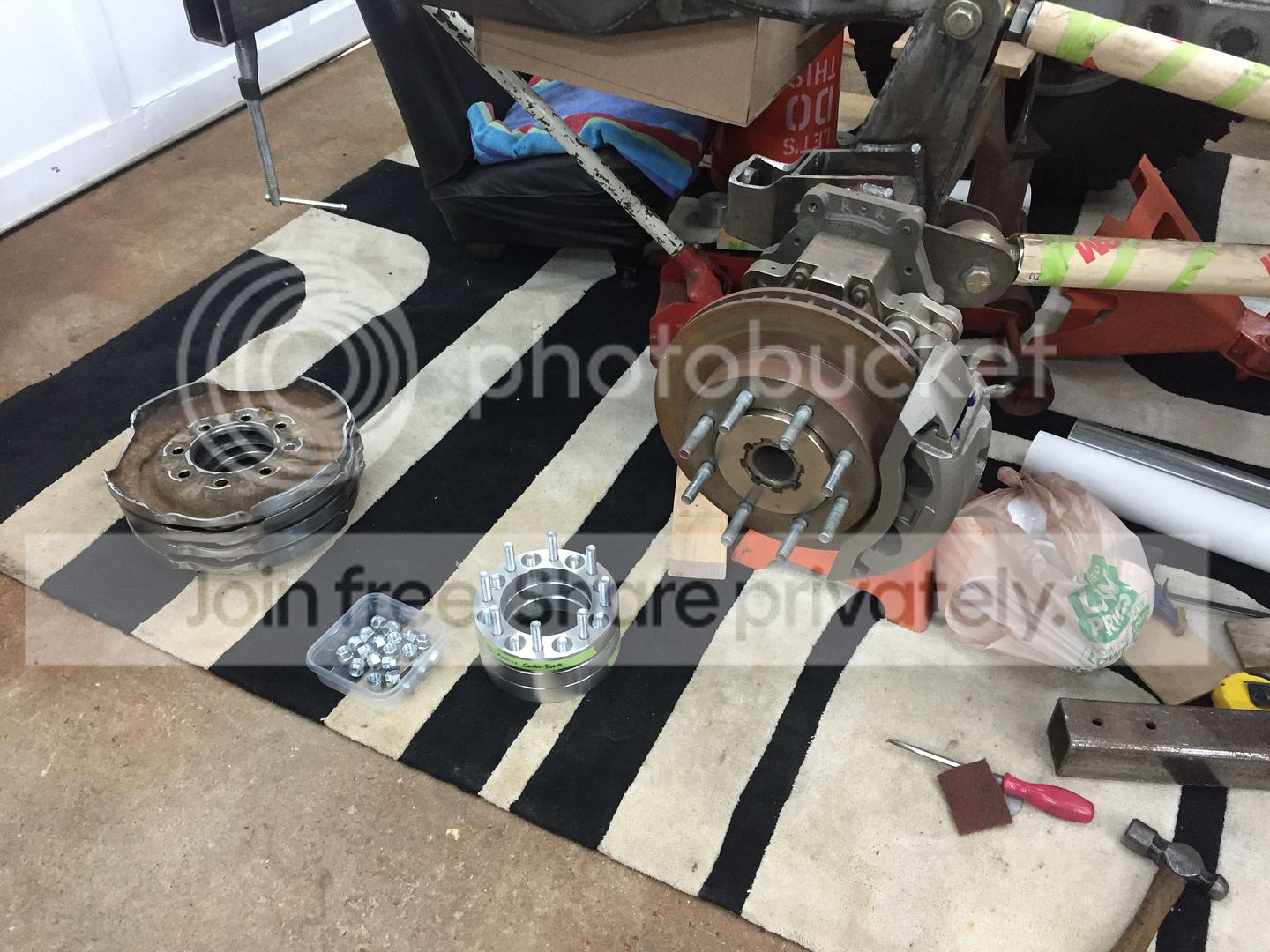
So.... Step 1 was to install the new 1.25" aluminum spacers and remove the 3/8" spacers that the H2 wheels were using. The backspacing of the new steel wheels is so severe that I needed a pretty thick spacer to keep them from hitting the steering arms, and other suspension bits. However, with the shape of the steel barrels it is possible to pull them in about an extra 1/2" closer than the H2 wheels would mount.

IMG_9879.jpg


The original 8-Lug conversion kit from eXaXt came with 1" thick through-hole style spacers, so the original wheel studs were pretty long. So long in fact, that they stick out well-past the mounting flange of the new spacer and prevent them from sitting flat against the WMS. So I needed to trim about 1" off each wheel stud (32 times!) to get the necessary clearance. It turned out that a 2.5" long wheel stud length was just about perfect. It stands proud of the adapter by just a few threads, but doesn't hit the back of the wheel when it's mounted up.

IMG_9883.jpg


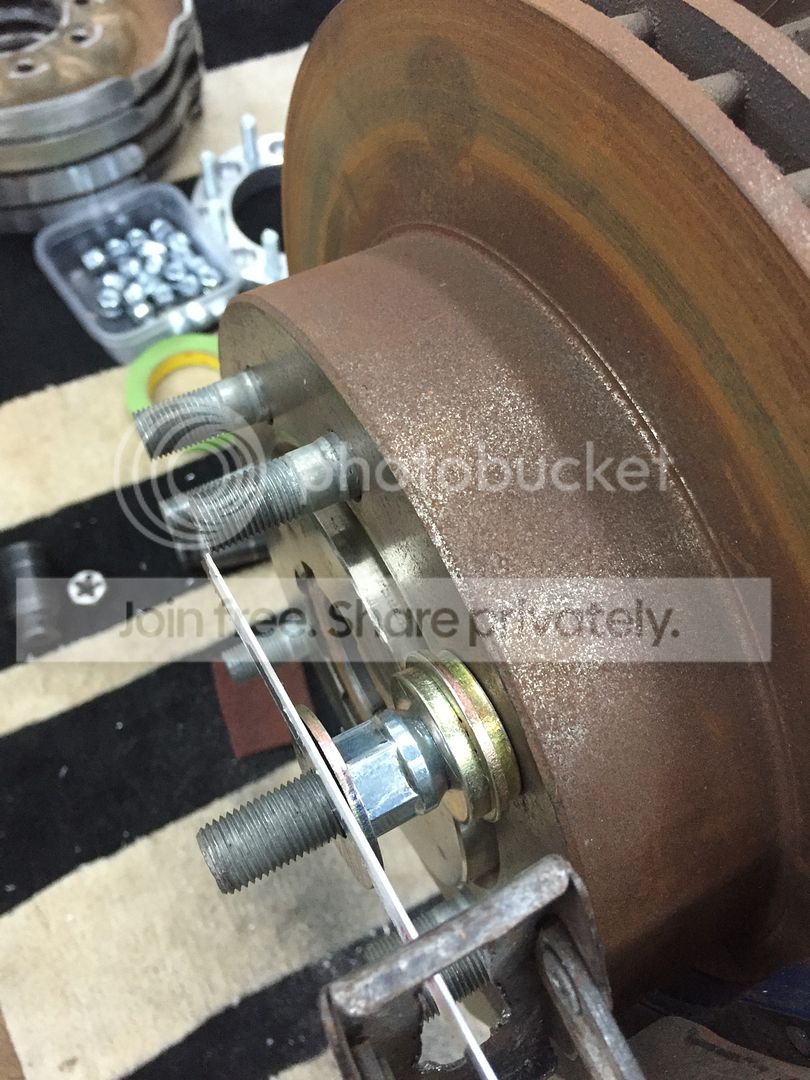
Once I had a good dimension figured out I set up a "cutting guide" for my Sawzall. This served two functions: Help to keep the blades aligned and square to the stud for cutting, and keep me from chattering and skipping around and damaging the threads on the remaining wheel stud. It's not fancy, but it worked great.

IMG_9891.jpg


After completing the 8 cuts, I installed the new wheel adapter using very modest torque from my impact gun. When the nuts were fully seated, I noticed that the adapter was actually NOT tight... :angry1: It turns out that the lugnuts had reached the bottom of the threaded stud BEFORE the seating surface of the nut had landed on it's conical seat.
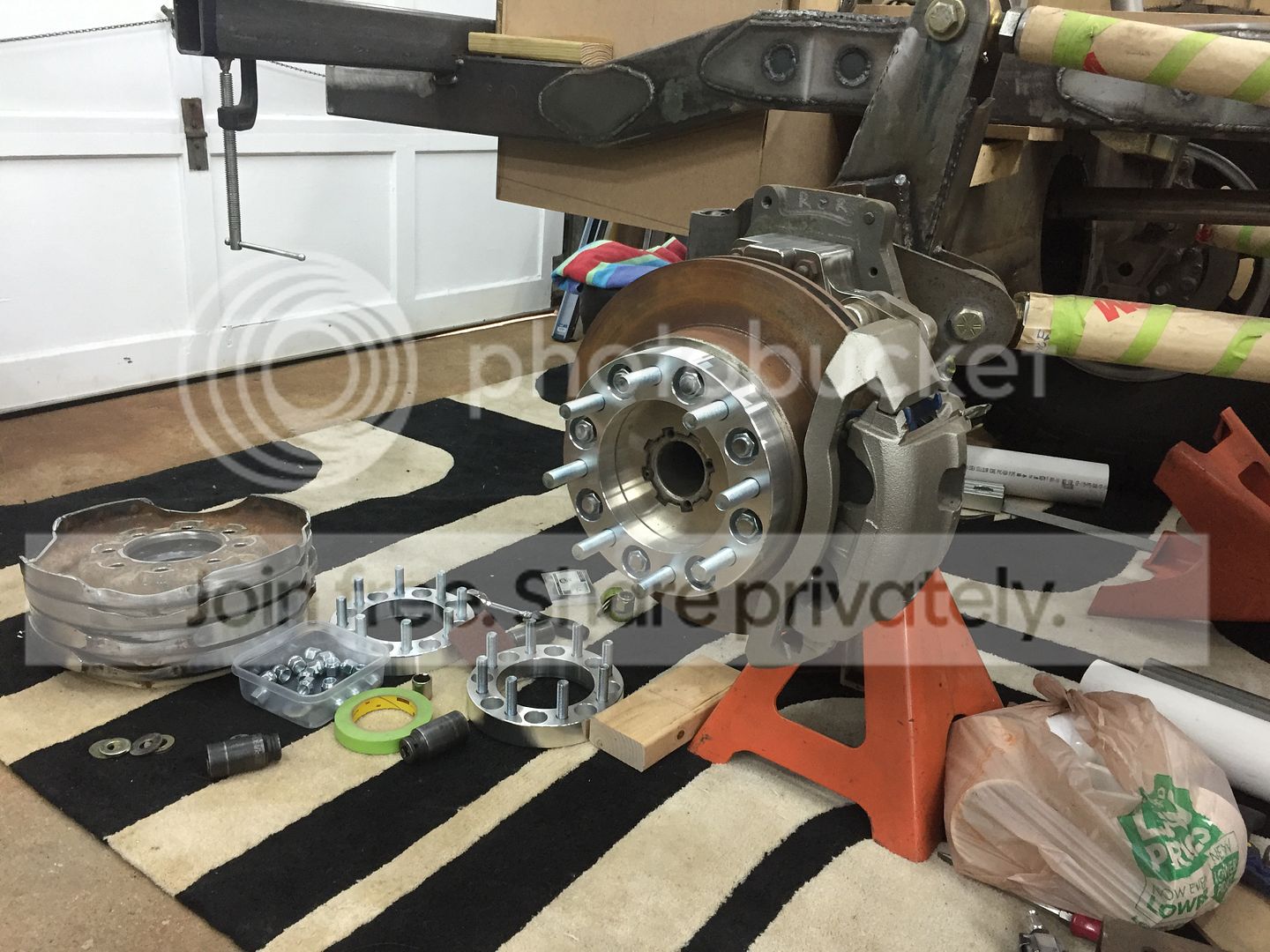
Looks great, but the adapter actually rattles...
IMG_9893.jpg


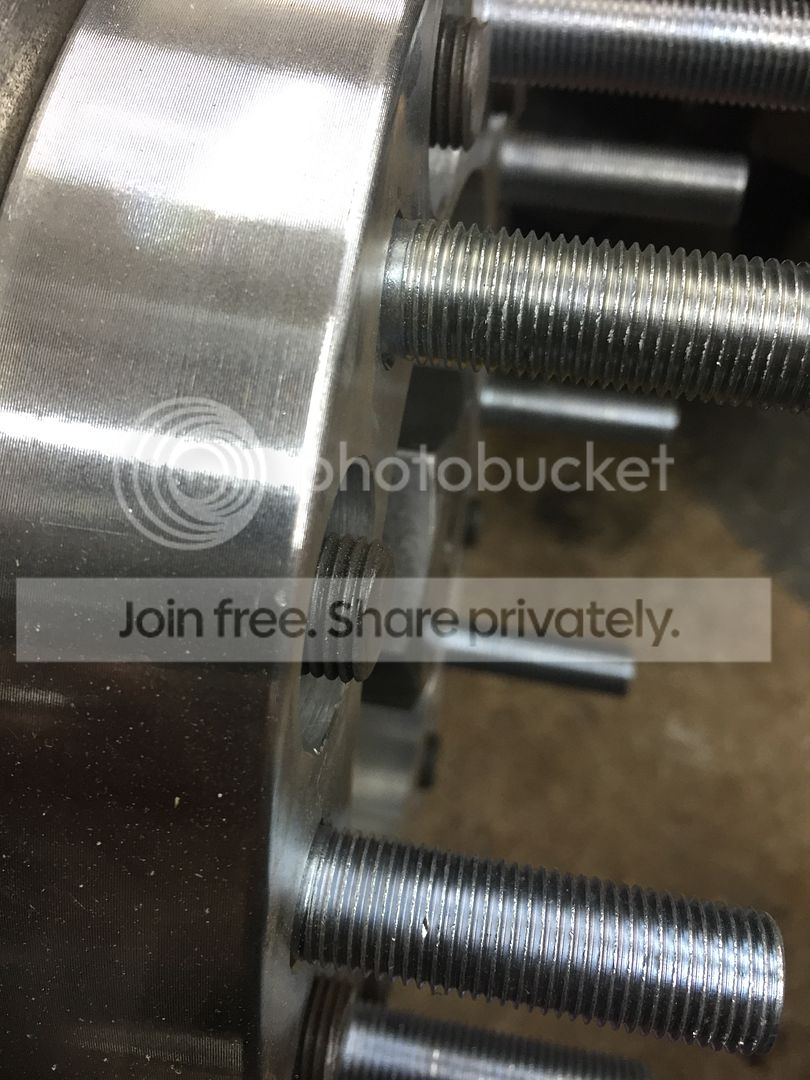
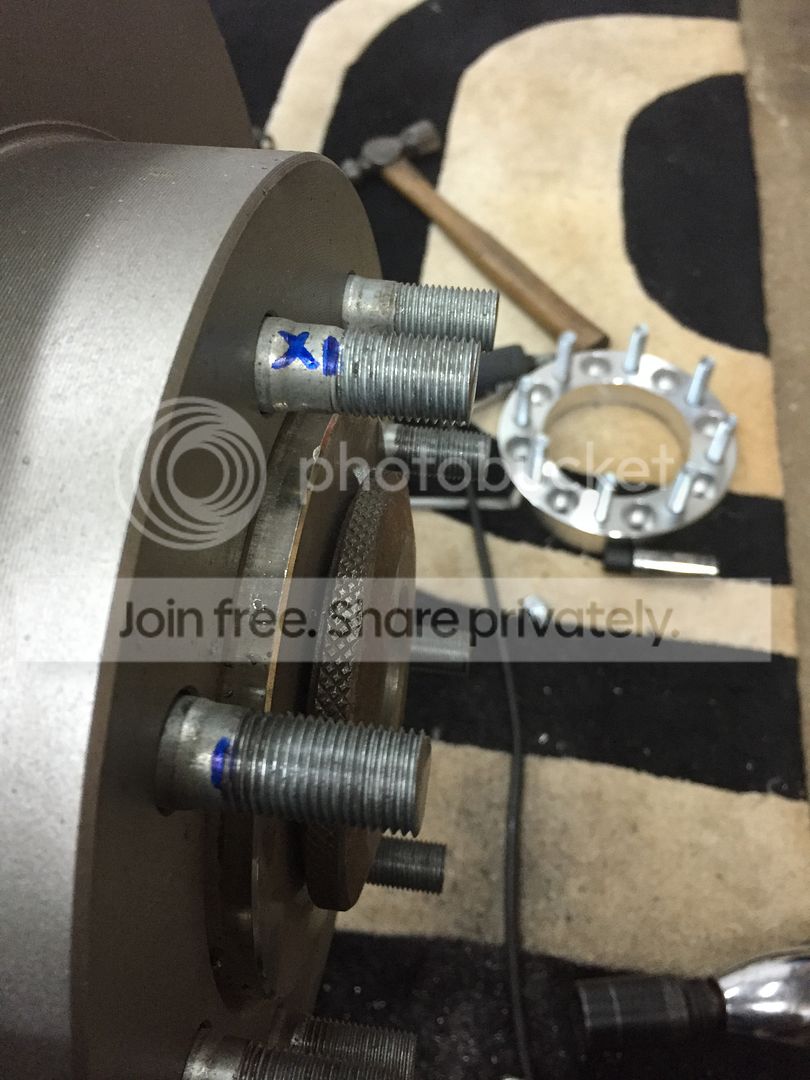
Here's a shot of how I had to deal with it. Fortunately I had a 9/16" die and was able to run it down the stud an extra 1/8" (32 times!) to cut a few extra threads into the shank of each wheelstud. This allowed the nut to land solidly and lock the adapters against the disc brake rotor, etc. This photo shows one thread cut (foreground), and one before cutting (Marked with "X") for comparison.

IMG_9896.jpg


Unfortunately, this whole process leaves me feeling VERY uneasy about the original studs. Now I've not only cut them to a new length, but I've also recut the threads deeper than they were originally designed to go.... I don't know much about wheel studs, but I'm fairly certain that they used a rolled-threading process instead of a cutting process for better overall strength and resistance to cracking, etc. So at this point, I'm not feeling comfortable with leaving them in this build as part of the "final assembly".... for mock up work it's OK, but I should probably seek out a high-quality set of wheel studs that were built with the proper dimensions from the get go and press them into the hubs.

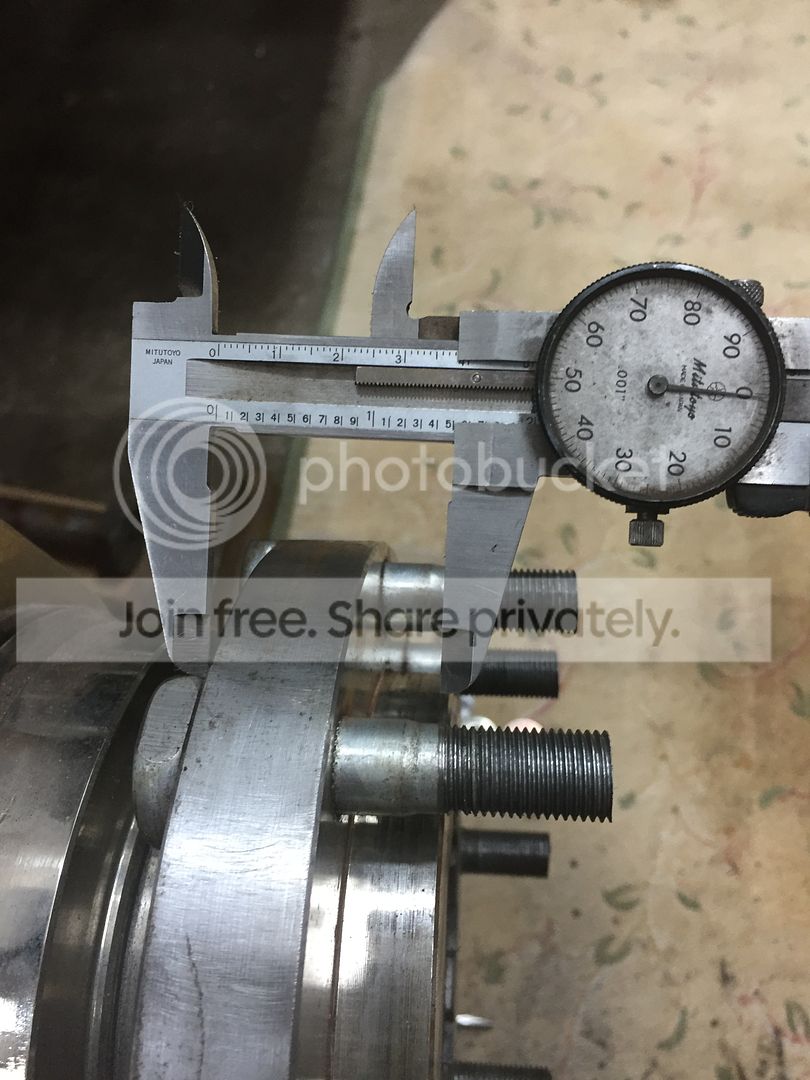
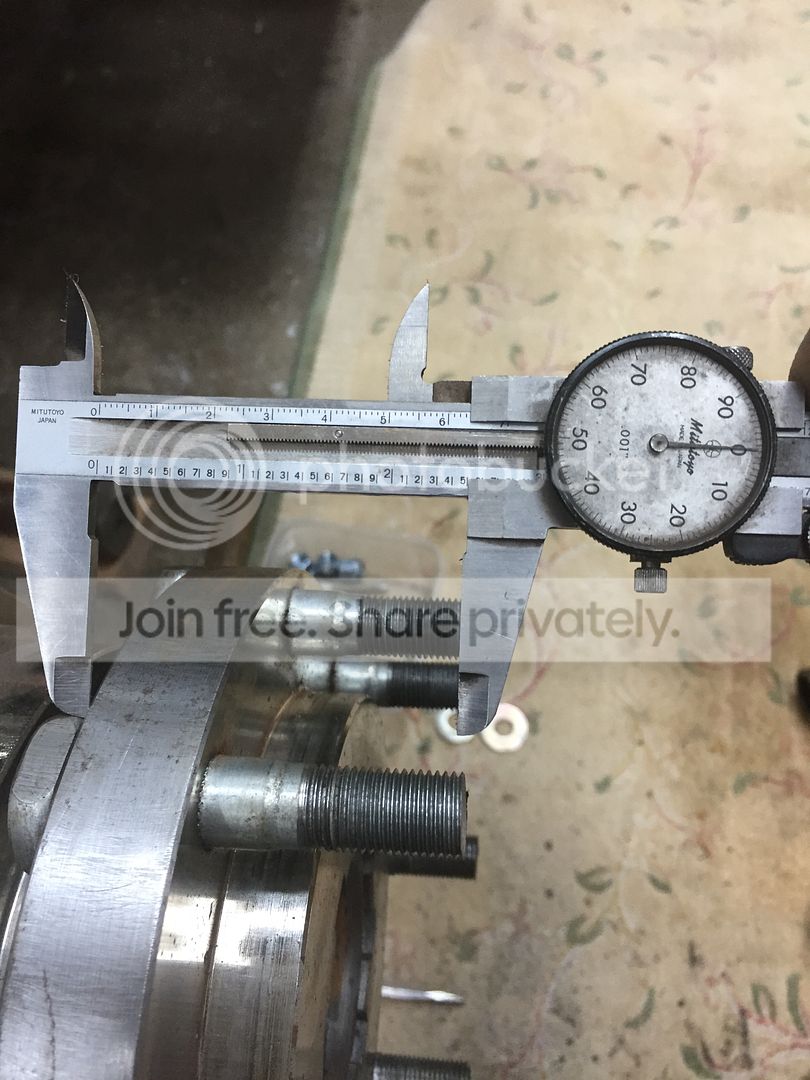
The silver lining at least is that I got pretty lucky with the dimensions of my "modified" wheel studs. The overall length (under the head) is 2.5" long.

IMG_9901.jpg


....and the unthreaded shank length appears to be 1.5".

IMG_9903.jpg


I haven't spent a lot of time on the ARP website yet, but I'm hopeful that those dimensions are common enough that it will be easy to find a complete set of 9/16" wheel studs that can be pressed-in and used without any "customization" or weakening of such a critical safety item.


-G
 
Thats a bummer Greg. At least you had the die you needed to keep moving.

Are the wheel centers welded to the outers yet? Anything special you have to do to make that happen and have the wheels still be reasonably balanced?
 
Thats a bummer Greg. At least you had the die you needed to keep moving.

Are the wheel centers welded to the outers yet? Anything special you have to do to make that happen and have the wheels still be reasonably balanced?


Ash,

Yeah it was "lucky" I guess.... I bought a thread chasing die to clean up some boogered studs and it ended up useful for a different reason.

I've been stalling on the wheel project because I wasn't 100% sure how I'd get them welded with minimal lateral runout (wobble). I machined the mounting surface of the hoops, and obviously the centers were machined to remove the extra welded steel to get them down to a perfect press-fit....so I don't have any radial runout to be concerned with.

I think professional wheel builders keep the lateral runout in the .005" - .010" range... and I suspect that hacks like me could maybe hold .030" - .060" with careful planning, tack welding and checking with a dial indicator. The problem is that I didn't really have a good strategy for assembling and spinning the wheel to check runout... but now that the rear of the truck is all dismantled, that passenger rear wheel is starting to look like a really nice "fixture" to mount the wheel center to. :thinking: I can get it torqued down properly then slide the hoop over it to the proper backspacing.... and I've got reasonably good access to the rear of the wheel to see if I'm lined up properly (backspacing) and to lay in a few spot welds on each of the four mounting flanges.

I think I can find a good spot for my magnetic dial indicator, either on the portal box housing or maybe somewhere off the rockslider or rear frame area. Then I can spin the wheel and measure the runout, make adjustments, and try to get that value as low as possible.

My final "failsafe" once the wheels are completely welded, is that I can bring them to my machinist and have him lay them face-down on his CNC.... then carefully machine the mounting flange (on the inside of the wheel) which will effectively remove any excess runout and get me to a proper, smooth-spinning result. :waytogo: Obviously, there are limits to how much I can machine off that flange.... but there should certainly be enough meat in those areas to allow me to correct for a few thousandths of excess runout that I want to get rid of.


-G


Brian,

Yeah, I thought about it too late, but it would have been just as effective to put the existing lugnuts in a vice and just bore into them from the underside to remove the first couple of threads. It would have accomplished the same thing (letting the cone seat go a bit deeper) as cutting more threads into the wheelstuds.... :dunno:

Anyway.... it's probably just as well. I got the wheel adapters from eBay for cheap money, and I was already planning to replace the studs / nuts that came with them because I'm sure they are Chinese off-brand stuff. Pretty sure a complete set of ARP studs will end up costing me WAY more than the wheel adapters actually did! :yikes:

:haha:

-G
 
Sounds a little sketchy to me.. I agree with you in regards to cutting vs rolling threads, along with the fact these are spacers to the load to the shank vs the threads might be amplified some by offset wheels etc. I used the Dorman website to find exactly what I needed to mount mine, summit stocked them so I pushed the button and they showed up. I went with 5/8ths for obvious reasons.
 
Sounds a little sketchy to me.. I agree with you in regards to cutting vs rolling threads, along with the fact these are spacers to the load to the shank vs the threads might be amplified some by offset wheels etc. I used the Dorman website to find exactly what I needed to mount mine, summit stocked them so I pushed the button and they showed up. I went with 5/8ths for obvious reasons.


Adding wheel spacers in the first place was not my favorite solution, but there just aren't a lot of good options otherwise.

One thing I will do for peace-of-mind is machine a "hubcentric" adapter for that large centerbore. There is a thick factory 404 "washer" that goes underneath that 55mm center bolt and keeps the hub from walking off the large portal gear. I figure if I replace that washer with a machined centerpiece that comes up through the 1.25" wheel adapter and the hole stamped in the Chevy 16.5" centers, I can carry all the loads on the hub instead of the wheelstuds themselves.


-G
 
If you went the hub centric direction I would leave the studs then.. As you already mentioned that is the best compromise in strength and not having to press in a million studs again..
 
2016.05.16 - UPDATE! - VIDEO!! - 1ST WHEEL WELDED...!!!

After much deliberation, measuring, head-scratching, and anxiety over how to do it.... the time finally arrived to fire up the welder and make a permanent useable wheel for the project. :waytogo:

There was a substantial amount of prep work to do. I cleaned the parts (again) and drilled a number of 7/16" holes for plug welds (to simulate the effect of the factory rivets on the OEM wheels). The valvestem was located and drilled (5/8" through-hole)... then welded up, smoothed and re-drilled 1/4" further over. :doah:

The center was pressed into the approximate location I wanted to use. This was most easily measured from the front side by putting a straightedge across the wheel face, and then dropping a ruler down to the top of the hubcap mounting area to get a measurement of 1.125"

I decided that the best place to do my setup work was on the vehicle itself, so I bolted the wheel to the rear axle and found a good mounting point for the dial indicator. By spinning the wheel it was easy to pull a runout measurement off the inner tire bead area and with some gentle prying and persuasion (and hammer taps) the wheel trued-up nicely.

The next step was carefully unmounting the wheel and flipping it around so that I'd have good access to the backside of the wheel where the flanges were going to be welded. It turned out to be a good setup which put me in a comfortable welding position. So I cranked up the welder to 22.0V and let 'er rip!!! I ran a continuous bead across the four mounting flanges (alternating 180*) and then puddled-in all of the 7/16" rosettes for good measure.

Once things had cooled, I took a final look and measurement of the runout:


Finaly value for runout was a remarkably low 0.025" overall!!! :D

That's really impressive. You can see in the video that there no detectable variation in the rim position as it spins... in fact, the only "bobble" at all is where the weld seam passes under the dial-indicator...since there is a slight amount of distortion in that area.

I figure... if I can do a good enough job where the wheel manufacturer's hoop is the weakest link for runout, I've done extremely well. I credit the fact that both the wheel centers AND the hoops were CNC'ed and matched to each other before assembly...so there really wasn't much opportunity for misalignment in the first place.

So.... 1 down, 4 to go. I've gotten the rest of the centers drilled and prepped so tonight I should be able to get a couple more pressed together and finish welded.... :thinking:


-G
 
Yeah, you want to make sure what you welded with (your fixture) was indeed square/flat.

Wouldn't be a problem if that wheel stays where it's at, but the other corners may not be the same.
 

Latest Posts

Top Bottom