CK5
Register an account today to become a member! Once signed in, you'll be able to participate on this site by adding your own topics and posts, as well as connect with other members.
I see twists and not perfectly straight runs of romex. I thought those things ate at your soul greg.

Yeah... well Romex is a weird exception.

In the 'old days' I would be tempted to pull perfectly straight runs, with lots of cable staples and no extra wire looping about.

Turns out, if you ever need to get back into that area to repair a wire, or extend a circuit it's a real pain not having a bit of "extra" Romex available at each fixture / outlet / gang box.


I cut myself some slack, and try to ignore the very NON-OCD way the wires often get run. Technically, I need to go back and make sure that there is at least ONE cable stable within about 6" of the boxes. Pretty sure there is a code requirement for that one. :)


-G
 
Building the house has already shown me the value of a little extra wire in the walls. Had a few plugs and switches that we decided to move that ended up being no big deal because there was enough slack... luckily.
 
2018.04.24 - UPDATE! - 24 HOURS AND COUNTING....

The spray foam guys arrive tomorrow (ready or not!) :yikes:

Gas line was moved last week... using flex line. Simple and will be completely hidden when the walls and floors are finally covered up.

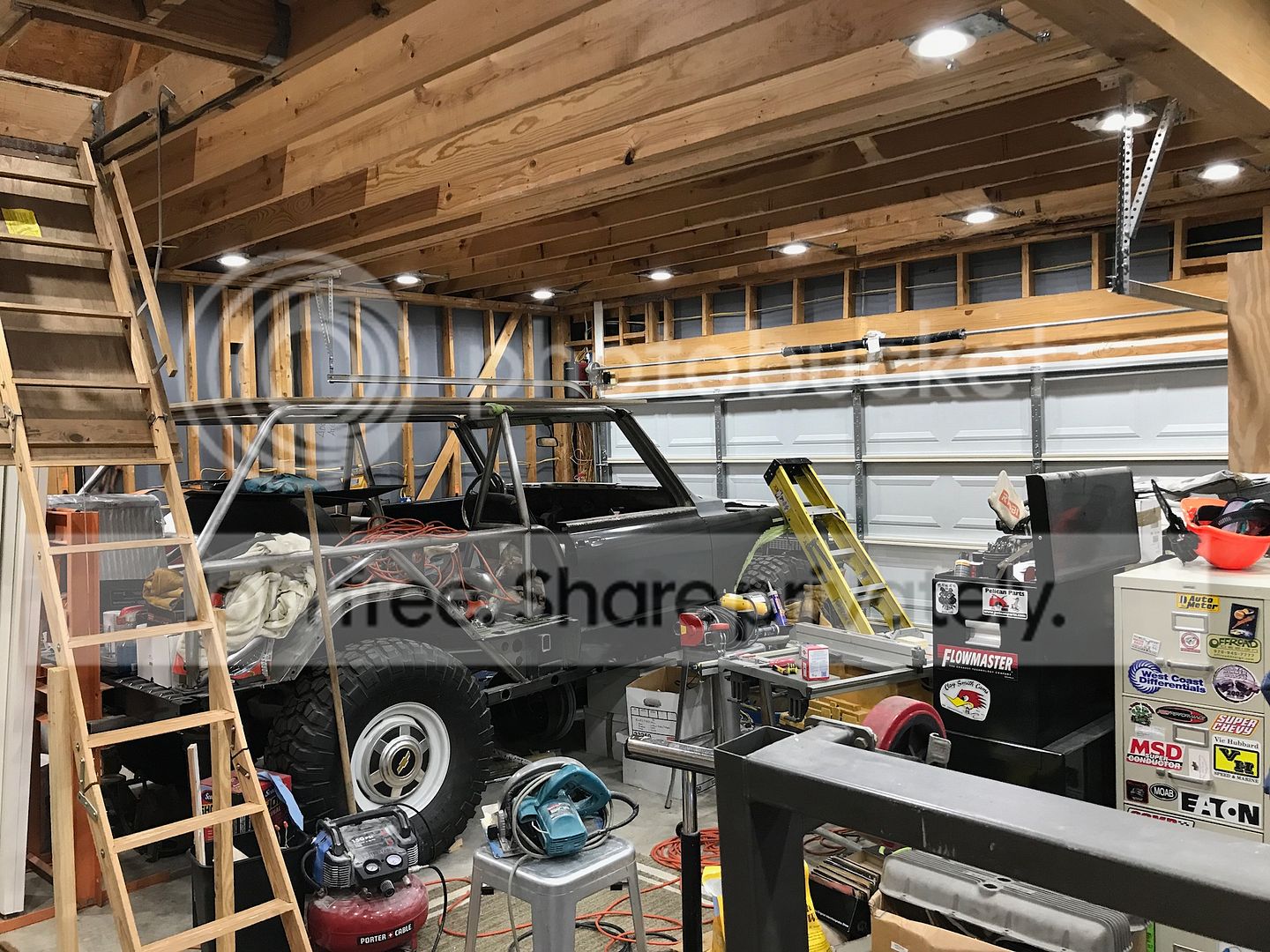
It's been a real scramble to get everything into the wall cavities that needs to get installed. Installed the first torsion-style garage door opener and it really works slick.... !!! Quiet and really cleaned up the look of the space when I unbolted the old chain-style opener from the ceiling.

IMG_2155.jpg


An entire 250' roll of 12/2 wire has already been used up getting outlets fitted to the walls, and last night I spent time trying to thread the heavy 6/3 wire for the 220V outlets.
The problem is that I want to have maybe 4 outlets for 220V but I don't want to run each one to a dedicated breaker in the panel. I know there must be a way to pigtail these wires in the junction boxes, but 6GA is huge, thick wire so it's clearly NOT going to use wirenuts to splice together. I thought there must be some kind of crimps... :dunno: There is something called a Polaris connector which is basically an insulated screw clamp splitter, but they are pretty expensive and it makes it almost seem cheaper (and easier) to simply run individual runs of 6/3 and put each outlet on it's own breaker??

Anyone have a clever tip for this? It's not urgent for tomorrow... I'll just leave the wires hanging out of the junction boxes for tomorrow and do the final wiring of the outlets next weekend or whenever I get things wired into the junction panel.


-G
 
Last edited:
63A88F6A-5EEE-4183-BFB4-F11636D89AE9.png

This would work really well, might not fit in a typical electrical box.

Those polaris pug style connectors will work well too.
 
Greg, I'm pretty sure by code you MUST have each 220V on a dedicated circuit. I certainly would never try to run more than one 220V per circuit.
 
Greg, I'm pretty sure by code you MUST have each 220V on a dedicated circuit. I certainly would never try to run more than one 220V per circuit.


Well, I did spend a small fortune on a 125' roll of 6/3, so I should have plenty of wire to do a direct run to each location. I have plenty of free space left in the breaker panel, and the 220V breakers themselves are relatively cheap too.

The idea of trying to splice and stuff a bunch of wires into each junction box sounds like a nightmare, so I think this question is working itself out the more I think about it. :)


-G
 
Well, I did spend a small fortune on a 125' roll of 6/3, so I should have plenty of wire to do a direct run to each location. I have plenty of free space left in the breaker panel, and the 220V breakers themselves are relatively cheap too.

The idea of trying to splice and stuff a bunch of wires into each junction box sounds like a nightmare, so I think this question is working itself out the more I think about it. :)


-G
Yeah in your case if you have them on one breaker you might know that and refrain from using them all at once, but once they are there someone might and it won't work.
Dedicated breakers is better.
 
Yeah in your case if you have them on one breaker you might know that and refrain from using them all at once, but once they are there someone might and it won't work.
Dedicated breakers is better.

Yep. In a 1-man shop it's pretty easy to guarantee that the loading is safe.

My upright compressor is 220V, my MIG is 220V, my TIG is 220V and I'm going to convert my APEX 20" disc grinder to 220V.... I suppose the compressor might kick-on while I was welding or grinding, but generally I can only operate one item at a time. :)


-G
 
Did you say 14-2 (15 amp) for wall outlet, should be 12-2 (20 amp) may have to reset the outlet breaker a lot.
 
I can see it, lights flickering in the house. Oh it's just Greg in the shop again. Also now that your in Texas you better budget in a 220 window unit. Trust me
 
I wired my garage for 4 seperate 220v, also added my 2-post lift and couple extra 110’s.

Main feed is a 70 amp so If I had couple things at full boogie it’d kick the breaker. But all legs are still seperate, and it’s really hard to use the 220v bandsaw while tig welding...
 
Glad it was 12-2

The 220 it's just easier to fuse em separate. And according to what I have read as far as code you cannot have more than 1 220 on a single breaker.

I'm doing 4 220 outlets in my shop all fused separate. Well 6 actually but one is for the compressor and one for an RV plug. So 1 on each wall pretty much
 

Latest Posts

Top Bottom