Wow - it has been over a year since this thread was updated...
So back-tracking a little bit...
Where to begin…
When we last left our hero, the shop was framed, roofed, and that’s it…
As I started contemplating how I was going to put color onto this thing, I quickly realized we needed to pick a good color. Emily (my beautiful wife) has a friend who is an interior designer – who we met with to come to agreement on a color choice.
We wanted something that would look nice and eventually be a potential decent color to paint the house as well. We settled on Duxbury Gray from Benjamin Moore with Rice Grain from Sherwin Williams – (You are now saying, where is this going, I don't care. But wait until you see it!)
Hiring someone else to pick the paint color is cheaper than marriage counseling too!
Next up, how to paint this thing? Emily’s cousin is married to a dude (Jeff) who lives in Medford. Jeff is a good guy and was a professional painter in New Jersey and New Mexico. He still is a painter in Oregon, but is currently also going to school, pursuing a nursing degree. Jeff walked me through prep and helped me figure out what materials I would need. As he was between side jobs and summer term of school was just finished, I hired him to come up and paint the shop over the Labor Day weekend. Jeff recommended that we brush and roll the paint on to get the absolute best coverage on the T1-11 siding.
Holy %$*&$*%$ paint is expensive! 16 gallons of color, 1 gallon of trim, 10 or 15 gallons of primer – ouch!
Jeff was thinking this would take approximately 4-5 days, with me helping over labor day weekend. That was for prep work on siding, one coat of primer, two coats of color, and two coats on trim.
Jeff showed up Friday night before Labor Day weekend. The next day we started around 8:30, with priming of the rear (east) wall. Jeff worked on the high spots and I worked on the ground.
We stopped at 6 pm that night, having completed one 36 foot wide gable end wall – this is when I began to realize the 4-5 days might be unrealistic – this was also the opening day for Oregon State football which was the day that the Beavers lost to Eastern Washington – not a great day for me…

The next day, Sunday, we began the next wall… Although it was a longer wall (44 feet) it was on the eave side, so was shorter and had a few holes in it (door & windows) so actually went a bit faster…
Here it is at 11 am… We had to stop this wall at this time, as it is south facing, and it was getting too warm for the paint (not to mention the humans) on this side.
There’s Jeff!
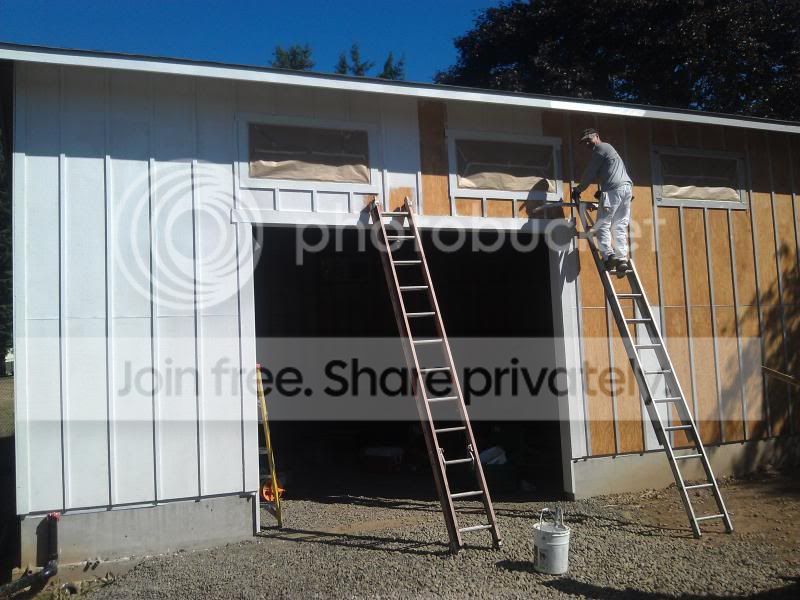
End of Day 3
Quick professional painter tip. Jeff introduced me to Ladder Gloves. These things are cheap and work awesome at keeping your ladder from scratching the &%$$*$ out of everything it touches. Check them out – get some if you regularly use ladders:
http://www.amazon.com/Louisville-Ladder-LP-5510-00-Extension-Pro-Guards/dp/B000U0H8PK/ref=sr_1_1?ie=UTF8&qid=1385515796&sr=8-1&keywords=ladder+gloves[/URL]
Jeff worked hard for 5 days that week, leaving Thursday morning for Medford, coming back the following Friday night to finish up – he’s a trooper (or crazy or both)
All told, it took Jeff 10 days to paint the shop. With help from me for 3 days and help from my brother Adam for 1 day.
Thank you Jeff!
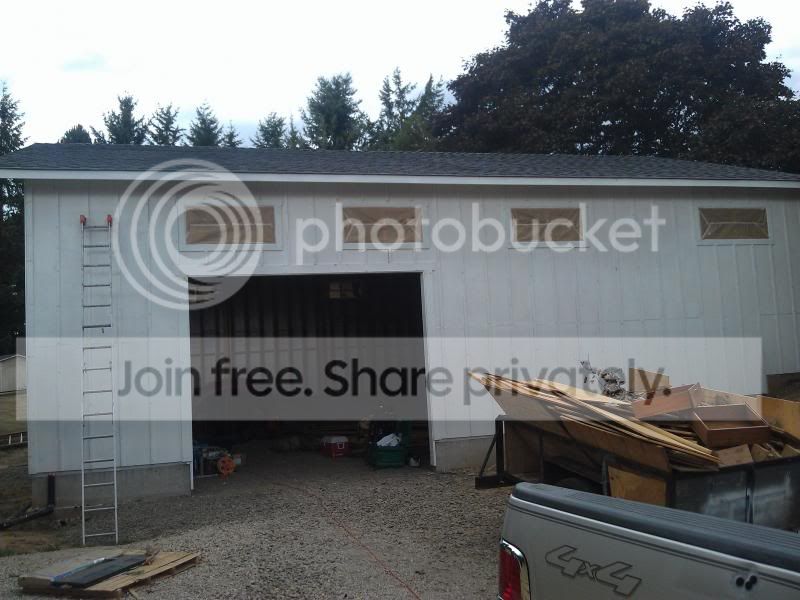
It came out beautiful… See now doesn’t that Duxbury Gray with Rice Grain trim look nice…?

Next up, getting that stubborn framing inspection finalized.
To backtrack a bit, I had two inspections that must be passed surrounding framing of the building:
1) Shear wall inspection – since my walls are so tall, they need to be engineered to prevent them falling over. I have the plans, they must be framed per plan and then are inspected to the engineered plans.
2) Framing inspection – this is simply a general framing inspection of workmanship, etc that every building would get.
Here is run down of trying to get framing & shear wall passed:
So in July, called for my shear wall & framing inspection after my d-bag framer (Darby) says to do it (in between his visits to the ladies…)
1) 7/31 - Framing & shear wall both fail, as framing isn’t complete –
I ask Darby why he told me to call for inspection – sorry, he wasn’t communicating to his crew, so didn’t realize it wasn’t complete – (he actually wasn’t this polite as he is never wrong – but I’m paraphrasing…)
Inspector also mentions framing cannot be passed until electrical rough in is complete
2) 8/14 - Shear wall fails as inspector can’t see nailing pattern on siding – Darby’s crew covered nails with batten boards
Darby’s crew comes out and peels up one batten board so nails can be seen
Darby also mentions that my violation is making things hard for him. (that’s what she said!)
8/20 – Shear wall fails as inspector notices I need double studs at each of the Simpson hold downs that are sunk into the foundation.
Here is Darby’s half-assed solution: Metal strap over the man-door header and a piece of cedar trim between the studs.
I sent this picture to Steve (my general) who was not impressed. (Note that Steve (my General Contractor) ignores most of the warning signs on Darby and proceeds to use him on another job – which ends up biting him in the butt.)

4) 9/11 – Shear wall passes inspection! Woot – (Happy Anniversary to my wife & I too)
So next up, Electrical service…
When I was issued my building permit, the system auto-generated a plumbing permit for gutters and an electrical permit for electrical service. Note that all three of these permits are tied to VIOLATION and state VIOLATION on the header of the permit.
For electrical, the minimum requirement for the electrical service is one switched light inside the building, one switched light outside the building, and a single outlet inside the building.
I consulted a close friend who is an electrician, and discovered that my house panel is 125 amps, and the service to my meter from PGE is 200 amp.
I also discovered in talking with PGE that to run a separate new service & meter to the shop would be in the $5k range – this was obviously ridiculously out of the question.
So I began exploring what it would take to run a 100 amp service with subpanel to the shop. This would be workable with the current panel and service after upgrading both to handle the 200 amps.
BUT, remember that electrical permit is tied to the VIOLATION for the original dirt removal. So if I add permit for the house, this will also be in VIOLATION.
So, I discussed with an electrician the cost of doing the bare minimum and quickly realized this was the equivalent of burning several hundred dollars after running the bare minimum wire from the existing panel to the shop. AND – this would all have to be undone once the “real” electrical work needed to be done.
So, I spoke with D, the county compliance guy about this, who recommended I talked to an electrical inspector. Both of these fine gentleman were okay with me not doing the electrical at this time, finishing the building, removing the VIOLATION and then coming back and opening a new electrical permit for what I really wanted to do.
OH but wait….
The framing inspector was not down with this. After my asking, D asking, etc… He was adamant that he could not approve framing inspection until electrical rough in is completed. A$$ho!e
This also clearly annoyed D.
So… I let this fester at the county for 6 weeks, knowing that every 30 days, D (the compliance guy) gets an email from his boss asking the status of each of his open VIOLATION cases. (I surprisingly have not gotten arrested yet)
Rather than proactively working to solve this issue for them, I sit on it.
Mainly because it amuses me that framing guy is not playing ball with D, D is under pressure to close my VIOLATION, and I’m sick and twisted like that (or lazy?)
Concrete Slab
So, all during August, Sept, and October Steve (general contractor) is asking about scheduling pour of the concrete slab – during this time, I decide it would be “wise” to at least put plumbing in the ground for a bathroom.
I get some quotes on this and pick a plumber – guess what – they are booked until 11/15. I use them anyway, as they come very highly recommended and are one of the cheapest bids (why do I even have a general contractor at this point?)
I realize I need to trench for the sewer and water line – I talk with the county to make sure that the sewer and water line can both be in the same trench and what depth they need to be. 24” for water line, 12” for sewer, sloped ¼” per foot. They can be in the same trench provided you use the appropriate pipe. Schedule 40 ABS for sewer and don’t remember on water… the county inspectors for plumbing are super cool by the way – as well as the code compliance & electrical people.
Screw the framing and soil folks though – they suck.
My brother and I rent a trencher on 11/09 and trench a 40’ trench. This goes swimmingly until brother decides to throw all caution to the wind and say “Don’t get stuck.”
Apparently Murphy was listening, as within 3 minutes I have the trencher stuck. No big deal, hook a chain to it and pull it out of the trench with a truck.
I am slapping myself on the back that this is going so easy until I realize the trencher has popped its track – which is now lodged to the inside of the machine. The next 90 minutes are spent loosening the track adjuster nut. (Keeping in mind the trencher is rented by the hour, weighs 2K lbs, and needs to be cleaned before returning to Boring rental place before it closes at 5 pm.
Stuck $*#&&*$(*$

Trench done
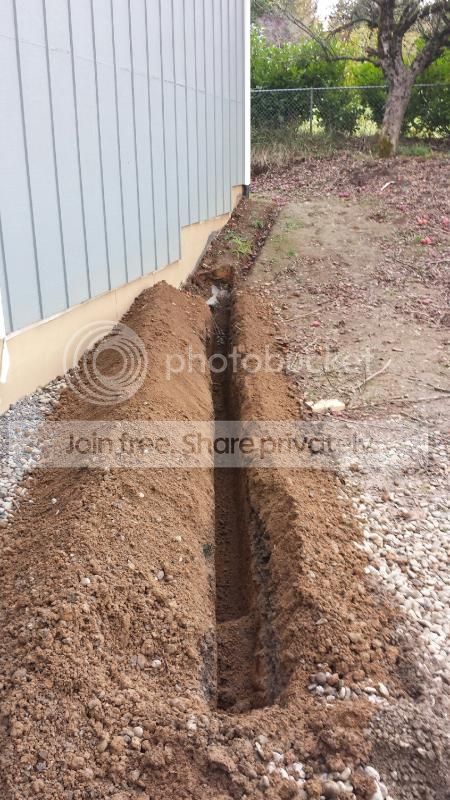
Tunnel for sewer and water Inside shop under footing

Plumbing in ground.
From right to left: Water line, Urinal drain, Toilet vent, toilet drain (not visible),
shower vent, shower drain, drain for possible future upstairs sink, and sink drain

Outside and clean out

In September, with the hard rains we had, I noticed the gravel was wet within the shop – groan…
After calling a drainage expert, I am installing an interior footing drain. Per the drainage guy, my exterior footing drain should have been 6-12” deeper than where I put it at the base of the footing. The water is wicking up through the fines within the crushed gravel base. The drainage guy recommended putting 4” perf pipe 12-16” away from the inside of the footing at 45-degree slope down from footing.
So, on Sunday, 11/24, my brother and I rented a trencher again to trench the interior footing area. This was working awesome until I hit the “overflow” concrete that the concrete guys wasted in the interior floor while pouring the stem wall.
I have about 30 feet of concrete that needs to be cut and then dug out to get that interior drain in.
^^&#$(&#$(*&$#@
I am so sick of digging in my backyard at this point. When this project is done I’m seriously contemplating burning my shovels.
Meanwhile, still no slab…



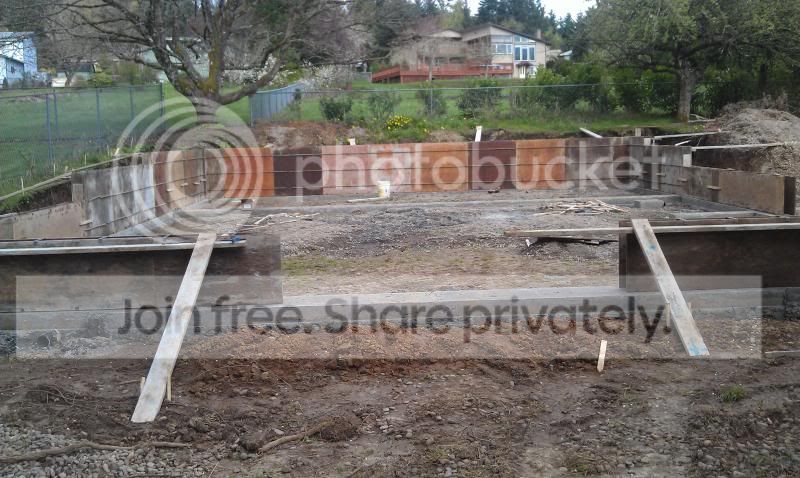

 )
)



 the ceiling is 15' so To borrow from Greg (check is in the mail, Greg) "might as well"


