CK5
Register an account today to become a member! Once signed in, you'll be able to participate on this site by adding your own topics and posts, as well as connect with other members.

'83 K10 SB "L1TSBFIBBC" build

Shoot man everytime I have rotated knuckles its a big hammer and a solid place to put the axle.

We tried that Eric, I wish it was that easy because I killed a couple days with something I thought I would do in an afternoon. They weren't moving, tried rotating them and removing them with a full size sledgehammer, wasn't moving, and the weld was gone, you could see the parting line where it was trying to move, but it wouldn't budge. We even had the darn axhe housing welded to a 2 ft by 10 ft I beam, they weren't moving. Tried an 8 ft lever arm on a 48" pipe wrench, and hit THAT with the sledge, they wouldn't turn. I decided that we were going to ruin the C before we got it where we needed it (off or rotated). So we looked for better options.

It must be the different tolerances from the factory, or the rust belt, or something. Because these suckers were on there, 60 tons on there.
 
That looks like a pretty nice setup, makes you wonder where to stop. If you cut the frame completely off and add tube to both ends, why not ditch the whole frame so you don't have a rectangular section in the middle, and build an entire tube frame?

Your right but my front won't get built for a while maybe even a long while. My buddies with buggies are built the same way with only a few feet of frame left. I guess that's just the way it is when you build them in stages instead of all at once.

This is a really good thread btw!!
 
That looks like a pretty nice setup, makes you wonder where to stop. If you cut the frame completely off and add tube to both ends, why not ditch the whole frame so you don't have a rectangular section in the middle, and build an entire tube frame?

This also begs the question why not just use everything you have and build a buggy?

I have decided to commit to Horton for the next several years. Couple months back I was thinking wheel this year and start the buggy build but, one I really like Horton and two I wanna wheel.

So like you I plan to do stuff that will take the truck down for no less than 6 weeks at a time.


Coils in front, or coilovers depending on money and coils in the rear. Full hydro steering and making it even lighter are all on my list.

I would really like a flat belly too and since I am using a pickup frame that has been modified its kind of hard to do. So I think I am going to raise the drivetrain 2". That will make it a bit easier to link the front. Full Hydro will make it easy too
 
We tried that Eric, I wish it was that easy because I killed a couple days with something I thought I would do in an afternoon. They weren't moving, tried rotating them and removing them with a full size sledgehammer, wasn't moving, and the weld was gone, you could see the parting line where it was trying to move, but it wouldn't budge. We even had the darn axhe housing welded to a 2 ft by 10 ft I beam, they weren't moving. Tried an 8 ft lever arm on a 48" pipe wrench, and hit THAT with the sledge, they wouldn't turn. I decided that we were going to ruin the C before we got it where we needed it (off or rotated). So we looked for better options.

It must be the different tolerances from the factory, or the rust belt, or something. Because these suckers were on there, 60 tons on there.


The reason I built the fixture with the jack is cause we couldn't get one to move. Did I mention it was a 50 ton bottle jack? :D Boy howdy when it rotated the first time it sounded like a shotgun.

Dana 44s by comparison are way easier to rotate the knuckles on.

What are you thinking on the rear end?
 
I hate to back track but if you don't mind...

Was the crank "ready to run" out of the box? Did you buy a rotating assembly or individual parts?

It was "ready to run", but I had it balanced to my rotating assembly since I bought all my parts seperately. You can buy a complete, balanced rotating assembly, but I don't know how accurately they balance them. I know my machinist will do it spot on. I think he even polished the journals even though it was a brand new crank.

I have an excel spread sheet I wrote that calculates static and dynamic compression, etc, to help pick pistons based on what cam and heads and the rest of the stuff you want to run is, or vise versa. If you want I can e-mail it to you to help you with piston selection.

Edit: This spreadsheet is now available in the CoG forum.
 
Last edited:
The reason I built the fixture with the jack is cause we couldn't get one to move. Did I mention it was a 50 ton bottle jack? :D Boy howdy when it rotated the first time it sounded like a shotgun.

Dana 44s by comparison are way easier to rotate the knuckles on.

What are you thinking on the rear end?

OK, that sounds more like it, BANG!, "yep, it moved"! I thought you were saying it was a piece of cake, and from my one experience, I would say otherwise. Actually, I take that back. If I had to do it again it would be a piece of cake, gouge out the welds, and take it to that shop with the 100 ton press. All you have to do after the the axle is in position is watch the owner press a button and plug your ears. :D (and stand behind one of the building beams in case something lets go!)

For the rearend I am think dual triangulated 4 link with coilovers. No reason to run a panhard back there. Don't know what travel yet or any of the details, I have to take some measurements. I know I will use the calculator and get the numbers the best I can.
 
Last edited:
I have an excel spread sheet I wrote that calculates static and dynamic compression, etc, to help pick pistons based on what cam and heads and the rest of the stuff you want to run is, or vise versa. If you want I can e-mail it to you to help you with piston selection.


oooooo yeah! :woot: My email is [email protected] do it whenever you have time because I'm still trying to invent money for this project. :doah:

Thanks again for all the info and great thread! :thumb:
 
Just a thought for you on the numbers I would actually go a little higher on the antisquat, say 120% or so. Why do you ask, well cause when you are roaring up a dune it will push the front end down, not very much but a little and might aid with traction.

The difference between 100% and 120% might sound like alot but in practice its not really much at all.

double triangulated is what I would do too. Can be built very stable.
 
Do you have any more pics of the axle side brackets? Do your tires rub the radius arms? Have you decided that the bind of keeping both sides as radius arms is worth it?
 
Just a thought for you on the numbers I would actually go a little higher on the antisquat, say 120% or so. Why do you ask, well cause when you are roaring up a dune it will push the front end down, not very much but a little and might aid with traction.

The difference between 100% and 120% might sound like alot but in practice its not really much at all.

double triangulated is what I would do too. Can be built very stable.

I've also considered just single triangulation for space and simplicity, but then I would probably end up with roll steer issues. Haven't gone down that path yet.

I'll consider more antisquat, but with almost 60% of the 5340 lbs (without me in it) in the front, I wouldn't think front traction would be an issue, but obviously going up a hill would put more weight toward the back.

From my experience in drag racing however, I don't see how more antisquat would push the front end down? I can see how it may look like that if the IC is back far enough, it may raise the back more than the front, however, the forces are still trying to raise the front too. If you push on the lower arm (compression) and pull on the upper arm (tension), it is trying to pivot the whole entire vehicle up over the rearend. This is trying to raise the frontend as well. The further back the IC is, the more violent this is, as it will increase the leverage arm and move the IC or "lift point" further back. But it's still trying to raise the whole vehicle right if I under stand correctly. What do you think?

Are you suggesting this will increase front traction based on experience with more antisquat in the dunes, or theory? I am not trying to be an @$$, I'm serious. You have more wheeling experience than me, I only wheel a few times a year lately since I moved farther from easy wheeling. If more antisquat works good in the sand that's good to know, regardess of why (although I always like to know why). But at the same time I don't want the axle trying to climb under me if I am going up a real steep dirt hill some other time at Bundy or wherever. These are the kinds of things I wanted to get some opinions on before I decided what numbers to shoot for, thank you. 4 links for drag racing are setup a lot different than 4 links for wheelin I am sure.

Do you have any more pics of the axle side brackets? Do your tires rub the radius arms? Have you decided that the bind of keeping both sides as radius arms is worth it?

I do have more pictures, should have them up later today around lunch time or something with pics of the finished suspension. As for my tires rubbing, initially I set the stops to just clear the u-joint bind with the axle turned as far as it could go, and the tires were rubbing the radius arms by 1/16" on the largest lugs only. So I adjusted the stops so they cleared by an 1/8". But after wheeling some more I realized they are still rubbing under load sometimes. I haven't decided yet if I am going to leave them rub a little, or adjust the stops more and lose a small amount of turning radius. I purposely used rod ends and thin adaptors to keep the joint where the upper arm attaches to the lower arm thin, with a short bolt, for more tire clearance.

As far as bind, so far what I have noticed is the coil springs stop the articulation before the bushing bind does. I don't really notice much difference whether I unbolt one arm or not articulation wise, or on the street. In fact, I drove it on the street and highway with one arm disconnected as well, and I couldn't even tell really. It may be because I have my dual spring rate stops pretty close to above ride height to reduce too much body roll and help absorb impacts. I think if I move that way up, or got lighter springs and lowered my ride height, that then the bushings may come into play. Since I couldn't tell a difference I always leave both radius arms connected for now, because I feel it is safer to absorb the braking forces on the road with both sides of the axle and not one. But I suppose it is no different than a 3 link in that regard.

Also, when building the radius arms, the bushing material and distance between them is a compromise of controlling axle wrap (wheel hop) and reducing articulation bind. Keep in mind, the longer the arms are, the less the bushings have to deflect for the axle to articulate, while still controlling axle wrap, because it reduces the angle change of the arms at the same travel. My arms were around 44" center to center, but that got reduced to 43" in the end.

If I needed a lot of articulation, I would probably move the dual rate stops up, and remove one upper arm bolt again. Or for extreme, get softer springs. Right now I have 300/450, which puts my initial spring rate at 180, and then it changes to 450 when it hits the stop and goes only to the stiffer spring for the last 5 inches or so. So when it does that I think it reduces articulation before the bushings do. I suppose if I took the dual rate stop off or moved it way up then it would only change to 450 if the 300 lb spring was under coil bind.
 
Last edited:
the tires were rubbing the radius arms by 1/16" on the largest lugs only. So I adjusted the stops so they cleared by an 1/8". But after wheeling some more I realized they are still rubbing under load sometimes

Ok cool! I was mostly curious if they were rubbing really hard. I have been thinking (alot but never going to be able to do it) about linking a chevy and felt that maybe a radius setup would be best so as to avoid some space restrictions. I guess i will see on your pics later so dont bother answering this question if you dont feel like it, but again, on the axles pumpkin side, did you butt the inner bracket up against the cast section? or did you incorporate the bracket into the cast portion?
 
Ok cool! I was mostly curious if they were rubbing really hard. ...on the axles pumpkin side, did you butt the inner bracket up against the cast section? or did you incorporate the bracket into the cast portion?

They weren't rubbing hard, in fact, I never heard or felt the tires rubbing, I just noticed the paint rubbed off the control arms.

I welded the pumpkin to the tube, then butted the bracket up against that weld. I spaced the opposite side an equal distance from the inner C.
 
Front Suspension Complete...

So I tore it apart and welded it up. Added some more bracing. I was running out of time, so Jer came over and helped out by fitting some tube braces for the shock hoops. Thanks again Jer. I was going to add a small truss bar to the bottom of the D60, but ran out of time. So I’ll explain what all I have and comment on any pictures if something else comes to mind as I go along.

Keep in mind some of these pictures were the initial assembly, then I had the shocks changed to remote rezis because the tires could collide with the piggybacks. At the same time I added the flanges to remove the engine crossbar and cutout and installed the inner fenderwells. So there is a few pictures in here where it's not quite done. Disclaimer, all brackets are hand cut with a plasma and ground with an angle grinder, and some of the welds aren't as pretty as I would like but I am confident in the strength. So go easy on me.

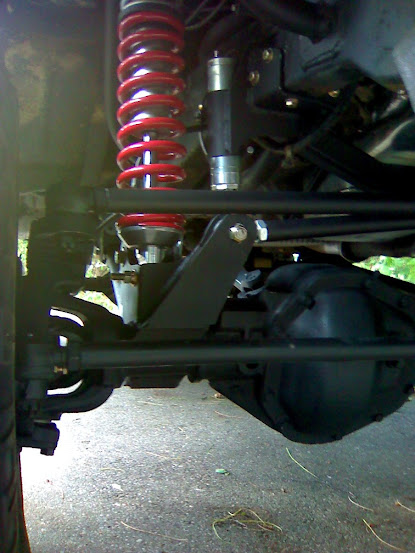
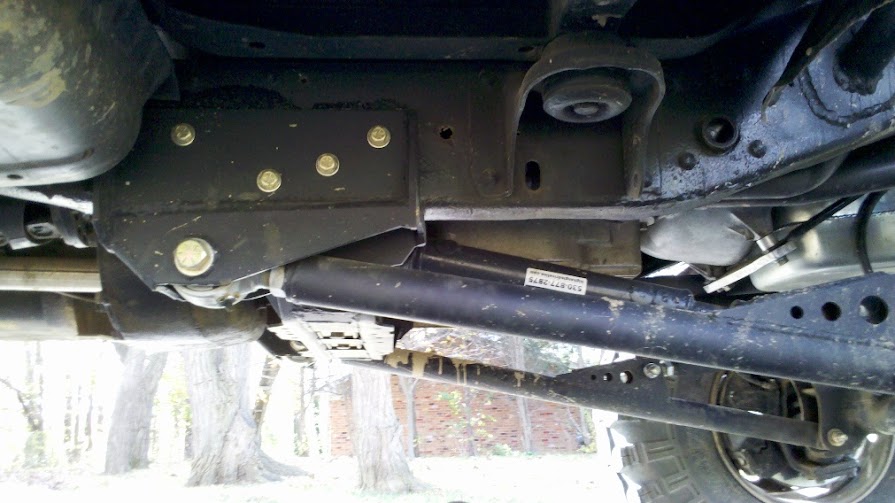
At the rear is the custom tranny crossmember that holds the 3” ballistic joints, they are bolted to the crossmember with ¾” bolts, then threaded into tube adaptors with a 1.25” threaded shank. From there the 2” x .250 wall DOM is welded to a .250 wall DIY4X bushing with a 9/16” bolt into the axle bracket. In the middle of the main arm there are short 1.75 x .120 wall DOM upper arms. Those are connected to the lowers with 7/8” heims in tube adaptors, to brackets I custom made and welded to the lower arms. These are thin for tire clearance, thinner than the 2” tube, but the 9/16” bolt head does stick out slightly more than the tube. The other end is the same .250 wall DIY4X bushing with a 9/16” bolt as the bottom. This crossmember is also held in with 3 bolts on the bottom of each side, for a total of 14 size 7/16" bolts through to the frame with only 4 new holes.
armR.jpg


txmemberRear.jpg


txmemberL.jpg


txmemberR.jpg


txmemberRF.jpg


txmemberRF2.jpg


Both the trackbar and draglink are 1.25x.250 wall DOM, cut, bent, and threaded by ORD to my measurements, all one piece. The draglink uses 7/8” tie rod ends for long life and smooth operation, but the ends BARELY have enough angle for full droop. I got the angles and lengths as close to parallel as I could. I even did some trig calcs and made simple solid computer model to simulate the bump steer and determined it was satisfactory. In my modeling I was considering slightly offsetting it to improve the slight error in bumpsteer, but determined I was just trading error at one end for the other, and decided I would rather have it more accurate where it was used the most, at ride height. In the end I don’t notice any bumpsteer anyway, it works great. The bumpstops are angled in slightly on purpose to help with coilover clearance during articulation. I tried to keep the track bar high for a better roll axis in the front as well. Also, since I rotated the pumpkin up quite a bit, I wanted to be able to raise my gear oil level to make sure the pinion bearings are oiled, so I cutout a rectangle around the fill hole including more area around the top, then flipped it upside down, and welded it back in. Raised it over an inch, done.

Fsuspension.jpg


The axle brackets were hand cut and ground from ¼ plate with the plasma and angle grinder. The have two side plates, and a brace connecting the two at the top, bottom, and middle. At the top each axle bracket also holds the lower shock mount, and the limit strap connects with the upper bushing bolt. The top/front brace on the passenger side that connects everything together is 5/16” plate, and also extends up to form half the panhard(track) bar mount. The other side is 5/16” late as well, all boxed in with ¼” plate. The track bar is held to the axle by a 7/8” heim joint using a 5/8” bolt. The other end connects to the frame with a 5/8” bolt as well, but with a rebuildable 2.63” ballistic joint with a 7/8” threaded shank. This picture was huge for me, I had a big smile on my face because the truck was sitting on the axle for the first time in weeks. The big jackstands on the front frame are lowered!

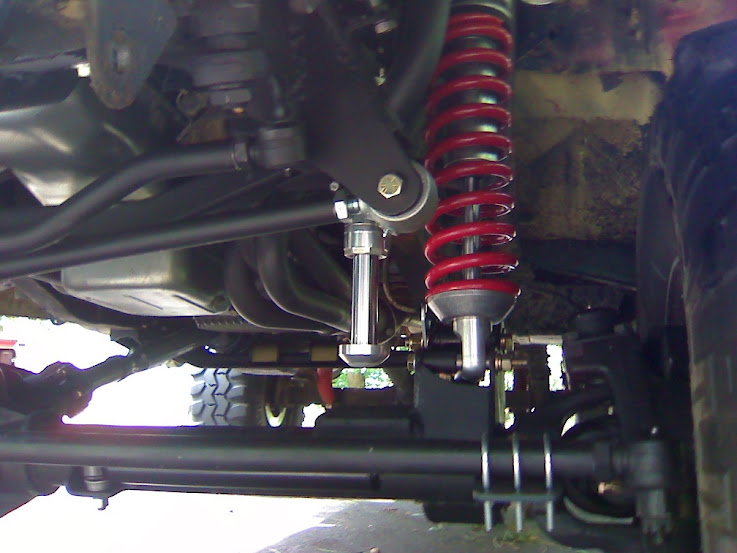
wheelwell+L.jpg


front+l.jpg


front+r.jpg


The track bar frame mount is 5/16” plate, custom cut and welded and “batwinged” to the frame. It is also braced to the shock hoops with some 1.75 x .120 wall DOM. The track bar batwing also holds the support pivot for the intermediate steering shaft since I had to add a 3rd u-joint to clear the coilover. I also had add in the weld in brace since I found a crack in my frame when I tore it all apart. I already had the bolt in brace, so I fixed the frame and added the weld in brace.

Track+bar.jpg


I don't have a tubing bender, so I couldn't of made the shock hoops or engine crossbar without dunejump and his help with his bender. The shock hoops are all custom bent 1.75 x .120 wall DOM, including the engine crossbar, which also has DIY4X flanges, and the upper shock mounts are DIY4X mounting angled mounting tabs. Those are such a great price it’s not worth making them yourself. I’m all about engine maintenance and keeping it up, so I kept the shock hoops out and away from the engine for easy plug and header access, and all around easier access to the engine and accessories.
The springs are 300/450 Eibachs. 12/16 inch for a total of 28 inches on a 14” travel 2.5” FOA remote reservoir coilover shock. The funny thing is I just ordered the 4 springs and when they arrived they were the same colors as my truck, half silver and half red. I was laughing.
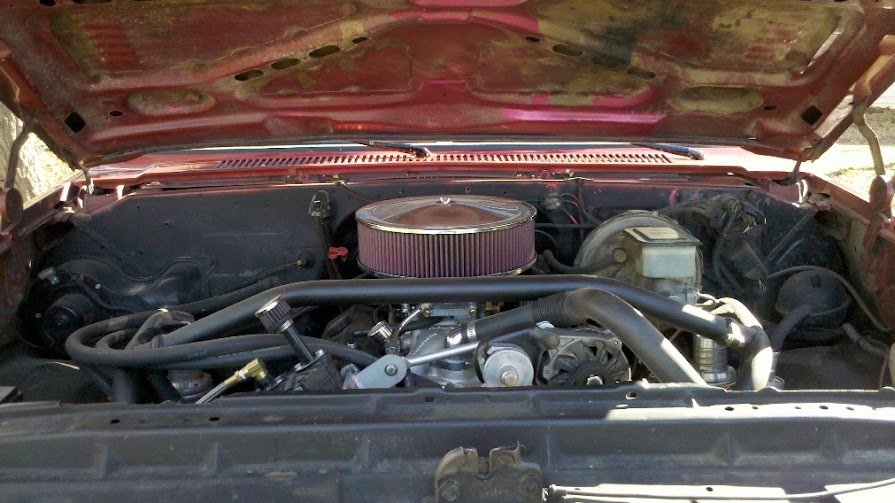
engineF.jpg


EnginePS.jpg


right+shock.jpg


left+shock.jpg


The engine crossmember I custom made from 1 piece of 6x6x.250 wall square tube, I cut it lengthwise on opposite corners to produce two 6” angled pieces with a bend at the bottom. These were cut and bolted to the frame. Then I cut and notched a piece of 2x2x.250 wall square tube to make the cross bar. This was originally done because I wanted to drill and tap it to cross the compressed air over to the other side, but determined that wasn’t going to be the best solution after there wasn’t much room when I got it all done. Anyway, I bent it together and welded the notches to create the overall bent shape, and then cut the top flat to fit the angled plates. Tack welded that in place after jacking it against the plates. Then made braces for the engine mounts. Also mounted the 2” x 4” travel FOA air/hyd bumps to that and braced that as well. I used mostly holes in the frame that were already there for this crossmember. If I were to do that over the only thing I would change is I would probably just bend a round tube for the crossbar instead of using the square one since I didn’t tap it for pipe fittings anyway.

ExmemberLR.jpg


ExmemberR.jpg


Brake lines were moved and angled down just outside the frame. New hard lines were ran and the braided flex lines I bought previously were reused.
The limit straps are from poly performance and attach from the lower bushings to the engine crossmember. I tightened the bolts on the strap tabs when they were pulled taught from full droop to keep them at even tension in the tabs. The limit straps will stretch so I ordered them two inches shorter than full shock extension.
The front driveshaft is now a HAD 1350 CV for high angle with a 1350 front u-joint and u-bolt yoke. The slip is only 3” because the radius arms are so close to the driveshaft pivot it only uses just over an inch of slip throughout the suspension travel.

F+dhsatft.jpg


I have to mention that I wouldn't have this axle, or the rear 14BFF, or the trans, or the tcase, without my Dad and brothers help. They are always finding parts and parts trucks and hauling things for me and I couldn't of built this thing without them or the parts. So I had already put the Detroit locker and all new bearings and seals in the axle, so when it was time for final assembly I got to put together the rest of the parts for the last time.This included all new kingpins and assemblies. The ORD crossover arm with ARP studs, new Spicer life u-joints with the stock large35 spline inners, and 35 spline stub shafts along with Warn Premium 35 spline hubs. I also had to replace the spindles since the seal surfaces were no longer serviceable. I drive this thing on the street as well as to and from the trails, so I definitely wanted to be able to unlock the hubs. I kept the stock plastic kingpin bushing and spring design. I believe that this helps absorb impacts if the 550 lbs axle comes crashing down on the tires and then the truck crashes down on top of that with large bumps and small jumps. Also, although I admit the bronze bushing and set screw design are stronger and eliminate the spring, what is the next weekspot on impact? The knuckle? The spindle? The inner C? I would rather be able to easily replace a bushing and spring than any of those pieces. Death wobble has been non existent so far in the driving I have done, everything from offroad, to city driving, to 80 MPH on the freeway. I aligned the toe myself with a piece of tape on each tire rotating them front to back.

Initial driving impression was, holy crap this steering is tight. With all new intermediate shaft, all new axle components, steering, track bar, tie rod, drag link, everything, it was VERY precise. The most precise I have every felt my truck at all, night and day, it was the first thing I noticed when I drove it the first time. And I had already replaced everything 7 years before that, so it's not like I haven't felt it all new before. Road manners are great, except one thing I didn’t expect is, coilovers with dual springs and a slider are kind of loud. The springs shift and slide up and down the coilover body and it travels right through the frame and into the cab. Nothing I can’t deal with I just didn’t expect it.

Offroad it is much better, absorbs bumps better, articulates better, ride smoother, steers better, has more traction with the front locker. I love it.

There is only one problem, I like the front so well that the back sucks now. The front will be soaking up everything and the back will bounce around like Tigger from Winnie the Pooh. And with the new carb on the big block I also have wheel hop in the rear now, even on sand. Also, this carb has more power, but on super steep hills at low load, low RPM, it goes pig rich and wants to die on me. Then I have no power steering or brakes, which is worse yet.

It really makes me want to 4 link the rear, and add EFI. The 4 link is happening, don’t know if I can afford the EFI yet.
In the meantime, I did some more stuff to the tranny and gauges a couple weeks ago, so that is next.
 
Last edited:
Man heath I wish you wouldn't have posted this. I am just gonna have to be happy with the 52s for now.
 
How the heck did you learn to do all of that! Talk about sweet!:waytogo:

You did this in your driveway?:bow: Wow!!
 
They weren't rubbing hard, in fact, I never heard or felt the tires rubbing, I just noticed the paint rubbed off the control arms.

I welded the pumpkin to the tube, then butted the bracket up against that weld. I spaced the opposite side an equal distance from the inner C.

:waytogo:

Good news! Thats what i was hoping for when i (never) build mine!

EDIT: Its kinda insane how you built exactly what i had envisioned in my mind. And i kept thinking, "ok, i have it all worked out to where everything will be perfect except the unknown." You pretty much documented everything my mind was questioning!
 
Heath that is some seriously sweet work man. The fabbed brackets and link mounts, etc etc. are very nicely done.
Its the Gold man!
 
Are you suggesting this will increase front traction based on experience with more antisquat in the dunes, or theory? I am not trying to be an @$$, I'm serious. You have more wheeling experience than me, I only wheel a few times a year lately since I moved farther from easy wheeling. If more antisquat works good in the sand that's good to know, regardess of why (although I always like to know why). But at the same time I don't want the axle trying to climb under me if I am going up a real steep dirt hill some other time at Bundy or wherever. These are the kinds of things I wanted to get some opinions on before I decided what numbers to shoot for, thank you. 4 links for drag racing are setup a lot different than 4 links for wheelin I am sure.

Based entirely on observation and a couple suspensions I have built for other folks. You are entirely correct the front end will not go down just cause the rear axle is trying to roll out from under the (raise) the rear of the truck.

If you crunch the numbers it would seem to make very little difference on the climbing ability of a truck and alot of it boils down to what you like. I did a suspension for a guy and he loved how the back end of a rig would squat under power. So we went low on his numbers.

But based on real world experience and observations seems the higher antisquat numbers in the back help the truck climb a bit better.

I am honostly not sure why it works like this I have some ideas about why but I don't know if they are valid or not. Alot has to do with the truck being at an angle but gravity is still pulling you straight down. It doesn't change with the angle of your truck so your true weight distribution is changed because you have essentially made the truck shorter. My math skills are lacking right now (but I am working on that) to prove this but it is just a theory.
 

Latest Posts

Top Bottom