CK5
Register an account today to become a member! Once signed in, you'll be able to participate on this site by adding your own topics and posts, as well as connect with other members.

'89 R3500 Crew Cab 2wd to 4wd conversion & beyond

Started out with 2wd TBI350 with SM465 to current 4wd with 454, 700r4, NP241
I had a set of 40's I borrowed for a couple of months and they kind of ruined my visual perspective on tires. Now going back to 37's is kind of underwhelming.

However from a performance standpoint the tired, old TBI350 couldn't quite handle them as well as I'd like. They were just a touch too large even with 5.13 gears. Also from a budget perspective it's a big jump in price from 37's to 40's.

Overall I'm happier with the 37's.

Your wheelbase is 3' shorter than mine so 35's would probably work okay with at least 4" of lift. 35's would definitely be easier on the wallet. However if it was me I'd still be looking at 37's.
 
I could do a 5.3L swap for the price of 40's; that's what gets me about it.
 
I could do a 5.3L swap for the price of 40's; that's what gets me about it.

Agreed. It's a catch 22 for sure.

One thought that may or may not be a big deal. I feel mild concern running battery cable alongside a fuel line. Just seems like a bad plan even tho realistically it'd never be an issue
 
One thought that may or may not be a big deal. I feel mild concern running battery cable alongside a fuel line. Just seems like a bad plan even tho realistically it'd never be an issue

Actually I feel the same way. I'm trying to figure out how I'm going to get the cable out of the bed without mixing it in with the fuel lines coming off the top of the fuel tank. Also thinking the same as you routing the cable down the frame. Unfortunately running it down the driver side would require quite a bit extra cable.
 
I have another dumb question on your tcase shifter, as I am thinking heavily about getting one...if you run the cable like you originally did (cable coming out the front of shifter and looping back around the the tcase), does this change the direction of shifting with the stick? Meaning the stock shifter goes all the way forward being 2hi and all the way back being 4lo, so does it change it to forward is 4lo, and back is 2hi?

This may seem like a dumb question, but if I get this shifter I have an idea of how I want it installed in my rig and trying to get a visual :thumb:

Here's the bracket for passenger drop:

2015-03-20%2016.57.27.jpg
 
Here's the bracket for passenger drop:

2015-03-20%2016.57.27.jpg

Nice! I ordered my cable shifter from Jon on Friday! He said there is a backorder on a certain part, so I am hopeful it should ship either by the end of this week or beginning of next. I am pretty excited :waytogo:
 
Awhile back I decided to replace the CO2 setup with a compressor. I want a system that will work well for more than just airing up tires. I also want to operate air lockers, airbags, and run a few power tools.

I debated a lot between an ARB unit or Viair kit. I know there are a few other options out there but Viair and ARB were the two I found to be mentioned the most. I was looking at Viair Ultra Duty kit and the ARB twin compressor. The Viair kit was about $50 less and includes a 2gal air tank. Both are 100% duty cycle. When comparing compressors you have to dig a little deep to find comparable stats. The closest I could come was the ARB twin flows 4.65cfm @ 29psi and the Viair flows 1.52cfm @ 30psi. It's easy to find 0psi specs but I feel they are pretty meaningless but for comparison the Viair is 1.76cfm and the ARB is 6.16cfm.

Ultimately I decided to go with the ARB for a couple of reasons. #1 would be the specs I listed above and another big reason was their level of quality. Viair does also make a twin compressor setup that is about $30 more than the ARB but it still doesn't have nearly the performance. The only complaints I found with ARB compressors was their higher price, which was the only thing in the negative column for me.

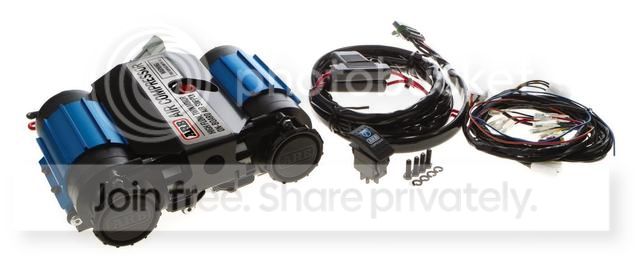
The ARB twin compressor is essentially 2 compressors mounted together with a little manifold. There is also a cooling fan to help keep operating temps down.

The ARB twin compressor comes with 2 harnesses, one for power and the other to activate the pump.
ckmta12.jpeg


The power harness has a big negative lead and 2 large power leads with a 40amp fuse on each, one lead for each compressor. That harness is about 6ft long. The harness for the activation switch includes plugs for 2 locker solenoids, plugs for 2 locker activation switches, and plugs for the switch to activate the compressor (including the switch itself). That harness is 10ft long.

I think my biggest complaint was that the ARB compressor doesn't come with a quick connect. It doesn't come with a hose either but that didn't really bother me because I already have the hoses from my CO2 setup. The compressor has a 1/4"NPT fitting so all you need is a quick connect with a male 1/4"NPT to be ready to connect an air hose.

One of the biggest decisions I had to make is where to mount the compressor. There were 3 locations I was considering; engine bay, cab, or the bed. The cab is most centrally located but I was afraid the compressor would be too loud for the people sitting in the truck while I aired up tires (and after using the compressor I do believe it would be awfully loud in the cab). The engine bay would make wiring the power leads the easiest and protect the compressor from the elements. However my motor likes to run hot and I was worried the heat would affect the durability of the compressor. So I decided on the bed.

2015-03-16%2017.56.12.jpg


The compressor base has rivet nuts. So I threaded M6x1.0 studs into the rivet nuts with loctite.

2015-02-24%2017.10.35.jpg


When it came time to thread the nuts on, it was extremely difficult to reach the studs between the panels of the bed so that will be good for theft deterrence.

I wanted to protect the compressor from stuff in the bed and provide it with some additional shelter so I made an aluminum cover for it.

2015-03-21%2012.22.01.jpg


11801d7c-d177-472d-9104-0dca6837e919.jpg


You will notice the little tube looking thing connected to the compressor. That
is a little manifold with 2 ports for the air locker solenoids. It is an additional item that I thought I was going to need but really didn't. I had planned to put the compressor under the overhang on the toolbox but it wouldn't fit there. If it had fit I would have needed to get the hose connection out where I could reach it. I thought the solenoid manifold would help with that and provide a future location for the locker solenoids.

I had to get power for the compressor to the bed. It will draw upwards of 56amps so I used 4ga cable connected to the battery with a 60amp fuse.

aa927939-9cef-422f-8d52-31fefa173ba7.jpg


I made my own cable clamps with thin strips of aluminum wrapped in electrical tape. Luckily there are enough holes in the frame I didn't have to drill any holes. I used abrasion sleeve on the section of cable that runs through the area next to the tcase because I couldn't get in there with a cable clamp.

I used the compressor today to air up tires after a trail run and it works great. I only needed air up my 37" tires about 15psi, and it made quick work of it. It only took about a minute per tire.
 
Awesome. I was really tempted to buy one of those after seeing richards. But I couldn't justify the cost.
 
Are you going to add a tank?

Martin
Yes, I meant to add that but by the time I was finishing up the post I felt like I'd already written a book. :doah:

I'm going to add at least a 5 gallon tank. I've been really wanting to add one now but I don't currently have needs other than airing up tires. I would at least like to have an air impact before I worry about adding the tank.

The only thing I thought might push the need for a tank up the priority list is the summer heat. I'm curious to see if higher outside air temps will reduce the compressor's performance. Based on how it did yesterday on the trail, I don't think it will be an issue.

Awesome. I was really tempted to buy one of those after seeing richards. But I couldn't justify the cost.
Yeah if you are only airing up tires it is definitely more cost than you need. Really one of the big reasons for buying it now is that we would really like to do ARB air lockers. We figured buying the compressor now would at least spread out the cost of doing ARB lockers.
 
Last edited:
I finally decided it was time to convert the rear suspension to a true 4wd setup. I had someone offer to help so I figured this would be the perfect time to do it. I'm sure I've mentioned it before, but for a refresher the rear spring hangers on a 2wd truck are about 3" shorter than their 4wd counterparts. In order to equal the front suspension I've been running 4" lift springs and 5.5" blocks. I really dislike running super-tall blocks.

Here's where I disclose that yet again this is an area where the 2wd conversion strikes again. Everything did not go as planned.

We have a 2-post lift in our shop but I don't use it very often; it's usually buried behind sign projects. The crewcab barely fits on it. The only way we could balance it was to lift the truck without the rear axle on the truck. Otherwise the frame of the truck and the arms of the lift don't line up right.

2015-04-18%2017.43.18.jpg


Lots of front droop.

2015-04-18%2017.44.33.jpg


Once the truck was in the air, we used the cutting torch to cut off a total of 32 rivets. I had a lot of reservations about cutting off the rivets for the front hangers. We torched off the rivets from inside the frame to avoid throwing slag on the fuel tanks. I had to be careful not to cut into the frame. Here's the clean, painted frame after cutting off the front hanger.

2015-04-18%2016.35.13.jpg


The new 4wd brackets came from DIY4x. Here's a comparison of the factory 2wd front hanger versus the new 4wd hanger.

comparison.jpg


We did have 2 problems with the front hangers tho. First, my truck has a bed bolt that passes all the way through the frame out the bottom. The brackets didn't have a hole for that so we had to drill those.

2015-04-18%2018.22.55.jpg


THe other problem was clearance with the fuel tanks. It was just enough interference that the brackets wouldn't quite line up to the holes. I had to massage the lip/seam of the tank and work the bend in it around the corner of the tanks.

Here's how it started out:

88d80698-5061-4a4b-93d0-9b8b0b1d84c1.jpg


And after the massage:

2015-04-18%2017.42.14.jpg


That gave me just enough clearance.

2015-04-18%2018.22.40.jpg


2015-04-18%2018.22.31.jpg


I like how Kurt does the nuts on the back welded to flat strap.

2015-04-18%2018.22.51.jpg


I had to put 1/2" spacers under the mounting clips for the brake line so it would clear the back straps.

3ac5ad0f-1cf2-47ae-84b3-82cad437353e.jpg


You can also see the big old bolt that passes all the way through the frame.

Now it's time to move to the rear hangers which should be straight forward bolt-on, right? :whistle:

Found these markings under the rear hangers. Not sure what they mean but kind interesting to find artifacts like this.

2015-04-18%2013.22.58.jpg


I had 1-ton shackle flip brackets on my K5. I had used a set of front hangers also made by DIY4x on the K5 to work with 1-ton spring perches and the 1-ton flip. I figured that worked out great because now the flip brackets would fit the crew cab. However of course this was NOT the case.

The mounting holes for the 2wd rear hangers were different from the bolt pattern of the shackle flip. Each bracket has 6 holes and I was only able to use 2. The forward 2 holes put the bracket in the correct place Luckily I have a K30 to use for reference measurements. The rear 2 holes on the flip brackets are about 1/2" further back than the 2wd mounting holes. The 2 holes on the bottom of the frame rails were too far forward and also too close to the face of the frame.

I wasn't sure if I was going to be okay with a 4" shackle or if I was going to need to use a 6" shackles. It turns out the 4" factory length shackle is perfect. However I ran into another road block.

2015-04-19%2016.17.48.jpg


That was a brand new bushing I bought when I put the springs in 2 years ago. Due to my frustration, I didn't get any finished pictures. I'll do that after I order in a new set of 4" aftermarket shackles with poly bushings.
 
Jeez, I think next time I'll be doing a 4wd frame lol.

Thanks for the heads up, I'll be digging into the rear soon, how much did those brackets run you? I don't see them in the website.
 
Yes knowing what I know now, I don't think I would do it all again. None of it has been easy. Course that's not too unusual with these project trucks.

I don't know if I can find the price; i bought them 2yrs ago. Originally this was going to be done before the first Blazer Bash with this truck in 2013. I had to send a special request to Kurt for them.

But you'll have the problem with 1/2 vs 1-ton difference. The 1-ton brackets are closer to the frame. Unless your axle has 1-ton width spring perches or you are redoing the perches anyway.
 
Picked up a pair of super shackles from Offroad Design. Benefit of living in the same street, shipping is basically next day. Here's a comparison of the ORD shackle versus factory:

2015-04-21%2011.55.44_1.jpg


2015-04-21%2011.55.57_1.jpg


Their factory replacement super shackle is technically 4.5" instead of 4".

Here it is in the truck finally:

2015-04-21%2014.38.42_1.jpg


2015-04-21%2014.38.50_1.jpg


2015-04-21%2014.38.24_1.jpg


The past 2 years I've been running 2wd brackets, 4" lift springs, and 5.5" blocks. Now I've got 4wd brackets (+3" over 2wd), 4" lift springs, and 2.5" shackle flip.

Whew! Good to have that project done.
 
Well not done as in the entire truck project done, just the 4wd hangers project done.

Took the truck for the first extended drive today and the ride is much improved. Didn't expect such a difference.

Also installed the gas can I bought a couple of months ago after I ran out of fuel on a snow run.


Not as necessary now that both tanks are working but maybe I can help someone else on the future.
 
Top Bottom