
CK5

You are using an out of date browser. It may not display this or other websites correctly.
You should upgrade or use an alternative browser.
You should upgrade or use an alternative browser.
Adjustable shackle for anti-wrap bar?
- Thread starter Blue85
- Start date


This sounds alot like a conversation I heard I michigan once apon a time
oh man dont get us started.


oh man dont get us started.
x2!

Here are some pics.

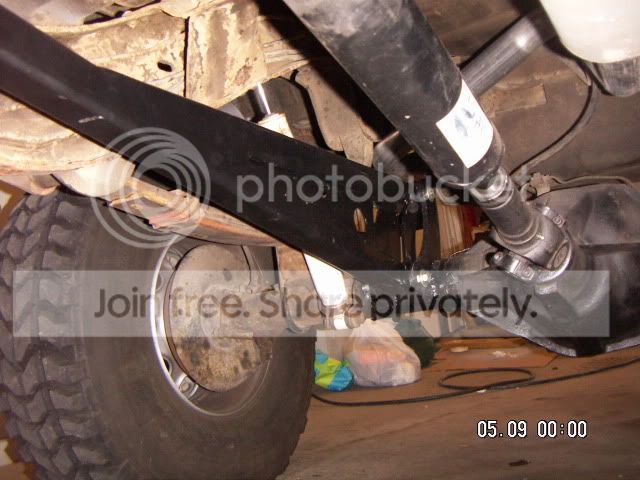
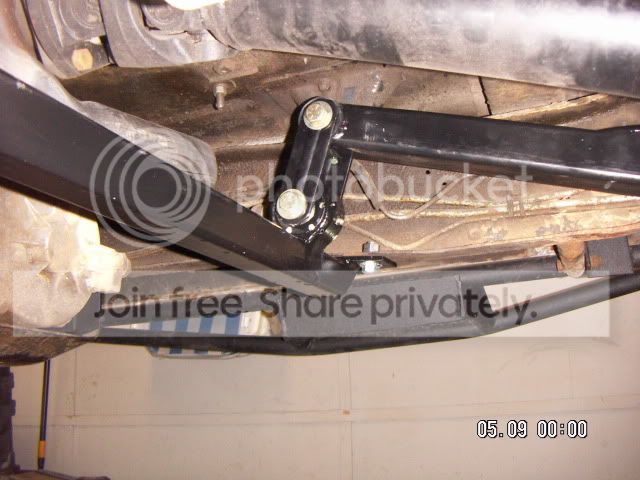
The whole thing is built pretty high up. The two tubes come together so far back to clear a little brace under the floor. The tubing is 2", .188 and the x-member is 1.75", 0.15 wall. The ballistic joint is wrapped all the way around with a piece of 1/8" flat stock to prevent ever coming off the X-member.
The whole thing is built pretty high up. The two tubes come together so far back to clear a little brace under the floor. The tubing is 2", .188 and the x-member is 1.75", 0.15 wall. The ballistic joint is wrapped all the way around with a piece of 1/8" flat stock to prevent ever coming off the X-member.
Could be the pic but it looks like your lower mount is at or above the axle centerline. Oh crap here we go

So how do we calculate the anti-squat? The torque on the bar is a function of the driveshaft torque, gear ratio, stiffness of the springs, etc., but on any given truck it's pretty much constant. That is - the balance between squat from weight transfer and anti-squat from the bar. So for this fixed torque, the force on the end is a function of its length. The longer the bar, the less lift.
You are correct, and you can calculate the antisquat by doing the normal 4 link diagram, except instead of doing the 4 links, you just place your IC at the point where that shackle attaches to the crossmember. Or, to make it quicker, just use the 4 link calculator, but make the links (both upper and lower), attach at exactly the same point in the front, which is also exactly where your joint is on the crossmember. The rear of the links can be wherever your traction bar attaches to the crossmember. Side to side it doesn't matter, you can just make them exactly where they are, or split them apart, just keep them parallel with each other and the vehicle in the calculator. The main thing is, with a traction bar or ladder bar (radius arm), the IC is fixed a the point where it attaches to the frame. Whereas with a 4 link, the IC moves with the angles of the links as the suspension cycles. And the IC can be changed drastically front to back with small changes in the angles of the links. That's one reason it's called the IC, becuase with a 4 link, it's only correct for that instant, once the suspension moves, it's a different instant, and a different instant center. Not so with a traction bar.
Also, one note, I would of put the ballistic joint on the bar, not the crossmember, then when the bar wants to rotate with the axle, it doesn't also want to turn the whole shackle, and try to move over at the same time. However, if it does want to move sideways, it can a little bit easier now. It's a trade off. I would just run it now, it probably has enough flex in the bushings it doesn't matter.
Nice work.
Could be the pic but it looks like your lower mount is at or above the axle centerline. Oh crap here we go
He's got it all braced as one big unit in the middle, so it's all good...

Curious if one of these would work on our heavy ass trucks or if it would just break with some use...
-----> Bam Bar
Looks like a pretty good idea to me judging by the geometry and the way it works.

The problem with this, is it puts the leaf spring under compression, not tension, which will still allow it to wrap under power. Not as effective. Many drag racing traction bars (which don't work well for articulation), and caltracs, put the leaf spring under tension while stopping wrap, which is much more effective. Also, because it's so short, even shorter than half the leaf spring it seems, it is going to fight the pinion angle with the leaf spring too.
The traction bar blue and these guys have made doesn't put it under compression or tension(because of the shackle allowing it to move front/back), it separates the rotating forces from the leaf spring completely, and controls it by itself.
Last edited:
You are correct, and you can calculate the antisquat by doing the normal 4 link diagram, except instead of doing the 4 links, you just place your IC at the point where that shackle attaches to the crossmember. Or, to make it quicker, just use the 4 link calculator, but make the links (both upper and lower), attach at exactly the same point in the front, which is also exactly where your joint is on the crossmember. The rear of the links can be wherever your traction bar attaches to the crossmember. Side to side it doesn't matter, you can just make them exactly where they are, or split them apart, just keep them parallel with each other and the vehicle in the calculator. The main thing is, with a traction bar or ladder bar (radius arm), the IC is fixed a the point where it attaches to the frame. Whereas with a 4 link, the IC moves with the angles of the links as the suspension cycles. And the IC can be changed drastically front to back with small changes in the angles of the links. That's one reason it's called the IC, becuase with a 4 link, it's only correct for that instant, once the suspension moves, it's a different instant, and a different instant center. Not so with a traction bar.
Also, one note, I would of put the ballistic joint on the bar, not the crossmember, then when the bar wants to rotate with the axle, it doesn't also want to turn the whole shackle, and try to move over at the same time. However, if it does want to move sideways, it can a little bit easier now. It's a trade off. I would just run it now, it probably has enough flex in the bushings it doesn't matter.
Nice work.
He's got it all braced as one big unit in the middle, so it's all good...
my bad it looked like two separate mounts
and I agree with putting the ballistic joint on the end of the bar
The bottom bolt is basically at the axle centerline. I assume you are talking about the tubes being in tension or compression? It shouldn't matter since the whole bar is like one giant mass. Those are the RuffStuff brackets, which tie the two bushings together directly. Then there is the center plate between them, as noted.Could be the pic but it looks like your lower mount is at or above the axle centerline.

I thought about it both ways and finally decided that articulation would be better this way. The sideways shackle movement will affect the pinion angle, but the joint only goes 15 degrees each way. That's 0.14" height change, which is like .2 degrees at the pinion. The end of the bar wants to go sideways as the axle articulates.folkenheath said:Also, one note, I would of put the ballistic joint on the bar, not the crossmember, then when the bar wants to rotate with the axle, it doesn't also want to turn the whole shackle, and try to move over at the same time. However, if it does want to move sideways, it can a little bit easier now. It's a trade off. I would just run it now, it probably has enough flex in the bushings it doesn't matter.
I thought about it both ways and finally decided that articulation would be better this way. The sideways shackle movement will affect the pinion angle, but the joint only goes 15 degrees each way. That's 0.14" height change, which is like .2 degrees at the pinion. The end of the bar wants to go sideways as the axle articulates.
It's definitely a trade-off either way. To be honest I've always thought it would be best to have a joint on both ends of the shackle, then the shackle can do whatever it wants without binding a bushing. Side to side motion at the axle end will be small enough it doesn't matter.

What is IC?
and could you explain it a little?
I'm trying to understand what you guys are saying, but my small brain big body is making it very difficult to understand.
I installed the Off Road Design rear traction bar, welded every thing in and then did a real stupid thing! I raised the rear up 1" inch. STUPID!!!!!!!!
and could you explain it a little?
I'm trying to understand what you guys are saying, but my small brain big body is making it very difficult to understand.
I installed the Off Road Design rear traction bar, welded every thing in and then did a real stupid thing! I raised the rear up 1" inch. STUPID!!!!!!!!

Here is mine, I may change it a bit, by adding a ballistic joint( god forbid I have to deal with those ass wipes again) right above the shackle so it can move more with the suspension.


Hard to see because of crappy cell phone pictures.

Hard to see because of crappy cell phone pictures.
You can google the term instant center and read up. Whether your links are tubes, springs, rods, etc., if more than one is attached to an axle, it rotates around a point which is not at a specific bushing or joint. The combination of pivot points and the geometry has it rotating somewhere else.What is IC?
and could you explain it a little?
I'm trying to understand what you guys are saying, but my small brain big body is making it very difficult to understand.
I installed the Off Road Design rear traction bar, welded everything in and then did a real stupid thing! I raised the rear up 1" inch. STUPID!!!!!!!!
If you raised the rear 1", can't you lower the crossmember 1" or use shackles that are 1" longer?
Well I have driven a few times without the top and with the top and the effects are the same. The rear end is definitely stiffer. I'm not sure that the old flex was just spring wrap. I still think that the anti-wrap bar forces a little spring wrap as the axle travels. If I disconnect the shackle and push the rear up and down by hand, the bar will hit the floor.
It's very stable and predictable on the road, though.
I think we all need coils and links.
It's very stable and predictable on the road, though.
I think we all need coils and links.

You are correct, and you can calculate the antisquat by doing the normal 4 link diagram, except instead of doing the 4 links, you just place your IC at the point where that shackle attaches to the crossmember. Or, to make it quicker, just use the 4 link calculator, but make the links (both upper and lower), attach at exactly the same point in the front, which is also exactly where your joint is on the crossmember. The rear of the links can be wherever your traction bar attaches to the crossmember. Side to side it doesn't matter, you can just make them exactly where they are, or split them apart, just keep them parallel with each other and the vehicle in the calculator. The main thing is, with a traction bar or ladder bar (radius arm), the IC is fixed a the point where it attaches to the frame. Whereas with a 4 link, the IC moves with the angles of the links as the suspension cycles. And the IC can be changed drastically front to back with small changes in the angles of the links. That's one reason it's called the IC, becuase with a 4 link, it's only correct for that instant, once the suspension moves, it's a different instant, and a different instant center. Not so with a traction bar.
Also, one note, I would of put the ballistic joint on the bar, not the crossmember, then when the bar wants to rotate with the axle, it doesn't also want to turn the whole shackle, and try to move over at the same time. However, if it does want to move sideways, it can a little bit easier now. It's a trade off. I would just run it now, it probably has enough flex in the bushings it doesn't matter.
Once you're willing to get into the design of all of this (AS, IC, etc), why not look into linking the rear instead?
Once you're willing to get into the design of all of this (AS, IC, etc), why not look into linking the rear instead?
I completely agree, which is why I will probably never put a traction bar in, because if I am going to go through the trouble of making a nice solid traction bar, I might as well add two more links and ditch the leaves. I almost did that this summer, but decided to hold off so I didn't put my rig out of commission most of the summer like I did last summer on the front suspension.
Blue, I think your traction bar turned out pretty well, did you ever figure your IC just to correlate how it feels for your future reference?


