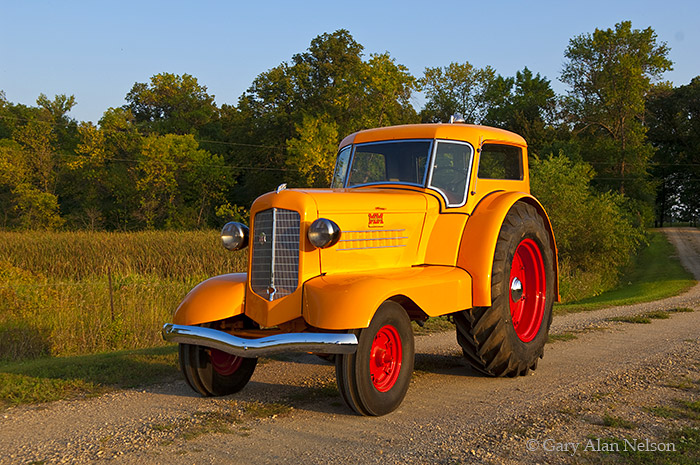
I was elated to see the machine running again, but Dad didn't like an engine knock that had developed over the previous decade of light-duty usage. We hadn't ever worked the rig very hard, so I don't think it had aged much. But he really liked the machine and didn't want it to get to the rod-through-the-block phase. I like mechanical projects, so I decided to rebuild it for him. He said I could have it if I fixed it up.

So without further ado...

I love hydraulics. And I sure miss having them around.

This is what I call a face plant.


This engine has a modular architecture that I haven't seen elsewhere. 2 cylinder blocks with 2 cylinders each, bolted into one crank case. Sharing a head between the two. But the blocks have side valves in them, so the head is really just a piece of metal with spark plug holes and coolant passages. The crankcase isn't cooled, it just has oil. Nowhere do water and oil mix at a shared gasket (like a normal engine). Water pump has a 2-channel manifold that bolts onto each of the blocks. It's a very scale-able design, and their larger tractors had 3 blocks with 6 cylinders. Also sharing one head and one crankcase. I understand why nobody makes engines like this anymore (it's complicated and expensive), but I really like it.

No oil pan, but a huge cast side plate giving easy access to the lower end. Gear-driven camshaft with foot-long rocker arms (no pushrods), located under those two side covers (the only thing here that isn't massively heavy). Hydraulic pump driven off of the timing gears (live hydraulics were a big new thing when this tractor was made, as most tractors had the pump behind the clutch)

This tractor was very advanced and fancy for its era. Here they bent the steering shaft up into a steering column. So the wheel tilts upward instead of going back horizontally like most rigs. The seat sat on a special 4-bar linkage that produced up-and-down motion instead of swinging in an arc like a Farmall.

It also had a hand clutch that stops the wheels while the PTO keeps running. Not as nice as a modern rig, but much nicer than what the others were making at that point in time. It has an actual gauge cluster with an optional tachometer (which mine does not have). Bright and dim headlights, and a rear light. This was the Cadillac of tractors.
But, then, this is the company that introduced this air conditioned, cab-covered, 40MPH tractor...in 1937.
Great idea, but so far ahead of its time that they never managed to sell anything very well. They hardly sold any of those UDLX models, and they only sold 3500 of my ZB model. Farmall, OTOH, sold 300,000 M models and 350,000 H models. So I'm outnumbered 200-to-1 just between those two models.
But back to the project (I'd never heard of a "build" back then). The tractor originally had its muffler underneath the sheet metal (another fancy quirk), but someone had straight-piped it at some point. This modification caused problems as the large, tall external muffler beat that half-baked pipe to pieces.


Side shot with the 3 covers removed. I love how easy it is to access everything. Why can't automotive engines be like this?
Another interesting quirk here is that the blocks have no oil passages. Oil is delivered via a copper tube that runs up from the crank case. The tubing is then pierced with small nails to cause the oil to dribble down onto the valve springs. The center main bearing oil delivery is the same. That one has a hand-soldered copper splice in it (center of pic). The governor runs off of the gear in the middle of the crankshaft, another thing that's not trivially done with an end-loaded cam shaft.

Then the head came off. Can't look directly down the bore, you're mostly looking at the side valves.

Front roller bearing, the crank shifted slightly out the rear, then came out sideways. It's a neat 3D jigsaw puzzle. Oh yeah, the blocks have been removed at this point. So it's just the lower end assemblies in that hunk of cast iron.

I was privileged to have a manual for this tractor. An old manual, even.


The lonely back half of the tractor.

At this point the crank was sent off to our local machining shop to be turned back into round. They also checked cylinder bores and told us they were still fine. The smaller pieces (blocks, head, cover, etc) were sand blasted in town. New bearings and rings completed the engine rebuild and I put it all back together.
Mounting the flywheel. This one was a good bit heavier than the one I'm wrangling for my 6.2 engine right now. It's truly impressive how heavily this machine is built. 4500 pounds, most of it metal. And the tractor is rated at 25HP. Now, that is 25HP at the Nebraska Test standard speed of 1500RPM (25 draft horses, rather than the hamsters they measure today), but that's still a huge weight-to-power ratio, putting it up in the 40HP weight class.


Needed to align the clutch, but didn't have the fancy plastic tool. So I made my own.