CK5
Register an account today to become a member! Once signed in, you'll be able to participate on this site by adding your own topics and posts, as well as connect with other members.

Boxing your entire frame seems pointless now

howdiy

1/2 ton status
Joined
Jan 28, 2004
Posts
3,306
Reaction score
14
Location
Fl
I suspect I know where you're coming from, but you know I can't agree with such a broad blanket statement without further explanation. It depends too much on which one you start with, and what you add to it. Consider the following:

FRAMERAIL1.jpg


Left to right, based on dimensions I've taken from trucks I've owned over the years:

1979 1/2 ton SWB 2WD frame---about .153" thickness
1985 3/4 ton Suburban 2WD frame---about .203" thickness
1979 1/2 ton SWB 2WD frame, boxed using more .153" material
1980 3/4 ton Crew Cab 2WD frame---about .224" thickness
1980 3/4 ton Crew Cab 2WD frame, boxed with .187" material


The numbers across the top (the 9.69 and .76) are the figures for moment of inertia over the major and minor axes for each cross section (units are inches to the fourth power). Suffice to say a bigger number indicates more strength. Numbers across the bottom (like the 1.66 and 5.65) are the cross sectional area (square inches) and approximate weight per foot (pounds).

The last iteration of the truck used pretty much the one on the far left---1/2 ton 2WD frame, .153" thick, no boxing. What's under the truck now started off as the fourth one from the left, except about a 2 foot long section under the rear of the cab (where the rear 4 link bars tie into the frame) that resembles the section on the far right.

By my math, I just about doubled my frame weight and in return nearly tripled the strength. (More importantly, it put that crew cab frame to good use, as it was previously just cluttering up the yard.) I think I'm happy with the result...at least for now.

Is a ~20% increase in bending strength worth while?

The formula for bending is

Stress max= Mc/I

M being the max moment that can applied, C is constant for this instance, and I is the numbers above the frames. It's also about a 60 pound increase in weight also, which isn't that much, but I am kind of thinking if you instead took 60 pounds of steel and added crossmembers it would be more effective.

The place I would only want to box is where the shackles are.

I'm not sure if boxing any of the frame is even very helpful if you have a fullcage in the truck


I'm going to look more so into the torsional strength increase, it seems like this is really where it is going to help. I haven't learned about torsion in c-channels in class.


Just saw this and found it very interesting and put down some of my thoughts
 
Is a ~20% increase in bending strength worth while?

The formula for bending is

Stress max= Mc/I

M being the max moment that can applied, C is constant for this instance, and I is the numbers above the frames. It's also about a 60 pound increase in weight also, which isn't that much, but I am kind of thinking if you instead took 60 pounds of steel and added crossmembers it would be more effective.

The place I would only want to box is where the shackles are.

I'm not sure if boxing any of the frame is even very helpful if you have a fullcage in the truck


I'm going to look more so into the torsional strength increase, it seems like this is really where it is going to help. I haven't learned about torsion in c-channels in class.


Just saw this and found it very interesting and put down some of my thoughts
In my opinion boxing is NOT worth the effort, you are better off making a cage, or at least some X members, meaning corss members in an X shape instead of just straight accross.
Tha cage is number one though on cost and labor vs gain in rigidity.
Anything that is 2 dimensionnal will work better, that is why the newer stuff is all unibody, it's stronger with less weight.
 
If you look in my build thread, I/we (Sixb and myself) boxed a considerable amount of the frame using plate that is approximately similar in thickness to the frame thickness.

Just from a purely aesthetic point of view it is overkill to the max. It caused a few issues that could have been prevented had I thought a few steps forward. like warpage from welding, I should have braced it more thoroughly.

But, for your question, I don't really feel the need to brace a 1 ton frame.

Mine is now indestructible.
 
I agree that boxing is not the end all be all of everything, but a 20% increase in strength is substantial.

I have ridden in one truck before and after the frame was boxed and while I think a cage would have helped more, the difference was truly impressive.

Shoot just adding sliders to our trucks with weld on out riggers helps a ton.

So while boxing may be the least effective way to gain rigidity, it is still nonetheless a way to gain rigidity.

When the time comes ( some time from now) I will box my crew cabs frame. I am never putting a cage in it.
 
I don't think anyone around here boxes their frame to increase bending strength (except maybe guys doing heavy diesel motor swaps)..... The objective is to increase torsional strength so the truck doesn't twist like a pretzel over rocks.

If I were to hold one end of my stock c-channel frame in a vice I swear that it would be possible to twist it by-hand and put an obvious amount of torsion into the part. With a boxed frame, there's no way I would be able to twist it in any sort of meaningful way.

Crossmembers make a big difference, but as mentioned already the BEST way to increase torsional strength is to tie the frame to a rollcage with triangulation into a z-axis (outside the x,y plane of the frame). That's when things become stupid-strong and stiff torsionally.

For some awesome visual examples of torsion and how to actually build a frame to resist it, check out "Chassis Engineering" by Herb Adams (Chapter 12). He's got some great scale model examples he's built that really demonstrate what works....and more importantly, what doesn't.


http://www.amazon.com/Chassis-Engin...341240539&sr=8-1&keywords=Chassis+Engineering

-G
 
Last edited:
On a K5, whatever twist the frame doesn't prevent, the body has to resist/absorb. Thus the popping roof, doors that rub when the suspension is even slightly twisted up, cracked seams on the fiberglass top, split A-pillar welds, cracked engine crossmembers (early), etc. When the frame twists, it's acting on ~4-5 ft of frame for the cab of a pickup, vs. ~14 ft of a K5. The cab of either is fairly rigid, but the K5 has nothing structural that ties the rear pillers of the top to the cab. The trucks avoid that problem. Just imagine a straight line off the back of a pickup cab along the bed rails at rest, then with the suspension twisted up, and where that straight line would end up. That is ALL being absorbed by the body of a K5.

Not that everyone doesn't know what I'm talking about, but this was the only picture I could find, and IMO doesn't show much of the flex the frame is actually capable of http://www.flickr.com/photos/boneil_photography/3051888556/

The only options outside of a cage are boxing and cross bracing. Simple and effective cross bracing on a stock rig of this type is nearly impossible. The drivetrain obstructs ~50% of the area that needs it. Without a cage, the only options are boxing and cross bracing where it can fit.

Combining the two is as close as you can get to a good cage. As has been experienced here before, partial boxing simply results in frame breaks where the boxing ends.

The stock *K5* frame comparatively is so light as-is, boxing the frame adds a very small amount of weight for the return. I calculated it at one point, IIRC the weight gain was around 100lbs if using similar thickness metal, and that doesn't include cutouts, which are needed at a variety of points.
 
If its only 20%...I'm surprised...after having my bare frame laying on supports and being able to lift and twist it in stock configuration, the boxing took away that twisting that I was able to do by hand....Going back in time even further, the Corvette frame in 63 was fully boxed to prevent the issues they had with C channel type frames and X members of the early Corvettes. If its only 20%, I think it was worthwhile, but I had mine completely bare when I did it too. I also have cage from front to rear, and the rigidness it gives the Blazer body is awesome...no creaking or popping while twisting up the suspension, which is the way a chassis, and suspension should be designed.
 
Zim,

The 20% improvement number was only for vertical loading of the frame (not torsion)

The data presented by the OP seemed more like "quasi-trolling" since nobody around here boxes a frame to increase the load carrying capability. 99.9% of the time the motivation behind frame boxing is to reduce frame twisting (torsion) but those calculations aren't shown....

-G
 
Greg is right.

Another thing to consider is a frame rail is not a stand alone component. One frame rail is connected to the other frame rail and connected to crossemembers. The crossmembers may now be connected to another plane of the "tubular" frame rail.

It's one of those instances where you need to look at the entire structure as a whole.

There are other benefits gained as well.
 
I think to find the max torsion in a c-channel you just break it up into individual rectangles and find max torque for each

I imagine this will give a more significant gain

I'll do this latter

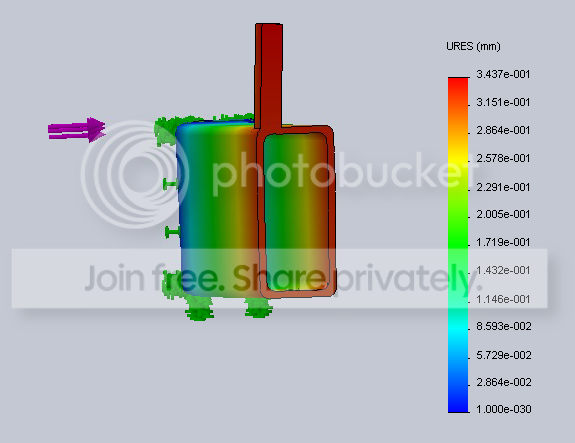
Maybe I can run a simulation in solidworks, I'll see about that also

Think about it though, I think that twisting the frame would bend it somewhat also though, you wouldn't be able to have it loaded purely torsionally.
 
Did it real quick, quite the difference

I supposed I could do more where you have two frame rails and cross members also

boxed.png


c-channel.png
 
If its only 20%...I'm surprised...after having my bare frame laying on supports and being able to lift and twist it in stock configuration, the boxing took away that twisting that I was able to do by hand....Going back in time even further, the Corvette frame in 63 was fully boxed to prevent the issues they had with C channel type frames and X members of the early Corvettes. If its only 20%, I think it was worthwhile, but I had mine completely bare when I did it too. I also have cage from front to rear, and the rigidness it gives the Blazer body is awesome...no creaking or popping while twisting up the suspension, which is the way a chassis, and suspension should be designed.

Our corvette frame seemed to twist pretty easy still even though it was boxed

It was a night and day difference after we caged it


I'm not really trying to tell people not to box their frames. I just thought it was interesting info.

It really depends on how much boxing a frame adds it seems, Seems like a full cage will end being around 300-400 pounds
 
Our corvette frame seemed to twist pretty easy still even though it was boxed

It was a night and day difference after we caged it


I'm not really trying to tell people not to box their frames. I just thought it was interesting info.

It really depends on how much boxing a frame adds it seems, Seems like a full cage will end being around 300-400 pounds


My cage stiffened everything up. If I didn't have a full on cage front to back I would have considered boxing.
 
A cage definitely stiffens things up. No doubt about that.

Boxing the frame isn't for everybody either. Its labor intensive for sure.
 
A cage definitely stiffens things up. No doubt about that.

Boxing the frame isn't for everybody either. Its labor intensive for sure.

Like I said before I have expirenced the difference in a boxed and non boxed frame on a truck. Only other mods were a 4" lift. The difference was a big one.

Kerts right but IMHO if your keeping a truck for a long time its best to start with a solid foundation. A boxed frame is a good start on a solid foundation
 
One of the bigger advantages to boxing the frame is keeping the lower lip from getting bent all to hell when you're bouncing it off the rocks. I've had it more than once where a crossmember was almost impossible to remove do to the lower lip being deformed and totally impossible to put back in once it was out.

Another one is the boxing forms a really nice big conduit to run your wiring through, or fuel lines of whatever. 100% protected.
 
I would think that doubleing a frame would be helpful in twist and load carring. what I mean is double frame like the big trucks one frame rail inside another. true alot more labor but it could be done. back in the early 90's I talk to a guy who had a pulling truck that he kept twisting he put one frome inside the other took all the twist out of it. since then I have aways wanted to do that but never enough time. I think the person told me he put a 1/2 or 3/4 ton frame inside a 1 ton.
 
I would think that doubleing a frame would be helpful in twist and load carring. what I mean is double frame like the big trucks one frame rail inside another. true alot more labor but it could be done. back in the early 90's I talk to a guy who had a pulling truck that he kept twisting he put one frome inside the other took all the twist out of it. since then I have aways wanted to do that but never enough time. I think the person told me he put a 1/2 or 3/4 ton frame inside a 1 ton.

You could fit the 1/2 or 3/4 inside the 1 ton in some places but not all.

Best way to do it and of course, most labor intensive is to box it, burn it in real good and any bolt for crossmembers or what have you that needs to attach to the NEW inside surface, drill all the way through and tube it.
 
Hate to come in on the backside of this thread, but I am currently working on my own k5 build and am currently trying to adress some of the same frame flex issues. I have an engineering background, and looking at the frame, I think a lot of the problem is poorly designed factory crossmembers, especially in the rear. Before I attempt to do the frame boxing job on mine, I am going to just weld in tubular crossmembers and see if that corrects some of the issue. I am trying to build a driver that will see some occasional offroad use, so I would want to avoid adding a roll cage if at all possible.
 
Hate to come in on the backside of this thread, but I am currently working on my own k5 build and am currently trying to adress some of the same frame flex issues. I have an engineering background, and looking at the frame, I think a lot of the problem is poorly designed factory crossmembers, especially in the rear. Before I attempt to do the frame boxing job on mine, I am going to just weld in tubular crossmembers and see if that corrects some of the issue. I am trying to build a driver that will see some occasional offroad use, so I would want to avoid adding a roll cage if at all possible.


Making small changes will insure that you also achieve only small improvements...

But if you decide to commit to increasing frame rigidity, it's a very slippery slope.


-G
 
Top Bottom