CK5
Register an account today to become a member! Once signed in, you'll be able to participate on this site by adding your own topics and posts, as well as connect with other members.

Buddies buildin a 383

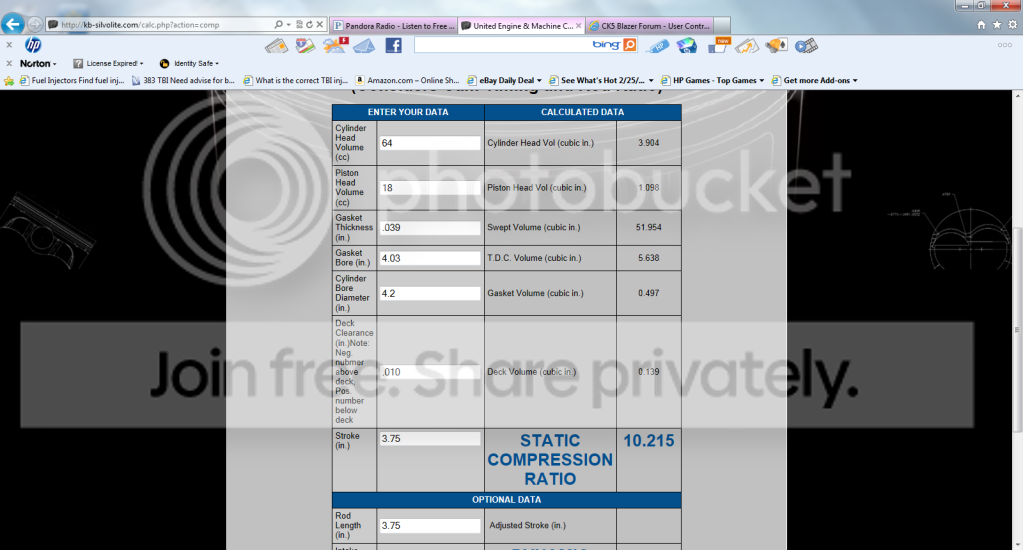
Per Daves calculator.

Im having trouble figuring:

-Deck Clearance

-Gasket thickness and bore for sealed power fel-pro kit 260-1269

-And the last part for the intake closing point

Also for the cylinder head volume do I just put 64 in???

I cant seem to find specs on the gaskets.

-Piston head volume is: 18

-Cylinder bore: 4.2

-Stroke and rod length: 3.75
 
Idk if this is right, but it should be in the ballpark I think.......:doah:

Didnt take the heads back off to measure the deck thing, but dave said its normally between 5-15 thou so I put 10 in. So between 10.1-10.3 ish.

COMPRESSION.png
 
Idk if this is right, but it should be in the ballpark I think.......:doah:

Didnt take the heads back off to measure the deck thing, but dave said its normally between 5-15 thou so I put 10 in. So between 10.1-10.3 ish.

COMPRESSION.png

Your cylinder bore is 4.030 if it's bored .30 over. Not sure about your gasket bore, they could be up to 4.125 - you can use 4.030 though, as this will give you the higher (safer) reading.

Also, my machinist said that most combustion chambers are just a bit larger than advertised. Mine were actually 65cc rather than 64 - brand new out of the box. Again, using the smaller volume will give you the safer reading. Looks like it's going to need premium fuel...
 
Using your same numbers except changing the bore to 4.030 in Summit's calculator gives 9.5:1.
 
Where did you get 18 cc for the pistons? Didn't he have flat tops? Flat tops usally vary from 3 to 7 cc dish for hte valve reliefs, probably 7 with those. If I remember correctly KB uses a positive number for a dish (never made any sense to me). So that means you are saying you have 18 cc dish pistons. You need to look up your pistons and change the number accordingly.

Also, I thought the 305 heads were more like 58 cc, are you sure they are 64? 64 is more common with a performance head or an aftermarket head I thought. 76 is really common as well, but not with 305 heads I don't believe.

If I put it all in my calculator exactly as you have it (except for the 4.2 thing), then I get 9.43, however, if I put in the 7 cc dish for the pistons, then I get 10.56:1, if I put in 58 cc heads I then get 11.32:1.

If you tell me your cam specs and rod length(assuming 5.700", unless you used 6", or the stock 400 rods?), (and double check your head cc) then we can get the dynamic compression.
 
Last edited:
Umm im pretty sure it said 18cc on summits site, ill have to check. I dont know all of his other specs. Btw he broke it in last night, i left after we put the motor in and hooked the th400 up as i came down with a bad head cold. He told me it sounded great so we will have to see. Should be able to tell if more octane is needed by how it runs right?
 
Umm im pretty sure it said 18cc on summits site, ill have to check. I dont know all of his other specs. Btw he broke it in last night, i left after we put the motor in and hooked the th400 up as i came down with a bad head cold. He told me it sounded great so we will have to see. Should be able to tell if more octane is needed by how it runs right?

Well, it could be 18cc, and that's good for him, but those definitely wouldn't be flat tops, I would double check that and the comb chamber volume. You will hear severe detonation yes, if you know what you are trying to hear. If he has open headers still then it may be difficult to hear.
 
Umm im pretty sure it said 18cc on summits site, ill have to check. I dont know all of his other specs. Btw he broke it in last night, i left after we put the motor in and hooked the th400 up as i came down with a bad head cold. He told me it sounded great so we will have to see. Should be able to tell if more octane is needed by how it runs right?
Eagles website has everything you need. They also have a compression ratio calculator.

You indicated Kieth blacks and I believe those are -18cc dished which gives you a compression ratio of 9.22:1. Assuming your buddy didn't get flat tops.
Piston top to deck height is .025 typically on a 383.

TBI heads are poop and a 305 heads on a 383 that wants to breath is even worse. Seems crazy to many of us that he would spend all that money to build a 383 and then stick really crapy heads on it. Sure it will run but your leaving a lot of power behind.
 
Deck clearance is the difference between the centerline of the crank to the top of the block and your entire rotating assembly length. If the block hasn't been machined your deck surface should be 9.025. Add together half of your stroke, rod length, and piston compression height and subtract it from 9.025. You can also pull a head and measure from the top of a piston to the deck surface when the piston is at the top of its stroke.
 
Adam, it's not just that the engine may run poorly, to high of compression with the wrong gas can destroy the engine in short order depending on the magnitude.


That's pretty high Dave, are you still running race fuel in that? (I know i could smell it at the build and greet) Have you considered switching it over to E85?

Which models are you referring too? I haven't looked at the others in quite a while, however, the one that recommends to add 15 deg to the intake closing is probably assuming you are going to use the number at .050" lift. So adding 15 deg will get it closer to the actual point where the valve is closed and it starts making compression. I think it's better to use the advertised closing number, which takes a little math if it only lists the closing points at .050". Yes, it's true that the advertised number will vary by manufacturer, I've seen that number listed at .004", .006", .015" lift, etc. However, simply adding 15 degrees is worse because cam profiles vary significantly depending on lifter style and cam applicaton.

Also, in reality its more complicated than that, because the air can start to compress at some lift number before zero lift depending on the piston speed and volume change relative to the pressure, valve size, etc.

With that said, this is just another way to guesstimate the limits of pump gas when you are selecting components, and is not an exact number anyway because of all the other variables such as ignition timing, combustion chamber shape, head material, sharp edges, temperature, RPM, etc. I believe the advertised duration number for intake closing is the most effective way to easily do that. It will get you to a much closer place in the piston stroke where you actually start compressing the gas, especially since you include the rod length in the calculation.

entered some new numbers...My calc model says 8.8 dynamic and 10.9 static, that uses @ .050 + .015 for the intake closing of 63

your model it shows 8.9/11.6.
I used the advertised duration int closing number of 69ABDC but that is @ .018 lift.

Both used a gasket of 4.125 bore and .039 compressed thickness.
5cc piston volume (4 relief flat top TRW)
deck height has been cut .010 for 9.015.

Summits easy/quick calc turns out to be 10.3....it asks for no cam data.
 
Last edited:
entered some new numbers...My calc model says 8.8 dynamic and 10.9 static, that uses @ .050 + .015 for the intake closing of 63

your model it shows 8.9/11.6.
I used the advertised duration int closing number of 69ABDC but that is @ .018 lift.

Both used a gasket of 4.125 bore and .039 compressed thickness.
5cc piston volume (4 relief flat top TRW)
deck height has been cut .010 for 9.015.

Something doesn't make sense there, the static compression should be pretty much exactly the same with either calculator, are you sure you used the correct number for the piston volume (mine uses negative for a dish, KB is backwards:D)

I have never gotten a different answer when inputting the same numbers into more than one calculator, once I checked mine to confirm my math was correct I haven't gone back to the online one in years.

Summit didn't have one when I made mine, but if it doesn't ask for cam data it can't calculate dynamic compression, only static (unless it asks for a cam part number?), I've never used that one.
 
yeah, 3 of them all over the place...

basic data:

bore 4.030
stroke 3.48
block decked .010
gasket compressed .039/4.166 bore
pistons flat top 4 v.r. (6.1cc)
Heads stock 64cc after .010 cut and bowl work
stock 5.7 rods
piston is .006 in the hole
6800 redline
1.6 rockers

cam:
http://crane.carshopinc.com/product_info.php/products_id/15904/113841

First, I thought that was a 327?

Next, with your numbers in my calculator I get 10.09 static, 7.79 dynamic (using 69 degrees advertised closing point)

With the KB page I get 10.09 static/8.17 dynamic. (using 63 degrees, which is closing point at .050" lift plus 15 degrees)

So if I go back to mine and put in 63 degrees closing point I get 8.17 dynamic. So everything matches up between the two.

So this goes back to my previous discussion, at what valve closing point does the piston actually make compression? It's not a fixed point, it depends on piston speed and leakdown rate how much the pressure will actually start to rise. If you notice, the difference between that 6 degrees of rotation is 0.38:1 dynamic compression difference.

There is 21 degrees of difference betwen the valve at .050" and the valve at .018". Assuming linear closing (its not linear, I am just making it simple for that .032" of valve travel to avoid looking up calculus I haven't done in years) that means its ~ .0015"/degree for that short peroid. Which means 6 degrees before that is .009", or the valve is open ~.027". I think if you open the valve .027", leakdown will be horrible, so in my opinion, the advertised duration is a better number to use.

Of course its more complicated than that depending on piston speed and and valve efficiency at the closing point. So I guess my point it, for what we have to work with, and all the other variables, I use the advertised duration and call it better then most.

Also, your engine may be fine with premium, depending on your timing, load, gear, temp, RPM, etc. My 489 has 8.2:1 dynamic and it runs fine on premium, although it does have aluminum heads.

Also, FYI, the Summit calculator says 10.14, becuase it assumes your gasket bore is the same as your cylinder bore (which is not usually the case). If you trick it and put in a gasket thickness that creates the same gasket volume as a larger diameter with the correct thickness, then the summit calculator matches as well. That just shows if you leave out info you get less accurate results.
 
Ugh my head hurts. I cant comprehend anything as i have a nice heqd cold. Stopped by after work. Thing runs fine, had it running around 10btdc with no knocking pinging or any of the sort on regular 87.

You guys are nutz lol:whistle:
 
First, I thought that was a 327?

It is.....at least thats what the block says:pimp:

Next, with your numbers in my calculator I get 10.09 static, 7.79 dynamic (using 69 degrees advertised closing point)

With the KB page I get 10.09 static/8.17 dynamic. (using 63 degrees, which is closing point at .050" lift plus 15 degrees)

So if I go back to mine and put in 63 degrees closing point I get 8.17 dynamic. So everything matches up between the two.

So this goes back to my previous discussion, at what valve closing point does the piston actually make compression? It's not a fixed point, it depends on piston speed and leakdown rate how much the pressure will actually start to rise. If you notice, the difference between that 6 degrees of rotation is 0.38:1 dynamic compression difference.

There is 21 degrees of difference betwen the valve at .050" and the valve at .018". Assuming linear closing (its not linear, I am just making it simple for that .032" of valve travel to avoid looking up calculus I haven't done in years) that means its ~ .0015"/degree for that short peroid. Which means 6 degrees before that is .009", or the valve is open ~.027". I think if you open the valve .027", leakdown will be horrible, so in my opinion, the advertised duration is a better number to use.

Of course its more complicated than that depending on piston speed and and valve efficiency at the closing point. So I guess my point it, for what we have to work with, and all the other variables, I use the advertised duration and call it better then most.

Also, your engine may be fine with premium, depending on your timing, load, gear, temp, RPM, etc. My 489 has 8.2:1 dynamic and it runs fine on premium, although it does have aluminum heads.

Also, FYI, the Summit calculator says 10.14, becuase it assumes your gasket bore is the same as your cylinder bore (which is not usually the case). If you trick it and put in a gasket thickness that creates the same gasket volume as a larger diameter with the correct thickness, then the summit calculator matches as well. That just shows if you leave out info you get less accurate results.

OK, sounds good, because I was thinking it was 10.2/10.3 while picking all these parts...the cam numbers sure can vary though huh? I run it mostly on 93-94, occassionally I'll throw race in it just cuz it smells good and when I race.

I should try my BB in the Maiden and see what I get with that.
 
Maiden specs:

bore 4.281
stroke 4.00
block decked to 9.780
gasket compressed .039/4.37 bore
pistons SRP 23cc dome
Heads stock 119cc after .010 cut and bowl work
stock 6.135 rods
piston is .005 in the hole
5500 redline
1.72 rockers

cam:
http://www.compcams.com/Company/CC/cam-specs/print-specs.aspx?csid=468

So how do you figure the @ .015 lift figures to use in the calculator?
 
Ugh my head hurts. I cant comprehend anything as i have a nice heqd cold. Stopped by after work. Thing runs fine, had it running around 10btdc with no knocking pinging or any of the sort on regular 87.

You guys are nutz lol:whistle:

Was that just revving it up in park, or was the thing warmed up with a load behind it?

Heat is a big factor with detonation, one of the big advantages of aluminum heads.
 
Top Bottom