CK5
Register an account today to become a member! Once signed in, you'll be able to participate on this site by adding your own topics and posts, as well as connect with other members.

How much front driveshaft slip?

I'm impressed that a thread about drive shaft slip has made it 12 pages. So I will take it to page 13 :D
 
But if your driveshaft slips, doesn't that mean that you aren't going anywhere fast?
No bueno...
 
Ok, so going back to the numbers I posted since no one wanted to do the math.

43.5" extended length
39" ride height
37.5" compressed length

I want 1" of buffer at full compression and 2" of spline engaged at full droop.

39-37.5 = 1.5"
1.5+1 = 2.5"

This means closest the end of the spline can be to the end of the slip yoke is 2.5" at ride height.

Now, 43.5-39=4.5"

This means my shaft pulls out 4.5" from ride height at full droop. If I wanted the shaft to separate at 4.5" of pullout then I would add 4.5 to 2.5 and get 7". This would be the internal length of the slip yoke needed.

But, I already said I wanted 2" of spline engaged at full droop so I need to add 2" to that previous number which gives me 9" of internal length in my required slip yoke.

I could not find a 9" slip yoke in a "factory" configuration so I ordered a custom shaft from HAD. Total cost was just under $500 shipped (no tax) for a 2.25 od .120 wall tube with a 12" spline (internal style slip) and 1410 single joints at both ends.

Now I have 4" of possible compression and 8" travel to pullout. Problem solved.

My numbers leave room for error and unpredictable trail conditions. If you didn't want to play it as safe and only left 1" of spline engaged and .5" of buffer you shave 1.5" off that 9" and get 7.5" of slip yoke needed.

I believe this last scenario uses the parts 4wheelingfury posted up based on the specs of parts he linked
 
I posted my numbers earlier, but I was about 3" between ride height and hanging the suspension. The rest was guesswork, but I was nervous that I could get everything perfect enough that 4.5" of usable slip could cover the range. With the long travel shaft I'm covered for articulation, axle wrap, imperfect measurements when setting the base length, and I don't need to buy a new shaft if I decide to lower my lift a bit in the future. The upper was not significant compared to what I've dumped into this truck.
 
With the long travel shaft I'm covered for articulation, axle wrap, imperfect measurements when setting the base length, and I don't need to buy a new shaft if I decide to lower my lift a bit in the future.

This is another very important point. If you have a custom driveshaft made with thin margins and then change anything with your axle location or suspension configuration then you have to get it reworked if you even can rework it at all.

I have learned to just spend the extra money up front once and not be nickel and dimed to death later. It will almost always come out cheaper in the long run.
 
This is another very important point. If you have a custom driveshaft made with thin margins and then change anything with your axle location or suspension configuration then you have to get it reworked if you even can rework it at all.

I have learned to just spend the extra money up front once and not be nickel and dimed to death later. It will almost always come out cheaper in the long run.
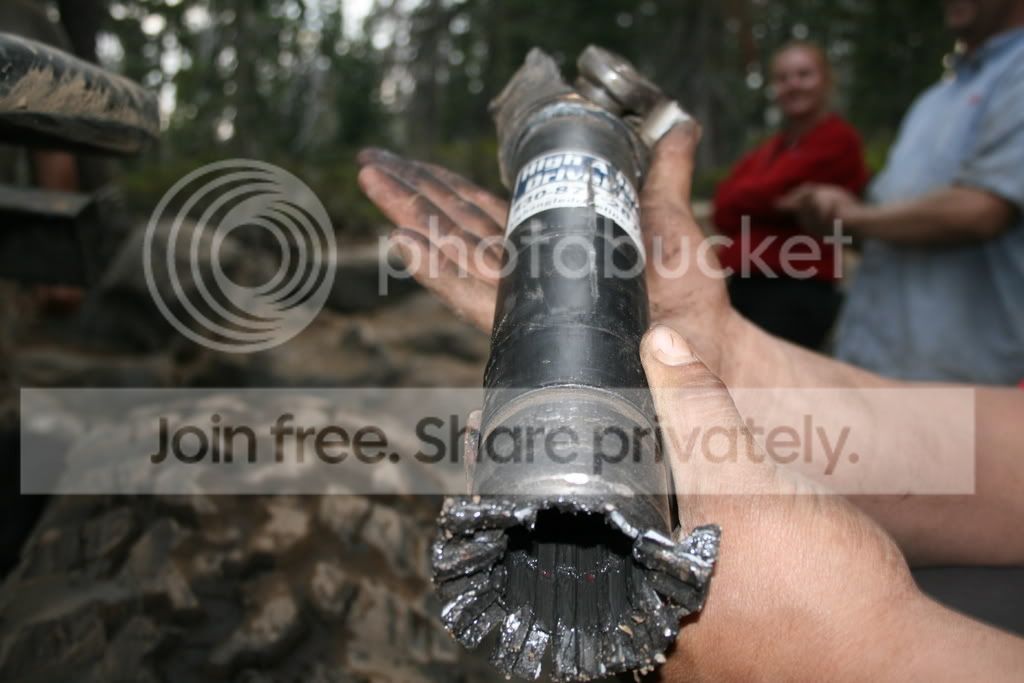
This. The brother of "there's always enough time to fix it the second time "
 
here is my concern and not something I want to deal with hours into a trail somewhere.

Fordyce7-4-8308.jpg


And I've already decided not to run a CV so the money I saved will be spent on a proper slip.
 
That guy must have not had that driveshaft set up right or something really really bad happened with his suspension. That is the internal style slip so he should be running a long travel spline shaft. If you don't take the measurements and do the actual math, you can still set up the long travel shafts wrong or if you do something like add a doubler after the shaft has been made obviously you are going to have to retube.

@skunked Are you sure it wasn't an impact scenario and he bottomed it out because he didn't leave enough room for bump?
 
it clearly was not setup with enough slip, that's my point :D

Yeah, it's still destroyed either way. I think the most common failure caused by minimal spline engagement is twisting of the splines. That mushrooming looks more like he bottomed out which is obviously equally as bad if not worse. Best case scenario if you don't have enough slip is you separate the shaft and have to pop it back in. Even then, it's not going to separate on nice even level ground. It's likely going to be in the most precarious pain in the butt place imaginable to put that shaft back together. Otherwise, it wouldn't have separated right? Worst case scenario you completely ruin your driveshaft, have to buy a whole new one, and in the meantime are stuck on the trail with 2wd. If you toast an axle u joint or axle shaft you at least still have 3 wheels turning. When you lose a driveshaft, you've lost that whole axle!

The stakes are high and the consequences expensive if you don't do this right. All it takes is that one damn time and then you'll learn the hard way.
 
Last edited:
I'm planning on building a spare like that.

Good idea, do you have the same size joints all the way around? If so you only need one complete setup if measurements are close enough.

If you had the same size joints at both pinion yokes or both t-case outputs but not all four matching then you could carry two inners or outers with different joints and one common tube inner or outer
 
Good idea, do you have the same size joints all the way around? If so you only need one complete setup if measurements are close enough.

If you had the same size joints at both pinion yokes or both t-case outputs but not all four matching then you could carry two inners or outers with different joints and one common tube inner or outer

That would be ideal and I would go that route if I was buying a new rear shaft.

Rear is setup for a CV with a fresh 1350 driveline currently. I'm adding 11" of drivetrain so that may need to change although I'm hoping the 1350 CV can handle it.

Front will be a non-cv 1410, possibly with super joints.
 
That would be ideal and I would go that route if I was buying a new rear shaft.

Rear is setup for a CV with a fresh 1350 driveline currently. I'm adding 11" of drivetrain so that may need to change although I'm hoping the 1350 CV can handle it.

Front will be a non-cv 1410, possibly with super joints.

Sounds like you are in the same boat as me. I have a barely used 1350 CV rear and 1410 singles up front so I would need two completely different spare shafts. I decided to keep the rear pinion 1350 because that's what it already had and the used shaft was set up for that also. The front had a 1310 yoke so I decided to upgrade to 1410 there for strength and angle tolerance. Didn't want to go 1350 CV at the front output because it's too bulky for my exhaust clearances, more expensive, and I don't have the right geometry for it to be effective (pinion isn't pointed at t-case output for caster reasons).

By the way, you only use one superflex joint per shaft not two and its usually at the t case output.
 
Top Bottom