CK5
Register an account today to become a member! Once signed in, you'll be able to participate on this site by adding your own topics and posts, as well as connect with other members.

Hydroboost or vacuum brakes

That might be a possibility--If I remember right,on this truck I never could get the brake warning light to shut off even after bleeding it and having excellent brakes,and full flow to the rear wheel cylinders..to pass inspection, you must have the light working,when they turn on the key without starting the engine..so I unplugged the wire on the PV to keep it from staying on once they started it up..still works when you apply the e-brake too..

They "test" your brake lines here by stomping on the brake pedal hard enough to pop new ones too,maybe that messed something up in the hydroboost,but it didn't start feeling like it lost some of the power assist until a few months ago--inspection time was in June..
I'm wondering if the leaking pitman shaft seal might be reducing the pressure to the hydroboost unit..but that didn't start leaking until a few weeks ago too..(and so far its not a "gusher",just drippage)..
I did the ORD 3" lift to my m1009.
Part of the lift was longer front brake lines and a longer rear line.
That rear line was very difficult to purge the air out of.
Vacuum bleeding, pressure bleeding.
It just would not go.
Then i discovered my tripped prop valve.
Took 2 tries to reset the prop valve and get air bled out.
There is a button under a rubber nub on the left side of the valve to reset the front brake failure.. but the rear has nothing.
The most common cure is to stomp on the pedal hard and hope to reset the prop valve.
In my case, no love.
So removal of prop valve and manual reset was neccesary.
You can reach through the hole under the warning switch with a pick tool and reset it too, but i found it near impossible with my big diesel radiator in the way.
 
But I'm not sure why I'm getting the soft pedal..
If you run your truck, shut it off.
Wait 10 sec.
Push pedal.. any boost left?
Also, engine off, no boost left.
Steo on pedal hard, start engine.
Any diff?

Maybe a bad booster or the vac to booster is leaking.
Take some startinh fluid, wd40, brakekleen whatevs.
Spray it around vac connections to find leak while engine running.
Dont burn your rig down.
Change in idle indicates leak.

Big cam?
What is you vac at idle?
Should be 18-21 and steady.
 
If you run your truck, shut it off.
Wait 10 sec.
Push pedal.. any boost left?
Also, engine off, no boost left.
Steo on pedal hard, start engine.
Any diff?

Maybe a bad booster or the vac to booster is leaking.
Take some startinh fluid, wd40, brakekleen whatevs.
Spray it around vac connections to find leak while engine running.
Dont burn your rig down.
Change in idle indicates leak.

Big cam?
What is you vac at idle?
Should be 18-21 and steady.

I will try all that and see what happens.
It's a stock 350 with very low miles.
 
If the pedal slowly moves toward the floor when your at a stop that is a good indicator that the MS is bad. I'm obviously assuming your brakes are properly bled and your system is not leaking.

No I get a solid pedal at stop but just get a random soft pedal that goes to the floor (I can still stop, it's just scary).
Brand new pads and my dad helped me with the bleeding, did each wheel twice to make sure it was good.
 
No I get a solid pedal at stop but just get a random soft pedal that goes to the floor (I can still stop, it's just scary).
Brand new pads and my dad helped me with the bleeding, did each wheel twice to make sure it was good.

sounds like a bad MS or air in the lines still.
 
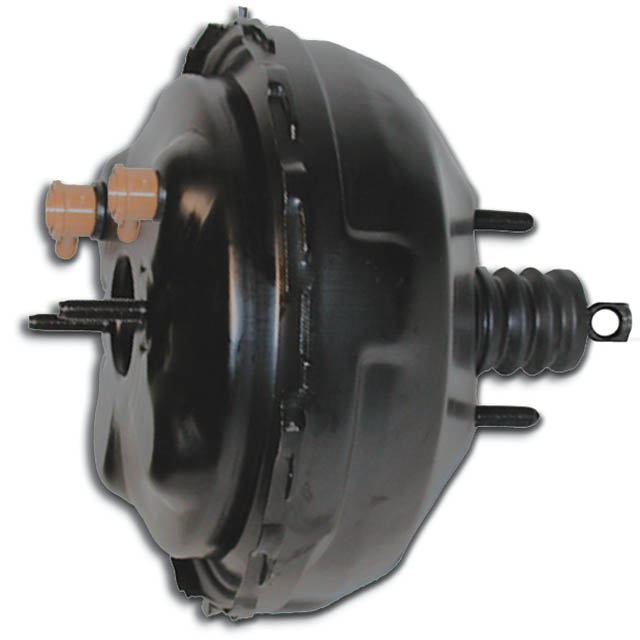
One other thing to consider. When arguing about vacuum vs hydro, everybody here is comparing stock units. While that makes sense for ease of installation, if you have the room under the hood, you can put a vacuum booster there that would over power any stock hydro setup.
As an example, which I AM NOT recommending, consider my old 1966 F650 Boom truck. Given its age, it has single circuit brakes. Which means if you break a line or a wheel cylinder blows out, you loose all your brakes.
Scary, but normal for that age.
When I got the truck, I filled and bled the brakes, and got them working fairly good. Had to stand on it a little, but it stopped fine. Would not idle worth a darn. After replacing the carb, still bad idle.
Couple of days later, I'm under the truck, and I spot something I have no idea what is.
Large round object, with a snout on it, mounted on the frame. What the heck? Brake lines go into it.
I suddenly realized that I was looking at a remote vacuum booster. With the vacuum line rotted off.
Replaced the vacuum line, idle cleared right up with that massive vacuum leak gone, and suddenly I could lock up all 6 wheels on this heavy truck on dry pavement if I wanted to.

So, you want good vacuum brakes with the added safety feature of a couple of boosted stops after the engine quits? Find either an aftermarket booster that will fit your truck, or a dual cylinder remote booster.
There are lots of companies out there that specialize in this stuff. If diameter of the booster is critical, they sell dual diaphragm boosters. Smaller diameter, much more power.
I went looking for some examples, cannot find a dual circuit remote booster. I'm pretty sure they make such a thing, but no luck right now. I suppose you could mount two of the units, but that would get expensive fast.
In the meantime, here are a couple of links for your reading pleasure.
This first one, is a link to the FAQs page. I strongly suggest reading them. They will explain something I have mentioned a few times here concerning brake problems when adding disks and not having the pedal right. After the FAQs, go to their universal products page and check around, or just order one of their catalogs. For instance they show an 8 inch dual diaphragm booster that should fit most trucks, and should almost double your braking power.
https://info.mpbrakes.com/faqs

Then there is this outfit. This is a link to their products page. Both these companies could use some serious webpage help, this one worst than the other. Because of this, this page is almost worthless, but not quite.
Try clicking on the 11 inch booster link. Scroll down until you see the
pb11504rv.jpg


GMC Motor Homes 1973-78 11" Delco -
P/N: PB11504RV

This is what they say about it: GMC Motor Homes 1973-78 11" Delco Style Dual Diaphragm Power Brake Booster Double Check Valve & Enhanced Reaction Disc
I suspect if you could shoehorn one of these under your hood, you could stop 60 inch tires if you could get them on your truck.
http://www.midwestbooster.com/products.html#3D
The advantage of the page, is you can see what years and model vehicles used which boosters and other parts.
 
No I get a solid pedal at stop but just get a random soft pedal that goes to the floor (I can still stop, it's just scary).
Brand new pads and my dad helped me with the bleeding, did each wheel twice to make sure it was good.
Yeah, that random soft pedal is about as clear an indicator as can be for a failing master cylinder.
I would do the other tests too.
But mc's are cheap.
Even if it was recently replaced, doesn't mean it's good.
I have known guys have 3 bad mc's right out of the box.
They are all made in china now.
 
Something else to consider. When my 99 Burb lost its tensioner pulley and I was 26 miles from any help, Eric and I drove it the 26 miles, it was all freeway and still a bit chilly. Burb ran fine no issues, had no power steering, had no belt. Also had no brakes because it is hydro boost. Kind of sucked having to try and slow down when you are doing 85-90 and the semi in front of you is going a lot slower.

I personally hate them would never convert a vac to a hydro. Would never change a hydro to a vac either.
Twinkie has vac. they work great no issues.
 
I agree about the MC. Random soft is usually the MC, not much chance of air getting into and back out of a system.
I did want to note, that I have no relationship with either of the companies I linked to, nor have I done business with either, so cannot recommend them from experience.
 
So it sounds like vacuum can work just as well if not better then hydroboost. It sounds like I have some work to do.

Would it be good to add an adjustable prop valve or no? In one of the earlier post, someone commented on @diesel4me's post and said a reason why his sister failed and couldn't stop was because of the added prop valve.
 
Found it. After reading his, I feel like I shouldn't add an adjustable prop valve.

View attachment 265575
I meant OR THE OTHER.
You will always have both, or front only, or rear only.
The prop valve cannot cut off fluid to both systems.
Sorry for the typo.

The stock prop valve works fine for disc/drum as designed.
It actually does a few things for you.
It safeguards the system.
Provides a warning of failure.
Initiates the rear brakes early to allow equal braking action between the two different brake types.
I would'nt worry about it if it is working correctly.
It will light up the dash light if it isn't.
You will still have one system or the other.
 
The stock prop valve works fine for disc/drum as designed.
It actually does a few things for you.
It safeguards the system.
Provides a warning of failure.
Initiates the rear brakes early to allow equal braking action between the two different brake types.
I would'nt worry about it if it is working correctly.
It will light up the dash light if it isn't.
You will still have one system or the other.

I swapped out the stock one that's mounted on the front crossmember under the engine to a disk/disk one. Also my light isn't wired up, I found out the stock one wasn't wired up either cause when I went to change it he cord was cut.
 
I swapped out the stock one that's mounted on the front crossmember under the engine to a disk/disk one. Also my light isn't wired up, I found out the stock one wasn't wired up either cause when I went to change it he cord was cut.

I always get nervous when a previous owner starts disabling things like BRAKE FAILURE WARNING INDICATORS.
But i still don't see how that is causing your random pedal issue.
However, i recommend you go ahead and fix the wire.
Get that warning light working.

Even hook up a test light from power to the switch on the prop valve.
Have someone stomp the pedal.
If the valve activates, it will ground out the switch and illuminate the test light telling you there is an issue with one system.
 
I always get nervous when a previous owner starts disabling things like BRAKE FAILURE WARNING INDICATORS.
But i still don't see how that is causing your random pedal issue.
However, i recommend you go ahead and fix the wire.
Get that warning light working.

Even hook up a test light from power to the switch on the prop valve.
Have someone stomp the pedal.
If the valve activates, it will ground out the switch and illuminate the test light telling you there is an issue with one system.

Yeah I got myself into a little mess when I bought the truck but I knew it was going to be a project. I'm making it solid. Rewiring is on the list lol.
I will fix the brake warning light.
 
One other thing to consider. When arguing about vacuum vs hydro, everybody here is comparing stock units. While that makes sense for ease of installation, if you have the room under the hood, you can put a vacuum booster there that would over power any stock hydro setup.
As an example, which I AM NOT recommending, consider my old 1966 F650 Boom truck. Given its age, it has single circuit brakes. Which means if you break a line or a wheel cylinder blows out, you loose all your brakes.
Scary, but normal for that age.
When I got the truck, I filled and bled the brakes, and got them working fairly good. Had to stand on it a little, but it stopped fine. Would not idle worth a darn. After replacing the carb, still bad idle.
Couple of days later, I'm under the truck, and I spot something I have no idea what is.
Large round object, with a snout on it, mounted on the frame. What the heck? Brake lines go into it.
I suddenly realized that I was looking at a remote vacuum booster. With the vacuum line rotted off.
Replaced the vacuum line, idle cleared right up with that massive vacuum leak gone, and suddenly I could lock up all 6 wheels on this heavy truck on dry pavement if I wanted to.

So, you want good vacuum brakes with the added safety feature of a couple of boosted stops after the engine quits? Find either an aftermarket booster that will fit your truck, or a dual cylinder remote booster.
There are lots of companies out there that specialize in this stuff. If diameter of the booster is critical, they sell dual diaphragm boosters. Smaller diameter, much more power.
I went looking for some examples, cannot find a dual circuit remote booster. I'm pretty sure they make such a thing, but no luck right now. I suppose you could mount two of the units, but that would get expensive fast.
In the meantime, here are a couple of links for your reading pleasure.
This first one, is a link to the FAQs page. I strongly suggest reading them. They will explain something I have mentioned a few times here concerning brake problems when adding disks and not having the pedal right. After the FAQs, go to their universal products page and check around, or just order one of their catalogs. For instance they show an 8 inch dual diaphragm booster that should fit most trucks, and should almost double your braking power.
https://info.mpbrakes.com/faqs

Then there is this outfit. This is a link to their products page. Both these companies could use some serious webpage help, this one worst than the other. Because of this, this page is almost worthless, but not quite.
Try clicking on the 11 inch booster link. Scroll down until you see the
pb11504rv.jpg


GMC Motor Homes 1973-78 11" Delco -
P/N: PB11504RV

This is what they say about it: GMC Motor Homes 1973-78 11" Delco Style Dual Diaphragm Power Brake Booster Double Check Valve & Enhanced Reaction Disc
I suspect if you could shoehorn one of these under your hood, you could stop 60 inch tires if you could get them on your truck.
http://www.midwestbooster.com/products.html#3D
The advantage of the page, is you can see what years and model vehicles used which boosters and other parts.


I will read the info you provided. Thank you for you're input.
 
I thought about it some more.
The proportioning valve can absolutely have an effect on brake pedal height.

Lets say you hit the brakes, the rear brake line burts.
The piston in the prop valve slides over and closes off the rear brake system and simylteneously grounds out the brake warning light switch.
You notice the pedal drop a bit as the warning light comes on.
The next time you hit the brakes, because the prop valve has sealed the failed rear brake system, the pedal height is maintained.
Without the action of the prop valve during a failure, the pedal would collapse the rear piston in the mc into the forward piston and your brake pedal would be on the floor.

Lets assume a front brake line blows suddenly.
The prop valve slides over and isolates the front brakes.
Now when you step on the brakes the rear piston in the mc activates the rear brakes and the front piston does not collapse because the proo valve sealed off the failure.

So, your brake pedal height issue could possibly be related to a failure in the rear or front brake system such as air in one of the lines.
The random pedal could be a function of the prop valve doing it's best to isolate the failure each time the pedal is pressed.

Just a thought.
 
fix the spongey brake issue, drive it and see if you need the prop valve after your brakes are working properly. If so it's easily added on the rear line with a couple flares.

No need to recreate the wheel.
 

Latest Posts

Top Bottom