CK5
Register an account today to become a member! Once signed in, you'll be able to participate on this site by adding your own topics and posts, as well as connect with other members.

I got my custom TPI conversion done-update- distributorless ignition

Thats awsome youre playing around with tuning your tpi, i'll bet you've done a lot of research on thirdgen.org. i wanted to do the same when i had my TPI engine, and still want to start playing around and learning to tune on my GenIII 6.0L.
Are you tuning the part throttle and no WOT tuning yet?
Can you explain how you go about tuning the VE table from the start, and how the acceleration enrichment comes into play?
I remember reading a page on thirdgen.org a few years back that had a wealth of information on how to go about tpi tuning..?
I remember reading some stuff like once you get it tuned with a conservative timing curve making sure there is no Knock, then when you avance the timing to get more power it has a leaning effect just like retarding the timing has a richening effect, then you have to go back through and re map your whole VE table again, because it effects that.. ?
 
Ryan,
I went to Thirdgen expecting a lot of help, but since my electronics are entirely different, all they were able to help me with was grinding/porting. I'm actually not even familiar enough with the TPI ECUs to tell you what tables they have in them. What I am doing applies the same to every engine in principle, assuming that all of the hardware is working and the basic settings are correct.

I don't know how to summarize the whole tuning process in a short post. There is a decent description on the MS website: http://www.megamanual.com/ms2/tune.htm

You have to calculate estimated tables for VE and spark based on engine equations or get some tables from somebody with a similar setup. Then once you get the fuel correct enough to start the engine, you idle it and start tweaking.

Now what you are saying about the process being iterative is true . However, with datalogging and the WBO2, it's easy to see what the Air/fuel ratio (AFR) was when it was knocking. If you were lean, add fuel there. If you were a little rich already (~13:1), then you have to pull timing back. It would be even easier with knock detection hooked up, but I haven't gotten that far yet.

Basically you start off very easy and slowly build the VE and spark tables towards higher load and higher rpm. You can estimate what the next portion should be based on what you already have running well, and this is what gets you close for WOT. There is an AFR target table, so the correction converges to those AFR values. Getting the spark right is actually a lot harder than fuel.

Of course I can't be *sure* until I get up there that the fuel pump and injectors will keep up. Lean is evil at WOT and high rpm. It's actually really hard to tune all load/speed conditions on public roads. I'm thinking I need to find a really long hill to climb. I basically have about 2/3 of the map dialed in. Everything above 4000 rpm is just calculated. Like I said before my throttle cable will only pull to about 80%, but at lower engine speeds this is really the same thing as 100%. It's at higher rpm that this makes a difference.

I will get some more pictures up later of the other goodies I'm working on to go with this.
 
I am no car computer wiz but I know the stock 1986 TPI system will not let me run a big cam??? Or can I with a computer reprogram??

Blue 85 congratulations with you’re success I have to admit you breathed some hope into my quest for "my cake and eating it too" option.

So without becoming one with my TPI system do you think I can get the chip reprogrammed to run a "lumpy" cam? If not just with the chip how far do you think I might have to go??

Quick.
 
TPI won't be real happy with a "lumpy" cam anyways. Assuming your "lumpy" cam makes its power up high, its not matched well with TPI, which is all about low end power, and REALLY falters on a 350 over 4500RPM.
 
Good work, very impressive. I only have experience with Howell (top notch,imo) and stripping down gm tbi harness's (pita).
You have helped me be more determined to make my own custom setup next personal F.I. conversion I do.
 
dyeager535 said:
TPI won't be real happy with a "lumpy" cam anyways. Assuming your "lumpy" cam makes its power up high, its not matched well with TPI, which is all about low end power, and REALLY falters on a 350 over 4500RPM.

What you have said is what I keep hearing and to be honest makes sense...But I met a local fire chicken running tpi with a very lumpy cam and 398hp ATW with N/A set up.???

So im going to ask him exactly what he did and I will let you know..but still does anyone know of a simple way to have my lumpy can and tpi? Oh and I plan to do some elevation 4X4ing in the 6-8000 range.
 
tpi (Without heavy modification) is not meant for high RPMs. It takes a lot of time, money, and energy to make TPI really good in the upper RPMs. Porting the stock intake can help, siamesing ports can help, but a full aftermarket intake is the best route to fix the problem.
 
I called my computer programmer and he said it’s easy to do (lumpy cam) with my stock computer he will program it no problem and I can use my stock sensors no problem.

To be honest I love the mega squirt idea but I just don’t have the time or knowledge. good job Blue 85 cant wait to see what’s next.


[FONT=&quot]

Quick[/FONT]
 
OK, I got tired of the 140 degree intake temps of my cone air filter behind the radiator and finally finished building an air intake. The cone on the throttle body was only supposed to be temporary anyway and it worked fine in the winter.

The new system is mostly stock TPI Firebird parts, including both rubber ducts and the air cleaner housing.

First I cut up a stock Firebird air cleaner. It is obviously too restrictive in stock form with that just over 2" intake hole.

PICT0094.JPG

Then I used some bondo to make a smooth entry into the cleaner.

PICT0096.JPG

This is the finished air cleaner housing. It has >3" tubing and fits directly on the stock air fitting in the radiator support.

PICT0099.JPG

The stock Firebird bracket mounts both the air cleaner housing and the charcoal cannister. I cut it up and made a support rod and a bracket to mount this bracket next to the battery tray on the passenger's side.

PICT0100.JPG

Here the filter housing is sitting on the bracket and connected to the radiator support opening:

PICT0101.JPG

And here is the complete air intake system. The piece between the two ducts is just steel 3" exhaust pipe. I run in speed density, so a MAF sensor is not used.

PICT0102.JPG

I mounted the IAT sensor just in front of where this system grabs air, so it is between the radiator support and the grill. My goal is to avoid measuring underhood air temps.
 
Last edited:
Looks good! I have the Firebird intake can on the TPI in my '75. I was pretty amazed at how hard the metal on that can is to cut! :shocked:

FYI, check to make sure that your filter is seating tightly at the top and bottom. I could reach in and spin my K&N with the lid installed. I fabbed up a plastic ring to fit in the bottom of the filter housing so that the filter would seal up right and not let air/dirt leak around the ends of the filter.
 
HarryH3 said:
I was pretty amazed at how hard the metal on that can is to cut! :shocked:

Angle grinder + cutoff wheel = easy :D

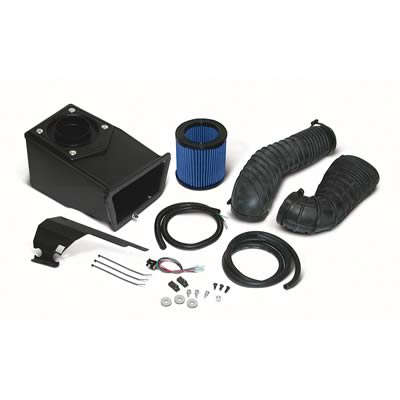
I'm actually pretty skeptical of the flow capacity of this firebird stuff. I mean, it was designed to support 225hp, maybe? It is about 3" throughout, but smaller in some places. But if you look at the "Cold Air Induction" package from SLP, it uses the exact same rubber ducts and filter of seemingly the same dimensions, yet it claims +20hp. Is the can the most restrictive part or is this for replacing some other system on older cars or something?

sle-21006_w.jpg


http://www.slponline.com/view_product.asp?P=21000
 
I did the cruise control months ago, but never posted up.

I am using my stock 1985 cruise control module by making the servo remotely mounted. I relocated it to the DS inner fender by building a little "cage" to hold the servo and mount the cable.

PICT0104.JPG

For a cable I went junkyarding to find one with the right connectors on each end and with the right length. It needs a little "pin" on the servo end and a long "slot" on the throttle end. What I have is from a GM front drive V6 - early to mid 90's I think. I saw several cars with this same setup. The cruise control and gas pedal cables are both molded into the same piece that snaps into the throttle body bracket. I cut that apart to separate them and just use one. It still snaps into the TPI bracket.

Throttle linkage.JPG

This let me re-use the existing cruise control harness just by re-routing it in the engine compartment (no cutting/splicing). I just had to make longer vacuum lines to it.

PICT0103.JPG

I verified that it works, but I haven't had any long highway trips since I installed it.
 
Last edited:
very very impressive stuff, im a TPI head myself, looking to build an accell super ram fed 302 cid sbc for my iroc. custom cam, ported vortec heads yadda yadda. im probly just gonna stick with the factory ECM and reprogram the flash prom with a laptop, but i was wondering with the degree of flexibility you had with your system, did you modify the wiring and program to turn your TPI into a sequential fire system or leave it as a batch fire setup?
 
I'm always a bit skeptical about power-gain claims, especially for intake tubing and such. I think there are a LOT of better ways to spend $300! :yikes:
 
im always wary of hp claims like that unless ive seen hp gains on a dyno, but the science of colder air making more power is solid, i dont remember exactly, but i seem to remember that for every degree F you drop the air temp, its worth another hp or something like that. so if you re-route the intake from over the radiator (probly the second or third hottest thing under the hood after the exhaust and engine block) to the fender where there isnt a heat source, it would definatly give you a cooler dencer air charge that would make more power.
 
But the Firebirds didn't take air over the radiator. The Corvette and the Camaro were setup that way. The Firebirds had the can shown in the pics above, with an air intake on the side. I don't think it was sealed to only bring in outside air, but it would take a really cold day to get an extra 20HP from the air temp alone.

It would be very interesting to see what the actual intake air temp difference is at the intake valve area. Since all of the plumbing and the airbox are still exposed to underhood heat, the real temp difference that the combustion chambers see may not be much. Some high tech thermal insulation may make a much bigger difference.
 
It would take a lot more than wiring mods to make it sequential. It would mean a new ECU, bigger injectors, a crank position sensor and new wiring.

I didn't modify any TPI wiring for this project. I built all of the harnesses from scratch. It is a batch fire system. It can fire the two banks alternately or simultaneously. There is a GPIO router board coming for Megasquirt that allows sequential injection. I'm not in a hurry to do this (I don't want to start a discussion on batch vs. sequential), but I am interested in the ability to do transmission control!

http://www.megamanual.com/gpio/
 

Latest Posts

Top Bottom