


I haven't been on the boards for a while because I have been busy  .
.
This post will seem long, but it's actually a very quick run-down of my project.
I started collecting parts months ago to run Tuned Port Injection with a DIY engine management system - Megasquirt. If you don't know what Megasquirt is, head on over to http://www.megasquirt.info/index.html. It's basically an open source project to build your own ECU. The schematics and source code are all readily available so you do everything yourself to run a K5, car, lawnmower, whatever. This was much more complicated than a standard TPI swap, but in the end it gives me the flexibility to do whatever I want in the future and it was actually low-cost.
I built the ECU to do fuel and spark, including idle speed control. The TPI hardware is from an 85 f-body that I got cheap off ebay. I plugged off the cold start injector stuff because it is lame. I built the harness from scratch using TXL wire and Delphi connectors/terminals/seals. I had the whole system including the ECU, harness, electrical center, intake, sensors, fuel tank, fuel pump, etc., running in the garage before I ever yanked the carb off.
I locked the stock HEI distributor down so that it doesn't have any advance at all. The ECU calculates timing and drives the coil directly, so there is no module in the distributor.


For fuel delivery, I used a 90 Blazer fuel tank, sending unit and fuel lines. However, the throttle body lines snake up the back of the engine and the TPI fuel rail connetors are on the front, so the last section of fuel line was replaced with SS braided teflon flex hose. The TPI lines were cut off and flared to make this work.


The fuel lines adapters at the front were very hard to get on and are not very pretty. Since then, I pickep up some fuel rail to AN-6 adapters from Earls, so I will eventually change this over.

A few weeks prior to doing the changeover, I installed this electrical center, to hold all of my under-hood fuses and relays. Before going MPFI, it handled only the electric fans and the A/C. I built a sealed 8-way connector into it so that I could simply plug the ECU harness into it when it was swapped in. Now it handles the fuel pump, the ECU, the O2 sensor, the injectors, the fuel pump and even the stereo. I thought it was messy before when I had 3 relays and 1 fuse mounted to the firewall. I can't imagine how messy it would be with the FI setup without an electrical center like this. I holds 7 relays and lots of mini and maxi-fuses. I think I got it out of a mid-90's Ranger, but I re-did all of the connections inside to suit this application. It's mounted near the passenger side fender, in front of the blower motor.


Here is the ECU and the mostly-finished harness. The harness feeds through the firewall via the hole originally used for the ESC harness. The ECU connector is a DB37 and there are connectors coming off for the 8 injectors, TPS, MAT, CTS, and the electrical center. The VR distributor pick-up coil is done through shielded twisted pair and the ignition coil drive is with coax.

To make tuning easier and allow fuel savings, I used a wideband oxygen sensor from Innovate motorsports - the LC-1. In case you don't know, a standard (narrowband) oxygen sensor is almost like a switch, indicating rich or lean, but not really by how much. A wideband sensor tells you the actual Air/Fuel ratio from <10:1 to >20:1, so you know what is actually going on. I also added an A-pillar triple gauge pod and there is an A/F gauge in there. I measured the response of the gauge on the bench and calibrated the second output of the oxygen sensor to match so that I can read true A/F ratio while I drive.

Here is the lower intake installed where the carb and cast iron used to be.

Here is the system mostly installed. I am using all of the stock accessories (non-serpentine), so I had to modify the alternator and A/C brackets to fit it all together. You can also see the WBO2 controller mounted on the evaporator box. I may fabricate a cold air intake system later, but the open filter was by far the easiest way to get things going.

I won't even go into all of the things I had to solve to get it running now. There are still a few bugs to work out, but I am driving it to work every day and it runs pretty good. When I get the higher load part of the fuel map done, I will adjust my new throttle cable so that I can get more than 80% throttle.
Here are some screen shots of the tuning software. Not only can you set it up to control anything via a laptop (assuming you know what parameters to set), there are even algorithms to automatically improve the tuning of the car while you drive. You can set these gauges to display ANY engine parameter that is measured or calculated. You can also log the data to analyze later what was going on. You can do that with OBDII or OBDIII cars with Autotap, but that costs more than this whole ECU and this software is free (plus open-source).
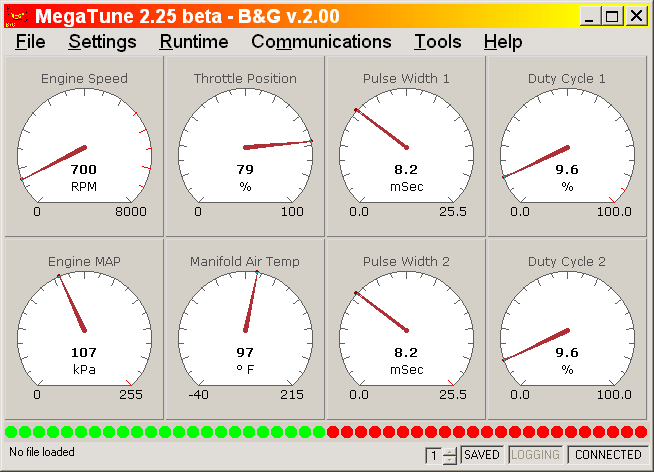
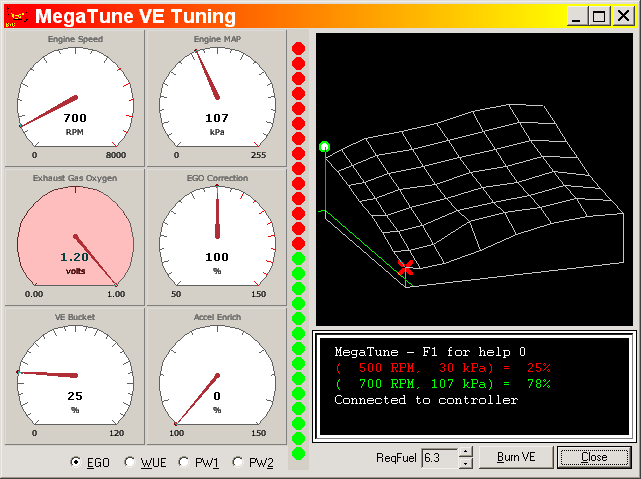
The three main tables are Volumetric efficiency, Spark advance and target air/fuel. Each is 3-D with manifold pressure on the y-axis and rpm on the x-axis. The idle control, warmup enrichment, acceleration inrichment and basically everything else imaginable is all tuneable.
.This post will seem long, but it's actually a very quick run-down of my project.
I started collecting parts months ago to run Tuned Port Injection with a DIY engine management system - Megasquirt. If you don't know what Megasquirt is, head on over to http://www.megasquirt.info/index.html. It's basically an open source project to build your own ECU. The schematics and source code are all readily available so you do everything yourself to run a K5, car, lawnmower, whatever. This was much more complicated than a standard TPI swap, but in the end it gives me the flexibility to do whatever I want in the future and it was actually low-cost.
I built the ECU to do fuel and spark, including idle speed control. The TPI hardware is from an 85 f-body that I got cheap off ebay. I plugged off the cold start injector stuff because it is lame. I built the harness from scratch using TXL wire and Delphi connectors/terminals/seals. I had the whole system including the ECU, harness, electrical center, intake, sensors, fuel tank, fuel pump, etc., running in the garage before I ever yanked the carb off.
I locked the stock HEI distributor down so that it doesn't have any advance at all. The ECU calculates timing and drives the coil directly, so there is no module in the distributor.
For fuel delivery, I used a 90 Blazer fuel tank, sending unit and fuel lines. However, the throttle body lines snake up the back of the engine and the TPI fuel rail connetors are on the front, so the last section of fuel line was replaced with SS braided teflon flex hose. The TPI lines were cut off and flared to make this work.
The fuel lines adapters at the front were very hard to get on and are not very pretty. Since then, I pickep up some fuel rail to AN-6 adapters from Earls, so I will eventually change this over.
A few weeks prior to doing the changeover, I installed this electrical center, to hold all of my under-hood fuses and relays. Before going MPFI, it handled only the electric fans and the A/C. I built a sealed 8-way connector into it so that I could simply plug the ECU harness into it when it was swapped in. Now it handles the fuel pump, the ECU, the O2 sensor, the injectors, the fuel pump and even the stereo. I thought it was messy before when I had 3 relays and 1 fuse mounted to the firewall. I can't imagine how messy it would be with the FI setup without an electrical center like this. I holds 7 relays and lots of mini and maxi-fuses. I think I got it out of a mid-90's Ranger, but I re-did all of the connections inside to suit this application. It's mounted near the passenger side fender, in front of the blower motor.
Here is the ECU and the mostly-finished harness. The harness feeds through the firewall via the hole originally used for the ESC harness. The ECU connector is a DB37 and there are connectors coming off for the 8 injectors, TPS, MAT, CTS, and the electrical center. The VR distributor pick-up coil is done through shielded twisted pair and the ignition coil drive is with coax.
To make tuning easier and allow fuel savings, I used a wideband oxygen sensor from Innovate motorsports - the LC-1. In case you don't know, a standard (narrowband) oxygen sensor is almost like a switch, indicating rich or lean, but not really by how much. A wideband sensor tells you the actual Air/Fuel ratio from <10:1 to >20:1, so you know what is actually going on. I also added an A-pillar triple gauge pod and there is an A/F gauge in there. I measured the response of the gauge on the bench and calibrated the second output of the oxygen sensor to match so that I can read true A/F ratio while I drive.
Here is the lower intake installed where the carb and cast iron used to be.
Here is the system mostly installed. I am using all of the stock accessories (non-serpentine), so I had to modify the alternator and A/C brackets to fit it all together. You can also see the WBO2 controller mounted on the evaporator box. I may fabricate a cold air intake system later, but the open filter was by far the easiest way to get things going.
I won't even go into all of the things I had to solve to get it running now. There are still a few bugs to work out, but I am driving it to work every day and it runs pretty good. When I get the higher load part of the fuel map done, I will adjust my new throttle cable so that I can get more than 80% throttle.
Here are some screen shots of the tuning software. Not only can you set it up to control anything via a laptop (assuming you know what parameters to set), there are even algorithms to automatically improve the tuning of the car while you drive. You can set these gauges to display ANY engine parameter that is measured or calculated. You can also log the data to analyze later what was going on. You can do that with OBDII or OBDIII cars with Autotap, but that costs more than this whole ECU and this software is free (plus open-source).
The three main tables are Volumetric efficiency, Spark advance and target air/fuel. Each is 3-D with manifold pressure on the y-axis and rpm on the x-axis. The idle control, warmup enrichment, acceleration inrichment and basically everything else imaginable is all tuneable.
Last edited:


 . It could also be a problem if the ECU is resetting while you drive, or maybe if you push start a vehicle with a manual transmission because the battery is dead. The ECU can come up very fast, but who knows what pressure it measures while doing it.
 im still working on all this tbi mess on my blazer be glad when im done.


