CK5
Register an account today to become a member! Once signed in, you'll be able to participate on this site by adding your own topics and posts, as well as connect with other members.

Illustrated Hydroboost swap

Some more info and pictures -- Blue85, I assume you don't mind. I had some hassles getting all of my parts sorted through, so I thought I'd share the results of my research in a "Everything you never wanted to know about hydroboost but were afraid to ask" post.

Note that most of these pics come from Oreilly, not that you necessarily have to buy from them but they're widespread, as opposed to local. Their web page also has pretty good information, so you can plug the part #'s right in there for year usage, or use the part #'s for crossreference elsewhere.

So, first, let's look at the typical 70's cast iron vacuum-booster master cylinder:

nmc1521.jpg


The large chamber for the front brakes is to the left, or front of the vehicle. It has a 1/2" fitting and uses 3/16" line.

The smaller chamber for the rear brakes is to the right, or rear of the vehicle. It has a 9/16" fitting and uses 1/4" line.

Now let's look at a typical 80's plastic-reservoir vacuum-booster master cylinder:

nmc1873.jpg


Notice that while the chambers are the same -- the larger one for the front brakes is still up front -- the fittings are reversed in size.

Compare these to a typical cast iron hydroboost master:

nmc1982-side.jpg


The smaller chamber for the rear brakes is now to the left, the front of the vehicle. This has a 9/16" fitting and uses 1/4" line.

The larger chamber for the front brakes is now to the right, the rear of the vehicle. This has a 1/2" fitting and uses 3/16" line.

The net result of this is that, when converting to hydroboost, you must pay attention to how your existing brakes are plumbed. You can identify which lines are front and rear by noting that the larger reservoir chamber is for the front brakes, and the smaller one for the rear.

You can also double-check this by following the lines down to the combination valve.

combovalve.jpg

Depending on the year of your truck and how it is plumbed, you may need to swap the lines front-to-back. I found it easier to do this once I'd unsnapped one or two brackets holding the lines together as they went down to the valve. Switch the lines, then snap the brackets back.

You may also find that your existing lines don't fit. I think this would occur if you had one of the plastic style masters, as above, and were switching to the hydroboosted master as pictured. Rather than cutting and reflaring the ends (and finding the goofy-sized fittings), there are conversion fittings to do this as a bolt-on. Edelmann 258307 bumps the 1/2" up to 9/16", and 258306 reduces the 9/16" to 1/2". (I found another thread here on CK5 that says " Weatherhead part numbers 7912 and 7913 are similar, only in brass".)


More to come.

-- A
 
Last edited:
Next up, there are two kinds of hydroboost. In the 70's, some 1-ton's had this guy

527249.jpg


527249-side.jpg


Notice the giant piston sticking out the left side (front of truck) that pushes into the master.

I'm assuming that most of us will convert to the 80's style hydroboost as the parts are more commonly available. If you have a 70's truck, this does mean changing your steering box to the O-ring style, or getting custom hoses.

This style hydrobooster is the one we've seen in this thread:

52-7307.jpg

And here we see the rod in the center that drives the master:

52-7307-rod.jpg


This is all fine and dandy, BUT the masters for the two are different in one key respect. Namely, the rear section where the booster drives the master.

The 70's style master looks identical to the later one, except the rear has a larger bore for the booster:

nmc1584.jpg


For the 80's style hydrobooster, the one you want looks like this:

nmc1982.jpg


Notice the shallow dimple in the center of the bore. The older style master will fit right up to the 80's hydrobooster, but the larger bore means it will never ever move. (Been there, done that, felt stupid for quite a while :doah: )

If you're getting used parts, go by the visual above. If you're buying by application, be sure to get a master for an 80's truck, but also double check it has the shallow dimple to match the rod in the hydrobooster.

In short, it's best to do the conversion by getting a matched set of booster and master. If you're doing this on a 70's truck, I'd also get the steering box and hoses so it all drops in.

Failing that, be prepared to do a little homework, comparing what you have to the pictures here, to make sure your brakes are set up properly and everything fits together with a minimum of hassle. Brakes are not a part of the truck on which you should skimp or take shortcuts!

-- A
 
Just to add a little more info. I have an '89 3500 with factory hydroboost. It has a cast aluminum plastic reservoir master cylinder.

nmc2353_rit.jpg


The smaller portion for the rear brakes is on the left/front of the truck and larger portion for the front brakes is on the right/rear of the truck.
 
Just to add a little more info. I have an '89 3500 with factory hydroboost. It has a cast aluminum plastic reservoir master cylinder.


The smaller portion for the rear brakes is on the left/front of the truck and larger portion for the front brakes is on the right/rear of the truck.

Took me a coupla looks to see that the forward chamber is indeed smaller. Taller, but narrower in comparison. I may hafta go look at the 80's plastic reservoir for vacuum booster and see what the deal is with those and the fittings.

-- A
 
This looks just like my MC. The large line (with larger fitting) is in the front and this goes to the rear brakes. The smaller line goes to the front brakes. This was the same situation with the cast iron Eldorado booster I was running. I don't have any records on how the stock 85 1/2-ton MC was set up to show whether or not I swapped the lines back then.

PICT0399.jpg

Nobody online crosses the AL/plastic MC to an 87, so somebody must have swapped this in before that dually went to the yard. Also, the rubber diaphragm that sits under the reservoir lid has 2 equal sized circles in it. I have seen them that match these reservoir sizes and that's what I would have expected. So some mixing and matching had been going on - possibly just by junkyard customers. So I guess I should get that part at some point.

chevy_camaro_1987_brake_master_cylinder_cap_gasket_oem_18006074.jpg


5042090.jpg
 
Last edited:
Took me a coupla looks to see that the forward chamber is indeed smaller. Taller, but narrower in comparison. I may hafta go look at the 80's plastic reservoir for vacuum booster and see what the deal is with those and the fittings.

-- A

Yeah it's easier to tell with the lid off. I even had to double check.
 
I know this thread is old, but it seems like a good place to chime in with this... Going to 1-ton axles, I swapped to the 1-ton (hydroboost I believe) master, but the pedal travel is still a bit much. I'm not interested in going hydro yet, but I wonder if the hydro pedal would help with my pedal travel issue. Would the pedal be a bolt in replacement for my existing one, or is there more to it than that?
 
On my 82 K2500 with factory hydroboost,I put a master cylinder from my '77 GMC K2500 on it that had vacuum assist brakes--and two equal sized fluid chambers,("Delco" style) --it was oval shaped on both ends rather than squared off original one with a small and large chamber ("Bendix"style)----it also had the same push rod seat depth and bolted on fine,I just had to use adapter fittings to allow the lines to screw into the proper ports...it stops fine ,however the rest of the brake system is bone stock except for an "Earls" stainless braided rear brake hose..

I found out the 73-87 trucks always had the 3/16" line for the front brakes and the 1/4" line was for the rears..the hard way!..

I made the mistake of simply screwing my lines into the ports on the master they fit into by flipping the front one to the rear and vise versa..well,that made for some butt puckering rides and "non-stops" on my first few test rides,let me tell you!..the rears locked instantly at the slightest touch of the pedal,and the fronts did squat...:eek:..putting the lines back where they belonged using adapter fittings fixed that problem..

The first "panic stop" was a near disaster--I came upon a cop at a work detail who decided to walk out in front of me when I was maybe 75 feet away going 40 mpg,and he holds his palm up in front of me to tell me to "stop"...my rear tires skidded instantly ,the truck felt like is actually went FASTER,and he had to step out of the way at the last second--a cloud of rubber smoke caught up with me,and he proceeded to ream me a new bunghole for "speeding" and failing to pay attention to the road!..:doah:..

I tried to explain my rear brakes were not working right,he then threatened to write me up for "defective equipment"..lucky for me traffic was backing up begind me,and people started honking,so he waved me thru and yelled "get your dam brakes fixed!"...my next stop was at Autozone,to buy the line adapter fittings..:blush:
 
I wonder if the hydro pedal would help with my pedal travel issue. Would the pedal be a bolt in replacement for my existing one, or is there more to it than that?
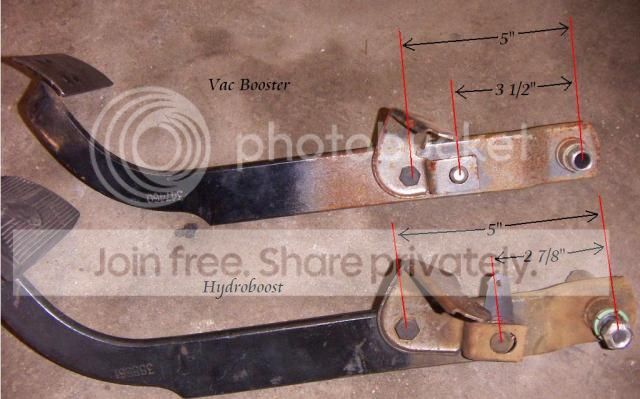
The pedals do swap directly and the hydro pedal would decrease travel and increase your effort.

However, the MC has a different centerline between hydro and vac. You can kind of see that in one of the pictures on page 1. Unfortunately I didn't make measurements at that time. There are several reports of messing up a hydro MC with poor rod geometry by using the vac pedal. I don't know if the opposite also happens, but it seems possible.
 
The pedals do swap directly and the hydro pedal would decrease travel and increase your effort.

However, the MC has a different centerline between hydro and vac. You can kind of see that in one of the pictures on page 1. Unfortunately I didn't make measurements at that time. There are several reports of messing up a hydro MC with poor rod geometry by using the vac pedal. I don't know if the opposite also happens, but it seems possible.

Hmm. When I dropped the new master in, it looked like a perfect match. I thought it was a hydroboost one because it was from a 1-ton application, and from what I can tell they all had hydro. I just blindly hooked up the lines to the ones they fit in, and it seems right, definitely not catastrophic locking, and the small front one is going to the drums (I remember because it has so little volume I had to refill constantly during bleeding).

Anyway, I'm going to look into the pedal option. The brakes seem fine, it just has too much travel for my liking.

20140107_204335.jpg


20140107_204419.jpg
 
We were talking about pedals, so I was referring to the difference in mounting location for Hydro vs Vac booster. Placement on the firewall is a little different. The MC of course lines up exactly on center with whatever booster you use. But there are differences in Booster/MC rods as well. The wrong one can give low pedal or dragging brakes. It's possible yours is too short, adding pedal travel.
 
We were talking about pedals, so I was referring to the difference in mounting location for Hydro vs Vac booster. Placement on the firewall is a little different. The MC of course lines up exactly on center with whatever booster you use. But there are differences in Booster/MC rods as well. The wrong one can give low pedal or dragging brakes. It's possible yours is too short, adding pedal travel.

I'm pretty sure the pushrod is pushing on the dimple correctly with no drag or slack. The piston on a 1-ton setup just has to move further I think. My hope was the 1-ton pedal could attach to my existing pushrod and just do the job with less mechanical advantage.
 
I jumped on this right away, but looking at your pics, it doesn't make sense:

Pedaldifferences.jpg


The hydroboost pedal in this pic has the pushrod closer to the pivot, so it would actually have more mechanical advantage. You would have to push the pedal further to get the same pushrod travel, so it would require less force to overcome the same resistance at the MC. I liked your explanation (that the hydro provides more assist and the 1-tons push more fluid), but I can't line it up with what I see here.
 
Thanks for all the pics on this one!
I needed a few things cleared up for me and you did it!!
 
One other item of note, though very minor. The unthreaded stud on the brake pedal, that the booster pushrod mounts to, is of different diameter between the two types. It's 1/2" for the vacuum booster pedal, and 9/16" on the hydro.

-- A
 
When my 6.2 dumped all over the motor swap pad,where I just happened to have parked, I ended up swapping a vac boost along with the gas motor replacement. I wish I'd kept the HB but knowing little about it all and being under the gun to get rolling back to the job I went with what I knew. I don't remember much on the details so this thread gives me a hint what I'd apparently done:waytogo: Well Done!
 
The hydroboost pedal in this pic has the pushrod closer to the pivot, so it would actually have more mechanical advantage. You would have to push the pedal further to get the same pushrod travel, so it would require less force to overcome the same resistance at the MC. I liked your explanation (that the hydro provides more assist and the 1-tons push more fluid), but I can't line it up with what I see here.

Since the 1-ton MC has a larger piston, it doesn't have to move as far and is harder to push. The pedal kind of compensates for that. You could figure out the ratio by taking the area of the two pistons and the difference in pedals. Worst-case emergency stop is with no assist, so the user supplies all effort.
 
Since the 1-ton MC has a larger piston, it doesn't have to move as far and is harder to push. The pedal kind of compensates for that. You could figure out the ratio by taking the area of the two pistons and the difference in pedals. Worst-case emergency stop is with no assist, so the user supplies all effort.

I was just responding to your original post that made it seem like the hydoboost pedal had less mechanical advantage, when it actually has more. I was all excited to swap in a hydro pedal to reduce my pedal travel, but it would actually have the opposite effect.

Lots of people seem to complain of extra pedal travel after 1-ton swap. Even though the 1-ton MC has a larger piston, the brakes also require more fluid to move them. Maybe it doesn't fully cancel out, or something.

Or maybe I'm thinking about this all wrong...
 
Great thread!!

I LOVE having the h-boost in my burb! I don't want to have anything without it now.
 

Latest Posts

Top Bottom