CK5
Register an account today to become a member! Once signed in, you'll be able to participate on this site by adding your own topics and posts, as well as connect with other members.

L18 8.1L swap resource thread

So, update.
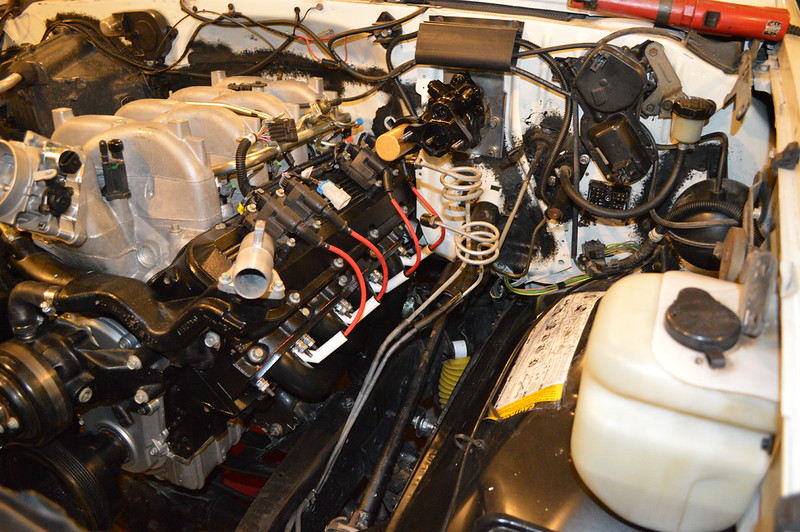
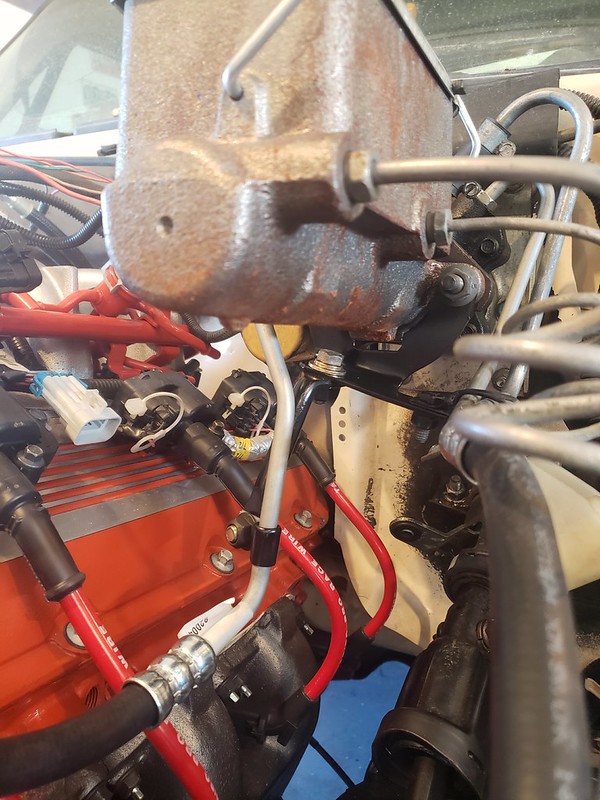
My "S" shaped fill tube showed up, my wiring pigtails, don't exist.
Also, my O2 sensors showed up. Had to order the front 2 sensors for a 6.0 litre, as that's the harness I modded, for the 8.1litre, installed
 
Last edited:
Something worth noting, those 79286 are 305 ohms/ft, which is over 6 times more resistance than the MSD superconductor wires at under 50 ohms/ft. Taylor also sells some low resistance wires if you prefer that brand. They are the 8.2 mm Thundervolt. They are also 40 ohms/ft, such as #82025. The have red or blue options too.

I would rather have the lower resistance than the thicker silicone, I usually run the MSD superconductor but Taylor is good quality as well.
 
I am looking for Taylor wires and the Part number @sweetk30 has in his post, Summit shows as not for my 2001 burb with L18. So @sweetk30 how did 79286 fit? So I can have @folkenheath get them for me.

So the part number is good if you search Taylor’s site for it. Comes up under the “custom” designation.

The 10.4mm wires seems to be one that works with without the ignition breaking up while lugging the engine in a higher gear at lower speeds. I’m not sure if that’s due to the resistance value or what, but smaller wires including the stock ones break up like mad in the same situation.

I know we had a serious issue at Workhorse killing 8.1 plug wires in extreme situations. Many aftermarket plug wires were tried. Most failed like the stock ones. Some lasted longer is all. Larry got tipped to go to these after we had all the problems on rvs. I want to say it was Larry at Raylar that told him about them. I might be wrong on that.

I know mine make a difference. I broke one when I had to pull one side loose to do an exhaust gasket. Just having one stock wire on it could be felt at low speeds.

Don’t get the LS version as they are too short to fit. I remember taking to somebody from Taylor when I was trying to replace the wire I broke and posed that question and there was enough difference to not try it.
 
Stock wires are usually over 900 ohms/ft or worse. Those 10.4 Taylor are down to about 300 ohm/ft, much better, but the real good wires are down to less than 50 ohms/ft. These include the MSD Super Conductor, Firecore50, and the Taylor Thundervolt, among others.

The sub 50 ohm/ft wires like MSD and Firecore 50 are used on everything from stock engines to top fuel dragsters. If you have a problem with them then something is broken or it's something else. Some drag only cars use solid wires but with EFI solid wires don't even work well on a race car so they use the good spiral wound wires like mentioned above.

Of course the spark plug gap is the highest resistance, but anything other than that just reduces the volts to the plug and reduces the chances of it jumping the gap, especially under compression and high cylinder pressure when requirements to jump the gap increases even more.
 
working fine for me still and happy with them . only wish was at the time black wires were out of stock .

and since MSD is now a holley owned company i wont run there stuff anymore.
 
I know some people prefer one brand over the other, that's why I suggested 3 different brands. If you like Taylor I would recommend the Thundervolt wire over the 409 series, but both are much better than stock.
 
I want to say it was Larry at Raylar that told him about them. I might be wrong on that.

Ya, you mistaken dude :wink:

My story with plug wires is more related to having a manual transmission where you can really lug the engine down low in the RPM band, while having the throttle plate open above 25+%, MAP signal extremely high because the load is high due to low RPM with a good amount of fuel and spark being thrown at the engine. That’s were you can really feel wires breaking down where the engine bucks and hiccups. When the wires break down it almost feels like a fuel issue. A lot of people think hard wide open throttle is where you feel wire issues, which you can to a certain degree, but the majority of wire issues I’ve seen in my life were under hard load. What I mean by lug the engine down at low RPMs would be like turning a corner on a neighborhood street at 5 MPH in 3rd gear at 800 RPMs and tipping the accelerator out of corner without down shifting it or being on a desert trail rolling at 15 MPH in 3rd of 4th gear just letting the engine lug along under 1000 RPM like a diesel. It can be noticeable pulling a heavy load like a big trailer as well.

My bone stock 2001 Silverado HD/8.1/ZF 6 Speed had a very noticeable buck and hiccup from the day I drove it off the lot brand new when lugging it down low. After 15 years I finally got tired of it and tried bigger core wires and at the time all I could find were the Taylor 409’s for an 8.1L. There were plenty of options for LS engines but those wires are too short if you have an earlier 8.1s with the bigger coils. The Tayor’s instantly fixed the buck/hiccup

The only wire worse than the stock 8.1 wires are actually the RayLar wires. They are basically the same tiny 7mm wire as stock but with a nice ceramic boot. The only good thing about them was the ceramic boots, which was good for one use as you can’t pull them off the spark plug without destroying them. Larry gave me a set of his wires when I was in San Diego one time and couldn’t wait to get home to put them on the K10. Those things started breaking down on the very first desert trip once the engine started lugging around at low RPMs in the hotass desert. I gave Larry honest feedback on those wires and he said “well, not everyone uses them that way”. Well, I guess he’s not wrong. I threw those away and got Taylors for that as well. All 3 of my 8.1s and Rob’s K5 now have the Taylor 79286 10.4mm and they’ve worked great.

RayLar Wires. These actually looked smaller diameter than the stock wires.
16689268640_e676b85c1e_c.jpg


Taylor 79286 409 10.4mm I’m not sure what they cost today but I remember the first set I bought off Amazon were only $80 and considerably cheaper than what RayLar was selling their wires for at the time.
50347208277_54f33ef04f_c.jpg
 
Last edited:
The large 10.4 mm wires are mostly silicone, yes, they do protect better against the spark jumping through the silicone and they do have a resistance probably 1/3 of stock, but with an even lower resistance wire the 10 mm jacket is not needed as the resistance to travel through the wire is smaller so it doesn't want to jump through the silicone. The Taylor Thundervolt are 1/6 the resistance of the 409 and about 1/32 the resistance of stock.

Now if the spark plug gap is too high then it could still cause issues as it has to jump the gap even at higher pressure.

What I mean by lug the engine down at low RPMs would be like turning a corner on a neighborhood street at 5 MPH in 3rd gear at 800 RPMs and tipping the accelerator out of corner without down shifting it or being on a desert trail rolling at 15 MPH in 3rd of 4th gear just letting the engine lug along under 1000 RPM like a diesel. It can be noticeable pulling a heavy load like a big trailer as well.

Larry, I don't recommend doing that to your engine. Lugging the engine at 800 RPM the ECU has to have your timing very low at high load at near idle RPMs using the higher gear. It's a spark ignition engine not a compression ignition engine, its not that efficient there and you would likely save fuel and potentially parts by going down a gear and holding it at a still relatively low 1200-1500 RPM. I know it will do it, but as you are seeing it wasn't designed to be driven that way and high load at very low RPM on an NA gas motor is not good for it. It's the best way to get detonation because the piston is going down very slowly, but the combustion still happens fast. And at higher load, it's a big fast bang on a piston that's moving very slow, that's almost detonation even if its not detonation yet. Cylinder pressure is apparently spiking very high or it wouldn't be causing spark to drop out. I know the 8100 is like a tank and it can take a lot of abuse, but it will last even longer without it. In my opinion lugging the engine at high load at 800 RPM is much harder on it then running it at near redline at any load. Now diesel fuel burns at a slower rate so that's easier to do, especially when you add boost because if you record cylinder pressure during combustion boost gives a longer push rather than a fast bang.

Remember, a 1/4 throttle at 800 RPM is basically floored as far as the engine sees, it probably can't take in any more air at that RPM than you are already giving it. The higher RPM can pull more air. Even at 100% volumetric efficiency (which is is probably not achieving) at 5500 RPM it would want to pull in about 790 CFM. But at only 800 RPM it only needs 115 cfm, which it can likely get at 1/4 throttle.

I got Taylor 79286 coming from summit. Have an automatic so probably won't get that lugging break down.

Sorry my distributor didn't have those in stock Wes, thanks for checking with me, I appreciate it.
 
Last edited:
Stock wires are usually over 900 ohms/ft or worse. Those 10.4 Taylor are down to about 300 ohm/ft, much better, but the real good wires are down to less than 50 ohms/ft. These include the MSD Super Conductor, Firecore50, and the Taylor Thundervolt, among others.

The sub 50 ohm/ft wires like MSD and Firecore 50 are used on everything from stock engines to top fuel dragsters. If you have a problem with them then something is broken or it's something else. Some drag only cars use solid wires but with EFI solid wires don't even work well on a race car so they use the good spiral wound wires like mentioned above.

Of course the spark plug gap is the highest resistance, but anything other than that just reduces the volts to the plug and reduces the chances of it jumping the gap, especially under compression and high cylinder pressure when requirements to jump the gap increases even more.
I don't think we have a direct correlation between ohms/foot ratings and performance. The anecdotes suggest that some brands work better than others, but the differentiator could be the end connectors or how the crimps are done. If the spark discharge is 1/4A and the wire is 6" long and 300 ohm/ft, the wire is dropping less than 40V over it's length, or something like 0.1% of the available coil voltage. So relatively speaking, the voltage along the wire is constant, and it wants to arc to the block about equally as much as with a stock wire, that is dropping 112V (0.3%). It's also odd with a spiral-wound conductor that nobody lists the inductance or what effect that has on the discharge.

There's some qualitative stuff from Denso here: https://www.denso.com/global/en/pro...d-accessories/plug/basic/spark/condition.html

I appreciate the effort here, but not sure we can take away numbers related to our plug and wire choices: https://wrcoutboards.org/wp-content/uploads/2020/04/Spark-Plug-Voltage-Requirements.pdf

So maybe in the end we're still in the anecdotal era?
 
Yes Luke, I agree with what you are saying, that the voltage drop is pretty low compared to the spark plug gap jump(or even the resistor core plug), which is why I stated the 409 are still way better than stock. I respect your EE background on this. Even the CnP wires are more like a foot long though, not 6", most are 10 - 15". And the old school V8 wires can be several feet long. So you end up with a resistance approaching a few thousand ohms vs like 140 ohms in some cases. Where in the case of the 8100 they are probably like 13" long and its close enough to a foot you could say its 50 ohms vs 300 ohms vs 900 ohms.

And like you said, the connectors and crimps are very important. This is why I myself use the MSD Super Conductors or sometimes FireCore50, a nice solid click on stainless terminals that won't corrode at both ends.

For me I would rather have the lower resistance than thicker silicone, as I know it works even with much higher current and voltage capability to fire under much higher cylinder pressures than any stock engine ever has. It may be overkill, but it works.

But to be honest, it sounds like this is all based on operating it under parameters that should likely be avoided if possible. And if that is the case, then even the stock wires are fine for a stock engine, and the 409 are more than adequate. I was surprised people were getting issues with stock wires on a stock engine with stock coils, but it makes more sense now.
 
The large 10.4 mm wires are mostly silicone, yes, they do protect better against the spark jumping through the silicone and they do have a resistance probably 1/3 of stock, but with an even lower resistance wire the 10 mm jacket is not needed as the resistance to travel through the wire is smaller so it doesn't want to jump through the silicone. The Taylor Thundervolt are 1/6 the resistance of the 409 and about 1/32 the resistance of stock.

Now if the spark plug gap is too high then it could still cause issues as it has to jump the gap even at higher pressure.


Larry, I don't recommend doing that to your engine. Lugging the engine at 800 RPM the ECU has to have your timing very low at high load at near idle RPMs using the higher gear. It's a spark ignition engine not a compression ignition engine, its not that efficient there and you would likely save fuel and potentially parts by going down a gear and holding it at a still relatively low 1200-1500 RPM. I know it will do it, but as you are seeing it wasn't designed to be driven that way and high load at very low RPM on an NA gas motor is not good for it. It's the best way to get detonation because the piston is going down very slowly, but the combustion still happens fast. And at higher load, it's a big fast bang on a piston that's moving very slow, that's almost detonation even if its not detonation yet. Cylinder pressure is apparently spiking very high or it wouldn't be causing spark to drop out. I know the 8100 is like a tank and it can take a lot of abuse, but it will last even longer without it. In my opinion lugging the engine at high load at 800 RPM is much harder on it then running it at near redline at any load. Now diesel fuel burns at a slower rate so that's easier to do, especially when you add boost because if you record cylinder pressure during combustion boost gives a longer push rather than a fast bang.

Remember, a 1/4 throttle at 800 RPM is basically floored as far as the engine sees, it probably can't take in any more air at that RPM than you are already giving it. The higher RPM can pull more air. Even at 100% volumetric efficiency (which is is probably not achieving) at 5500 RPM it would want to pull in about 790 CFM. But at only 800 RPM it only needs 115 cfm, which it can likely get at 1/4 throttle.


Sorry my distributor didn't have those in stock Wes, thanks for checking with me, I appreciate it.

Thanks for the input but I disagree. This is an engine making over a 100 lb. ft. of torque at idle and operate comfortably down low without sounding like its choking to death and detonating to beat the band. I just took a guess at the TP angle at 25% as I’ve never really plugged in an monitored it, but it’s probably well below 10% as you’re actually barely tipping into the throttle. None the less, they like to be lugged and they were designed to be a low RPM/ high torque engine. Zoomad and I have much experience with these engines back from our Workhorse days where we worked directly with the GM Powertrain design and application engineers that created it. Workhorse sold more vehicles with 8.1s than GM did in GM trucks for many years and continued to sell them into the 2012 model year when GM was done in 2009. In fact, I still work closely with engineering at PSI on the 8.8L that we use in our school bus line at Navistar. The current 8.8L with the Allison 3000 with the FuelSense calibration upshifts the transmission around 975 RPM and can run up to 6th gear below 1000 RPMs with slight throttle tip-in in a 30,000 lb. school bus. They don’t do it fast, but they do it and love it although the on-road 8.8L is cammed for even lower RPM torque over an 8.1 and have goodies like oil squirters under the piston skirts to help with cooling and lubrication and an LS design valve train. I’ll continue to lug the hell out of my 8.1s because that is what they do
 
Last edited:
Larry I agree it's a low RPM torque monster, but it's not an even bigger 8.8L engine with a smaller cam and an automatic transmission with a torque converter, these are key differences, and as you found out driving that engine like that with a manual trans caused issues with stock and some aftermarket plug wires. This is a sure sign of high cylinder pressure at very low RPM, and it's a lot easier to get detonation at low RPM, so I would avoid that if it was my engine. I just think our ideas of lugging are just slightly different by only a few hundred RPM, I'm not saying don't lug it, I was just saying I wouldn't lug it down quite that low where it caused the issue, so we'll have to agree to disagree on this one.

I also mean no disrespect to your experience with these engines. Because although I have worked on a couple of those 8100s before they were even available to the public back in the late 90s, and I have built and driven engines up to 10.4L, I admit I myself haven't driven one of those exact 8100 engines behind a manual trans. So if you "feel" it is fine it might be, but there can also be detonation happening that you don't quite hear/feel yet. The knock sensors will probably pick this up, and likely retard the timing, but efficiency is not there, so why do it if it's more efficient just a few hundred RPM higher? That's all I am saying, I am surely not saying don't lug the 8100, because it is indeed a torque monster.
 
Last edited:
I noticed that there is an alternative temperature thermostat 180° is available for the L18. Has anyone tried to run it in theirs ?
 
Top Bottom