Feel free to ask questions (for those who have answers, help us with good sound answers, and don't make us feel like we're asking a stupid question)
For the most part its something that has always been just out of reach for me. I struggle to understand it and more so properly apply it. I've always relied on others to help me through it.
So in my quest to be better educated on it, I thought I would open the proverbial can of worms and get it on the table for discussion.
First up for me is understanding relays. I understand that they can control (switch?) heavier current carrying wires without having to have a much larger amperage rated switch to handle the power.
So what exactly are single pole (SP), double pole (DP), single throw (ST), double throw (DT)...etc?
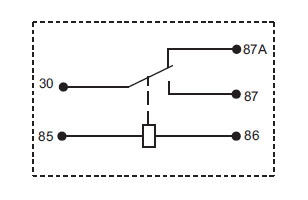
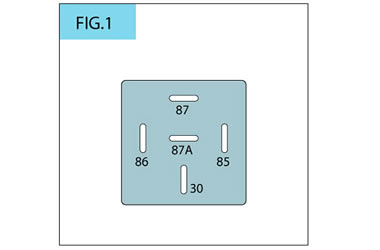
I see a typical SPDT Relay has a common (30), ground (85), power (86) and open and closed circuits (87 & 87A).
My first questions concerning Relays are:
1) Are relays a circuit protecting device (like a fuse)?
2) What is the common circuit (30)...what wires would hook to this circuit? How does its purpose fit in with the rest of the relay's circuits?
3) Does the ground circuit (85) go to chassis ground or the device being controlled ground?
4) Does the power circuit (86) come directly from battery power?
5) Opening a circuit means no power passes through the relay to the device, and closing the circuit sends power to the device, so I'm assuming(?) with power going to the device it needs a ground as well. Does this come from the device mounting (and/or a separate wire to chassis ground) and does the relay have to be grounded to the controlled device as well?
Feel free to take the above relay and use it as an example of a circuit for wiring a device and a switch controlling the device.
On behalf of myself and many others (I hope) thanks for your patience and input!
For the most part its something that has always been just out of reach for me. I struggle to understand it and more so properly apply it. I've always relied on others to help me through it.
So in my quest to be better educated on it, I thought I would open the proverbial can of worms and get it on the table for discussion.
First up for me is understanding relays. I understand that they can control (switch?) heavier current carrying wires without having to have a much larger amperage rated switch to handle the power.
So what exactly are single pole (SP), double pole (DP), single throw (ST), double throw (DT)...etc?
I see a typical SPDT Relay has a common (30), ground (85), power (86) and open and closed circuits (87 & 87A).
My first questions concerning Relays are:
1) Are relays a circuit protecting device (like a fuse)?
2) What is the common circuit (30)...what wires would hook to this circuit? How does its purpose fit in with the rest of the relay's circuits?
3) Does the ground circuit (85) go to chassis ground or the device being controlled ground?
4) Does the power circuit (86) come directly from battery power?
5) Opening a circuit means no power passes through the relay to the device, and closing the circuit sends power to the device, so I'm assuming(?) with power going to the device it needs a ground as well. Does this come from the device mounting (and/or a separate wire to chassis ground) and does the relay have to be grounded to the controlled device as well?
Feel free to take the above relay and use it as an example of a circuit for wiring a device and a switch controlling the device.
On behalf of myself and many others (I hope) thanks for your patience and input!