CK5
Register an account today to become a member! Once signed in, you'll be able to participate on this site by adding your own topics and posts, as well as connect with other members.

Lets talk wiring

I've gotten to the point that buying new terminals/connectors and using new wire, when possible (which is 90% of the time), is what I prefer over soldering. Most of the terminals GM used are pretty easily and cheaply found.

It's also easy to get the proper colored wire (including striped) if doing something like replicating a circuit from a GM manual. I'm finding it less and less important to have the correct wire color however, all the connectors number the terminals.
 
This is basically the setup I use to solder. Wouldn't use anything else.

Also I found its MUCH easier with super thin solder.

image.jpg
 
So....

1. So technically no, you should have a fuse on the input power to the relay, but they definitely burn out when they're overloaded. I've been running most of my accessory for years on a couple relays and have to replace them from time to time but have never burned anything out. Best practice, put a fuse on em.
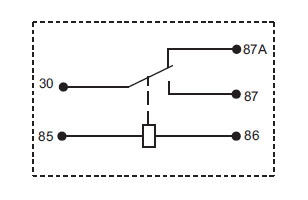
2. 30 is batt (or acc) +ve, your feed voltage.
3. 86 is actually the ground. 85 is your switch voltage. Technically on your truck everything is a chassis ground. They all end up at your -ve batt terminal. When I'm putting these in the engine compartment, I usually run a short ground wire with an eyelet hooked to a self tap I've used to secure the relay on the inner fender or firewall. Works great.
4. 85 is your switch power. It can be either batt or acc, should be fused (very small, very little current) through a single pole switch for example. Switch off, no voltage here. Switch on, +12v.
5. So on a SPST you have a single out (87). Switch on power on. Switch off power off. On an SPDT you have 87 and 87a. Switch off - 87 off - 87a on. Switch on - 87 on - 87a off. Useful for example my headlights run off an SPDT, switch off power goes to low beam lead, switch on power goes to high beam lead.

HORNRELAY_SPDT_CIRCUIT.jpg


Hope that helps!

I'm sorry, but I have to correct one thing about your post and that is 85 being switch +12v.
From what I seen, 85 is switch -12v
I post some examples from a dodge tech manual.relay example.png
relay.jpg
Normally, if wired to a dumb manual switch, it does't matter. However if the the relay is control by a computer like a PCM, it is best to have the +12v go to 86, and the relay have a diode. The diode prevents voltage spikes going to the electronics.
 
I have a power probe soldering torch
Success has been sporadic

image.jpeg
 
It does help.....some!
So if I was to power up a single speed, temperature triggered cooling fan, that draws 22amps, I should supply power to terminal 30, including a 25 or 30amp? fused circuit with #10 stranded copper automotive rated wire coming from a continual hot 12v sourced supply?
Then use the same #10 wire to feed the cooling fan from terminal 87. I would assume the cooling fan has its own source to ground?
Where do I wire in the temp sender unit?
Then use a 16ga. (big enough?) wired circuit (from a continual hot 12v source?...with fuse protection?) to a single pole switch then out to terminal 85. That leaves terminal 86 being the ground.

Painless wiring has several harness for a decent price for running fans. I have used them in the past and they are truly painless. Excellent directions and work great forever. Might look into these. Much cleaner install.
 
I'm sorry, but I have to correct one thing about your post and that is 85 being switch +12v.
From what I seen, 85 is switch -12v
I post some examples from a dodge tech manual.
Normally, if wired to a dumb manual switch, it does't matter. However if the the relay is control by a computer like a PCM, it is best to have the +12v go to 86, and the relay have a diode. The diode prevents voltage spikes going to the electronics.

Spikes wouldn't get to the electronics anyway, 85/86 control the coil don't interface with the engaged power.

Either way, that's the way I've wired dozen of relays, both must work. :)
 
Spikes wouldn't get to the electronics anyway, 85/86 control the coil don't interface with the engaged power.

Either way, that's the way I've wired dozen of relays, both must work. :)
Anything that has a coil of wire (I.e. a coil in the relay or windings in the motor) create a voltage spike when first turn on or off.
 
Anything that has a coil of wire (I.e. a coil in the relay or windings in the motor) create a voltage spike when first turn on or off.

That's true, as well as an inductance, but that circuit isn't touching the power going to any electronics. There are two flows in a relay; one from switched power through a coil and out to ground, the other from a power source switched to the desired load. They are physically seperate.
 
I'm sorry, but I have to correct one thing about your post and that is 85 being switch +12v.
From what I seen, 85 is switch -12v
I post some examples from a dodge tech manual.View attachment 201748
View attachment 201747
Normally, if wired to a dumb manual switch, it does't matter. However if the the relay is control by a computer like a PCM, it is best to have the +12v go to 86, and the relay have a diode. The diode prevents voltage spikes going to the electronics.
It doesn't matter if 85 or 86 is power or ground they can be wired either way. They are just controlling the coil in the relay and one has to be + and the other one - or it won't work.
 
OK, everybody hang on a second. I better jump in here before this goes farther off the rails. Actually everybody here is right, but most of you are not seeing the whole picture.
Trust me, I deal with this stuff all the time.

First, the coil on a relay will produce a voltage spike when turned off. If anyone needs an explanation just say so and I will go into further detail.
Of course, that spike is not linked to what the contacts on the relay are controlling. The spike occurs on the control circuit that turns the relay coil on and off.
If that circuit is a mechanical switch, then the spike pretty much goes nowhere unless its strong enough to arc across the switch contacts. Believe it or not, that can happen when switching large inductive loads. But its not going to happen in an automotive circuit.

The trouble comes in when the relay is controlled by a solid state switch, such as a transistor or other device. In that case, the spike can damage the controlling device, since it is often of fairly high voltage, and is usually of reverse polarity.

To prevent that some relays have what is known as a freewheeling diode. I have no idea where that name came from, and I have never heard anyone use that term in a conversation.
But I ran into it on some circuitry one time and have been itching for a chance to use it.

It is a diode across the coil of the relay. It is designed to be reverse biased when the relay is wired correctly. In other words, it does not conduct.
However, when the spike occurs, it is of reverse polarity, and so the diode conducts and shorts out the voltage before it can do any damage.
Most auto relays do not have that diode. I am going out on a limb by saying most, because I have no idea of the ratio between diode and non-diode relays.
But, I have not seen as many with diodes as without in my workings.
How do you tell them apart? Sometimes its hard to tell. Most of the time the ones with a diode will have either a diode symbol on the case between the coil contacts, and/or have polarity markings on the coil contacts.
If the coil contacts on a relay have a "+" and "-" on the case, its best to wire it that way. It probably has a diode.

If you are building something and need a relay, do you want to order one with a diode? If its going to be controlled by a switch, probably not. Its not needed, and eliminates the necessity of watching which wire goes where.

If it is going to be controlled by a solid state switch, such as the output of the car's computer, or a PLC, then go ahead and use a diode version.
Most outputs of those units are already diode protected for just that reason, but the cost difference is usually very small.

In some of the big computerized machining equipment I sometimes work on, they may have a relay board or two with up to a hundred relays on them.
And usually everyone of them will have a diode.

I once worked on a wire EDM machine that was driving the place crazy. It would work fine until a certain function occurred. Then it would glitch, either forgetting where it was, or miscounting its length of travel.
Fortunately I had not spent too much time on it, before someone mentioned that they had been having to run the machine without that function for a while, until they got the part to fix it.
But as soon as they fixed it, the other stuff started happening.

Cardinal rule of troubleshooting: If something starts going wrong after something was done to the machine, no matter how unrelated the two events seem, always go to what was done.
In this case, a relay on the main board had failed. It was a plug-in relay, so they just ordered a new one from a parts house and plugged it in.
They did not order one from the factory. As soon as I looked at the new relay, and compared it to the old one, I saw the old one had a diode and the new one did not.
I had some diodes with me, so I tack soldered one to the back side of the board until I could order the correct type relay. No problems after that.
 
Diodes
I have always been impressed with Fordum's knowledge but sometimes I can easily get lost in the technical terminology and kind of glaze over as I read his highly informative posts.

Remember I am just a student so I will try to keep using simple terms to explain some of the things I have recently learned.
Keeping it stoopid simple.

The text books defines a diode as a simple semiconductor devise that permits the flow of electricity in one direction but not in the opposite direction.

Remember the analogy of the river of electricity that allows current to flow? The diode is like a one way check valve that allows the current to pass through but not return back upstream.

How would I use this on my rig?
My first lesson in diodes began when I wanted to flat tow the JIMMY but I didn't want to use those magnetic tow lights. I had to install a pair of diodes in front of the tail lights so the current from the tow vehicle's brake lights and turn signals would illuminate the lights of the vehicle being towed properly.
Without the diodes in place the current would back feed through the path of least resistance and light the other tail light and not function the way I wanted it to.
With the diodes in place the current back feed was prevented and everything worked fine.

Clamping Diodes

On today's vehicles a clamping diode is commonly used to prevent a voltage spike. This is used by installing a clamping diode in parallel creating a bypass for the electrons during the time the circuit is opened. The diode absorbs the spike and the circuit voltage remains within it's limits.
This would be used in something like an air conditioning compressor clutch because it is operated by electromagnetism, opening the the clutch coil circuit produces a voltage spike. It the voltage spike is left unchecked it can fry a vehicle's computer.
A clamping diode is connected to the circuit in reverse bias.

Zener Diode
A Zener diode works the same as a normal diode until a certain amout of voltage is reached. When the voltage reaches this point, the diode allows the current to flow in the reverse direction. This would be used in voltage regulators.

Converting AC to DC with Y and Delta windings

I found it interesting that diodes are used in alternators. There were a few examples of this but it can get confusing.
Y windings use a stator in the shape of a Y and use the center of the Y as a neutral junction. As the alternator rotor turns it powers 2 in series and the 3rd is neutral and inactive.
The Delta stator is in the shape of a triangle and instead of having 2 in series, all 3 windings are in parallel.

Both Y and Delta windings send the current through a series of diodes and this process essentially converts AC to DC ( DC Rectification).
 
Last edited:
Right!
Thanks to all for the input!
Again I seek to understand so proven theories on information is greatly needed as I generally don't know right from wrong!
Hopefully this will help others following along as well
 
I'm a little more on the basic side.
Aux fan for my trans cooler.

Relay close power is from an aux fuse panel that I installed for accessories thru a temp switch plumbed into the trans return line.
I used the ground side of the fan to go thru the relay.
Direct power to fan is from the battery thru a fuse.

Temp switch closes, relay closes and fan is grounded thru relay, fan comes on untill temp switch opens allowing the relay to open, fan shuts off.

image.jpg
 
Is it harder on a relay to have the contacts always closed w power on them?
I'm thinking like a set of ign points....they don't like being closed w power on.
 
Of course.

For example- an aircraft jet engine hydraulic pump can be turned off (bypass mode) by a flip of a switch.

A solenoid on the pump is powered ON which turns the pump OFF.
When the solenoid is OFF(Normally open) the pump is ON.

If the solenoid was powered anytime the pump was commanded on it would reduce its life cycle due to electrical current and induced heat.

The solenoid is only powered when it is required to turn the pump Off for an operational test or a pump malfunction.

In our applications we use a relay to turn an accessory On not Off as in my example.
 
Top Bottom