CK5
Register an account today to become a member! Once signed in, you'll be able to participate on this site by adding your own topics and posts, as well as connect with other members.

lifters..

4xcrazy

3/4 ton status
Joined
Oct 31, 2003
Posts
9,485
Reaction score
13
Location
Elma, Washington
So, I'm gonna guess, that while attempting to adjust the lifters to remove the tick, that when the tick slowly returns with the engine running, just after an adjustment to where they were quiet, assuming a bad lifter...

These are the roller lifters I had installed in the TBI 350 in the burb a few years ago. MAYBE 5500 miles on them.

Just can't get a few of them to keep quiet, real noisy during start up, quiets down pretty quickly, but still at least one I know of I keep adjusting, keeps idling for a few minutes then starts ticking again, snug it up a bit more,,, a few minutes later, tick comes back..

Annoyed..
 
There might not be enough oil getting to that lifter,or perhaps the cam lobe is wearing down...it could be the lifter is defective internally,if it pumps up and stays quiet "sometimes",it could be the check ball in it is bleeding off oil pressure..

I had a 454 that had some noisy tappets ,until one day I decided to change the oil and put in a quart of marvel mystery oil,ran it 2 days,then I put Castrol GTX 20w-50 in it instead of Amalie 10w-30...I noticed the lifters quieted right down after start up,the oil pressure increased by about 10 psi when hot,and they remained silent after that...some engines like thin oil better,more of it gets to the valve train...others prefer thicker and more pressure to push it up there I guess...
 
I've pretty well determined it needs new lifters, I think this was more of a rant really... yeah, annoyed..

Shouldn't be anything wrong with this cam or any part of the engine with less than 6000 miles on it, ran a break in period of conventional oil, then swapped over to full synthetic for the trip to Indiana the few years ago when I originally moved, it started this ticking deal shortly after I got there and just haven't been able to adjust it out at all.

Switched back to a 20/50 conventional to try that out, being a bit thicker, still there.. gonna do one more oil change and see what happens, it still drives fine, it's not a crazy loud tick, but enough it annoys me, I can hear it, it's a pretty authoritative tick coming from under the hood.

They aren't too badly priced really, from what I have seen, 3/4 day job, a few gaskets and some new fluids...

we'll see..

Needs a transmission first really though :doah:
 
you might have a rocker stud pulling out try tapping it back in and if it moves then you found the problem you'll have to go with screw in studs
 
I understand what you're saying, but the fact that ALL, or I should say, it sounds like all of them are clattering pretty hard during initial start-up, is what has really lead me to believe used lifters were installed, or just cheap China crap.

Pretty well given up on them really.. I'll check that stud out regardless, not rejecting your suggestion though.
 
Any recommendations on a particular brand for replacement that won't break the bank, but still be reliable enough to last?
 
I've got comp magnums in one of my 350s. Guy from our local speed shop wouldn't sell me the cheaper comp ones, said had to many issues with em. They were about a $100 up here in the great white north.
 
Wait a sec...you said you had rollers stuffed in a TBI block? Don't know the details of your engine but did kinda follow your cross country saga. Tried looking for engine details but 9k + posts makes it difficult.
TBI truck blocks are not set up for roller valve trains.
The block needs to be machined for rollers...unless you have a post '92 truck block. TBI truck roller blocks are nearly nonexistence. Won't say completely as there are tales of '91 TBI truck blocks have roller bosses.
Most common are passenger car only blocks that got OEM rollers in this era.
Push rods get shorter with roller lifters and springs need to be changed.
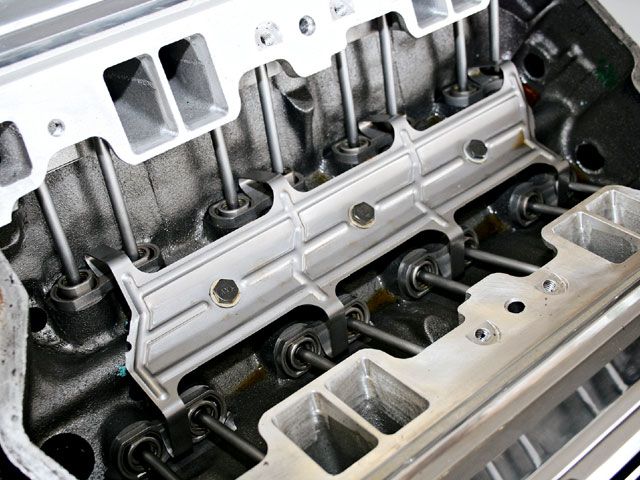
Did block have the bosses for the tin lifter alignment AKA spider? Engine look like this by any chance? If not, there is a big part of the problem. Lifters could be spinning in lifter bore causing the tick and not so slowly killing the cam.
rollerspider.jpg
 
Wait a sec...you said you had rollers stuffed in a TBI block? Don't know the details of your engine but did kinda follow your cross country saga. Tried looking for engine details but 9k + posts makes it difficult.
TBI truck blocks are not set up for roller valve trains.
The block needs to be machined for rollers...unless you have a post '92 truck block. TBI truck roller blocks are nearly nonexistence. Won't say completely as there are tales of '91 TBI truck blocks have roller bosses.
Most common are passenger car only blocks that got OEM rollers in this era.
Push rods get shorter with roller lifters and springs need to be changed.
Did block have the bosses for the tin lifter alignment AKA spider? Engine look like this by any chance? If not, there is a big part of the problem. Lifters could be spinning in lifter bore causing the tick and not so slowly killing the cam.
rollerspider.jpg

Just about EVERY block after 1987 were machined for roller lifters but trucks never had roller cams until the Vortec engine came about.

To the original poster, have you replaced the rocker nuts yet with NEW ones? The nuts are really one time use although people reuse them all the time but if they are fairly easy to turn when doing an adjustment they are bad and need to be replaced.
 
Just about EVERY block after 1987 were machined for roller lifters but trucks never had roller cams until the Vortec engine came about.

To the original poster, have you replaced the rocker nuts yet with NEW ones? The nuts are really one time use although people reuse them all the time but if they are fairly easy to turn when doing an adjustment they are bad and need to be replaced.

Sorry but I'll call you on this. I respect your knowledge but this not true.
Only passenger car blocks were machined for rollers. TPI and LT1 only.
Show me a Gen II one piece main seal truck block produced after '87 with bosses machined for roller cam. Some bosses were there but undrilled/untapped and some had no previsions for roller bosses at all.
 
The block was roller ready, I saw the lifters and cam in there when the engine was built. It takes some little kit to keep them in track or something, it definitely wasn't a slap in and play setup.

I don't know about the rocker nuts, I wasn't the one who installed everything, they did leave the covers, intake and oil pan off for me to inspect, they always did this for new engines as they had a lot of guys that wanted to recheck the torque specs before final assembly.

The block didn't have that tin plate, but whatever kit was purchased to use the roller lifters utilizes those bolt holes.
 
I've had 2 both original motors. On 350 in my 90 suburban I had. It was roller ready.

Another 89 305, even had a roller cam in it. It was in a k1500.

I got a 88-94 one piece rear seal off a member on here, it was not drilled/machined.
 
Sorry but I'll call you on this. I respect your knowledge but this not true.
Only passenger car blocks were machined for rollers. TPI and LT1 only.
Show me a Gen II one piece main seal truck block produced after '87 with bosses machined for roller cam. Some bosses were there but undrilled/untapped and some had no previsions for roller bosses at all.

The engine in my 89 blazer is a roller ready truck block as is the original engine I removed.
 
Ugh...in my drunken Jack Daniels/cough syrup state I screwed up a little so let me first apologize for mucking up your thread. :o Not very helpful...

I had two thoughts going on last nite in my coconut and mixed them together along with some wrong yrs too.

The "TBI trucks were roller cammed from factory" argument vs the TBI block roller cam provision argument.

The L05 TBI truck never came with roller cam as we all know however block may or not have provisions for roller cam.
Common casting number is see is 14101148, non roller truck block.

Bosses may or not be there and may or may not be drilled & tapped. That's only one part of equation. The top of lifter bores would need to be machined flat to accept the roller lifter retainers.


The 305 roller was Camaro/Firebird thing. Around 90-91 I think but could have earlier too. Seen one or two but never really messed with 305s.
Casting number would have ended in 058.

10054727, 14079287, 14088548, and 14101148 are flat tappet non roller blocks.

10243880 (Vortec#),14011148, 14088526, and 14093638 are roller blocks.
And any of them could be 2 bolt or 4 bolt main.

Some service blocks did make it into production on trucks & cars so again there is another roller block and they would have a machined mech fuel pump boss.
Depending on production needs, any block could end up in a truck but again most common is the 14101148 block.

The LT1 and TPI 350 engines were roller cammed as were the cop car TBI 350. Buick Roadmaster and the Caddy 350s also got roller cams.

Anyway, to say nearly EVERY block since 1987 is roller ready is not correct.
I have come across far more truck engines that were not roller ready. My current 89 Blazer (Flint plant, 08/88 doesn't have the bosses nor did my last four 89-94 blocks but picking up a '95 truck block tomorrow that is roller ready.
I did have an 88 that was roller cam ready but it was a service block in a bone stock '88 Blazer.

Photo of '89 TBI truck block. Bosses there but not drilled/tapped but lifter bores machined for retainer. Not roller ready.

 
Irish, it's useless to argue with you about this, just remember that I professionally built engines for 22 years and have probably seen many more than you have.
 
so yeah, anyways,,, brands, Comp Magnums is the only name I see up here, I' not doubting the given info, thank you, was just curious about any others or any thoughts, experiences? Engine builders? :D
 
Ok, not to distract from the OP's thread but since it was brought up here and I was told differently i'm going to post a pic of my 1989 FACTORY ORIGINAL 350 TBI BLOCK to show that it IS a ROLLER READY block with the bosses drilled and tapped AND the lifter bosses machined for the lifter bars. This engine had 217K original miles in 2008 when I pulled it to install the engine that is currently in my rig.

factory 89 blazer engine.jpg
 
Scott and Irish...just a little PSA for both of you. You both have a ton of great info to share, you are both well respected here. So share what you know, and accept that GM didn't do anything definitive with anything for the majority of the time it's been in business. One example doesn't make a rule, for every rule there is an exception etc etc.

My take is roller ready was a crap shoot. Certain years having better odds, but beyond that there isn't anything the General did you could rely on 100%. They have always had a rep for building stuff by dredging the obsolete bin and just making it work (sometimes).

no need to argue, or break out the dick measuring tools.:D
 
Scott and Irish...just a little PSA for both of you. You both have a ton of great info to share, you are both well respected here. So share what you know, and accept that GM didn't do anything definitive with anything for the majority of the time it's been in business. One example doesn't make a rule, for every rule there is an exception etc etc.

My take is roller ready was a crap shoot. Certain years having better odds, but beyond that there isn't anything the General did you could rely on 100%. They have always had a rep for building stuff by dredging the obsolete bin and just making it work (sometimes).

no need to argue, or break out the dick measuring tools.:D

I will say this, the roller cam was brought into production in cars starting in 1987. GM didn't just automatically have a stash of blocks sitting around waiting for 1987 to arrive to install a roller cam so yes for a year or two i'm sure there are non roller ready blocks out there. My whole point is that there are way more roller ready blocks without roller cams than there are non roller ready blocks.
 

Latest Posts

Top Bottom