CK5
Register an account today to become a member! Once signed in, you'll be able to participate on this site by adding your own topics and posts, as well as connect with other members.

My TBI computer chip programing thread/adventure.

So if my calculations are correct, i have taken away approx 40% of fuel at idle. Does that sound normal?

 
Info formyeslf to take into consideration later,

I had the same thing with my 350HO. With Fast's advice, I enabled open loop idle and set the AFR at 13.5 and it idles the the L05 did. I know it burns more fuel, but it idles so well that I don't want to go back to closed loop idle. Same here man,BLM/INT was 128 at idle but it shaked, even at 800 rpm for me. Now it's like butta at 650 rpm.
Before OL idle, I changed everything from injector terms to SA to prop gains, etc and nothing worked. Idle SA for me with the open loop idle is about 28 deg. Try it out!
Mike

From here,

http://www.thirdgen.org/techboard/diy-prom/421143-pointers-help-me-get.html
 
Anothe question/concern of mine is the IAC steps. With my old computer, the steps were like around 5-8 IIRC, and now they are like 35 or so. Should i dick around with any of that?
 
Look up the TPS sensor adjustment and the Minumum air adujment on third gen tech articles, first! Then see what data says.5-8 is a little low. 35 is OK on stock motor high side, cammed motor low side. Once you do min air adjust you must do TPS adjust. That will put you where you need to be before adjsuting anything to do with IAC in prom. :waytogo:
 
Info formyeslf to take into consideration later,
I had the same thing with my 350HO. With Fast's advice, I enabled open loop idle and set the AFR at 13.5 and it idles the the L05 did. I know it burns more fuel, but it idles so well that I don't want to go back to closed loop idle. Same here man,BLM/INT was 128 at idle but it shaked, even at 800 rpm for me. Now it's like butta at 650 rpm.
Before OL idle, I changed everything from injector terms to SA to prop gains, etc and nothing worked. Idle SA for me with the open loop idle is about 28 deg. Try it out!
Mike


From here,

http://www.thirdgen.org/techboard/diy-prom/421143-pointers-help-me-get.html
That is exactly what I had to do with that BB Mopar cammed engine... good advice! I'm not sure you need it yet and if you still have a cat it will not like it at all!
 
About the minimum air thing, i have done it before. Several times in fact! But, with my old computer. Do i need to do it again with this one? And yes i do have a cat, but its just one of the cheap magnaflow hi flow units.
 
Oh yea, one more question, Is there a way in the 7747 to just turn off closed loop at idle, but allow it to come back on during cruise?
 
Couple more notes to self from here,

http://www.thirdgen.org/techboard/diy-prom/360906-tonights-fueling-question-idle.html

A typical TBI system will idle with an IAC count of 35 to 45. On a cam'd
engine, zero steps may be better. Myself, I shoot for three to five steps
with a warm engine, and no A/C. The reason for this has to do with the
injectors residing above the throttle plates.


During idle, the TBI injectors are designed to spray onto the bore walls.
When this happens, the fuel runs down the walls, and past the throttle
blades. The air speed past the throttle blades is very high. This action
shears the fuel into vapor that is then able to travel to the chambers.

If the engine idles with a high IAC count, this IAC air is bypassing
the throttle blades, hindering the flow of fuel into the plenum. By
opening the throttle blades and reducing the IAC counts, there is a
greater volume of air drawing fuel past the throttle blades.

Next time you are timing the engine, shine that light into the TBI
bores, and look. Then, knock out that throttle blade adjustment plug, and
turn it in. Just keep an eye on the IAC count, you do not want to try
to get it below zero. This is the reason I set the idle to have at least
a couple of counts.

0x5C7: Time delay for small error IAC retract. (desired idle too low)
0x5C8: Time delay for large error IAC retract. (desired idle too low)
0x5C9: Time delay for small error IAC extend. (desired idle too high)
0x5CA: Time delay for large error IAC extend. (desired idle too high)

The past four entries are used to slow-down, or delay, the operation
of the IAC at idle. When in closed loop idle, the IAC attempts to
maintain the desired idle. The error term is the difference between
the desired idle rpm and the current engine rpm.

A larger error term has a shorter delay, to move the IAC quicker. Once
the idle is close, the delay is longer. This is done for better control
of the idle speed.

If the engine idle oscillates wildly, seems like the IAC can not
'keep-up', increasing these values (slightly), may correct it. Note
that an oscillating idle can also be caused by incorrect VE% and SA
tables.

An oscillating idle can be caused by:

Incorrect VE% table (flatten idle area).
Incorrect SA table (flatten idle area).
Too fast IAC reaction, increase (slightly) the delay values
at 0x5D7 through 0x5DA.
Stall saver set too high (it's kicking in).
Battery voltage varying.
 
About the minimum air thing, i have done it before. Several times in fact! But, with my old computer. Do i need to do it again with this one? And yes i do have a cat, but its just one of the cheap magnaflow hi flow units.
No need to do it again because of a ECM or chip change. Those are mechanical adjustments.

Forcing open loop idle and changing AFR with a cat is not something I would advise. Cat is designed to run at 14.7 AFR and very hot. With lower AFR at idle will raise Cat temperatures even more.

Your finding tricks for motors built more than yours and probably cat delete. You don't need these tricks.
 
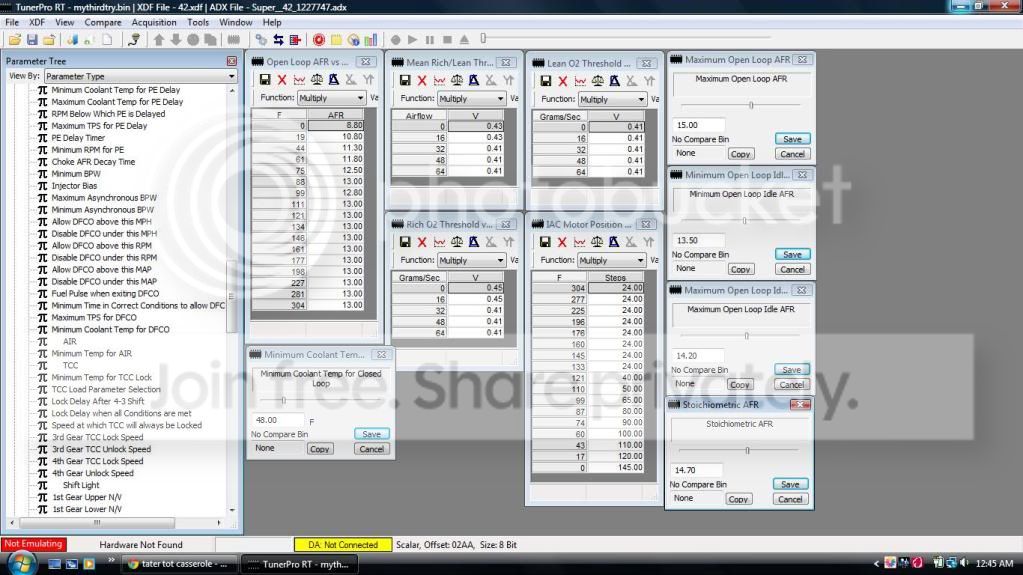
Screenshot of final adjustments. BPW is still stock at 135.
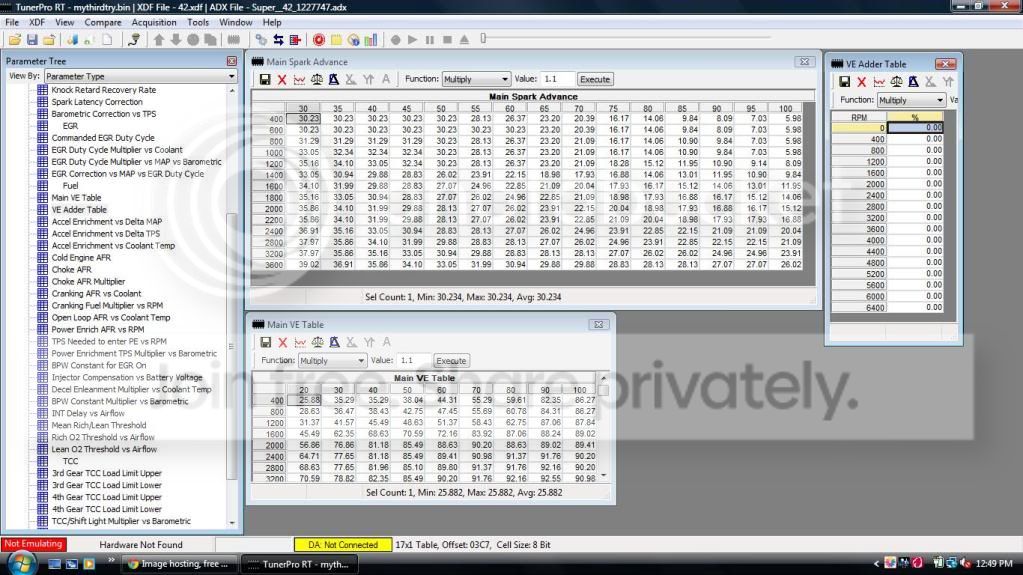
thirdtryfinal.jpg

I have not had a chance to look at the logs. I think you are making good progress.:waytogo: I think your learning curve is less steep now that you can see how the chip changes are changing the data logs.:waytogo:

Typically, I like to get the BPW set first. I like to get a BPW (when the VE tables are combined) so that has VE cells are ranging in numbers from low 40's to mid 90's. Injectors seem to work best when the VE numbers are between 45 and 95. I think a BPW of 133 would work better because the low numbers in the VE table will need to be closer to 40's, and get the injectors working better.

dave w
 
I have been nervous so far about messing with the BPW. The ve table i can wrap my mind around with a visual, the BPW is still somewhat "mysterious" to me. I do plan on it in the end im affraid. The funny thing about all this, is that i really dont plan on having this thing hit the road for at least another year! So until then, i just want the dang thing idle right so when i move it to mow the lawn im not instantly annoyed! Also, this way, when i do get it on the road, i will have gotten the "hard part" out of the way. I really wish i was willing to spend the money on some time of emulator gizmo that would allow on the fly adjustments! That would be super awesome! It has already started getting old having to pull the chip every time i want to adjust even the slightest thing. Im still kinda considering playing the the afr cause i dont really need my cat. If it does get toasted its not big loss. Seems like alot of people over on TGO(ive obviously been spending tons of time over there) have had a situation like mine where the blms are right at 128 or very close to it but it still runs "rough". Of those people, some have had success playing with things like idle deadband, o2 threasholds, and afr's. Just not really sure what else to do to get rid of that roughness. Or my part throttle "surge" where i can sit in the driveway, bring the rpms up, and have them go WWWWWWWwwwwwwwWWWWWWWwwwwwwwwWWWWWWWWWwwwwwwwwwWWWWWWWwwwwwwwWWWWWWW
Anyway, we'll see.
 
I have been nervous so far about messing with the BPW. The ve table i can wrap my mind around with a visual, the BPW is still somewhat "mysterious" to me. I do plan on it in the end im affraid. The funny thing about all this, is that i really dont plan on having this thing hit the road for at least another year! So until then, i just want the dang thing idle right so when i move it to mow the lawn im not instantly annoyed! Also, this way, when i do get it on the road, i will have gotten the "hard part" out of the way. I really wish i was willing to spend the money on some time of emulator gizmo that would allow on the fly adjustments! That would be super awesome! It has already started getting old having to pull the chip every time i want to adjust even the slightest thing. Im still kinda considering playing the the afr cause i dont really need my cat. If it does get toasted its not big loss. Seems like alot of people over on TGO(ive obviously been spending tons of time over there) have had a situation like mine where the blms are right at 128 or very close to it but it still runs "rough". Of those people, some have had success playing with things like idle deadband, o2 threasholds, and afr's. Just not really sure what else to do to get rid of that roughness. Or my part throttle "surge" where i can sit in the driveway, bring the rpms up, and have them go WWWWWWWwwwwwwwWWWWWWWwwwwwwwwWWWWWWWWWwwwwwwwwwWWWWWWWwwwwwwwWWWWWWW
Anyway, we'll see.

One cause for surging is the injector duty cycle. We all understand that the injector is cycled on / off hundreds of times a second. There is a "ZONE" or lower / upper limit of times the injector can be cycled on / off per second and work correctly. I think having low VE table numbers is not good.:eek1: I also think having high VE table numbers is not good.:eek1: Ideally, the VE numbers will gradually increase as engine load is increased and engine RPM will increase. Surging can be caused by having a few neighboring VE cells having large increases in values, and not gradually increasing as engine load increases and engine RPM increases.

I think most all experienced chip programmers would agree with me, when I say, the BPW is a course adjustment and the VE table is a fine adjustment.

Don't fear the BPW setting. Always make small baby steps in BPW of only 2 or maybe 3. I posted earlier, adjust the BPW so the combined VE table numbers are between 45~95. The injectors will be sooooooooo very happy with VE numbers between 45~95.:doah: No matter who you talk to about tuning a chip, absolutely no one has ever posted a good reason NOT have the VE numbers between 45~95
dave w
 
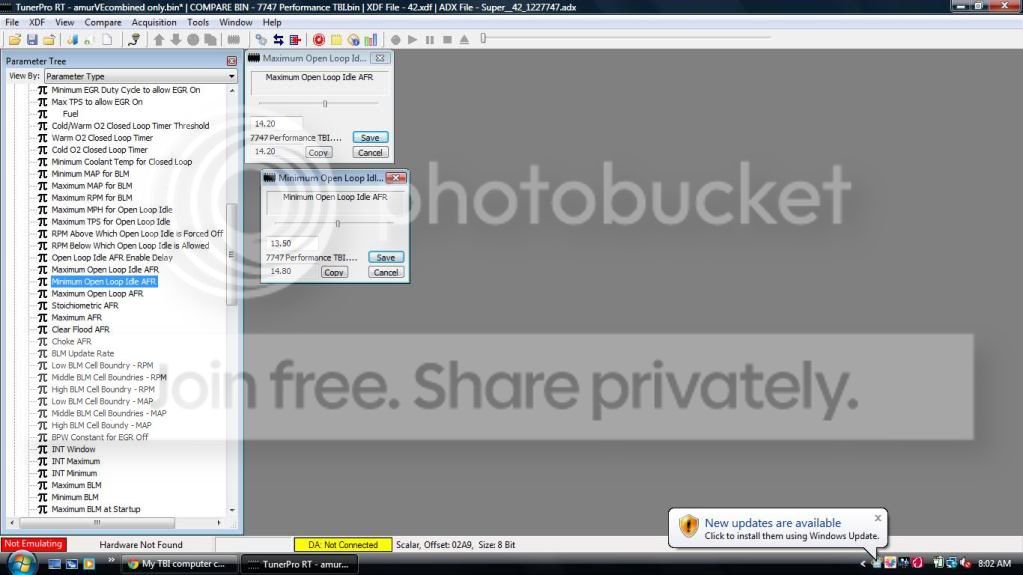
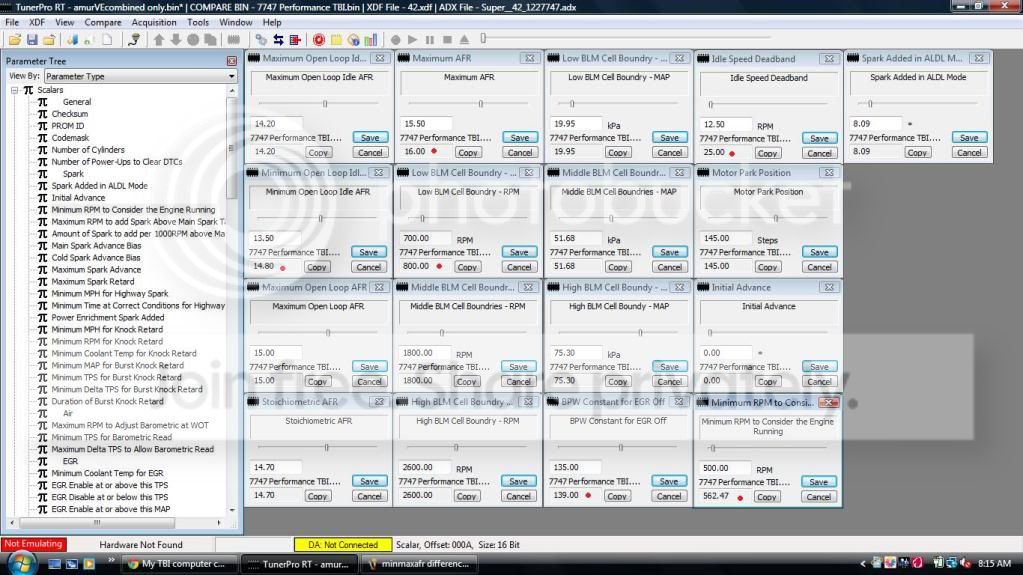
Got it. So then in that case, should i(with the ve tables still combined) leave the ve tables totally stock and adjust my blms at idle down using just the BPW? Also, i noticed a strange thing messing around in TP just now, the min/max open loop afr between amur and the performance bin are different. Do you know what reason the change is for?

minmaxafrdifference.jpg
 
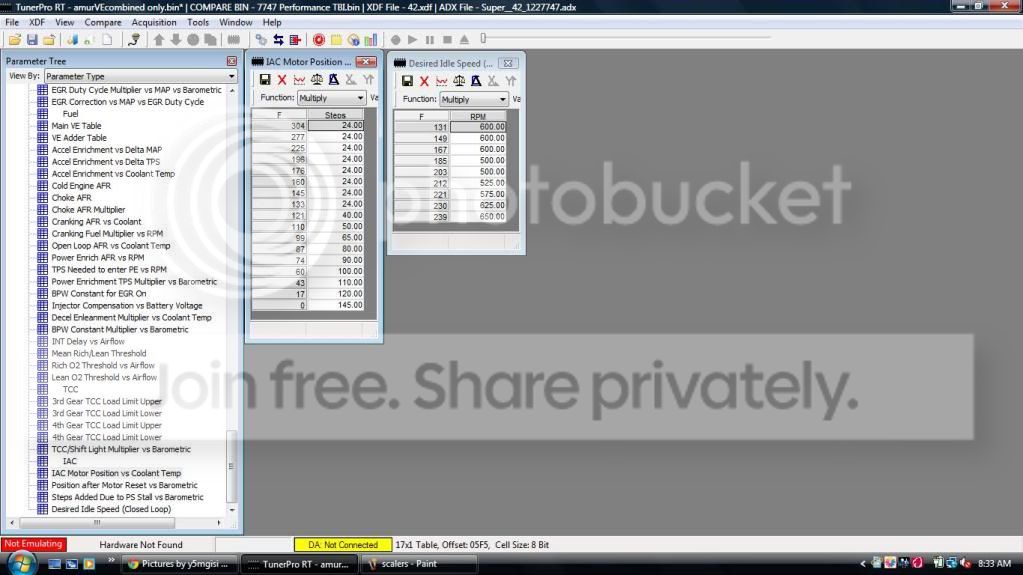
Bunch of scalers. All the ones with a red dot show a difference between amur and performance bin. Any ideas on the reason for these changes?

scalers.jpg
 
Everyone tunes a chip differently, but usually there is common ground that most all tuners agree on. I'll try to focus my comments that are generally accepted as common ground.

Starting with a stock .bin is good.
I often start with a stock .bin with changes to the Timing Table and combined VE tables. By the way, many tuners feel their timing tables are a "Trade Seceret"!

The next step is to tweek the BPW to get the combined VE tables to populate with numbers between 45 ~ 95. This step is easier said then done. Quite often a performance cam likes timing of 18 ~ 22 degrees at idle and near idle RPM's. Quite often a performance cam works best with total timing advance of only 32 ~ 36 degrees. Quite often a performance cam needs all the 32 ~ 36 degrees of advance by 2800 ~ 3200 RPM.

I've learned not to cloud the data log with multiple .bin changes. I change either Timing or VE, never both at the same time. Timing or VE changes will usually affect both BLM and Kpa. Knowing how much timing or how much VE changed the BLM and Kpa is the difference between a headached and successful tune!


I've also learned that chip swapping sucks, and using an emulator is the only way to get an engine tuned in a short amount of time. Makining one change at a time to a .bin is an accurate way to tune, but is a slow way of tuning. Using an emulator is the best tool for quickly seeing how making one change to the .bin affects the BLM's and Kpa's.

dave w
 
I hear ya. I whish i could get myself to spring for the emulator, but i just cant quite get myself to do it knowing that i could very well possibly put less then 10 miles on this truck over the next 3 years. And also knowing that i am going to be swapping in a 5.3 or 6.0 ASAP! But, what im kinda hoping to do is get it running good enough to where i can just get motivated to WANT to drive it again! As it is, its just unpleasnt to drive and kinda ugly. I know it will be a looong time before i can get it painted so if i could at least get it running good i would settle for that to allow myself to be re-motivated. Any how, blah blah blah, Starting to think the dern cam swap would have been faster/easier! But, i'll get there. Eventually.
 
Bam! Just got TP to logg! Right as i need to be done for the day and get ready for work... So tomorrow i will just go ahead and log some data with TP. Then, my next question, is how do i post TP data loggs here? Do i zip them like i had been with winaldl?
 
Top Bottom