CK5
Register an account today to become a member! Once signed in, you'll be able to participate on this site by adding your own topics and posts, as well as connect with other members.

Power wheels - dual 12v motor upgrade

16ga wiring and two 30a relays. Got the harness nearly built. Need to pick up some quick connects. I also got everything reverse engineered. I forgot this thing had lights and a stereo.

IMG_20200411_135041.jpg

IMG_20200411_135045.jpg

IMG_20200411_135057.jpg

MVIMG_20200411_133900.jpg

IMG_20200411_152405.jpg
 
16ga wiring and two 30a relays. Got the harness nearly built. Need to pick up some quick connects. I also got everything reverse engineered. I forgot this thing had lights and a stereo.

View attachment 335945

View attachment 335946

View attachment 335947

View attachment 335948

View attachment 335949

Where did you get the schematics from? Haven’t looked at them closely, but is that +12V I see going to the speaker or is it just labeled incorrectly? Should be the +signal coming out of the amp.
 
It's the 12v feed to the speaker system. I didn't feel like drawing the circuit board haha. It's a whopping 2w speaker. I should have done this part first. I'd have eliminated that circuit and wiring. Oh well. Now she'll have the fastest and loudest power wheels on the block haha.
 
It's the 12v feed to the speaker system. I didn't feel like drawing the circuit board haha. It's a whopping 2w speaker. I should have done this part first. I'd have eliminated that circuit and wiring. Oh well. Now she'll have the fastest and loudest power wheels on the block haha.


Whoa, wait a minute. The stereo system and headlights were running off of 6V and now you’re going to run them off of 12V? Have you verified that these two systems can handle that before you fry them? Headlights can be wired in series if they were originally in parallel.

Also, red wire in the second drawing - goes to headlights I assume?
 
Meh they'll be fine haha. I've got some left over LED's from a project on my truck that I might throw in. I think they are like 500 lumen or something like that. The radio has never been used and probably never will be. Requires something with an aux out. Be cool if it had an FM antenna. I do have a spare head unit. Hmmmm.

Actually, the red wire goes straight from the circuit board to the main on//off switch and then has a pink wire that ties into it and then goes to one side of the throttle switch. It also supplies the power to the speaker system. It's a useless wire that could be bypassed entirely and just run the lead from the main on/off switch to the throttle switch.

The lights are actually tied into the motor side of the system as they only turn on when the motors are active.

IMG_20200411_103042.jpg
This is the main on/off switch. Both wires run straight back to the circuit board.

IMG_20200411_100715.jpg
This is the throttle switch. The wire with heat shrink is the jumper from the red wire. The other pink wire goes to the middle post of the next picture.

IMG_20200411_103127.jpg

This is the forward/reverse switch. Blue and yellow go back to the circuit board and tie into the relays. Blue in relay 1 which I believe is forward and yellow to relay 2 which is I believe reverse.
 
Meh they'll be fine haha. I've got some left over LED's from a project on my truck that I might throw in. I think they are like 500 lumen or something like that. The radio has never been used and probably never will be. Requires something with an aux out. Be cool if it had an FM antenna. I do have a spare head unit. Hmmmm.

Actually, the red wire goes straight from the circuit board to the main on//off switch and then has a pink wire that ties into it and then goes to one side of the throttle switch. It also supplies the power to the speaker system. It's a useless wire that could be bypassed entirely and just run the lead from the main on/off switch to the throttle switch.

The lights are actually tied into the motor side of the system as they only turn on when the motors are active.

View attachment 335965
This is the main on/off switch. Both wires run straight back to the circuit board.

View attachment 335966
This is the throttle switch. The wire with heat shrink is the jumper from the red wire. The other pink wire goes to the middle post of the next picture.

View attachment 335967

This is the forward/reverse switch. Blue and yellow go back to the circuit board and tie into the relays. Blue in relay 1 which I believe is forward and yellow to relay 2 which is I believe reverse.

Awesome! I’ll take a better look at things tonight. Good reading material. :D
 
The part I'm struggling with is how to wire the relays up. The original system used two relays, 1 for forward and 1 for reverse, for a single motor. I'm now running dual motors and while I think it would still work the same, I don't know. It would be great to have one relay per motor that does both forward and reverse but I don't think that can be done.
 
My boys wanted more power too so i gutted one of my makita chargers and wired the contacts to the power cord with some spade connectors on the other end that plug straight into the gator. Strapped it to the hood for easy battery changes. It will fly now w 18v on it.

5227B412-7C27-4235-BA05-9996B6315E1C.jpeg

44A97AAF-B6C7-4001-BF89-4BA82DC89C01.jpeg
 
The part I'm struggling with is how to wire the relays up. The original system used two relays, 1 for forward and 1 for reverse, for a single motor. I'm now running dual motors and while I think it would still work the same, I don't know. It would be great to have one relay per motor that does both forward and reverse but I don't think that can be done.
As long as you have a separate power switch or relay, one relay to control direction is easy. Depending on the current, both motors could run off one relay, just wire them in parallel.
If you used two relays, one per motor, that would reduce the load on the contacts. Just use DPDT relays. Hook the motor wires to the common terminals, hook positive to one NC and the negative to the other NC.
Then hook positive and negative to the opposite NOs.
I would wire it so that the motors run in forward with the relay off, thus reducing the power drain slightly when driving forward.
Like I said at first, you will have to have a on-off pedal that controls the power to the motors before the relay, or something, because the motors would be hooked to power all the time otherwise.
Just make try to make sure that the direction change is not made under power. Not only would that wear the relay contacts faster, but if one of them were to not do a break-before-make, it would short the battery out.
 
I meant to post this last night but I dozed off before I finished it.:doah: Hopefully you didn't wire it up already.
A few things with your schematic. First, are you sure the relays you got are both dual 87 terminals (SPST relay) or is one 87 and another 87a (SPDT)? There should be a diagram on the side or top of the relay to show it's internals along with the pin numbers. Second, we want the polarities on the leads of the motor to both be able to switch between positive and negative. The way you have it drawn up the one lead on each motor is hard wired to ground. Third, and most importantly, you see when you turn on the relay on the right there is a dead short to ground - terminal 30 is 12V then it goes through terminal 87 to the motor which is tied to ground.

upload_2020-4-12_2-1-26.png

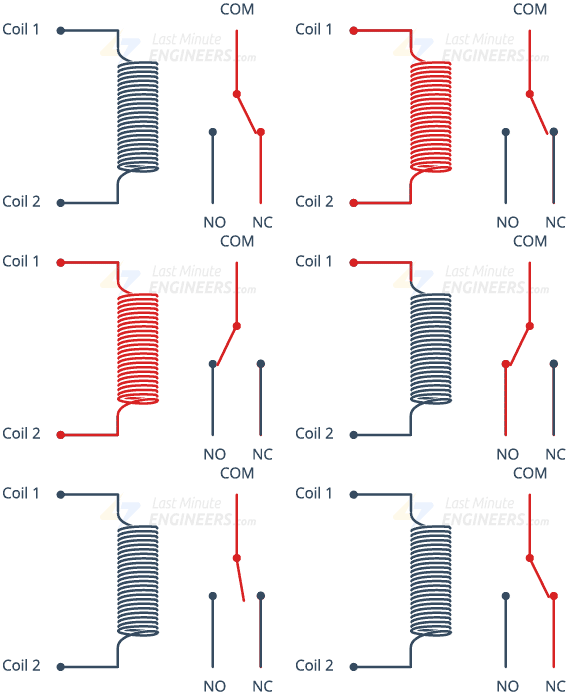
So if you're trying to replicate the original printed circuit board you would need two relays with the 87 and 87a. They are sort of hooked up in reverse of how you'd normally think they work. In case you don't know how this relay works here's a little animation:

Coil 1 = pin 86
Coil 2 = pin 85
COM = pin 30
NO = pin 87 (NO means Normally Open when the coil isn't energized)
NC = pin 87a (NC means Normally Closed when the coil isn't energized)

relay-working-animation2.gif


As you can see, when you don't apply voltage to the coil (pins 85 and 86) then COM and NC (pins 30 and 87a) are connected together and when voltage is applied to the coil the then COM and NO (pins 30 and 87) are connected together. What we're going to do though is connect power and ground to pins 87 and 87a respectively so we can switch pin 30 between power and ground.
Here's the schematic from the printed circuit board you posted:

Motor direction control.jpg

Both motors each get one wire to each relay (in parallel), if they run in the wrong direction just swap wires on the motor.
And as @Fordum said, this is assuming the relays can handle the current of both motor, otherwise you need to make two of these circuits, one for each motor.
 
Last edited:
That ground short was purely an oversight on my end.

Thanks for the information!!! Hopefully this weekend I can get it wrapped up. I need to double check if they are 87//87a or just dual 87's. I can't remember.
 
our Jeep project has been , well like a Jeep project.


My oldest son Parker installed some 40k rpm motors.


CA179E47-9FF8-49A1-971D-B95D677BD989.jpeg


The new motors are nice because they have a tab that you can screw to the body so you don’t get that motor bounce like the factory setup.
A819A48A-8E09-45DB-909D-F02778E27A8E.jpeg


my youngest one Austin is checking to see how we’re going to convert it to 4wd.

7ED7C3D1-9D33-41F7-B185-17F45BEB8B6F.jpeg


Here’s our setup for now.


No judgement on the spaghetti it’s still in testing.and I need to add some circuit protection
And mont all the components to the firewall.


70405C41-91E5-451F-A820-52AF428FA8B1.jpeg

12v system runs all the normal stuff except the output to the motors flips the relay switch and connects the 18v battery to the motors. there is a motor speed controller in the top left corner.

I tried the cheaper winch switch at first but like mentioned before it was poorly built and faulty. It only worked one way.

So I spent a few more bucks and got a Warn winch
Switch. It works good but now I need to add those L7812 voltage regulators to keep the amps low so I don’t burn out the receiver unit or the winch switch.

Since my output of the receiver is reverses polarity for forward / reverse I plan to put one on both sides.
 
Just to add a small comment, @pblaze725, you say you keep burning out your 12V remote control receivers, you do know a simple LM7812 regulator would cure that? Right?
Its a simple three terminal linear regulator that will take from 15 to 35 volts and give you 12 volts at about one amp.
A couple of small capacitors are usually used for stability, but in a pinch I have gotten away with just running one straight.
They run about $1.5 in single lots.
Here is a spec sheet, I think it worked.
The problem with these, is that they are linear. So, they have to dissipate the excess power as heat and are not that efficient.

Hey @Fordum -

will these LM 7812’s work on a reverse polarity circuit?

my power supply for the relay switch is
(+-) forward, (-+) reverse.
I figure I would put one one each side between the relay and control unit.


BE20F504-379D-40FE-A313-7F915E4C03BC.gif
 
Hey @Fordum -

will these LM 7812’s work on a reverse polarity circuit?

my power supply for the relay switch is
(+-) forward, (-+) reverse.
I figure I would put one one each side between the relay and control unit.


View attachment 338784

The 7812 is a voltage regulator that, when you apply a voltage above 12V to the input pin (pin 1), will keep the output pin (pin 3) at 12V. Ground (pin 2) will always be ground. You can’t switch the ground and input voltage to the pins around if I understand what you want to do correctly.
 
I'm not 100% sure what you mean either. I assumed that the receivers were powered by 12 volts, and the output was relay contacts.
If so, then just let the 7812 power the 12 volt receiver and let the relay switch the higher voltage and current.
Remember, the 7812 will only handle about an amp, so you could not drive a motor with it.
On the offhand chance, that you really need minus 12 volts from the higher voltage, they make a LM7912, which is a negative voltage regulator. It generally works like the 7812, but regulates negative voltage.
You can get lost in the planning if you are not careful.
Also, the pinout is different. The input and ground pins are reversed.
Here are a couple of pics that might help.
First, the pinout:
LM7912-pinout-diagram.jpg

And a circuit where it is used.
LM7912-example-circuit-negative-12-volt-power-supply.jpg

Try explaining a little differently, and I'm sure either Rampage or I can help.
 
ADF2ABB5-98C9-4505-AA83-C27036128EA4.jpeg

This is the control unit. The connector in my hand sends 12v power to the motors. the polarity switches for reverse.

I’m using these posts to flip a winch switch that connects an 18v power to the motors.
 
View attachment 338855

This is the control unit. The connector in my hand sends 12v power to the motors. the polarity switches for reverse.

I’m using these posts to flip a winch switch that connects an 18v power to the motors.

Didn’t forget about you. Was trying to decipher the two different poster’s info last night and the compounded issues you were having and the next thing I know I opened my eyes to the beginning of daylight. :doah:

We shouldn’t be having this much trouble. Could you post a link to the Warn switch you got or the part number. Also if you know how many watts each motor is or the current it draws or a link that would be great too. Also, if you know the power rating/amp draw on the control unit and receiver unit in the car too. Should be printed somewhere on the units themselves.

The reason I ask for all this is because there’s a few ways to do this. One is to use the 18V battery to run everything and have the LM7812 power the electronic only - that is if they don’t require more than an amp. Another would be to use the schematic I posted earlier and use two separate batteries - the forward/reverse lines would be connected to the two wires you are holding and instead of the +12V I have shown it would be your 18V. We would just need to find relays that can handle the current, have a coil that operates off 12V and the contacts can handle a minimum of 18V. There’s a few other ways too but just to give you an idea of where we’re going and why the info I asked for would be helpful.

And I just noticed that you’re in my neck of the woods (well, part of the year at least), so I’ll try to find something from Jameco since you’re right next door to it. :waytogo:
 
I didn't forget him either, but ran into a few things lately around here and been just coming in and crashing. I agree, we are missing some communication somewhere.
When I suggested the 7812, I assumed it would run the remote control unit and everything else would run off the 18 volts.
Didn't figure the receiver would draw all that much. Of course, if its switching a large relay or two directly, we may have to toss a 2N3055 in the mix.
I just assumed it would switch a small ice cube relay or two and let them drive the big ones.
I've got maybe two more days of trouble to handle, and then should be able to jump back in. I'll be monitoring the thread and will try to jump in if needed.
 

Latest Posts

Top Bottom
