CK5
Register an account today to become a member! Once signed in, you'll be able to participate on this site by adding your own topics and posts, as well as connect with other members.

quadrajet: the fuel pump, fuel bowl, and accelerator pump

If I didn't have a return line, that would be the FIRST thing I'd do if I had a heat soak issue. Period. That I know of the fans used on the carbs were some of the big block trucks and the Monte SS's, both in the 80's, after they had already been using return lines. Without a return line it's pretty hard to measure if fuel temp is changing.

In a return line setup the tank would be a heat sink, sure, but my belief is that is only part of the solution to keeping the fuel cool. Engine temp at ~195* will mean some pretty high fuel temps if it's not moving real fast. Since ambient is never that high, even with no airflow the fuel lines are going to radiate heat. The higher above ambient the lines get, the more heat they will shed, differentially speaking of course.

I think if you were SOLELY relying on the tank as a heat sink, you would run into problems. With hot fuel coming back to the tank, eventually the tank temp will rise, and the feed temp will rise, eventually getting to the point that it takes very little increase in temp near the motor to boil the fuel.

IIRC, none of the setups with carbs used a fuel line clamped to the block between the carb and pump. Since GM did elsewhere on fuel lines, it wasn't solely an issue with rubbing IMO, it was probably to eliminate conducting heat from the intake into the fuel line.

I don't know why insulating the carb would be a bad thing...I know someone here had mentioned they had experienced icing with a carb before, but that is what THERMAC is for...I'm sure the carb being heated from the intake helps in that regard, but that would be counter-productive when heat became the problem.

None of the Q-jet base gaskets are made out of a material considered to be a good conductor of heat are they? Not sure why increasing distance from manifold with an insulated base would make things worse.

You mentioned the fuel vapor perhaps causing a rising idle, perhaps I've never experienced it because I never ran a "returnless" carbed setup? All mine have been the later return-line equipped setups, and I don't remember ever running into fuel issues (except starvation under prolonged WOT), even with a 400+ cubic inch motor that overheated pretty good.
 
I see now. The key point is both the intake and return lines are radiating heat with a ~100 deg F temp differential from ambient on a hot day. You double your surface area with both lines. Insulation on the intake line will help reduce temp until heat saturation of the fuel tank, and at that point the insulation is hurting your system.

Ok. What about increasing the cooling surface area on the tank or the fuel lines? I suppose bolting the fuel line to the frame might achieve just that.

EDIT: A key conclusion from your good point on fuel line radiant heat. With a return line fuel system. If you insulate. Insulate the exhaust pipe from radiating heat to fuel line. Do not insulate the fuel line to prevent absorbing heat from the exhaust.

Is the OEM exhaust routed down the frame rail opposite the fuel line? I use dual exhaust to increase ground clearance and provide clearance for drive shaft articulation. Both problems I had with my '72 OEM single exhaust.

The dwell time of the fuel next to the headers. With dual exhaust the headers sweep down along the frame and the collector sits just below the frame at the t-case. The OEM style exhaust manifold - particularly ram horns- collects everything into one pipe at the bottom of the heads, and then a single pipe drops straight down past the frame and under the engine. Providing minimal dwell time to radiate heat to the frame, fuel pump, and fuel line bundle.

I am now seeing the system-wide effect of changing the exhaust.

EDIT: Just for the record. With my current setup - dual exhaust, headers, no fuel return, uninsulated fuel lines, and the fuel filter sometimes touching thermostat (maybe that was cooling the fuel) - with a Holley, even in 110 deg F central valley heat, slow speed wheeling, almost overheating at 210 deg F, mid rpm in low gear, while nervous about boiling over, I have never had a detrimental problem with heat or boiled over. Might have been reducing performance, but nothing I noticed.

Right now I have the q-jet bolted flat to the intake with a thin gasket. I wanted to start with a 'hot' setup and then add insulating pads to see the effect. I did not expect fuel bowl evaporation would be the core issue. Possibly made worse by drainback of fuel to 1/2" level + slow leak in bottom plug + ethanol damaged accel pump skirt + a fuel bowl and venting not designed for volatile ethanol + upper 70+ air temps.

To cool the carb Cliff Performance suggested using the insulator gasket that comes with their rebuild kit. He has had good experiences with that and without cold weather issues. I will give both the insulator pad and the wood insulator a try. Maybe they are equivalent.
 
Last edited:
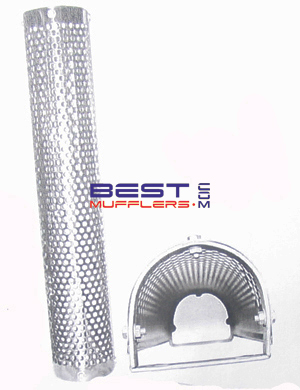
if I can buy/fabricate a 6' length of shield like this - I like the cooling holes like a barrel shield. EDIT: looks like it would plug with mud/rust fast. It would need to be made from stainless steel.

I don't want to boost anyone, but I borrowed this image from bestmufflers.com

GH636.jpg
I already bought some of this for the header bend. It is a tri-y so there are only two tubes at the frame. Pulled this image from hrpworld.com, not who I bought mine from but again, don't want to boost any particular vendor

At the fuel tank, I want to shield against heat takeup from the exhaust pipe - it passes inches away from the tank corner on both sides. I can use one of the pipe shields like above, but those are really expensive, and I am concerned with trapping mud. I bought some perforated heat shield - looks similar to this. Image is from heatshieldproducts.com

And I am thinking of forming it around the tank corners with an air gap behind it - haven't exactly figured it out yet, or how to shape it. More or less like this, but less exsexstensive coverage. Image from i.imgur.com

And the fuel return. Now I need to rethink all of this. Fuel return needs to be a part of this.
 
I run a 1 inch edelbrock wood spacer under my quadrajet and can't say it makes any difference.

I also have the plug kit installed with epoxy and still after more than a day of sitting cranking and pumping is required for start. I blame evaporation.

When I start my truck hot after approx more than 10 minutes sitting I have to just touch the pedal a bit and starts right up, a tad rough for a few seconds but then fine. I think a touch more bypass air will help that but haven't tried yet. If it sits for a few hours or less than 24 hours it starts with just the touch of the key.

I also have rerouted the fuel lines away from the block and don't use any metal lines after the pump. Don't believe that mattered either.

I use a glass filter just so I can see the fuel and also use the paper filter with no problems other than an occasional WOT problem of fuel press dropping off which I think the problem is in the tank. I've replaced all rubber lines everywhere suspecting collapse on the suction side to no avail.

I have a new tank and sender to install with the fourth line for a return to try if I choose.
You can run a pump with the third line or a filter with the third line for the return which is what I started to try and use the tank vent line to the canister for a return to the tank to give it a try but leave the gas cap loose or you will pressurize the tank. Ask me how I know so I abandoned that for now.

And on the power valve adjusting hole, that hole is not exposed to the bowl or vent in any way. Makes no diff on how it runs with or without the plug. With that said I use a threaded plug on mine to cover the hole.

Not sure what you are referencing with the idle creeps up.
On a cold start high idle of say 800 cold and more rotational friction could be 1200 or more on a warm engine with less rotational friction.

Always take the time and spend the money for a quality kit from Cliffs HiPerformance which also comes with the float and will modify the kits to what you want.
Just due to the fact that he gives free advice and has a forum is enough reason for me.
Some times he takes a bit to reply to the forum but worth it.

I like my quadrajets and gave up on Holly's 600 and 650's years ago before the truck avenger became popular but never tried one an don't care to.
 
blazer74, super informative post, nothing like real world experience to rely on.

You have tried everything I have also tried, and then you've tried everything I was going to try. No need for me to reinvent the wheel. Using the vent line for return was the route I was also going to take. For an alternative vent, there is a vent line on the filler neck. I was going to cut this and put a vent cap on both ends - it vents the tank and vents from the filler neck. I am still thinking about if I want fuel vapor in that part of the vehicle (probably as good as venting under the hood) and what will this do with the fuel pump auto shutoff.

So, there is a problem with the ethenal fuel evaporating from the quadrajet. The question is, why? And then, how to prevent the evaporation?

I never tried the avenger carb. It seemed like an untested gimmic. And there are a ton of threads with people having problems with them. My holley is from '94 and it basically now has all the avenger modifications plus the mods all the avenger owners have to make to get them to work. One thing I can say, the holley does not have the evaporation problem. It starts every time even if it has sat for awhile. Good to know, since if the holley can do it, the q-jet can too. So it must be a difference in the fuel bowl design, vent design, or the accelerator pump design. I am going to look at these three aspects and give them some thought.

Exactly the same thoughts about Cliff and the time he takes with discussing q-jet details. He will have my business for a very long time.

The idle. I see what you are saying. It could just be rotational friction changing the idle speed between cold and hot. I can make a test. I will pull the air cleaner and attach hoses to the vents and vent away from the engine to eliminate the possibility gas vapor is causing the rise. Either way, using the fast idle will probably resolve it. Right now I have disabled the choke and fast idle so I can work on a few variables at a time.

The fuel. I am going to do a few tests.
A) open a spare q-jet and fill the bowl with room-temp fuel, then time how long it takes to evaporate (EDIT: after a year I still have not tried this test).
B) after driving, measure the fuel temp in the bowl - then repeat the q-jet fuel test, this time with hot-fuel, all safety precautions taken
C) repeat with siphoned fuel condition - hot fuel with reduced fuel bowl level
 
Last edited:
I don't think the heat into the tank is going to be an issue. It probably wouldn't help, but at idle exhaust heat isn't going to be as much as when moving, and when moving, distance from engine (pipes have already shed a lot of exhaust heat) coupled with airflow probably doesn't make for efficient heat transfer into the tank. Look at it this way....how many people are having problems like you are? Guaranteed there will be some, but it's not the vast majority. Normally when that happens, it's a peculiarity with your setup, not a general flaw in design. Then again, with things such as carb fans, obviously in some very particular instances, GM recognized an issue. IIRC, the Monte SS's had aluminum factory intakes, it would make sense that would be an issue for fuel vaporization in the carb. Doesn't explain the HD truck carb fans of course.

From the factory GM did not run the exhaust on the same side as the fuel lines. It was drivers-side only after the introduction of catalytic converters (except diesels which had dual exhaust). Obviously cats get very hot, so bad idea to have them near the fuel lines, but woudl certainly reduce heat getting into the lines even with no converter.

FWIW I'm running dual exhaust (off the diesel) and don't have issues with fuel heat, but that again is on a ~43PSI system. I never really considered the exhaust proximity to fuel lines as anything other than a safety issue, but it now makes sense in this arena as well.
 
this tread is getting topic drift but it works

I purchased a thermometer with a data logger and before I do anything more, I want to know what the temperatures are with an open air cleaner while driving in moderate stop and go traffic, the air as it enters the carburetor

At carb air temp 125 Deg F

Outside airtemp measured 95 deg F

Weatherspark airtemp at nearest airport (10 miles) 85 deg F

Depending on what to use as outside airtemp - my measured temp inside the cab in the shade with windows open or the airport 'official' temp, with the engine at 185 deg F, there is a 35 to 45 deg difference between outside air and air at the carburetor. This is less than I expected.

Next I will measure the air temp outside the air cleaner and if possible under the carb (might be able to snake the thermometer wire through butterfly) and then fuel temperatures at a few different spots

to view attachment in spreadsheet, download and rename file extension from *.txt to *.csv

open the text file to read notes about start/stop times and outdoor airtemperature

blazer_airCleaner_temperature.jpg

blazer_airCleaner_temperature_.jpg
 

Attachments

  • blazer_airCleaner_temperature.txt
    42.2 KB · Views: 4
  • K5_air_temp.txt
    19.1 KB · Views: 3
Last edited:
Followup - after 2 hours the inside the air cleaner temperature is 100 deg F, the out side temperature is 76 F. I am amazed at the heat retention at the top of the carburetor.

Also found this "when a hot engine is turned off. Heat from the engine and exhaust system increases the temperature of the fuel in the system (which is no longer flowing). Carburetor float bowls are a particularly significant source of hot-soak emissions."

They are saying the fuel is evaporating from the fuel bowl.

As this thread is discussing, if it all evaporates, then you must somehow get fuel back in the bowl before the engine will start.

The question is, "can I keep the fuel from evaporating in the first place?"

A good starting point is that my Holley did not loose all the fuel, even after sitting several days in 100+ deg F summer weather. If Holley can do it, so can quadrajet, right?
 
And they have this advice

"For older vehicles equipped with carburettor and/or fuel return systems, engine operation results in a significant temperature increase in the fuel tank and/or the carburettor (Morgan et al., 1993). For such vehicles, the combined effect of high ambient temperature and exhaust system heat can generate a significant amount of vapour in the fuel tank. For gasoline vehicles with fuel injection and returnless fuel systems, the fuel temperature in the tank is not affected by engine operation,"

I learned earlier in this thread there is such a thing as a return system that was intended to reduce fuel temperature at the carburetor. My '74 K5 is returnless. So, if I can control the fuel temp at the carburetor some other way, I want to keep my returnless system since they say the heat in the tank causes the fuel to evaporate. This is not good for fuel economy.
 
Last edited:
This paper (pdf) found that over 24 hours, at 70 deg F, in an open jar, 10% to 25% of the E10 ethanol fuel evaporated.

A quadrajet has vents and is not an open jar, so there are differences. But, the vents are large, and there are two, so maybe it is the same as an open jar.

I'd guess that in 2 hours sitting in the fuel bowl at 100 to 120 deg F (assuming fuel is same temp as air in the near vicinity, fuel is probably hotter) an initial 25% probably evaporates. That is a super rough estimate based on the table they present since I cannot find a user friendly equation to calculate the loss.

Add to that some siphoning of fuel back through the fuel line.

That might be enough that the accelerator pump is dry after 48 hours.

And this paper (pdf) found that at 120 deg F you will lose .001 gallons of fuel in two hours.That is 1000th of a gallon, not much. But, I can't find anywhere what the volume of the fuel bowl is. I'd guess a 1/4 cup? That is .01 gallon, or 100th of a gallon.

So, to close the reality check, .001 evaporated from .01, that is 10%. And that that was not E10 fuel. It checks out. Both papers found that in the first two hours during 'heat soak' you are going to lose at least 10% of the fuel bowl volume to evaporation. And both papers reported wide variations in actual evaporation due to all the differences in exact fuel composition, exact this and that. So, 25% evaporation in the first 2 hours after shutdown with E10 fuel is probably right there. Then in the next 24 hours, another 25% evaporates. That does not leave much for fuel pump siphoning past the check valve and enough to get a full accelerator pump squirt.

I think this is case closed.

Now how to fix it?
 

Attachments

  • e10_evap_10473289%2E1994%2E10467294.pdf
    2.3 MB · Views: 0
  • hot_soak_P10021WT.PDF
    216.2 KB · Views: 0
Last edited:
An electric fuel pump would fill the bowl almost instantly before cranking,which would probably eliminate that problem...also would help with any vapor locking too..

I put an electric fuel pump on a riding mower I have,that had a problem with starting after it sat a few weeks--the carb would dry up,and by the time the tiny vacuum operated pulse fuel pump would refill the carb bowl,the battery was about flat from having to crank it 30 or more seconds...once I wired the electric pump up,I just turn on the key,wait about 5 seconds,and it'll fire off on the first revolution...the 20 HP Kohler Magnum now feels like it has all 20 horses too,it never felt as powerful with the stock fuel pump..it is old and probably not working that great..
 
dielsel4me, do you have an idea of how many of the CK5 community that still uses quadrajets have switched to electric fuel pumps?

My startup is not that bad. Right off, before turning on the ignition, I turn the engine over for half a second; I have a push button starter. Then, I turn on the ignition, pump the gas a once and it starts right up. Maybe the prelube is even a good thing. But, that is not how this thing was intended to work. And the electric fuel pump is a tempting solution for several reasons. But, electric fuel pumps have their own downsides. And this truck was designed without the electric fuel pump so it should work with just the mechanical.

I am guessing that back in 1965 that little fuel bowl was barely adequate with fuel evaporation. The technical report the engineers published basically said the fuel bowl was just enough to cover the evaporation loss, and that was not E10 fuel.

Maybe I need to put the little paper fuel filter and check spring back in the inlet housing. it might be that the shut-down siphoning is enough that even in '65 they had a problem with evaporation.

Also, the quadrajet has the fuel bowl right in the middle of the carburetor. It probably stays hot the longest there. The Holley has the fuel bowls on the ends, where they cool down. So, just by temperature dwell time after shutdown, I'd expect the quadrajet to loose more fuel to evaporation than a holley.

Maybe this is where wood heat insulators under the carburetor come into play.
 
Last edited:
"Adequate" fuel remaining is easily checked simply by watching the primaries and seeing if the accelerator pump gives you a few shots.

IIRC of the design, there is a check ball for the accelerator pump, but after one shot it should be nearly empty if the float bowl is dry.

I'm just going to put out there that "For gasoline vehicles with fuel injection and returnless fuel systems, the fuel temperature in the tank is not affected by engine operation," is false. Returnless yes, but that's relatively new on the fuel injection side. Fuel will always pick up heat in the engine bay.

Somewhere I've got my measured inlet air temps, using the stock "cold air" snorkel. Ah yes: "Anyways, MAT on restart after a short shutdown and some idling was 152*. After cruising down the freeway (60MPH) for 10 minutes, the MAT was 94*. Can't recall what ambient temp was, but I'd guess in the 70's and sunny. I was just as surprised that it took so long to cool off. I had expected it to decrease much quicker, but it leads me to believe the sensor is getting some of the temp reading from heat coming from the manifold metal, not just the air. I know I've seen 3rdgen posts on the different MAT sensors."

Much of GM's attempts to "improve" the Q-jet (and fuel system) were for emissions, and to better meet the expectations as consumers changed. From 1965 to 1990, vehicle miles travelled doubled (roughly) so what may have been an inconvenience in 1965 was probably considered unacceptable by the 1980's. More frequent startups were a given, so that would require mitigation of the heat soak issues.
 
This paper found that over 24 hours, at 70 deg F, in an open jar, 10% to 25% of the E10 ethanol fuel evaporated.

A quadrajet has vents and is not an open jar, so there are differences. But, the vents are large, and there are two, so maybe it is the same as an open jar.

I'd guess that in 2 hours sitting in the fuel bowl at 100 to 120 deg F (assuming fuel is same temp as air in near vicinity, fuel is probably hotter) an initial 25% probably evaporates. That is a super rough estimate based on the table they present since I cannot find a user friendly equation to calculate the loss.

Add to that some siphoning of fuel back through the fuel line.

That might be enough that the accelerator pump is dry after 48 hours.

And this paper found that at 120 deg F you will lose .001 gallons of fuel in two hours.That is 1000th of a gallon, not much. But, I can't find anywhere what the volume of the fuel bowl is. I'd guess a 1/4 cup? That is .01 gallon, or 100th of a gallon.

So, to close the reality check, .001 evaporated from .01, that is 10%. And that that was not E10 fuel. It checks out. Both papers found that in the first two hours during 'heat soak' you are going to lose at least 10% of the fuel bowl volume to evaporation. And both papers reported wide variations in actual evaporation due to all the differences in exact fuel composition, exact this and that. So, 25% evaporation in the first 2 hours after shutdown with E10 fuel is probably right there. Then in the next 24 hours, another 25% evaporates. That does not leave much for fuel pump siphoning past the check valve and enough to get a full accelerator pump squirt.

I think this is case closed.

Now how to fix it?
Finally I got the data-logger thermometer working, they had to send me a new probe.

Today it was 65 deg F in the garage and the official airport temp is 67 deg F.

During a short half hour drive down the freeway the fuel temp was 95 deg F.

I measured the fuel temp by sliding the thermometer probe down the heat sleeve that is over the rubber fuel hose. To limit outside heat transfer, I positioned the probe in the sleeve at a point where it is furthest from the engine block. I still have it in the sleeve so I can watch the cool down time. I assume the temperature inside the sleeve next to the fuel hose is the same as the fuel temperature. The hose will act as a an insulator but eventually the inside of the hose and outside will equalize. And since the sleeve is on there, it should equalize faster since the outside of the hose is not cooled by airflow. Summed-up, I am confident the fuel temperature is 95 deg F. And, on a longer drive it will probably be higher.

So, based on the above quoted thoughts, a lot of fuel is evaporating from this carburetor. Particularly since I'd bet the fuel temp in the float bowl is well over 100 deg F due to heat transfer from the intake manifold to the carburetor body. And after shut down the fuel temp likely rises higher to to heart soak once everything stops moving; no cooling air flow, no cooling fuel flow, no cooling coolant flow.

Does this seem true from your experience?

74K5_fuel_temp_.jpg

74K5_fuel_temp.jpg
 

Attachments

  • quadrajet_fuel_temp.txt
    32.9 KB · Views: 4
  • 74K5_fuel_temp.txt
    37.5 KB · Views: 3
Last edited:
100* ambient temps are a given in some parts of the country. To my knowledge, GM did nothing with the Q-jets (any variation) to decrease fuel evaporation based on the temperature of a given region, unlike the high altitude variations made for Colorado.

I just don't think there are enough people having problems in this manner for it to be carb-specific. If it were across the board, no ones vehicle would run with a Q-jet, and I know that's not the case, I've run them for decades.
 
Cliff does not list a windowless seat --> could explain why I got a windowed seat in my rebuild kit.

dyeager535, you do not have a problem with your quadrajet and you are right that across the board nobody is.

Could this be a problem misdiagnosed as other problems. I see a lot about suspected leaking fuel bowls. And there are posts about hard starting attributed to numerous reasons.

Do you drive your truck daily? You'd never notice the evaporation if that was the case.

Also, from Cliffs advice if I remove the hook from the float bowl and use a windowless seat, everything should be fine. It could be, I am one of the few posting someplace like CK5 that still has the needle hook on their float bowl.

Somehow this all makes sense, just not yet.
 
Last edited:
I don't have a carb on the truck anymore. But when I did, the only problems I ever had were mechanical...sticky float, bad choke, etc. FWIW my previous cars were Q-jets as well, never had an issue related to evaporation. All were pretty much daily drivers.

Sitting for long periods I can see evaporation being an issue, but at that point I'd be just as concerned about the white crud that builds up in the float bowl plugging the jets than just evaporation.

Leaking float bowls (the well plugs) are a real problem for many of these carbs, it's a pretty easy fix.

I don't see windowless seats here http://www.cliffshighperformance.com/parts.html#a (although I do see what appear to be throttle bushings for a reasonable price, cool, those were always tough to find) but is the assumption that perhaps the fuel is draining back out of the bowl to the level of the "window" on those setups?

Somewhere I've got a needle/seat replacement piece that uses a ball instead of the conventional needle. Supposed to flow much better, never had the opportunity to test it. No idea who made it, or if anyone still does.
 
how far back were you running quadrajets?

It could just be the new ethanol. I had a quadrajet on my truck back in the early '90s and never had a problem with the fuel bowl evaporating low enough that the accelerator pump could not get a good shot.
 
It's been awhile, I'd say right around the switch to ethanol, but there are still plenty of people running q-jets that don't have the same issues. Could always be something in the ethanol that made something that already existed in your case alone, but can't be across the board.
 
you make some good points

I need to open the carburetor and test a few things

First, I guess I should check if there is an accelerator shot at startup. I have not pulled the aircleaner and checked this after sitting for a few days.

I will make short video and post it, brb in a few days.
 
Last edited:

Latest Posts

Top Bottom