CK5
Register an account today to become a member! Once signed in, you'll be able to participate on this site by adding your own topics and posts, as well as connect with other members.

Question about alternators and electric fans

Im fairly certain on them style ALTs, you need an idiot light on the "exciter" wire to get it to charge correctly below a certain RPM. I know I read/heard/seen/imagined that somewhere.

 
I checked output with a digital meter and it's putting out 14.45 volts at idle. If I turn on spot lights, headlights, blower, and 4 rocklights, it puts out 14.4 volts. I would say that the alternator is working correctly. I've read that you need to wire up a light or diode in order to prevent alternator damage. Just need to verify.
 
Where did you read that? Only thing I've ever read is that the bulb or a resistor is needed to get the alternator charging. But pretty sure I've also seen others say it's NOT needed. Since you are getting a charge apparently you don't, I had never heard of any damage occurring from lack of light/resistor.
 
Here is a bunch of information I gathered before swapping - can't remember where it all came from.


Terminal Label
Delco-Remy Name
Function
Connects to:
Notes

P

Phase (Relay)
Drives external device
Electric Tachometer or hour meter. (optional)
The "P" terminal is connected to the stator, and may be connected externally to drive a tachometer, hourmeter, or other device. Optional.

L

Indicator Lamp
Warning Lamp
Alt warning lamp

F

External Field Monitor
Used to externally monitor the rotor’s magnetic field.
External Device (optional)
The "F" terminal is connected internally to field positive, and may be used for diagnostics.

I

Ignition
Field Current Supply
Switched Ignition 12v+ (excitor wire)
Used to excite alternator, with or without a resistor between switch and terminal “I”, either a) in absence of an alternator warning lamp in the vehicle or b) as a backup (redundant) method of exciting the alternator.

S

Remote Sense
Voltage Sensing
Main Power Distribution Terminal
The "S" terminal may be connected externally to a voltage, such as the main power distribution point, to sense the voltage to be controlled.

B or Bat

Output Terminal
Alternator Output
Battery / Main Power Distribution


Notes: -
  • Alternator will have either an “F” terminal or an “I” terminal, but not both.
  • If the alternator has an “F” terminal (i.e. no "I" terminal):
    • It must be excited by the L terminal.
    • When exciting via the L terminal, there must be some resistance in the circuit (bulb and/or resistor) or a short circuit will be created.
    • If no alternator warning lamp is desired, a 50 Ohm resistor is used.
    • If an alternator warning lamp is used, a resistor should still be used, in parallel with the lamp. This is so that the bulb burning out does not prevent current flow and therefore alternator excitation. The resistor should be equivalent to a 3-4 watt bulb. Using Ohms law, we can use the Electrical Wheel of Doom from Part 1 to calculate the required value of the resistor as R = V^2 / Watts. In this case R = (14v*14v) / 4W = 49 Ohms. So a 50 Ohm resistor will do.
  • If the alternator has an “I” terminal:
    • You can use this I terminal to excite the alternator, whether or not you are using an alternator warning lamp (i.e. whether or not anything is connected to terminal L).
    • Terminal “I” has a built-in internal resistor to prevent a short circuit when connected to the excitor wire. Therefore, you can connect the ignition switch to terminal “I” using an excitor wire with or without a resistor in series.
    • If you do not have or do not wish to install an alternator warning lamp, you can excite the alternator by connecting the ignition switch to terminal “I” using an excitor wire with or without a resistor in series.
    • If you do have an alternator warning lamp connected to terminal “L”, you can still connect the the ignition switch to terminal “I” using an excitor wire with or without a resistor in series as a backup method of exciting the alternator. This is good practice as this type of redundancy enhances reliability.
 
Wiring
It should now be obvious how to wire a CS-series / 4-terminal alternator, but just to summarize:
PLFS-type
Mandatory connections:
1) Connect the alternator output terminal (B or Bat) to the electrical system's main distribution point (bus bar, junction, etc.) Less optimal alternatives that will work include connecting it to the battery + terminal or a terminal on the starter motor that also connects to the battery + terminal.
2) Connect the L terminal to a source of switched ignition power through an indicator lamp wired in series. Also connect a 50 Ohm resistor in parallel with the indicator lamp so that if the bulb burns out, the alternator will still be excited.
3) Ensure there is a good ground connection between the bare alternator case, the mounting bracketry and the engine block/heads and/or install a dedicated ground wire from the engine block to the alternator's ground terminal (if it has one).
Crucial connections:
4) Strictly speaking, the alternator will work with only the three wiring connections listed above, but I consider it crucial for good performance that you also wire up the remote voltage sensing terminal. To do this, connect the S terminal to the vehicle electrical system's main power distribution point (bus bar, main switch, fuse panel, etc.). If the S remote voltage sensing terminal is not connected, the voltage regulator will revert to internal sensing of the alternator output terminal voltage - with all the limitations that brings. You will see some alternators wired with a short jumper wire from the S terminal directly to the battery connection at the back of the alternators, but this is neither the proper method for remote voltage sensing nor necessary for internal sensing - do it properly or leave it out.
Optional connections:
5) If you have an external device such as a tachometer, hourmeter, or other device, it may be connected to terminal P. Connect the device in the manner specified by the manufacturer of the device.
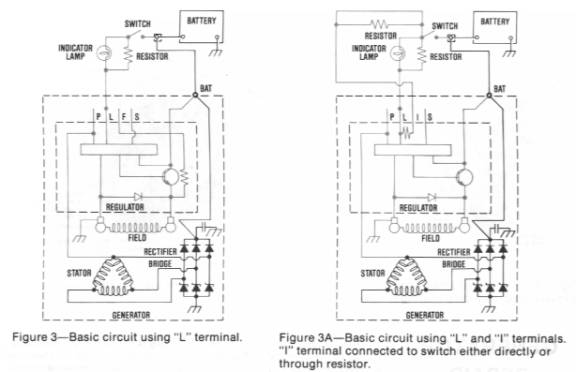
Below is a diagram of such a CS-series, PLFS alternator wired using terminals L, S, and BAT.


PLIS-type
Mandatory connections:
1) Connect the alternator output terminal (B or Bat) to the electrical system's main distribution point (bus bar, junction, etc.) Less optimal alternatives that will work include connecting it to the battery + terminal or a terminal on the starter motor that also connects to the battery + terminal.
2) Connect the L terminal to a source of switched ignition power through an indicator lamp wired in series. Also connect a 50 Ohm resistor in parallel with the indicator lamp so that if the bulb burns out, the alternator will still be excited.
3) Connect the I terminal to a source of switched ignition power through a 50 Ohm resistor wired in series.
3) Ensure there is a good ground connection between the bare alternator case, the mounting bracketry and the engine block/heads and/or install a dedicated ground wire from the engine block to the alternator's ground terminal (if it has one).
Crucial connections:
4) Strictly speaking, the alternator will work with only the three wiring connections listed above, but I consider it crucial for good performance that you also wire up the remote voltage sensing terminal. To do this, connect the S terminal to the vehicle electrical system's main power distribution point (bus bar, main switch, fuse panel, etc.). If the S remote voltage sensing terminal is not connected, the voltage regulator will revert to internal sensing of the alternator output terminal voltage - with all the limitations that brings. You will see some alternators wired with a short jumper wire from the S terminal directly to the battery connection at the back of the alternators, but this is neither the proper method for remote voltage sensing nor necessary for internal sensing - do it properly or leave it out. (Or this terminal can be connected after your battery isolator to compensate for the voltage drop in a diode isolator).
Optional connections:
5) If you have an external device such as a tachometer, hourmeter, or other device, it may be connected to terminal P. Connect the device in the manner specified by the manufacturer of the device.

This is a diagram of such a CS-series, PLIS alternator wired using terminals L, S, I, and BAT.
image043.jpg
 
Here are all the part numbers I found for the plugs (PLIS, PLFS, whatever). They are used on many different vehicles. Sometimes the "wrong" one is a fraction of the price and just needs a key removed or has the wrong terminal letters on it or some other issue that doesn't affect operation.

AC Delco:
PT1742 - 88987962
PT2297 - 88862216
PT1929 - 88860484
PT494
8077 (no resistor)
8078 (with resistor)
Haywire 2110
Painless 30707
PICO 5622 (pigtail)
Wells 1P1067
Standard Motor S552
12085525, 12085527, 12085528, 12117361, 7106, PT494
NAPA:
EC82
EC80
Motormite 85854 (extra keying)
AIRTEX 1P1067
 
When you guys use temp switches to control the fans, do you do anything for the A/C? I'm told that both fans should be going when A/C is running and that GM used some sort of pressure switch to detect this in some applications. Or maybe this is overkill?

My ECM will trigger the fans when A/C is turned on, but if I switch to controlling one if them with a temp switch, that one won't know about the A/C.
 
Could you not use an AC pressure switch combined with a temp switch? That way either one would trigger the second fan?

As I understand it, the better the condenser is cooled, the colder the AC. In your locale, I would think that to be a benefit. Could always test with a single fan, then temporarily run with both fans, see if the AC temp change is worth the additional wiring.
 
If it's only A/C performance, I'm not so concerned. I thought maybe it had to do with physical damage to the A/C if it ran for a while without enough cooling. You'd think they'd have enough design margin in there that the big fan alone would be good enough though.

My current problem is that my check engine light is blinking on sometimes for a fraction of a second. I think I've correlated it with when the fans come on. At first I was thinking about a voltage sag, but this is happening while cruising with dual batteries. Now I'm thinking maybe there is a short surge of current back to the ECM from the signal line right when the fans kick on. I'm thinking about putting a capacitor someplace to either slow the fan startup, or just filter the grounding (signal) line from the ECM.
 
Just use the same control line the ECM uses now to turn on the fans to control a relay that is in parallel with the temp switch.
That way, either can turn on the fans.

In general, as long as there is enough heat in the condenser to push the liquid through the system, then the cooler the condenser the better.

When I put an ice machine that is designed to be used indoors outside, it will quit working when the outside temp gets too low.
The compressor compresses the gas down to a hot gas under high pressure. Then the condenser condenses it down to a liquid still under some pressure.

This pressure is what forces the liquid through the system and makes things get cold.

With the big oversized condensers on ice machines, when the air temp gets down to the low 40s, the liquid just puddles up in the lines and there is not enough pressure to force it through.
High side pressures drop down to around 20 lbs or so.

I fix that by powering the condenser fan with a pressure switch. When the pressure reaches 150 lbs, it turns on the fan.
Under normal conditions, the fan runs all the time. If the air gets too cold, the fan cycles on and off to maintain 150 lbs.
Then the machine will make ice down to 32 degrees, at which point the water supply will freeze.
I have a safety to turn the machine off at that point.

All that means is, that your AC is going to have problems when the weather is really cold.
You probably will not notice it, but in some cases the car runs the AC along with the heat to defog the windshield.
If you have oversized fans, then it might not be as good a defogger, but I suspect that you will never notice.
 
You must have a fan on the condensor when the compressor is running - unless you happen to have a temp sensor on the condensor or compressor outlet to enable low temperature cycling. But you probably don't. If you don't have a high pressure cut-out switch on the high-side, firing up the A/C with no fans WILL VENT refrigerant from the safety valve. Even with the switch, it's not a good thing to do. No cooling happens inside the vehicle that doesn't happen underhood first.

So the simple solution is to have the fan(s) turn on whenever the compressor clutch is on. If your fan relays are now controlled by a high-side signal, you just need some diodes - easy peasey. If the ECU (or block-mounted switch) is providing a GND to enable the fans, you will need an additional relay, controlled by the compressor clutch signal.
 
Currently the ECM monitors the A/C line and turns the fans on automagically. I'm glad to keep it this way.

I'm back to thinking that when the ECM triggers the two relays simultaneously and turns on both fans, the sudden rush of current is causing a brief (fraction of a second) voltage sag that is affecting the ECM. I have a little fuse block underhood next to the battery and the ECM, fans and lights feed off of it. This happens even when cruising, so it's not an alternator problem. It's not even noticeable except for the SES light (and I can see the glitch in the ECM logs).

Anyone have any thoughts on how I might patch my setup to avoid this? They have things that can be used to stagger the start times of the two fans... or maybe a capacitor on the ECM power line, or the fan (big one)?
 
The most common reason for that is a too small wire supplying power. All wire has resistance.
When the fan is running, the wire between it, the ECU, and the power source is big enough.
When the fan kicks on, it is suddenly very low resistance, and this causes the supply wire to seem to be much higher resistance.
So, the current gets sucked to the fan, starving the ECU.

Sounds like the ECU and the fan are sharing a supply wire somewhere. If you run the fan supply direct to the battery, fused, of course, then that may stop the problem.

Otherwise, you might just put in a capacitor with a resistor and diode. The diode is reversed biased when the voltage on the capacitor is lower than the supply voltage, so the capacitor charges through the resistor.

A capacitor is a dead short when you start to charge it, and a big one can draw hundreds of amps for a second or two.
The resistor limits that current, and lets the capacitor charge over a few seconds or a minute.
The diode is alongside the resistor. When the voltage in the line drops below .7V below the voltage in the capacitor, the diode conducts and lets the capacitor make up for the sag.
 
OK, its ECM, not ECU, but my leg hurts and I am in the last week of turkey season.......
 
I would think too small wire would prevent the fans from drawing as much current, actually making my problem better (at the expense of hot wire and slower fan speed). For preventing surge current, maybe just a big-big low ohm resistor in line with the fan would be the ticket.

I'm really confused by the fact that my system can't maintain charging level voltages with the fans and lights on. I'm around 12.5 V with both fans and the headlights going. I have a brand new 140 amp alternator installed. What kind of alternator does a Windstar van have that it can run these things and still charge? Or maybe the ECM on those vans cranks up the idle when needed. :dunno:
 
Mine run on a switch (soon to be changed), both on or off at same time. My idle actually drops when I hit the switch, then it stabilizes itself but it takes a second or two.
 
I would think too small wire would prevent the fans from drawing as much current,
Unless you're looking to set your engine compartment on fire I wouldn't do that. Notice what happens to the small tungsten filament in your headlight?

Also, adding a resistor in series will cut down on the voltage seen across the fan, making it run slower. The resistor would also need to handle some serious power (wasted as heat). Think P=R*I^2
Where P is power(watts), I is current(amps) and R is resistance(ohms)
 
Last edited:
I would think too small wire would prevent the fans from drawing as much current, actually making my problem better (at the expense of hot wire and slower fan speed). For preventing surge current, maybe just a big-big low ohm resistor in line with the fan would be the ticket.

I'm really confused by the fact that my system can't maintain charging level voltages with the fans and lights on. I'm around 12.5 V with both fans and the headlights going. I have a brand new 140 amp alternator installed. What kind of alternator does a Windstar van have that it can run these things and still charge? Or maybe the ECM on those vans cranks up the idle when needed. :dunno:

If you put a filter capacitor in series with the fan motor, it will completely eliminate the start-up surge :D

Seriously, there are a few things you can look at. First of all, at idle, current may be an issue, depending on what kind of alternator you have. Find the specs for current flow at idle. If possible, borrow a clamp-on current meter and measure alt current, batt current, fan current, etc. While cruising the overall current from the alt should be fine. Maybe the fan relays can draw power from somewhere other than where the ECU draws. The ground connections are just as important. Where do the fans ground? What about the ECU? Are all the ground straps in good shape?

Can you datalog? What voltage does the ECU see during the event?

Kicking the idle up is not that hard. I use a vacuum switch to let a little air bypass the throttle when the A/C kicks on. However, you'll find that the surge event is already over by the time the idle comes up. And when you pull in 3 relays, the A/C clutch, two fans and a vacuum solenoid all at once, it's a significant surge.

How good is your battery? Are you sure the connections to it are good and good grounds? It shouldn't have any problem sourcing big current for a second. You don't want to increase resistance to the fans, you want to decrease it so it sees mostly just the battery internal resistance.

Staging the fans could also help - or move one to a temp switch control or something. But there should be some way to make it work without that. The coolest way would be a PWM speed controller that ramps the voltage up over a several seconds. Or maybe a current controller that won't let the motor draw more than 35A or whatever.
 
I would think too small wire would prevent the fans from drawing as much current, actually making my problem better (at the expense of hot wire and slower fan speed). For preventing surge current, maybe just a big-big low ohm resistor in line with the fan would be the ticket.

I'm really confused by the fact that my system can't maintain charging level voltages with the fans and lights on. I'm around 12.5 V with both fans and the headlights going. I have a brand new 140 amp alternator installed. What kind of alternator does a Windstar van have that it can run these things and still charge? Or maybe the ECM on those vans cranks up the idle when needed. :dunno:

You are looking at the system wrong. The too small wire has to be between both the fans and the ECM, and starves both when the fans kick on.
You just don't see it with the fans.
Putting the ECM or fans on a separate power lead direct to the battery with a fuse would probably solve the problem.

When I get some spare time, I am going to do a write-up explaining voltage drops.
If the alternator does not maintain voltage only at idle, that is not too bad. I have seen factory rigs that would not do that.
It can sometimes be corrected by going to a slightly smaller pulley on the alt.
But, they have a maximum rpm they are rated to, so you need to be sure you will not cause it to explode if you floorboard the engine.

If it will not maintain it at speed, then you need to back up and address that issue. That may be part of your problem.
Many times alts will only put out the rated amount of current under perfect conditions, but I would expect one rated to 140 amps to keep up with the fans and headlights at speed.
 
Thanks for the help guys. Just so you know, I have a degree in electrical engineering, so I know the basics. I don't do circuits or electronic for a living though. This is more about what's going on in this specific case and what people have found to work in real life.

I have two annoyances/problems:

1) Potential very brief voltage drop when fans kick on. Totally unnoticeable to driver, NOT a "surge". Engine idles through it just fine, but on occasion the ECM seems to do something like a reset. I noticed it because the SES light blinks. I can see in the datalogs voltage as low as 11.x volts immediately after the fans are enabled for a fraction of a second (my ECM logs at 17 Hz).

2) With my newfangled fan setup, my batteries look like they don't charge at idle with the fans and headlights on (low voltage).

I have a dual battery setup. There is a secondary fuse block that runs ECM, headlight and fans and is connected to the batteries with 8 gauge wire - this is the one in common to ECM and fans. It's about 6 inches long. Wires to the fans are 10 gauge.

For the voltage drop I can think of a few things:

1) Stagger the fans, either with something like this: http://www.casperselectronics.com/store2/product_info.php?products_id=1227 or by running the second fan off of a temp switch. This is sort of a patch, but may be good enough.

2) Some sort of filter/hold up on the ECM power line.

3) Some sort of filter/capacitor type thing to slow the fan startup.

4) ?

Yeah, thinking more about it there is no resistor value that won't either steal to much power from the fans, or not help the surge situation. The difference between what I would consider "surge" and what the fans take steady state is not very much.

Now the charging issue. I have a 140 amp alternator that claims 97 amps at "idle". The fans may take as much as 60 amps, and headlights up to 40, so there it is. I'm just kind of weirded out that I bought this "performance" alternator but I can't do what a minivan can do. Unless they up the RPM. Maybe I should run some tests on my wife's caravan.
 
Top Bottom