CK5
Register an account today to become a member! Once signed in, you'll be able to participate on this site by adding your own topics and posts, as well as connect with other members.

Ryoken's Guide to Rust Treatment and Bodywork 101

Chief Brody

"Amity Island Welcomes You"
 Premium
GMOTM Winner
Joined
May 18, 2010
Posts
9,606
Reaction score
1,980
Location
Alabama
Chief Brody submitted a new Build:

Ryoken's Guide to Rust Treatment and Bodywork 101

Has anybody used the Rust Bullet stuff? I need to sand the rust on the inside edge of my bed rails near the tailgate. If I sand it to bare metal, I will likely have to build it back up with filler. I don't yet know how deep the rust is, but I figure about 1/16th to 1/8th inch ...it's not through and through, but is rough to the touch.

Will Rust Bullet work? Would you trust it? :confused:

Read more about this build here...
 
Last edited by a moderator:
Ask yourself what Rust Bullet is and what it is not. Apparently it is a moisture-cured urethane with aluminum in it. It is not a magic cure and it is not compatible with the existing paint system, meaning that rust can always creep underneath it from the edge. If you can cover an entire part it works pretty good for a while. So in a hidden area I would say it's definitely better than rattle-can primer. Just don't mistake it for a bodywork product.
 
So you are saying I would be better off to take it to bare metal and then do whatever is necessary (body filler) and I will have better results?
 
your always best off getting rid of the rust.. always... RB and POR15 are encapsulators, they do exactly that, they prevent air from getting to the rust... they dont always "stop" the rust.... a converter, such as Marhydes, Eastwood, etc, attempt to convert rust to black iron tannate, but it has limitations..

both approaches are not as good a way to deal with rust as sanding or media blasting is, or even acid...


clean raw steel with a good etching primer can't be beat for a proper coating start... pits, etc can be dealt with during the fill primer phase... they fill easy and can be sanded right out when prepping for paint.. worst case, ya need a little glazing putty in the priming process..
 
Is this the interior or the exterior of the vehicle?
 
Is this the interior or the exterior of the vehicle?

Technically, it is interior but since it is high on the bed rail and a very visible location, I sort of consider it to be of equal importance as exterior.

DSC_0011.JPG

DSC_0008.JPG
 
Let me get it out in the sunlight and take some more focused photos...I really need some guidance on how to handle this because I don't want to screw it up.

I'll post better pictures here on this a little later today.
 
What kind of grinder do I need for this kind of surface?
 
I bet a flapwheel would clean that right up. What kind of paint will you use on it? You need to work backwards from there to decide what materials to start with.
 
I bet a flapwheel would clean that right up. What kind of paint will you use on it? You need to work backwards from there to decide what materials to start with.

"Flapwheel"? Is that something that fits on an angle grinder?

I will be using 2 stage urethane paint (Base and clearcoat).
 
If you have a compressor I'd seriously look at a small sandblaster. There isn't really anything else that will be able to remove all the rust, especially the areas where there is pitting. After sandblast give it a spritz with some zinc chromate (ryoken green) then some high build primer. Then you'll need to determine if any fill is required...might just need a bit of glaze.

Prime and topcoat from there.

Rene
 
As for the flapwheel, those will screw onto an angle grinder just fine...but beware it's easy to create more work for yourself with those. Go gently. Another item that works really good on an angle grinder is a wire cup brush. Flap disc to remove the worst of the scaling, then cup brush to get the next 50%. Sandblast for any pitting...

Rene
 
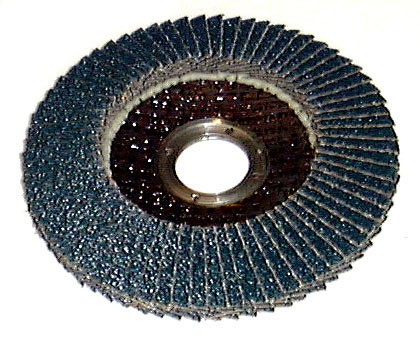
Flapwheel is little pieces of sandpaper stacked up on a wheel. It attaches to your angle grinder. Great for removing rust and smoothing metal, but can remove material at a frantic rate, as well.

flap-disc1a.jpg
 
Technically, it is interior but since it is high on the bed rail and a very visible location, I sort of consider it to be of equal importance as exterior.

well... your gonna need a sander at some point, doing paint work... even if you have a grinder for rust, ya still need a sander for feather edging paint, etc.

a DA with some of the nice gold series 3M paper on it, in say 60 grit, will rip 90% of that to raw steel in a minute or 2... then your just left with a few spots of rust here and there that a flap wheel should pull right out...

just be careful with rotary tools and bodywork, I've seen guys DESTROY stuff with rotary tools.. the cutting action is not conducive to making flat surfaces...

the point I'm trying to make with this post is 2 of the most important things to know in body work are what are the best grits/abrasives to use for different processes and when to use a rotary tool and when to use a dual action...

personally if i was gonna machine do that, no spot blasting, i'd 3 step it.. hit it hard with the DA and 60ish, nip out the bad areas with a grinder or flapwheel, than rehit the heck out of the whole area with the DA again...

spot sandblasters are available too...
 
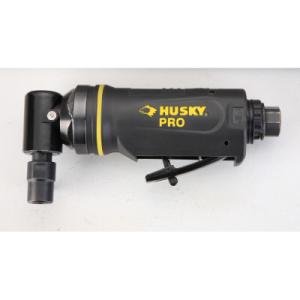
If you're really worried about the flap wheels, because they will take a small job and make it much bigger if not careful. Maybe a 1/4" angle die grinder with some Roloc disks. This tool has easily became my favorite. The discs come in many different grits..36, 60, 80, with available scotchbrite pads coming in fine to "sparks flying" grits also.

These tools are much easier to handle, but they will put your compressor to the test. I bought the Husky Pro with probably 2-300 disks being used so far, without a problem.

31Ef%2B9s6ncL._SL500_AA300_.jpg


And here are the disks. They are available on line, but you can get them from HF and Fastenel too.

mediawebserver
 
I agree a rotary tool can make a mess of a body panel quick, but we're talking about this little edge of the bedrail. It doesn't even have to be real straight when it's done. How could you notice?
 
it was just a statement in general, not applied to this particular situation, my bad should have said that... just a word of warning to noobs, "eh, grinder, sander, same thing!"

i would still do that rail in the tool order the way i said, tho i'd probably use a 2" roloc in the middle.. like Mike, roloc on a right angle is probably my most often used, followed up by 7" discs on the big grinder...

but there's plenty of tool options to achieve the same end result...
 
Thanks for the advice, I will try to get to it this weekend...I had to hang gutters this past weekend...yippee!
 
Top Bottom