CK5
Register an account today to become a member! Once signed in, you'll be able to participate on this site by adding your own topics and posts, as well as connect with other members.

The Shop Truck

1971 Chevy C20 with a custom flat bed.
Most of the time, this won't be loaded, but occasionally it will likely be way overloaded.
The "rod ends" I'm using are speedway motors forged rod ends that have bushings, but I think they're Delrin or something harder than poly. I was already worried about them, but if I have issues I'll just switch to some FK heims.
 
Most of the time, this won't be loaded, but occasionally it will likely be way overloaded.
The "rod ends" I'm using are speedway motors forged rod ends that have bushings, but I think they're Delrin or something harder than poly. I was already worried about them, but if I have issues I'll just switch to some FK heims.
I figured your setup would be just fine. Just thought I'd spread the info I had learned. He was running the Nfamus Metal 4 link kits just with a poly leaf spring type bushing.
 
Minor update with a major setback...
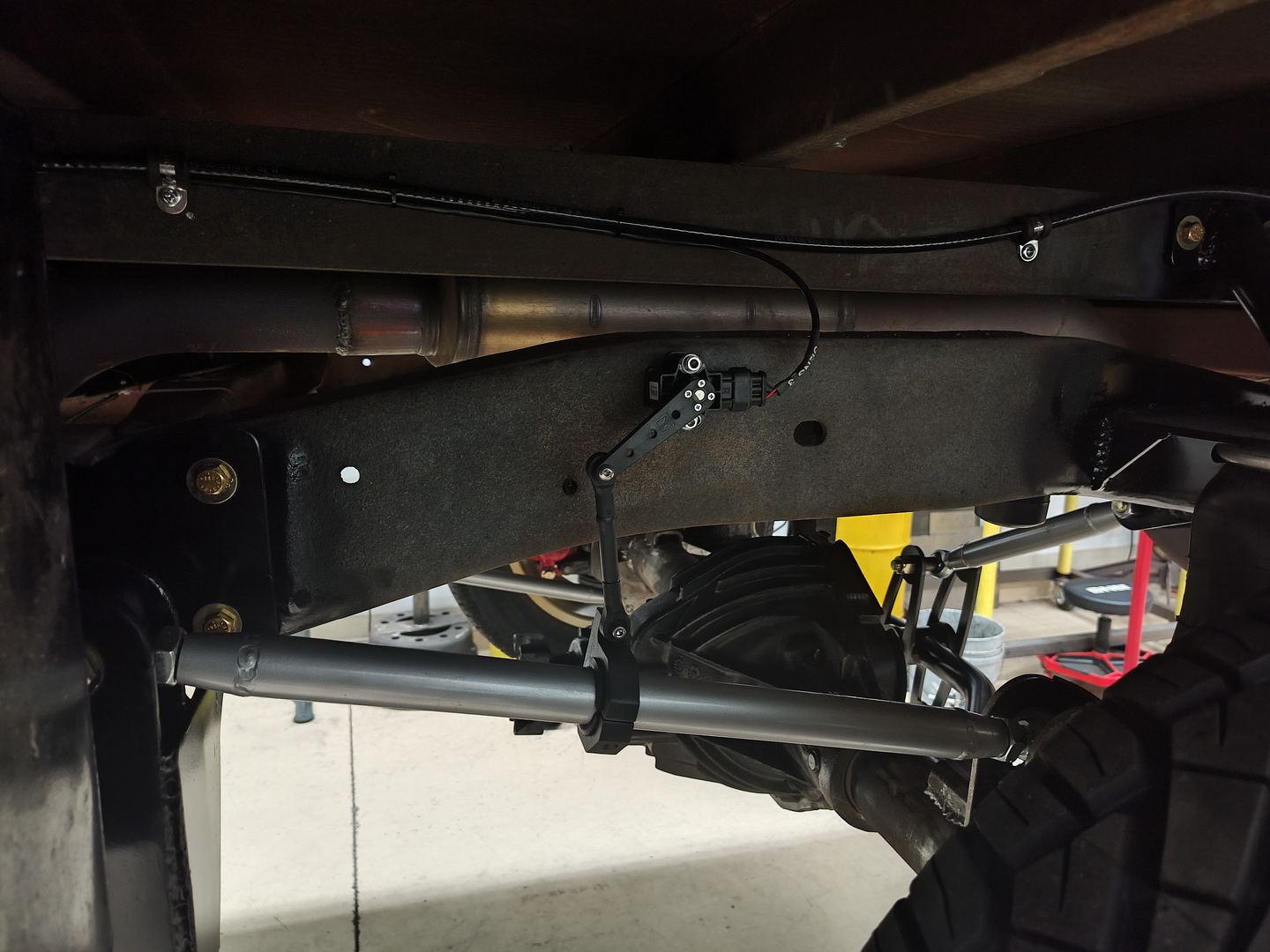
On Monday after work we went back out to try to finish up the last few items on the list before we could test the new level sensors. We got the two rear sensors mounted and connected to the upper links.

IMG_20240430_182832717.jpg


Then we finished up running all the wires and put the wheels back on. We messed with the air bag controller for a while but couldn't get it to calibrate. I unfortunately had to work Sunday night so I was going on 4 hours sleep and decided to call it a night ending in frustration.

I did some research and figured out a way to do the manual calibration and got the level sensors somewhat calibrated and that's when the issues I was running into became clear. I've never bagged a vehicle before so I just assumed a bag was a bag. The first issue I was running into (and why the auto calibration wouldn't work) is that the front bags take about 170psi to lift the truck. While I can control the pressure of the tank with the ECU, it only has 3 settings and the 200psi setting is on at 160psi, off at 200psi. The first step in the auto calibration is that it airs the bags all the way up to max tank pressure, the front bags go up quick, then the bigger rear bags drop the pressure in the tank down well below 160psi. Solenoid valves stop air from going one direction only, if the bag pressure is higher than the tank, they deflate so as it tried to pressurize the rears, the fronts dropped and the whole system errored out.

The manual process has you set the "max height" first and it goes from there so it allowed me to complete the calibration process. Once that was complete I started playing with the system a bit and noticed some other issues. The 4.5 gallon tank can't get the truck to ride height without kicking on the compressor which means I lose some pressure out of the front bags. This was pretty annoying but could have been fixed with an additional tank, the real problem was that the front end was ridiculously stiff, jumping up and down on the bumper caused equal deflection in the suspension and tires so it would have been a rough ride for sure. Since this isn't a show truck and I actually plan on using it regularly, this isn't going to work for me so it's back to the drawing board.

Knowing what I know now, I certainly would have gone a different route with the front suspension, QA1 makes stock arm replacements that would have been easy to install a regular airbag on with a shock in the stock location. Unfortunately, I have the coilover setup. I went out and spent some time staring at it and I think I can make some brackets to mount a more standard, larger airbag up there and move the coilover shock back to the stock location. I'll have to weld a shock mount bracket on my pretty powder coated arms, but I think I can make it work. I could just convert the fronts back to coilovers and only have dynamic suspension on the rear, but it looks so good sitting on the ground that I want to keep bags on all 4 corners.

I'll pick up some new bags this week and hopefully knock the front suspension mods out this weekend.
 
Any possibility you can draw that out?
I'm not sure what you're saying here, maybe slow down the rate at which the bags fill? If that's what you're asking then yes, the tank has throttle valves built in to the tank that can be used to slow down the rate of inflation/deflation. I have the rears cut down to 20% or less (one turn from all the way screwed in) and it helps, but does not fix the problem. Even if they filled properly I'd still have the issue of the front end being way too stiff.
 
Sucks about the bag problem in the front end. Separate tanks seems like the way to go if you can code the system to work together with the front and rear sensors, but the stiff ride you found would suck. Bagged cantilevered upper shock mounts would be sweet. Or if the dough is flowing grab two of these: https://jrishocks.com/collections/ride-height-system/products/ride-height-system

Either way this truck is super cool!
 
I thought about the hydraulic coilovers, but I need the dynamic load capacity of airbags in the rear. Running a hydraulic up front and airbags in the rear would be cool, but that's a lot of extra equipment to haul around and pay for, too many things could go wrong.

I'll just get a set of normal bags and make some brackets to mount them and move the shocks back to the stockish location.
 
I thought about the hydraulic coilovers, but I need the dynamic load capacity of airbags in the rear. Running a hydraulic up front and airbags in the rear would be cool, but that's a lot of extra equipment to haul around and pay for, too many things could go wrong.

I'll just get a set of normal bags and make some brackets to mount them and move the shocks back to the stockish location.
So I am not familiar with your leveling system but on my big rig, the system holds the height stable and the valve either raises pressure to compensate for the weight or bleeds the air when you remove weight.
Would a system like that work for you?
 
So I am not familiar with your leveling system but on my big rig, the system holds the height stable and the valve either raises pressure to compensate for the weight or bleeds the air when you remove weight.
Would a system like that work for you?
I have the same mechanical system on my motorhome. This system is a little more high tech than that as it has sensors and solenoids so I can program the desired height (up to 3 different pre-programmed heights). It uses electronic height sensors, solenoids and an ECU for this. While it would work, and I did consider it, I like the ability to adjust the ride height on the fly. This way I can drop the rear, pull under a trailer hitch and pop it back up to lift the trailer, or raise the front of the truck and dump the rear for easier unloading, or dump the rear bags so it's more stable when I'm using the crane etc. etc.
 
So the issue is the mismatch in bag size vs weight of the front/rear so it is requiring way more pressure on one end vs the other and also the lack in volume of supply air?
 
So the issue is the mismatch in bag size vs weight of the front/rear so it is requiring way more pressure on one end vs the other and also the lack in volume of supply air?
That is part of the problem, the front bags need 170ish psi and the rears need somewhere around 30-40psi (not quite sure but it's not much). I could find ways around that, but the real problem is that a small bag at high pressure is going to give a terrible ride quality. I've never done airbags before so I thought small bag = soft ride, big bag = stiff ride. Apparently this is the opposite of how it works.
The More You Know Nbc GIF by For(bes) The Culture
 
Yep the bigger the bag the more surface area and the less pressure required and better ride. Just like how hydraulics work.

That is some crazy high pressure. I have a truck at work that we move a 25k gooseneck dump trailer full of mud with. Truck and trailer gross like 34k at times. It has the Air Lift compressor kit and maxes at like 100 psi bag pressure and that is with like 5k lbs of tongue weight or more on it. Semis run at roughly 125 psi system pressure and their bag pressure would only be that high with an extremely heavy load on them.
 
Yep the bigger the bag the more surface area and the less pressure required and better ride. Just like how hydraulics work.

That is some crazy high pressure. I have a truck at work that we move a 25k gooseneck dump trailer full of mud with. Truck and trailer gross like 34k at times. It has the Air Lift compressor kit and maxes at like 100 psi bag pressure and that is with like 5k lbs of tongue weight or more on it. Semis run at roughly 125 psi system pressure and their bag pressure would only be that high with an extremely heavy load on them.
I understand bigger cylinder = more lifting power for the same pressure. What I don't understand is bigger cylinder = softer ride, generally in suspension you equate more capacity with stiffness and lower capacity with a softer ride. I'm sure I could figure out the math/physics behind it, but I don't want to :D.
 
I mean a quick drawing of what's routed to where and in what order, was kind of lost where valves were ect.

However, just reading through this, any possibility you can put some kind of coil in the front - to take up a part of the load. Instead of needing 170lbs maybe only 80 lbs..? Kinda defeats some of what you're going for but may help w/ your problem.
 
I picked up some mounting plates today from Switch Suspension today that will bolt on to the crossmember for a standard bag and I picked up a bottom plate so I can mount that onto the lower A-arm. They didn't have the bags the recommended in stock so I ordered them from Summit and they'll be here Friday.

I'm tired of having my truck stuck on the lift so I'm itching to get it back on the ground. I thought about adding a spring, but the logistics of getting a spring, shock and airbag all working together seemed too difficult. 1000's of people have bagged their C10s and C20s with what I'm putting in there so it should work out just fine. It's just going to hurt to grind the nice powder coat off the QA1 lower arms to weld a shock mount on though :cry:.

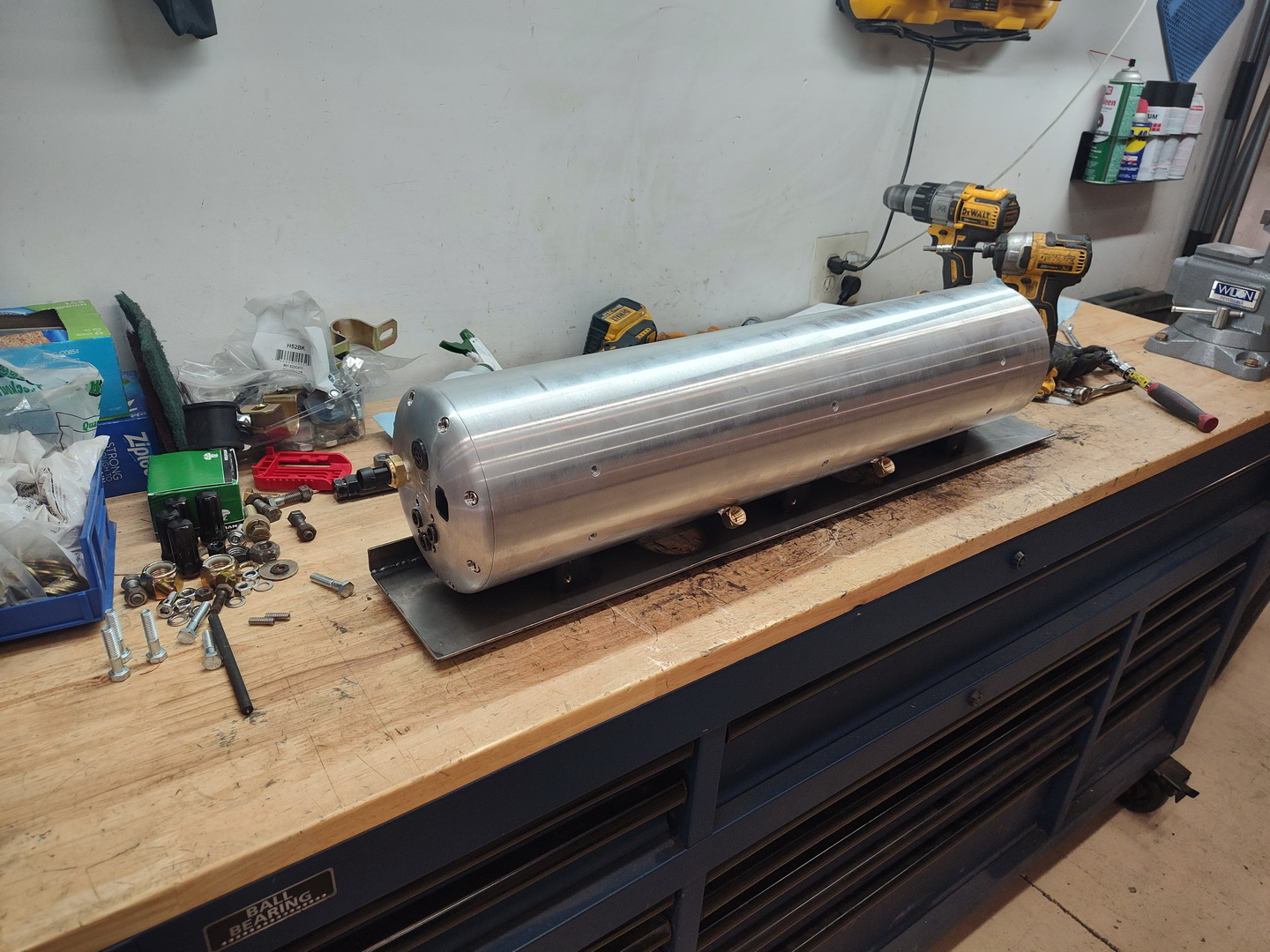
For routing, the valves are mounted inside the end caps of the air tank. You can see in this picture below. It makes the plumbing super simple, there are three ports on each end of the tank the front one goes to the front bag, the rear one goes to the rear bag and the lower middle one is the exhaust port.

IMG_20240407_132427158_HDR.jpg
 
Are you using the 170psi benchmark for the height you want, or for a specific spring rate?

Your description sounds like it's too high of a spring rate (pressure). Does the 170psi still give any down travel at that point?

If you need it softer, and you loose too much height, is the bag height adjustable? Can you re-mount the shock/bag unit for height?


If this is the bags you got, it says in there 16lbs per psi. Which by my math shows 2720 lbs of support per side (5400lbs on the front end). Which is gonna be pretty stiff on that truck.
 
Also I was looking at the above and the amount of weight the bag is gonna lift is basically calculated on psi x surface. So narrow bag - hypothetically say 10 sq in x 1 psi, would be 10 lbs of lift. wide bag 100 sq in x 1 psi would lift 100lbs.
 
I don't know the exact pressure that it takes to lift the front, I just know from watching the tank pressure on the app that it takes more than 160psi (the "on" setting for the compressor). Once the pressure is high enough to lift the front end, it doesn't change much through the range of motion.

Yes, it is too high of spring rate. Standing on the bumper and bouncing gives equal travel between the suspension and the tires so very stiff.

You have to take into consideration that the coilovers are attached to the middle of the a-arm so it's not a 1:1 ratio so 5400lbs of lift at the center of an arm would only be 2700 at the wheel. I'm not sure exactly what the ratio is, but I know the coilovers came with 700lb/in springs so that seems to be in the right neighborhood. That being said, it takes X amount of pressure to get X amount of force to lift the truck, once it lifts the pressure shouldn't change much as you go through the range of travel, adjusting where the bag sits would not change the pressure required.

Your last post is exactly what I'm talking about. If you put a 2000lb weight on top of an airbag with 5.64" radius (area = πr²=100in²) it will take 20psi to lift it. That pressure shouldn't change throughout the range of travel of the airbag, it just requires more volume of air.

That concludes todays physics course.
 
If I would have just bought a kit, it would have been all sorted out for me. That's why I just went with the airbag that they recommended at Switch Suspension. It's the size most kits use for the front of a C10/20/30.
 

Latest Posts

Top Bottom