CK5
Register an account today to become a member! Once signed in, you'll be able to participate on this site by adding your own topics and posts, as well as connect with other members.

The Shop Truck

1971 Chevy C20 with a custom flat bed.
My base timing and fuel maps look like it's running on 91 octane (that's what we get here, not 93). There are tables that modify the timing and fuel based on the flex fuel sensor (ethanol content) and there are other tables that modify for nitrous.
The table is in VE so it doesn't matter if I change injectors, as long as I put the right injector information in.
1761055551801.png
 
Mines definitely different than that, but a lot of this one is the self tuning. And trying to get my idle to behave under load.IMG_20251021_092817679.jpg
My timing is the one that I'm told is odd lol.
Little bit of me playing around and bits from YT vids IMG_20251021_092718419.jpg

I'm trying to see what I can modify to get a bottle in a good place. If I can fit it right, I'm probably going to end up with a 100 shot.
 
The injector tester showed up today. It's pretty limited on the tests it can do, but everything I tested looked good, I only tested the evens so far but they were always within 1ml on every test.
 
Yes, I bought some graduated cylinders along with the injector cleaner/tester. I'm going to rig up a way to test them with my fuel system, installed in the intake manifold. I'll have to test them one at a time, but with the Dominator I can set it to do X number of pulses for X number of MS each. My injector pulse width was right around 10-11ms on that run so I can use that number to test with.

Whatever the issue is, it's only on higher demand that it shows up. I can also move my fuel pressure sensor to the outlet of the fuel rail right after #8 to see if we're losing pressure there for some reason.
 
I had thought of that too and it was the first thing I looked at when I pulled the rail off. It's all clear.
 
As much trouble as you've had, I gotta wonder if there isn't something funked up w/ the nitrous plate you have, may not show up at normal temps or something... May be worth exploring a different system, it may have cost you a head now.
 
Can't go individual injectors with that intake?

Have you ever pulled the plugs after a 100 shot pass and looked at them? Was 8 the same as all the others then?


At this point I'd almost skip the bottle and cram 14psi down it's throat instead lol.
 
I was going to bounce this question off @Bent77 first, but since there's activity here I'll post it.
I've melted plugs in this engine numerous times, when we went to DTD I thought we had it figured out finally, but we didn't.
The previous 2 runs before DTD went as follows:
300hp shot, #9 plugs, instant shutdown after 6 seconds of run time, melted #7 AND #8 plugs.
350hp shot, #10 plugs, 10% extra fuel and -1° of timing on #7 and 8, instant shutdown after 6 seconds of run time, obliterated #8 plug and damage the valve and head.

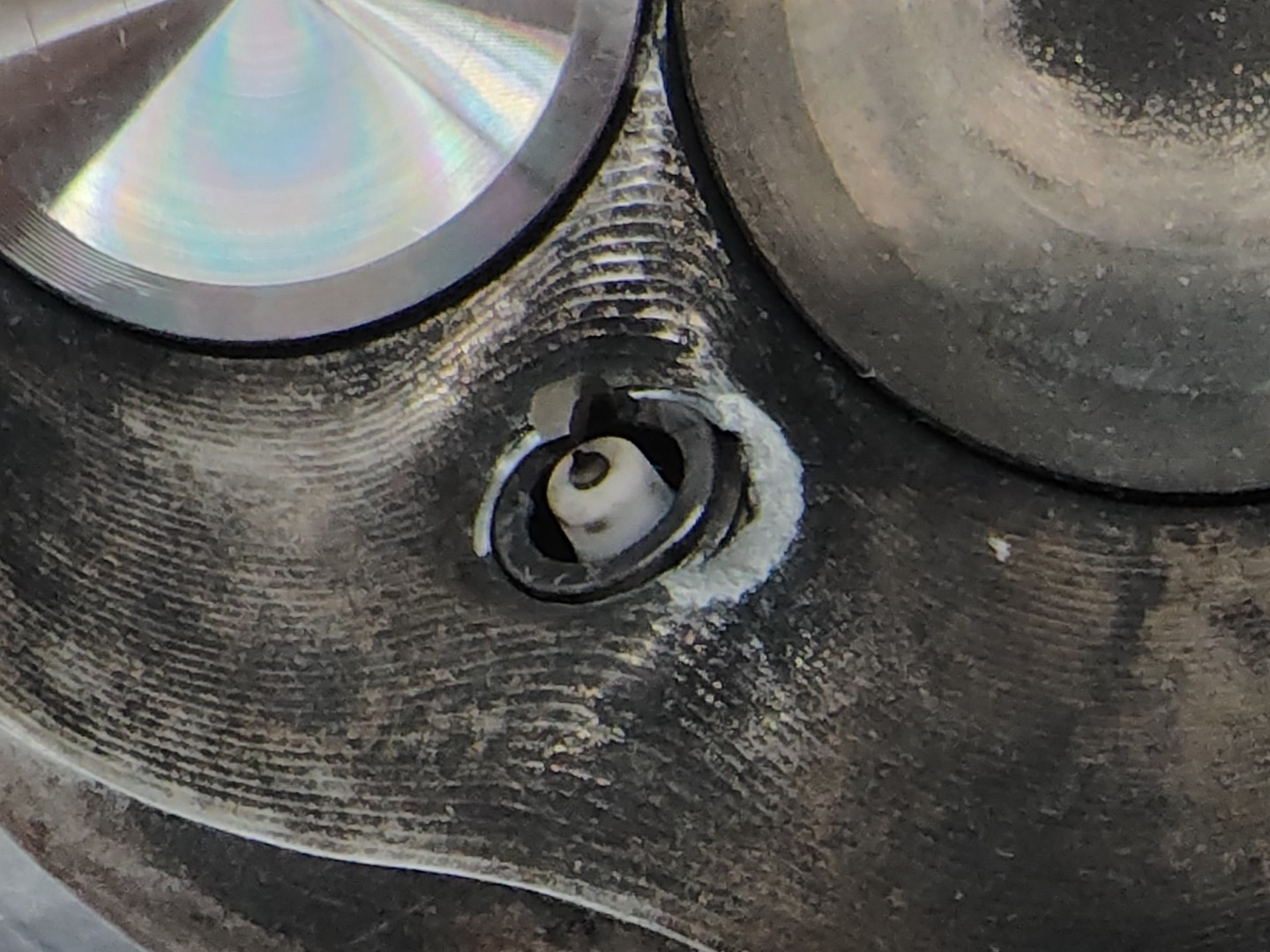
We pulled the head and replaced the valve, but I didn't do anything about this:
IMG_20250927_101426215_HDR.jpg


5 runs at DTD, nitrous shut off after about .5 seconds on one run due to a lean safety, but all 4 other runs destroyed #8 no matter how much fuel I added or timing I pulled.

I'm thinking that exposed part of the plug made it get so hot that the cylinder started to diesel, which is a much more violent combustion than a regular ignition via the plug. It's obvious that the cylinder kept running after the plug was gone based on the damage to the valve and how it felt on track, so that makes sense to me.

The truck makes 505RWHP NA, add a 300hp shot of nitrous and I'm close to 1000hp at the crank. The exposed plug is apparently fine at lower power levels, but nitrous is a much hotter faster burn (which is why you have to pull timing).

I'm just brain storming, but that's my current theory since the injectors and fuel rail seem to be fine.

I don't understand the physics of what's going on inside the combustion chamber, but something was causing it to behave differently at DTD than the last time I had it at Firebird. The exposed plug is the only thing I can think of that's different.
 
As much trouble as you've had, I gotta wonder if there isn't something funked up w/ the nitrous plate you have, may not show up at normal temps or something... May be worth exploring a different system, it may have cost you a head now.
The nitrous plate costs almost as much as the head. I have a new head being delivered today and it will be back on the road by Monday. I'll attempt to get the other one repaired and keep it for a spare.
Can't go individual injectors with that intake?

Have you ever pulled the plugs after a 100 shot pass and looked at them? Was 8 the same as all the others then?


At this point I'd almost skip the bottle and cram 14psi down it's throat instead lol.
I could do a custom setup with individual nitrous jets on each runner like this. That would be difficult and not hidden like the current setup. Changing jets would also require 8 jets every time, but would allow for tuning of individual cylinders. It would also require 2 nitrous solenoids and 2 fuel solenoids (if I wanted to do a wet shot).

Trust me, I want to just slap a big turbo on this and go, but I'm determined to figure out this nitrous stuff. The instant power is so much fun.
 
I still think that you are getting a much larger than expected and uncontrolled volume of nitrous in the back cylinders due to airflow. Until you have 100% way of controlling the exact amount of nitrous at that cylinder, you don’t know exactly how much fuel to add

You probably need to pull more timing, most nitrous and boost systems once they go live are pulling 8 to 12° the timing out of the cylinder. The plug I think is just making it worse, but I don’t think it’s the culprit.

You probably need to add closer to 25% fuel with an 8° cut to be close enough to tune it. The other problem is now you have that back set of cylinders doing more worked in the rest of them, you really need to get them balanced in order for it to run optimal
 
Last edited:
Here's why I don't think that is correct. The last time I was at Firebird I did a 300hp shot, it barely melted #7 and #8. On this run I pwm'd the nitrous on over .5 seconds, ran it full for another 5.5 seconds then shut it off instantly causing a huge lean spike (17:1). Here are the safeties I had in place on that run:
-#9 spark plugs in all 8 holes.
-14° timing retard when nitrous is active.
-12:1 target AFR
On the last run at DTD I destroyed #8, #7 was absolutely fine. On this run I PWMd the nitrous on over the first .5 seconds and ran it out the back, datalogs showed minimal lean spike when the nitrous came on (13.2:1). Here are the safeties I had in place on that run:
-#10 spark plugs in 1-7, #11 in #8.
-16° timing retard when nitrous is active, additional 4° of retard on #7 and 6° on #8 at WOT above 3000RPM.
-11.5:1 target AFR with an additional 15% fuel being added to #8 and 10% to #7 at WOT above 3000RPM.


With all those safeties, the damage shouldn't have been as severe, but it was way worse. Nothing happened to #7 all weekend, only #8 this time.
 
Here is the datalog from Firebird, the lean spike hit 17.88:1 average with one bank reading over 18:1. The yellow line is stage one nitrous duty cycle, red is RPM, pink is target AFR, red is AFR average, blue is left AFR, green is right AFR (these may be backwards).
1761320419512.png
Here is the datalog from the last run at DTD.
1761320534041.png
When I say it was my best looking datalog so far, that's why.
 
13.2 on the NOs is still too lean. I still wonder if the #8 cylinder is getting more NOS than 7. Unfortunately there’s no way to measure the quantity


So when is the turbo showing up?
 
Top Bottom