CK5
Register an account today to become a member! Once signed in, you'll be able to participate on this site by adding your own topics and posts, as well as connect with other members.

The Shop Truck

1971 Chevy C20 with a custom flat bed.
Well, in an effort to make sure I check everything at the track I've been working on a post run checklist to go through between rounds. During this process I've been digging into my datalog from the last run at Duct Tape Drags. I noticed the fuel pressure seemed to stay flat through the run rather than raise with boost pressure, I changed the scaling to make it stand out better and I came to the realization that I'm running out of fuel pump.
It was making 9.4psi of boost on the 2 step and fuel pressure was great, but once boost got to 12.5 with the nitrous also coming on it couldn't keep up anymore. CL comp saved my butt, but it was hitting 15% added fuel by the time I let off. I'm not certain I can trust the EGT temps since they seemed to be erratic, but 3 cylinders peaked at just over 1500°F which isn't good.

I have the 3.5gpm Fuel Lab pump, unfortunately I have tried to use their 5gpm pump twice and both times it didn't last more than an hour. The 3.5GPM pump seems to be rock solid.

Amber and I brainstormed about this and I think there is a fairly simple solution. When I built my fuel cell I put a 6an drain on the bottom, I can hook a fuel line to this and run an external pump for a dedicated nitrous fuel system. This will remove the nitrous load from the main fuel pump and I could even add more fuel than needed for the nitrous to help out the main fuel pump at WOT. The main fuel pump has 3 ORB fittings for return lines, I'm currently only using one so I can easily add a second. I already have the fuel solenoid from before, so I just need to get everything plumbed up. This has the added benefit of cooling the intake charge down even more.

I checked my day zero log from Michigan Miles as I ran that one NA. Even there fuel pressure was short by a couple PSI, so I'm on the borderline with the party pulley.

I'm going to try to get something set up so I can test Friday, that way I'll be able to do the 10.50 bracket, otherwise I'll need to drop down to the 11.50 bracket to save the engine.
 
Positive it was running out of pump?
Should be able to tell by seeing what your injector duty cycle was during a run.
If it's hitting 95-100% or something I'd say yeah, out of pump, too small of lines, etc..

Could the boost signal to the regulator not be working correctly? Or the reg it's self?
 
It's definitely the pump. You can see in this datalog, blue is boost pressure, red is fuel pressure, teal is CL Comp. Base fuel pressure is 45psi, on the two step, boost is 9.2psi, fuel pressure is 54psi (45+9). When I let off the trans brake boost starts rising quickly to 12.5psi and fuel pressure follows to 58psi (45+13) but at that point it starts dropping and no longer follows boost but just sits around 57psi for the remainder of the run. This indicates that the pressure regulator is fully closed and not returning anything to the tank.

CL Comp is 0% on the 2 step and peaks out at 15% at the end of the run. I still have injector left as it was only at 85% duty cycle. Increasing the pressure of the fuel will lower the duty cycle, but it will also lower the output of the pump making the problem worse. You can see in the CL Comp graph how it's compensating for the lack of fuel pressure. It should be hitting 61ish psi at the end of the run (15.8psi of boost) but it's only at 55psi by that point.
1793736867416.png
 
I've seen setups where it has main fuel line, Y's out, has two pumps, then Y's back to one line.
You could run something like that, with 2 of the 3.5's. and have the second kick on above X amount of boost, or when nitrous is engaged.... :dunno:

I'm sure you have enough line for it.

Think I've even seen like Dual pump headers to parallel pumps. Seem to remember that when I was looking up pumps back when I wanted to turbo my old engine.:thinking:
I had thought about that, but it would require pulling the fuel cell and modifying it. I can't get that done by Friday.
Switching to a wet shot should fix my issue, I could even program the nitrous fuel solenoid to work like water/meth injection on the road, but I'd have to change the fuel jet for that. A wet shot is going to give me the additional fuel I need and cool the intake down. It's a win win.

The truck is almost to where I want it, it doesn't really justify putting another 3.5gpm pump in.
 
At that point you could go to dual 2.5 or something..
But yeah, the dedicated smaller pump for nitrous should be enough for drag racing.
Playing on the street or road course you'd never be in it that hard that long.
 
It's definitely the pump. You can see in this datalog, blue is boost pressure, red is fuel pressure, teal is CL Comp. Base fuel pressure is 45psi, on the two step, boost is 9.2psi, fuel pressure is 54psi (45+9). When I let off the trans brake boost starts rising quickly to 12.5psi and fuel pressure follows to 58psi (45+13) but at that point it starts dropping and no longer follows boost but just sits around 57psi for the remainder of the run. This indicates that the pressure regulator is fully closed and not returning anything to the tank.

CL Comp is 0% on the 2 step and peaks out at 15% at the end of the run. I still have injector left as it was only at 85% duty cycle. Increasing the pressure of the fuel will lower the duty cycle, but it will also lower the output of the pump making the problem worse. You can see in the CL Comp graph how it's compensating for the lack of fuel pressure. It should be hitting 61ish psi at the end of the run (15.8psi of boost) but it's only at 55psi by that point.
View attachment 538515

What is the fuel flow showing during that run, especially when the pressure flattens out?

My math says that pump should be enough unless it's not performing as expected.


Switching to a wet shot should fix my issue, I could even program the nitrous fuel solenoid to work like water/meth injection on the road, but I'd have to change the fuel jet for that. A wet shot is going to give me the additional fuel I need and cool the intake down. It's a win win.

The truck is almost to where I want it, it doesn't really justify putting another 3.5gpm pump in.

IMO you are going backwards when converting to a wet shot, you lose the fine fuel control of the injectors. Now granted, you are using a pretty small shot, so it's not that much fuel to be off, but its also not that much fuel to relieve the pump either.

If the pump really isn't keeping up and you have tried their larger pump and it died twice, and now this one isn'y supplying what it should, I would run a different pump.

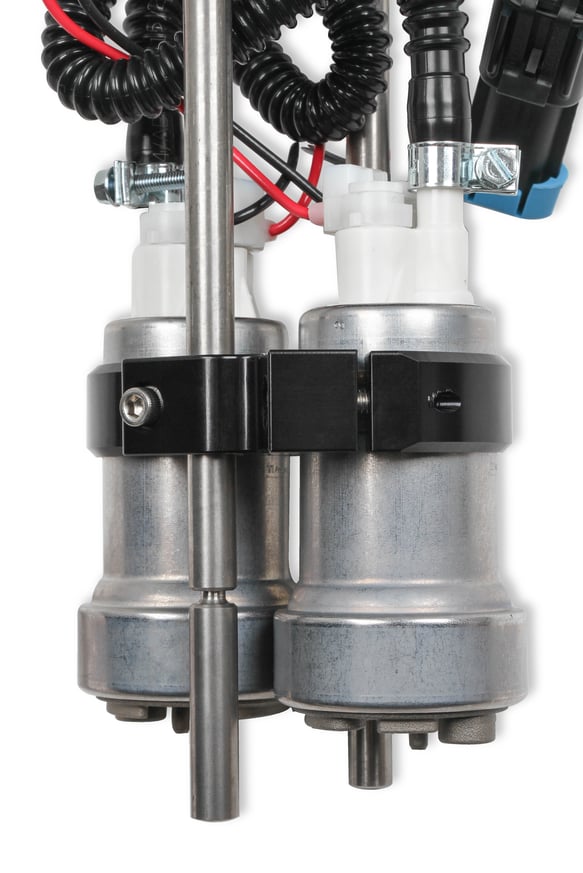
This is a dual 450 pump, 900 lph total, and you can only one run pump for normal street driving and turn the other on at a certain throttle and/or boost level.

It should also drop right in your fuel cell, worst case you may need to drill some holes.

It should eliminate any doubts once you turn the other pump on.


9b8ad24839307603da5b3e35cfc5fdb51fff2304.jpg


1ac681c088186332ddd155ee4630a5c2a65eefe6.jpg
 
I've had the Fuel Lab pump in there for a year and a half, it's been rock solid. Mine is the 625lph (3.5gpm) and it works fine, the 1100lph version (5gpm) is in the same body and pulls 2.5 times as much current (10A vs 25A) to put out 60psi, so it's not surprising to me that it can't survive. It's designed to be run for less than 10 seconds at a time, not all day driving.

I have a spare pump, spare regulator, and a spare element for the 5 micron fuel filter. I'll swap the filter before I go to the track and I'll take my spare pump and swap it there if I'm still seeing an issue.

My reasoning behind the wet shot is that it will further cool my MAT. Even with the intercooler and nitrous it's hitting 163°F by the end of the run, intercooler inlet water temps are remaining constant. I could put ice in the box, but I'd prefer not to.
 
Your IAT sensor is after your nitrous nozzle?

I am not finding a flow rating at ~60 psi for that Fuel lab pump. Just 625 LPH at 43 psi.

The 900 LPH pumps would drop to ~760 LPH at 60 psi. It pulls about 15A at 43 psi and 17 A at 60 PSI per pump, so 30 - 34 A total. But you only run one of the pumps most of the time.

I switch which one is my primary pump every couple years and I have had the same pumps for 9 years.

EDIT: I found the chart, its just over 150 GPH at 60 psi, or around 570 LPH.

So the dual 450 would flow about 1/3 more fuel with both on and run plenty cool with just one on.
 
Last edited:
Now. When doing the math for how much fuel he needs... Are you going by 1200-1300 HP total....
Because that's at the wheels, and his crank HP has to be at least 15-16 hundred. :thinking: :dunno:

It'd be AWESOME to have to worry if 3.5 GALLONS PER MINUTE, is enough gas to power my play toy.
Thas one problem I'd gladly shoulder lol.
 
Last edited:
Your IAT sensor is after your nitrous nozzle?

I am not finding a flow rating at ~60 psi for that Fuel lab pump. Just 625 LPH at 43 psi.

The 900 LPH pumps would drop to ~760 LPH at 60 psi. It pulls about 15A at 43 psi and 17 A at 60 PSI per pump, so 30 - 34 A total. But you only run one of the pumps most of the time.

I switch which one is my primary pump every couple years and I have had the same pumps for 9 years.

EDIT: I found the chart, its just over 150 GPH at 60 psi, or around 570 LPH.

So the dual 450 would flow about 1/3 more fuel with both on and run plenty cool with just one on.
I'm talking about MAT (Manifold Absolute Temperature), which is after the intercooler in the intake. I also have intake air temps, but that isn't used for anything other than logging.

They dyno the pumps and provide a dyno sheet, the pump puts out just over 600LPH at 60psi assuming 13.5 volts, I should be at 14.5V at the alternator, but I don't measure at the pump obviously.

I looked at quite a few different datalogs and every run (even when I had the big pulley on) seems to have the same issue. Fuel pressure at WOT doesn't keep up with the rise in boost.
 
This is the datalog from my last run down the track with the big pulley, maxing out at 8.6psi of boost. Even in this one, the fuel pump struggles to keep up after I let go of the 2 step. It initially tracks then just flattens out. What's weird is that I'm 300lb/hr lower flow rate here, now I'm wondering if it's the pump or the regulator.
1793750032106.png
 
Also, my pump has the SAE 10 bolt flange, that one seems to have a 12 or 14 bolt flange.
Now I'm wondering if it's my fuel tank design. If I run a full tank it comes out the breathers so I try to keep it around 1/2 tank at the track. The fuel pump sits in the center chamber closest to the camera in this shot. The fuel return comes back into the fuel pump and just dumps down into that chamber, so aeration could also be an issue.
IMG_20250201_172951154_HDR.jpg
 
I've had the Fuel Lab pump in there for a year and a half, it's been rock solid. Mine is the 625lph (3.5gpm) and it works fine, the 1100lph version (5gpm) is in the same body and pulls 2.5 times as much current (10A vs 25A) to put out 60psi, so it's not surprising to me that it can't survive. It's designed to be run for less than 10 seconds at a time, not all day driving.

I have a spare pump, spare regulator, and a spare element for the 5 micron fuel filter. I'll swap the filter before I go to the track and I'll take my spare pump and swap it there if I'm still seeing an issue.

I looked at some of your old logs and it is going up to 58 psi when you hit the higher boost, but that was when your target A/F was lower so slightly less fuel flow, also didn't check if the nitrous was on in that run.

My reasoning behind the wet shot is that it will further cool my MAT. Even with the intercooler and nitrous it's hitting 163°F by the end of the run, intercooler inlet water temps are remaining constant. I could put ice in the box, but I'd prefer not to.

That's somewhat true as it has more time to cool, but it's not much fuel you are talking about changing. If you really want a fuel solenoid I have them here and my solenoids use o-rings not pipe threads and have full flow for center or side exit. I feel I designed the best solenoids on the market.

I'm talking about MAT (Manifold Absolute Temperature), which is after the intercooler in the intake. I also have intake air temps, but that isn't used for anything other than logging.

They dyno the pumps and provide a dyno sheet, the pump puts out just over 600LPH at 60psi assuming 13.5 volts, I should be at 14.5V at the alternator, but I don't measure at the pump obviously.

I looked at quite a few different datalogs and every run (even when I had the big pulley on) seems to have the same issue. Fuel pressure at WOT doesn't keep up with the rise in boost.


Glad you know the difference, most people mistakenly use IAT and MAT intercheably because most don't have both and most people are in the intake tract between the throttle and air filter. A true MAT would be inside the intake manifold after the throttle which is rare.

In practice it doesn't matter much as its consistent enough if you don't move it.

I myself use IAT right before the throttle for fuel calcs, and I log ambient in front of the radiator.

This is the datalog from my last run down the track with the big pulley, maxing out at 8.6psi of boost. Even in this one, the fuel pump struggles to keep up after I let go of the 2 step. It initially tracks then just flattens out. What's weird is that I'm 300lb/hr lower flow rate here, now I'm wondering if it's the pump or the regulator.
View attachment 538523


Also, my pump has the SAE 10 bolt flange, that one seems to have a 12 or 14 bolt flange.

Yes there are different bolt patterns of 6, 10, and 12, you may have to drill some holes but the fuel cell opening diameter is pretty standard. It uses a metal ring inside the tank with threads so you don't have to tap the holes.

Now I'm wondering if it's my fuel tank design. If I run a full tank it comes out the breathers so I try to keep it around 1/2 tank at the track. The fuel pump sits in the center chamber closest to the camera in this shot. The fuel return comes back into the fuel pump and just dumps down into that chamber, so aeration could also be an issue.
IMG_20250201_172951154_HDR.jpg

I typically recommend to return the fuel at the bottom to not introduce air, and into the same reservoir the pump pulls from to not starve the baffle area. Can you extend the return closer to the bottom with some hard aluminum or SS tube and some AN sleeves and nuts?

The dual 4150 pump extends the return down up to a foot.

Now. When doing the math for how much fuel he needs... Are you going by 1200-1300 HP total....
Because that's at the wheels, and his crank HP has to be at least 15-16 hundred. :thinking: :dunno:

It'd be AWESOME to have to worry if 3.5 GALLONS PER MINUTE, is enough gas to power my play toy.
Thas one problem I'd gladly shoulder lol.

Good question, to be honest I didn't do either as I didn't look up his HP. I quickly calculated both how much HP 15 psi on a 6500 RPM 427 at ~110%VE would make, I also calculated how much HP it would take for a 6000 lb vehicle to hit 127 MPH in the quarter, both of those were less than 1100 HP, so that is what I used to calculate how much fuel he would need for a supercharged engine on E85, which is also about how much fuel he is flowing at boost.

If he is making more HP, and it is quite common, especially for a multi-use ride, to not get a lot of the power to the ground, then he would need more fuel yes. I did some quick estimates is all to see if the pump is in the ballpark. He could also be making more HP/lb/hr than I estimated, but that would change the HP per fuel flow not necessarily the fuel required.

If I use 1600 HP at the same .85 lb/hr/HP estimate, it's showing over 200 GPH asnd thats at 100% DC, which is very short bursts, his pump at 60 psi is less than that. Usually you would use 80 - 90% DC for street use, but he doesn't use full power on the street, there is also margin in the .85 number.

Over 260 GPH is needed at 80% DC at 1600 HP, and that is 4.2 GPM or 990 LPH at the same .85 BSFC.

I don't think he is making that much power, he is making a lot, but probably not quite that much, that flow would need over 200 lb/Hr injectors.

If you just use the simple fact that you want enough fuel to supply his 166 lb/hr injectors at 100% DC, he would need 767 LPH or 203 GPH, which is 3.4 GPM at 60 psi,

His fuel pump chart shows 150 GPH.

In either case, its a pretty good argument for the dual 450s vs the single 625.
 
I looked at some of your old logs and it is going up to 58 psi when you hit the higher boost, but that was when your target A/F was lower so slightly less fuel flow, also didn't check if the nitrous was on in that run.
This is going to be another long post, I can feel it :haha:
I went through a bunch of different logs and scaled the fuel pressure and boost pressure so the graphs were next to each other and should track along the same plot. What I found was interesting and confusing.
This is from the last run, you can see the pressure is keeping up until it hits 57psi and then it drops off (boost is blue, fuel pressure is red).
1793805533831.png
This next one is from Northern Michigan, the truck made 16.8psi of boost in that nice cool air and it was my quickest pass of the week. The fuel pump hit 60psi at the beginning, but did a much better job at keeping up throughout the run. Maybe because the fuel itself was cooler therefore more lbs/hr with the same flow rate??? I'm not sure. This was with a baby 25 shot jet. You can see the pressure seems to be unstable, but it's keeping up for the most part.

1793805778660.png
Now here's my last run at Firebird before we went to Michigan. No nitrous and only 11 lbs of boost because that set screw backed out. Once again, the fuel pressure doesn't keep up.

1793806091649.png
I even went back to when I took it to Firebird with the big pulley on. It peaked at 9 lbs of boost and I'm still seeing the fuel pressure drop.

1793806245674.png
Going back further than that for drag passes gets me to when it was on nitrous and the fuel pump tracks perfectly with a 300 shot. It's a bigger gap because the manifold is at a vacuum, but the pressure tracks perfectly.

1793806479791.png
Looking at street driving when I was testing the transmission after getting back from Michigan, the fuel pressure tracks perfectly.
1793806666977.png
1793806717755.png
So the problem only happens at the drag strip, and doesn't really seem to be related to fuel flow directly. I even looked at fuel level and battery voltage to see if I had something else going on, but I couldn't find a correlation.

That's somewhat true as it has more time to cool, but it's not much fuel you are talking about changing. If you really want a fuel solenoid I have them here and my solenoids use o-rings not pipe threads and have full flow for center or side exit. I feel I designed the best solenoids on the market.
I already have a fuel solenoid, but I'll keep you in mind if I decide to swap it out.

Glad you know the difference, most people mistakenly use IAT and MAT intercheably because most don't have both and most people are in the intake tract between the throttle and air filter. A true MAT would be inside the intake manifold after the throttle which is rare.
I've always had my MAT at the bottom of the back of the manifold, that's where most manifolds have a spot for it.
In practice it doesn't matter much as its consistent enough if you don't move it.
I would say in my case it makes a huge difference, if I put ice in the intercooler tank, that would drastically change the MAT but not the IAT. If the pump failed that would also make a huge difference.
I myself use IAT right before the throttle for fuel calcs, and I log ambient in front of the radiator.
I'm not familiar with your setup, but I'm assuming if you're boosted that's post intercooler. When I was running nitrous I had to change the fuel modifier for cold MAT temps as it was adding way too much fuel because MAT was hitting below freezing.
Yes there are different bolt patterns of 6, 10, and 12, you may have to drill some holes but the fuel cell opening diameter is pretty standard. It uses a metal ring inside the tank with threads so you don't have to tap the holes.
When I bought this pump I thought it had the same pattern as everything else, I have yet to find another pump that uses the same pattern. I couldn't find a flange when I built my tank so I made my own with a 1/2" thick chunk of aluminum that I drilled and tapped for the 10 bolt pattern. It's welded around the base inside and out so fuel can't get to the bolt holes. It would not be easy for me to change patterns.
I typically recommend to return the fuel at the bottom to not introduce air, and into the same reservoir the pump pulls from to not starve the baffle area. Can you extend the return closer to the bottom with some hard aluminum or SS tube and some AN sleeves and nuts?
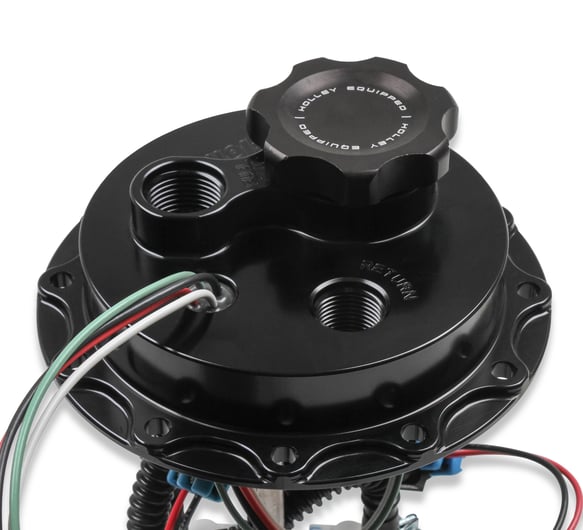
Unfortunately that isn't possible with this pump, not easily anyways. If I had a 3d printer, maybe I could make something that slid into here and guided the fuel back down to the bottom of the tank, but I'm not sure how I'd secure it, or if they make E85 safe filaments. The pump has 3 -10 ORB fittings that all just dump into this hole on the bottom of the fuel pump flange. I didn't like that aspect when I bought it, but I really wanted the brushless pump. It's amazing how quiet it is for a 3.5GPM pump.
1793807651733.png

The dual 4150 pump extends the return down up to a foot.
I get what you're saying, but I've got $3000 worth of fuel pumps that have lifetime warranties. 600LPH should be enough to fuel the blower and I shouldn't be running out of pump yet.
Good question, to be honest I didn't do either as I didn't look up his HP. I quickly calculated both how much HP 15 psi on a 6500 RPM 427 at ~110%VE would make, I also calculated how much HP it would take for a 6000 lb vehicle to hit 127 MPH in the quarter, both of those were less than 1100 HP, so that is what I used to calculate how much fuel he would need for a supercharged engine on E85, which is also about how much fuel he is flowing at boost.

If he is making more HP, and it is quite common, especially for a multi-use ride, to not get a lot of the power to the ground, then he would need more fuel yes. I did some quick estimates is all to see if the pump is in the ballpark. He could also be making more HP/lb/hr than I estimated, but that would change the HP per fuel flow not necessarily the fuel required.

If I use 1600 HP at the same .85 lb/hr/HP estimate, it's showing over 200 GPH asnd thats at 100% DC, which is very short bursts, his pump at 60 psi is less than that. Usually you would use 80 - 90% DC for street use, but he doesn't use full power on the street, there is also margin in the .85 number.

Over 260 GPH is needed at 80% DC at 1600 HP, and that is 4.2 GPM or 990 LPH at the same .85 BSFC.

I don't think he is making that much power, he is making a lot, but probably not quite that much, that flow would need over 200 lb/Hr injectors.

If you just use the simple fact that you want enough fuel to supply his 166 lb/hr injectors at 100% DC, he would need 767 LPH or 203 GPH, which is 3.4 GPM at 60 psi,

His fuel pump chart shows 150 GPH.

In either case, its a pretty good argument for the dual 450s vs the single 625.
I'm not sure where the 1600hp came from. I based my numbers on my dyno pull (950hp on a hub dyno) and that I put a slightly smaller pulley and 100hp worth of nitrous, so I was estimating 1100-1200RWHP.

Today I'm going to change the fuel filter. I have most of the components for the secondary fuel system, but I'm not sure if I'm going to install it now or after we take it to the track. Unfortunately it doesn't seem like I can test this anywhere other than at the track, which is the safest place to do it anyways.

Here is my plan for testing.
-First run, no nitrous, check fuel pressure after the run (checking to see if it was the filter).
-Assuming the problem still exists, add 6 gallons of E85 and try again (I usually start with 1/2 tank to prevent it coming out of the overflows).
-Assuming the problem still exists, swap the fuel pump with my spare and try again.
-Assuming the problem still exists, swap the regulator with my spare and try again.

If the problem still exists after that, I'm not sure what I'll do. If it's the pump, I'll send it in for a rebuild, if it's the filter, I'll try to get a 10 micron element for it to use next time.

If it fixes the problem, I'll see what time I can run without nitrous and figure out what I'm going to do for street car takeover. If I decide to install the secondary fuel system before Friday, I'll test it when I'm at the track.

It would be a major undertaking and expense for me to swap in a noisy brushed pump, so that isn't going to happen. If my pump isn't working properly, I'll get it fixed, if my fuel cell sucks, I'll get it fixed. Because the tank is right up under the bed, I don't have much room to go up on the vents which is why I can't run a full tank on the track.

I could add foam to the chamber the fuel dumps into, that should help with aeration, I could also add a sump and extend my pickup down further, I could weld a bung to the tank so I could return the fuel to the bottom, there's a lot of options, but unfortunately only one place to test them.
 
1600 was just the high end of me guestimating how much you'd have at the crank, since you're seeing 1100-1200 at the wheels.
You have to be at least near 1400.

The fuel calcs wouldn't care about wheel HP.
They'd need to be what the engine makes at the crank. Gotta make at LEAST 1300 to see that much at the wheels.

So I added a few hundy for good days lol
 
This is going to be another long post, I can feel it :haha:
I went through a bunch of different logs and scaled the fuel pressure and boost pressure so the graphs were next to each other and should track along the same plot. What I found was interesting and confusing.
This is from the last run, you can see the pressure is keeping up until it hits 57psi and then it drops off (boost is blue, fuel pressure is red).
View attachment 538564
This next one is from Northern Michigan, the truck made 16.8psi of boost in that nice cool air and it was my quickest pass of the week. The fuel pump hit 60psi at the beginning, but did a much better job at keeping up throughout the run. Maybe because the fuel itself was cooler therefore more lbs/hr with the same flow rate??? I'm not sure. This was with a baby 25 shot jet. You can see the pressure seems to be unstable, but it's keeping up for the most part.
View attachment 538565
Now here's my last run at Firebird before we went to Michigan. No nitrous and only 11 lbs of boost because that set screw backed out. Once again, the fuel pressure doesn't keep up.
View attachment 538566
I even went back to when I took it to Firebird with the big pulley on. It peaked at 9 lbs of boost and I'm still seeing the fuel pressure drop.
View attachment 538567
Going back further than that for drag passes gets me to when it was on nitrous and the fuel pump tracks perfectly with a 300 shot. It's a bigger gap because the manifold is at a vacuum, but the pressure tracks perfectly.
View attachment 538568
Looking at street driving when I was testing the transmission after getting back from Michigan, the fuel pressure tracks perfectly.
View attachment 538569
View attachment 538570
So the problem only happens at the drag strip, and doesn't really seem to be related to fuel flow directly. I even looked at fuel level and battery voltage to see if I had something else going on, but I couldn't find a correlation.

It certainly looks like fuel pressure is tracking sometimes and not others, the erratic logs do make one wonder about aeration. How long is your boost reference line? I saw something about a vent on your regulator, is that clear?

I've always had my MAT at the bottom of the back of the manifold, that's where most manifolds have a spot for it.

I would say in my case it makes a huge difference, if I put ice in the intercooler tank, that would drastically change the MAT but not the IAT. If the pump failed that would also make a huge difference.

I'm not familiar with your setup, but I'm assuming if you're boosted that's post intercooler. When I was running nitrous I had to change the fuel modifier for cold MAT temps as it was adding way too much fuel because MAT was hitting below freezing.

You are correct having it before vs after the intercooler would certainly make a huge difference and you need it after the cooler if you have one or you don't have an accurate air calculation for the proper fuel.

My engine is NA or a little nitrous, I don't have boost thus far, though it would be nice!

How large is your liquid to air intercooler up front? It seems to keep up with the temp quite well if the tank temp is consistent.

When I bought this pump I thought it had the same pattern as everything else, I have yet to find another pump that uses the same pattern. I couldn't find a flange when I built my tank so I made my own with a 1/2" thick chunk of aluminum that I drilled and tapped for the 10 bolt pattern. It's welded around the base inside and out so fuel can't get to the bolt holes. It would not be easy for me to change patterns.

Drilling and tapping some holes in aluminum is not really that big of a deal, especially compared to what you have done.

Unfortunately that isn't possible with this pump, not easily anyways. If I had a 3d printer, maybe I could make something that slid into here and guided the fuel back down to the bottom of the tank, but I'm not sure how I'd secure it, or if they make E85 safe filaments. The pump has 3 -10 ORB fittings that all just dump into this hole on the bottom of the fuel pump flange. I didn't like that aspect when I bought it, but I really wanted the brushless pump. It's amazing how quiet it is for a 3.5GPM pump.
View attachment 538571


I get what you're saying, but I've got $3000 worth of fuel pumps that have lifetime warranties. 600LPH should be enough to fuel the blower and I shouldn't be running out of pump yet.
I hear you there, that's a lot of money to have in pumps and those are really nice pumps!

I'm not sure where the 1600hp came from. I based my numbers on my dyno pull (950hp on a hub dyno) and that I put a slightly smaller pulley and 100hp worth of nitrous, so I was estimating 1100-1200RWHP.

Today I'm going to change the fuel filter. I have most of the components for the secondary fuel system, but I'm not sure if I'm going to install it now or after we take it to the track. Unfortunately it doesn't seem like I can test this anywhere other than at the track, which is the safest place to do it anyways.

Here is my plan for testing.
-First run, no nitrous, check fuel pressure after the run (checking to see if it was the filter).
-Assuming the problem still exists, add 6 gallons of E85 and try again (I usually start with 1/2 tank to prevent it coming out of the overflows).
-Assuming the problem still exists, swap the fuel pump with my spare and try again.
-Assuming the problem still exists, swap the regulator with my spare and try again.

If the problem still exists after that, I'm not sure what I'll do. If it's the pump, I'll send it in for a rebuild, if it's the filter, I'll try to get a 10 micron element for it to use next time.

I like your plan, I think the 10 micron is a good idea, 5 micron may be restrictive and not really necessary...

If it fixes the problem, I'll see what time I can run without nitrous and figure out what I'm going to do for street car takeover. If I decide to install the secondary fuel system before Friday, I'll test it when I'm at the track.

It would be a major undertaking and expense for me to swap in a noisy brushed pump, so that isn't going to happen. If my pump isn't working properly, I'll get it fixed, if my fuel cell sucks, I'll get it fixed. Because the tank is right up under the bed, I don't have much room to go up on the vents which is why I can't run a full tank on the track.

I still think drilling and tapping some holes in aluminum is not really that big of a deal, especially compared to what you have done.

I also think the 450 walbros are quiet, I can barely hear it when the engine is off, just yesterday I keyed on and I thought the pump didn't turn on because I couldn't hear it before I started it, but it made pressure so it was on, and I certainly can't hear it when the engine is running. The gerotor pumps are quiet, they aren't like the vane pumps that sound like a cheap jet engine running. And they are reliable as they are OEM made in USA pumps for high power E85 factory vehicles.

I could add foam to the chamber the fuel dumps into, that should help with aeration, I could also add a sump and extend my pickup down further, I could weld a bung to the tank so I could return the fuel to the bottom, there's a lot of options, but unfortunately only one place to test them.

Adding a lower return port is a good idea but welding on the tank is more work than drilling and tapping holes because you have to completely wash and purge is several times so it doesn't explode on you. I have never welded on a used tank for that reason, not worth the risk, I just buy a new tank and weld on that one if needed. Though if I made the tank from scratch I would probably wash/flush it several times and then backpurge with argon to weld on it.

But even if you do weld on it, it only solves one of the potential problems, you still may need more fuel in addition to the lower return because the fact is your injectors can supply more than your fuel pump can at 60 psi. The dual 450s would run out of flow about the same time as your injectors.

Also, a spare 450 walbro to drop in is ~$130, not $1500, not to mention if it ever does go out you could flip a virtual switch and use the other pump to drive where you can swap it easier, you don't have to swap it on the side of the road.

However, I respect if you really want the brushless, and you already have it, so hopefully your plan fixes the issue and you can move on, either way I won't mention it again as I have said enough already.

I hope you get a new PB when you go back to the track with that awesome truck!
 
Last edited:
Top Bottom