CK5
Register an account today to become a member! Once signed in, you'll be able to participate on this site by adding your own topics and posts, as well as connect with other members.

tuning HEI for 4spd 350

These videos show the lean buck. The first and second video are the exact same tight turn in a parking lot. One went good and the other not so good. Just before it starts bucking the vacuum drops for an instant from 20 in-hg to 15 in-hg then pops back up to 20 in-hg and then goes nuts. I have no idea why the vacuum drops but once it does it seems to set off a chain reaction - my guess is a reverberating pressure wave in the intake that repeatedly stalls the air through the carb and each time builds on itself. Once I gave it a slight press on the gas it mellowed out (accelerator pump richening) and I suspect because the vacuum was dropping down to 5 in-hg the power valve was richening as well.

A slow turn in 2nd gear (same turn is in the next video with lean bucking); everything is perfect this time. Video is 2x slow motion.

Exact same turn in 2nd gear - my kids thought the bucking was fun. Usually I would have used the clutch to avoid the bucking but I let it go for the video - once my eyeballs settled I was able to drive out of it without stalling. Video is 2x slow motion.

This is the expressway off ramp in 3rd gear, the rpms drop low and there is a slight single buck that sounds more like a knock (probably t-case coupler going slack and then tensioning)
 
Last edited:
Hard to tell if its lugging or a lean misfire. In 2nd gear you are loading he engine up and it may be lean.
 
Hard to tell if its lugging or a lean misfire. In 2nd gear you are loading he engine up and it may be lean.
The Stackexchange description of lugging:
If an engine is rotating slowly then two related bad things happen - unless the amount of fuel-air mixture in the cylinder is small such as when the engine is idling:

First, combustion speed increases as cylinder pressure increases. When the engine is at speed, the combustion pressure is stable because the piston moves down as the combustion expands. If the piston does not move down at the same rate as combustion then pressure builds. At low speeds the piston speed is limited by wheel speed. In turn, the increased cylinder pressure will cause a faster combustion expansion that will then further increase the pressure.

Second, at TDC the force from the piston is not transferred into turning the crank. If a crank is at 90 degrees, all piston force will be converted into torque; at 0 or 180 degrees, none will get get converted. Further, because combustion begins before the crank hits top-dead center, if combustion is too rapid (due to issues given in previously) then not only will that force not convert into forward torque but it will actually apply torque in reverse. (I edited the original post for readability)

If I understood correctly lugging is when there is too much explosion for the engine speed. So lugging is a too high HP to vehicle speed condition? Bucking is an over lean condition? To me both bucking and lugging seem related to pressure - lean fast burn and more power produced than piston can transfer. Before my engine starts bucking the only indication of bad things is the vacuum drops to 15 in-hg. Will 15 in-hg activate my power valve? 15 in-hg seems too high to activate the power valve. Richening the mix should reduce cylinder pressure caused by a lean burn. This could explain why richening the idle removes the bucking. Also explains why after a few rounds of bucking things soften up once the vacuum get down around 5 in-hg (power valve certainly activated).

This could be one of two problems, each related to diving style
  • Bucking, I am lean and need to richen things somehow only when I am in low speed idle (I think this is impossible without fuel injection since carb is vacuum operated and has no idea if there if forward speed or not); solution is to feather the clutch
  • Lugging, I have too much air/fuel mixture in the cylinders and that is producing too much HP at low speed. Could be I let off the throttle too late and the velocity is stuffing the cylinders. There is no tuning of the carb that will resolve this. Watching the videos side by side - the turn that did not buck I came into with a higher rpm and maintained slowing momentum through the turn so this idea of a neutral speed does not hold up.
Since this thread is HEI tuning and not driving style. The pressure, combustion, a/f ratio, and top dead center are at play here. The vacuum is high so all the vacuum advance is in. When I disconnected vacuum advance the problem was worse for some reason so I am at a loss since less BTDC combustion would mean lower pressures and that should have solved the problem.

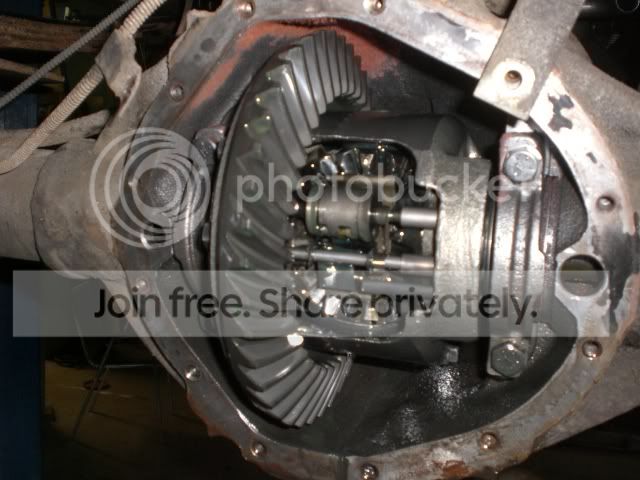
Maybe my locker locks mid turn and that puts pressure on the drivetrain back up to the engine and slows the piston speed briefly. It could be in video 1 the locker did not lock in the turn and in video 2 the locker locked and setoff a chain reaction. Listening to the video 1 with headphones I can hear the locker click click click through the turn. In video 2 I hear the click, click, and then there is a clunk and the vacuum drops and then the idle drops and both pop back up; I think the locker locked and unlocked for an instant. When I think back, this bucking started when I added the locker 20 years ago. Before then, with the open diff it just sort of made a slight clunk, clunk, clunk, clunk sound sometimes turning a corner. I think my '72 truck I had before the blazer made the same clunking noise sometimes.
 
Last edited:
With my rear drum dragging (intermittently) it definitely affected how much force was required to turn.

Aren't most lockers unlocked as you coast?
 
Aren't most lockers unlocked as you coast?

I did not think about that, I assumed they were locked all the time and unlocked for turns. Based on the explanation in wikipedia https://en.wikipedia.org/wiki/Locking_differential the lock-right (they call it the old style lunch box locker) is always locked. The front of the teeth are ramped and allows a tire to overspeed the other tire and that is the click, click, click sound of the teeth passing over each other. The backside of the teeth is straight and does not allow a tire to move slower than the engine rotation.

All that said. I took the family for a drive yesterday and noticed that on a straight drive in a residential area where I had to slow I got the same bucking occasionally. Not as bad but still the engine was not happy about something. My theory about it being the locker stalling the engine for an instant might be valid but there is more to it. It might take a few days but I will try to make another video of bucking at slow speed without a turn.
 
It would seem that a true locker (as opposed to the gov-lock) would have a hard time "failing" in a random manner as you describe, and probably unlikely to fail in general in any case.

My suspicion would be it's a coincidence if it's not consistently repeatable. it might not help matters, but as you say, sounds like there is probably more to it.
 
It would seem that a true locker (as opposed to the gov-lock) would have a hard time "failing" in a random manner as you describe, and probably unlikely to fail in general in any case.
I have a lock-right; it is a carrier locker like the gov-lock but functions like a normal locker just it is weaker and I assume less precisely machined
gov-lock complication
zephyr094.jpg


lock-right simplicity)
185044d1365162281t-batmojeep-2012-07-28_11-18-09_62.jpg


My suspicion would be it's a coincidence if it's not consistently repeatable. it might not help matters, but as you say, sounds like there is probably more to it.
I agree, needs more testing and observing; it has been a problem for 20 years so no rush - same problem with Holley as with Quadrajet and it did become a big issue with the addition of the locker but was there even before the locker but was not the same joy ride experience. I lived with it but I want to figure it out since I should be able to and it will be one less thing to think about while driving.
 
Last edited:
New idea; maybe it is a slow accelerator pump shot. Before I added the pressure regulator I lowered the float so the fuel bowl was less likely to overfill. The accelerator fuel chamber does not have a check valve so whatever the float level is that is also the accelerator pump level. Maybe my fuel level is low enough that there is a head of air at the top of the chamber, the pump must compress this before fuel will be delivered. That will create a lag between throttle blades opening (and lean condition) and the accelerator pump shot the makes up for the delay between throttle plates opening and drawing fuel through the venturi boosters.
 
I suppose on the plus side, if you want to dig into it, GM used a few different accelerator pump designs, should be able to find one that sits the piston/seal lower.
 
I suppose on the plus side, if you want to dig into it, GM used a few different accelerator pump designs, should be able to find one that sits the piston/seal lower.
Shoot, that is right, they have different spring rates and heights in addition to fuel level set by the float; those are a lot of variable to account for. Now I get to be an expert on accelerator pumps.

A little venting: At some point, I am glad to pay a GM engineering team to figure this all out and just give me a couple pedals to push and a wheel to turn. I have concluded, the Q-Jet is the most evil device ever concocted and is the work of the devil himself. They needed another 6 months of development on the Q-Jet to make it less of a engineering prototype and more of a modular tunable platform like the Holley. Everything is drilled or bent linkage and there is almost no tuning documentation provided. How about a quick release top for the thing? I know the Q-Jet was not meant for the aftermarket world so there was zero effort put into that. I guess that is enough complaining.

Also, I found that the newer WD-40 silicon recipe works vastly better for sticking throttle shafts than the original WD-40 recipe. I was spraying my shafts every month or two and after each long drive. I tried the silicon mix and have not had to respray yet. My high vacuum holds the throttle plates open slightly if the shafts drag even just a smidgen.
 
I'd have to look at one, are studs/nuts an option for the air horn? Can't recall if any of those would interfere with the air cleaner.

When you actually spend the time to dial in a carburetor as you are doing, I really don't think they are any easier or simpler than fuel injection. Most people just get the carb "close enough" and run with it. Checking fueling under various conditions, ensuring it works hot and cold, etc., it's fairly simple to get close, but to get it as close to perfect as possible, takes a ton of time. GM had the advantage of making millions of vehicles with exactly the same components. When we change one thing from that original setup, it affects how it runs.

As you mention, it's all mechanical adjustment, and it's very hard to make changes and see your results. Especially on the Q-jet, it's a lot of disassembly/reassembly and testing out what components to use or change to get X Y or Z result. It's very interesting to learn everything that was and can be done with them.
 
As you mention, it's all mechanical adjustment, and it's very hard to make changes and see your results. Especially on the Q-jet, it's a lot of disassembly/reassembly and testing out what components to use or change to get X Y or Z result. It's very interesting to learn everything that was and can be done with them.
Should I create a new thread for the accelerator pump? I could also go back to the fuel system thread I had and start on the accelerator pump there.

I read through Cliffs book and the Doug Roe QJet book and there is quite a bot to the accelerator pump. I ignored all this the last time I had my QJet open. There are three key checks
  • slack in accel pump linkage and adjusting it out (could be my issue is a lag in the shot)
  • size of accel pump shooters; I recall this being a big tuning parameter on the Holley; my shooters are probably undersized and could be the problem
  • the accelerator pump volume, checking the height of the pump rod at full compression and a few other things (good to check but I had too small a accelerator pump volume on my Holley and solved it with the accl pump cams - my QJet does not have this problem).
 
Should I create a new thread for the accelerator pump? I could also go back to the fuel system thread I had and start on the accelerator pump there.

You have so much info, probably doesn't matter lol.

I would think that at least for your initial pump shot, you could turn the truck off, then manually work the linkage to see what sort of throttle movement is needed to get a shot. If the rod just needs adjusted a bit, that would be easy.
 
Skimmed through here, Forest you are one focused dude on this problem. Little experience without getting too techy. My old 75 was running a wore out 350 with unknown rv cam specs, headers, Edlebrock performer (1410 IIRC) intake and q-jet with a HEI dizzy. Now the engine was way down on power to be lugging around 35's with only 3.73 gearing and the 465 4-speed. That being said a previous owner got smart and installed a MSD super HEI module. Most stock HEI equipped small blocks I have ever driven could not spin much past 5,000 rpm, but in stock trim that probably isn't a big deal. The MSD module however even with the wheezy worn out 350 could be spun well past that point without detonation. Valve float yes, but no pinging. I'm pretty sure that's how the kid I got the 75 from grenaded the 350 that was in my truck before I got it. Granny low, 4low with 3.73's and 31 inch tires adds up to an easy way to spin the rpm's up quickly. He did and spit two rods out of the block. Bad for him, good for me, bought it for $500 with the blown engine.

Still, keep one other thing in mind. Timing can vary based on elevation. What works at sea level don't work at 4,000 ft up or 9,000ft or more. My home elevation is 4,800ft. But I can go wheeling and end up at 13,000 ft plus. Truck ran fine leaving home, but slowly gets worse as I go up. I've purposely left the the dizzy clamp bolt only snug so I could hop out and bump the advance up with the palm of my hand. Just enough so the idle smooths back out and stops struggling. Get done wheeling and just cruise it home and break out the timing light to re-set it back to where I had it.

As far as the q-jet goes, I loved mine. Other than it being a cold blooded beast below 40 degrees, the carb otherwise ran great. My Dad is a detail freak when it comes to rebuilding them and got mine really dialed in. I'll I ever did after he rebuilt it was set the idle speed. Never loaded up on the trail. Never coughed or wheezed on slopes in any direction nose up or down or sidehills for that matter. That carb can be made to work and will run circles around a holley off road when dialed in. Just takes patience. Which I don't have so again, shipped it to somebody that does.

As much as I liked it, can't beat the EFI on my 91 with the 5.3 in it. That being said I could have bought a few dozen carb kits for the q-jet for what I have in the 5.3 swap so far. It's better but not cheap.
 
Top Bottom