CK5
Register an account today to become a member! Once signed in, you'll be able to participate on this site by adding your own topics and posts, as well as connect with other members.

Will this remote solenoid work?

EdPDX

Registered Member
Joined
Sep 12, 2010
Posts
26
Reaction score
3
Location
Portland, OR
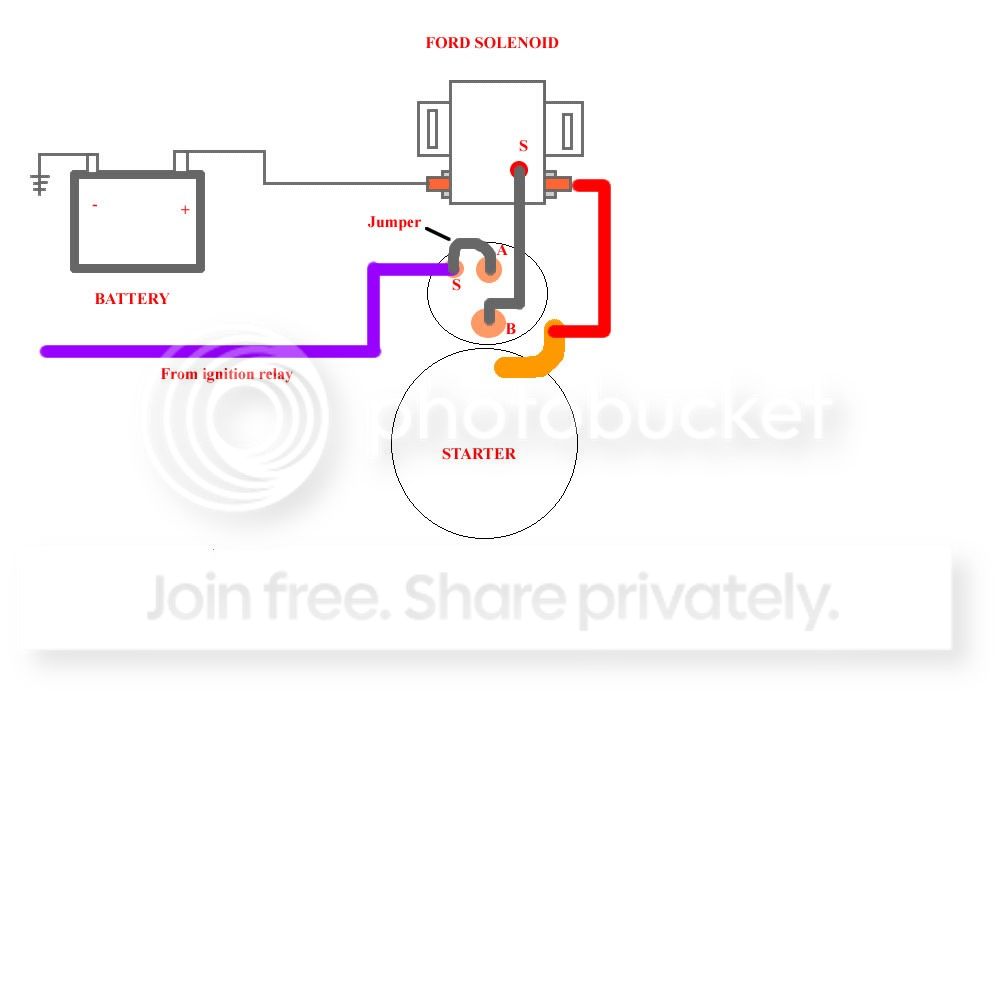
I have been burning out Starter Solenoids in my 24 volt Blazer. I have replaced glow plugs, added ground straps. new injectors to help get an immediate start, and built all new 2g battery cables. I am ready to install a remote- Ford type solenoid to alleviate the burnt contacts, I feel are responsible for so many burnt up solenoids. I have a 24v Ford type solenoid I hope will crank the starter and take the beating instead of the on board starter solenoid. It will be mouted generally where Ford mounts theirs- above the passenger side fender well. The purple wire that feeds 24volts to the stock solenoid will be routed to the remote "S" terminal. All found diagrams of remote solenoids for chevys have the battery cable routed to the top lug (#1 on drawing) of the stock solenoid- with a jumper from there to the "S" terminal lug. Since the week link seems to be the "Solenoid Contact Disc" (Drawing), I wonder if I'd be ok with the exact setup, but instead, the battery cable from the remote solenoid would go to the lower lug (#2 on drawing)?

The original remote idea was born to eliminate HOT STARTER problems. This idea I'm floating eliminates, I think, the "Solenoid Contact Disc" as the weak link. Because even if it does become pitted and carbonized it wont matter as it is no longer needed to act as the gate for power to flow to the starter motor from lug #1. (The jumper will still be required; but it will go from the "S" terminal to the #2 lug.

On the one hand I hate to move away from stock- I'd rather find and fix the problem; but I have been unable to figure out why I go through so many starters. The last starter I bought was a Wilson that cost about 3x what the chinese versions cost. The motors still seem ok. The solenoids are hosed. Further, they are the sealed kind so no kits to repair them. It's not that they run $60-70 each either, it's getting stranded away from home and having to change a starter in the field so often sucks.

I 'm thinking if this wiring idea works, then I'll have fewer field repairs to perform on my back. The remote solenoid can be swapped out in five minutes. OR even jumpered in an emergency.

If you have an opinion as to whether-or-not this would work, I'd appreciate hearing from you.

Ed
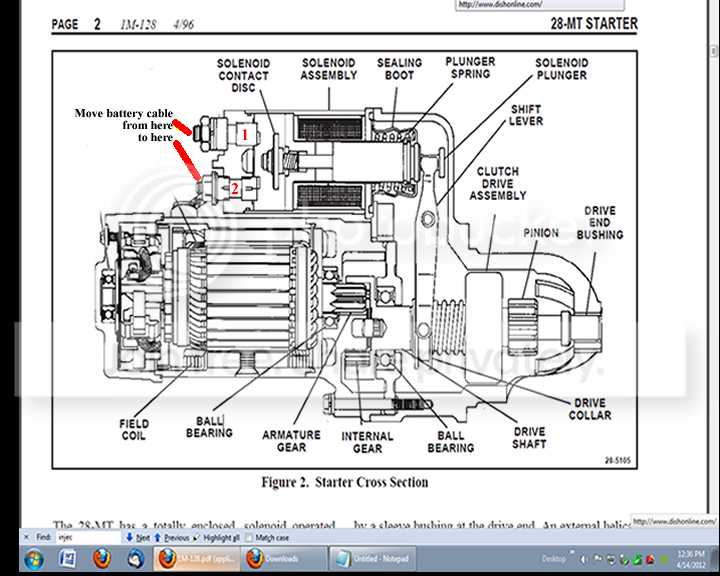
solenididea.png
 
You say you are burning out solenoids. From the body of your thread, it sounds like the solenoids click OK, but the contacts don't turn the starter on.

In general, there are a few reasons why a set of contacts burn out.

Too much current.
This is possible. A bad starter might cause that, but you have changed starters.
However, if the teeth are meshing too deeply into the flywheel, it might bind the starter and cause an over current problem.
Also, low voltage will cause a large increase in current. Does the starter sound like its dragging? You may have a ground issue since you have changed the power leads.


Oil or grease on the contacts.
Should not be the problem since you have replaced them and they are sealed.

Low switching force. Again low voltage, or a mechanical problem. When those contacts are engaged, they have to move the Bendix out. If it has trouble moving out for some reason, the contacts are not going to hit as fast and hard as they should.

As for your wiring idea, I know its been posted here somewhere. I don't remember if that is how they did it or not.
My only worry is that the starter might start spinning before the solenoid gets it engaged all the way.

Personally, I would use the original contact that used to run the starter to trigger the Ford relay.
Then hook the battery lead from the Ford relay to the starter power post.

This would cause the starter to not start spinning until the Bendix was all the way engaged, and the original solenoid would only have to fire the Ford relay which should make it last forever.

It would sound a little different.
When you turn the key, you would hear a clunk, another clunk, then the starter would start turning.
 
FORDUM< Thanks for your thoughs. We may be saying the same thing about how to wire the remote solenoid:

I said:
The purple wire that feeds 24volts to the stock solenoid will be routed to the remote "S" terminal.
You said:
Personally, I would use the original contact that used to run the starter to trigger the Ford relay.
Then hook the battery lead from the Ford relay to the starter power post.
In my scenario- I see your point: The juice reaches both terminal simultaneously- No guaranteed the starting gear will have sync'd yet.. Hmmm?

In yours the purple line from the starter relay would go to the ford relay- as in mine. It energizes the starter at which terminal? Where is the jumper?
 
it might not be the same thing. but I was getting the "hot start" starter issue.. I replaced the starter with a Brand new starter, Not Reman. still the same.. replaced the power cables. still the same problem.. then I added a 0gauge Power cable from the starter to the battery.. and it never happened again.
 
Ok, I got some sleep, and finally got back online.

My idea would be a little harder to do than yours, but would make sure the Bendix was engaged before the starter turned on.
Looking at your diagram, I would take the battery hot wire from terminal 1 and put it on one of the main posts of the Ford solenoid.
I would take the starter power tab off terminal 2, and hook the other side of the Ford main post to it.
This is the tricky part. There is not a lot of tab. You would have to use a good quality bolt and insulate that connection well with something that can handle heat.
If you could find a copper bolt and nut, might do better. Plus they sell some Teflon insulating tape. That with some tough overwrap would do well.

Then, either run a small hot wire or a jumper from the purple wire still hooked to the original solenoid to terminal 1.
Run a wire from terminal 2 up to the trigger for the Ford solenoid.

That way, when the purple wire goes hot, the original solenoid would pull in. When it pulls in all the way, it shorts across terminals 1&2, sending 12 volts up to the Ford solenoid.
The 12 volts would either come from the purple wire jumper or a separate hot wire hooked to terminal 1.

Its a little complicated, but it would take the load off the contacts of the original solenoid, and make sure that the starter did not come on before the gears were all the way engaged.
 
FORDUM,

Thanks for the idea. I had to draw it on paper to get the flow in my mind. It's great. It will work. The problem I have with it is that it puts me back at square 1 as it does not accomplish what I want. Here's why:

The jumper does accomplish what you say it it will; but it brings the Solenoid Contact Disc into the equation again which is the weak link as it pits-up and carbonizes when it closes the circuit between A&B. Could a relay be worked in to get the starting gear into place before the juice hits Terminal Lug #2(B in new drawing)?

newSolidea-1.jpg
 
So the starter is 24V, but where does the purple wire come from? Your diagram is basically the opposite of the normal Ford solenoid installation. Compared to the usual way of adding these, this diagram doesn't address the weak voltage from the pink ignition wire. Does the 24V truck have a 12V ignition switch and a relay to send 24V to the solenoid? If so, that circuit is basically taking the place of the Ford solenoid conversion and upgrades to it could solve all of these problems.


For reference, I'll tell you that my Ford solenoid does nothing but supply good current to the starter solenoid ("S"). The starter solenoid is still tied directly to the battery and switches the current to the motor. This gives normal synchronization. It completely solved all of my hot start issues and instead of swapping the starter every year I've had the same one for many years. There's another common way of doing it where you route the motor current through both solenoids, but that doesn't seem ideal to me.
 
That way, when the purple wire goes hot, the original solenoid would pull in. When it pulls in all the way, it shorts across terminals 1&2, sending 12 volts up to the Ford solenoid.
The 12 volts would either come from the purple wire jumper or a separate hot wire hooked to terminal 1.
The real question here is whether the stock solenoid is pulling hard enough to engage the bendix, but not hard enough for good electrical contact. Because this proposal doesn't make it pull any harder.
 
The jumper does accomplish what you say it it will; but it brings the Solenoid Contact Disc into the equation again which is the weak link as it pits-up and carbonizes when it closes the circuit between A&B

Actually it does eliminate that problem, as well as help or eliminate the possibility of weak actuating force.

The contacts in the original solenoid are designed to switch several hundred amps. A tight engine can cause the starter to draw 400 amps.
With this system, instead of trying to switch that many amps, now it only has to fire the Ford solenoid.
When you have a set of contacts rated to 400 amps switching only an amp or two, they should last forever.
Also the switching force problem.
When you are switching 400 amps, you need to get those contacts together hard and fast.
Contact surfaces are never perfectly smooth and even. And electricity is fast.
As the contacts approach each other, there comes a point where a small part touches first.
Say you need 1/2 square inch of contact to handle the current. When they first touch, a small bump of about .001 square inch makes contact first.
That small an amount cannot handle that current, so it vaporizes causing a pit.
As the contacts continue to move closer, they arc more and more until enough metal touches to handle the current.

If they do not come together hard enough, only the high spots touch.
If they come together fast enough, the high spots do not have time to melt before the rest of the contact comes together.

But, with that small 1-2 amp current, the first part that touches can handle the current until the rest hits.
Same thing as the necessary amount of force per amp.

Of course, if the linkage is binding and the contacts are not touching at all, then that will be obvious when the Ford does not fire.

Two other points:
If the original solenoid is already pitted and burned, you are going to need to replace it one last time to ensure its reliable to fire the Ford.

Also, if it turns out that the Ford is not strong enough, with this remote mounted setup, you now have options.
You can easily find solenoids that will mount there that are capable of handling a thousand amps if necessary.
 
Blue85, on the Military Blazer the sytem is 24 volts to the starter only. There is not a pink wire as in standard Chevy ignitions. A starter relay sends 24 volts to the starter solenoid's "S" switch.

The top Terminal of the starter solenoid receives 24 volts from a 24 volt power buss. just those two wires go to the starter.

FORDUM, 400 AMPS!

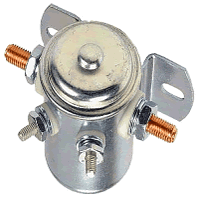
Will this solenoid handle the load? If not could you recommend one?
15_141.gif

[FONT=Arial, Helvetica, sans-serif]
AMETEK 24 Volt DC Universal Applications
Power Up Relays,Pump Motors ,High Current Utility Vehicles, Winches, Lift Trucks,
Snow Plows etc.
Insulated Ground Circuit
Normally Open Circuitry SPST
Contacts : Silver

Voltage Rating 24V DC
Terminals copper; 10-32 thread
and 5/16"-24 thread.
Continuous
Rating 200 Amp
Can be used to in place of Prestolite
15-141, 15-196, 15-310,
SAS4401, SAS-4408, SAS-5401
[/FONT]
 
OK, had a minor brain fart.
In case you have not been following me on other threads, and why would you? I am 3/4 through a four week everyday turkey season.

So, I'm not running at my peak.

The 400 amps I quoted is correct for a high load 12V system.

But, Work, the amount of force needed to turn the engine over at a certain speed, is equal to Volts times Amps.
So, since it takes the same amount of work to turn the engine over no matter what voltage it is, then 400 amps at 12 volts will equal 200 amps at 24 volts.

So, the solenoid you show should work.

Look up the specs, and you will see that the make current is much higher than the continuous rating.
The amp draw when first made is going to be more than the amount when the engine gets started spinning.

But, be warned, the one you show has an insulated ground. What that means is that the case is not grounded to the other side of the activating coil.
Not a problem as long as you run a ground wire to one of the small terminals and the trigger lead to the other one.
There are other websites that carry heavy duty solenoids, but I cannot find one right now.
I have posted one here before, and I will do a search in a minute to find it.

But I think that one should do.
 
Yes, we all know that switching heavy loads causes pitting. But your proposed scheme is just moving the pitting to a different set of contacts. That means the only advantage is that it's easier to replace. What I'm trying to say is that with the right drive current, the stock solenoid pulls much harder and works for many more cycles. If it is weak, then the actuation of the bendix is also in question.

This 12V controlled 24V starter relay is essentially the "regular" Ford solenoid conversion already done. If that relay just had short enough and heavy enough wires from the battery to the starter solenoid, then the starter could work as intended. But without voltage measurements, it's hard to know which part of this system is "most" to blame.
 
True. But there are a couple of advantages to the system I wrote up.
First, while it does move the load to an easier to replace unit, it also offers the ability to increase the current handling ability of that unit.

With the factory setup, you are pretty much limited to what will fit on the starter and work the Bendix.
With a remote solenoid, you can upgrade to something huge if needs be.
As for the operation of the Bendix, its not as critical with this design. With this setup, it would not matter if the original took 10 seconds to engage the Bendix, because the Ford will not fire until its engaged all the way.

And as for which pulls harder, I have no idea. Don't forget that the Ford unit is also a starter solenoid which is designed to last as long as the GM one.

I agree that the stock setup should work. Its possible that there is a misalignment somewhere that is causing the solenoid to move slow.
From what I read, it seems that he has replaced both the starter and solenoid more than once.
So it is likely to either need a shimming, or there is something basic wrong.

In either event, there is a known problem with these designs that is addressed by the Ford conversion, plus his question was how to make the remote solenoid work.
So that was where my primary point was aimed.

I personally know of several GM trucks that never seem to have starter problems. But, there are a few that crank slow when hot, and it seems to happen a lot on here.

Its pretty much a matter of taste.
Sometimes you want to fix the main problem and make something work like it was originally meant to work, and other times its just easier to bypass the whole thing and build something that will work better than stock.
And other times you just want it to work.

Had a problem with my old Jeep blowing the turn signal fuse.
I am very good with electricity and electronics. But this thing would run fine for months, blow, then work fine 5 seconds later for months again.
Nothing I could do would make it blow. It just had to do it when it wanted to.

Finally I just mounted a dash mounted circuit breaker in place of the fuse.
Every few months, I would turn on the signal, and the breaker would trip. I would just press the reset button and it was fine for a long time again.

About 8 years later I found the problem by accident and fixed it. But I left the breaker hooked up.
 
Getting good info here from guy's that obviously have good electrical application knowledge.

Blue, you said:
Yes, we all know that switching heavy loads causes pitting. But your proposed scheme is just moving the pitting to a different set of contacts. That means the only advantage is that it's easier to replace.
Yes, that's the advantage I am settling for, as I have no more clues as to why I am burning up solenoids. I will, next chance I get, inspect the run out on the flexplate, check it for ant damage, and verify that the clearance with the starter gear is in spec. But as I have stated, no other problems, no funny noises, no grounding issues (extra chassis to engine ground added), and all new 2 gauge battery cables with soldered lugs. New glow plugs too. So I am not thinking it is a wire resistance issue. The batteries have been replace with new Group 31s and load tested.
Moving the burning solenoids to the firewall wont fix the STOCK issue; but will give me peace-of-mind when on road trips as it is a lot easier to swap out a small part in an easily accessible area- packs small too.


What I'm trying to say is that with the right drive current, the stock solenoid pulls much harder and works for many more cycles. If it is weak, then the actuation of the bendix is also in question.
3 different solenoids on as many starters, I don't believe it is the solenoid.

This 12V controlled 24V starter relay is essentially the "regular" Ford solenoid conversion already done. If that relay just had short enough and heavy enough wires from the battery to the starter solenoid, then the starter could work as intended. But without voltage measurements, it's hard to know which part of this system is "most" to blame.
Copy that. I think that the 10 gauge wire that runs from near the radio, behind the dash through the firewall and across the cowl down along the transmission dipstick is too long. I have spliced in a new line on the engine bay side hoping it will help. If you could suggest a test procedure for voltage measurements, I'd follow through.


FORDUM, is the callout in this revised schematic addressing the Insulated Ground issue the right way? WAIT! I just finished reading a few articles on "insulated Solenoids" one of the manufacturers said DO NOT GROUND THE "I" terminal to either mounting screw as shown in my drawing above. Instead drill a small hole and add a self-tapping screw and star washer on the firewall and run your "I" lead to it. There's probably one already near the battery). Not sure why; but I'll follow their advice rather than break down and not have a clue why.- FYI.
 
Last edited:
That jumper is correct, IF the solenoid is wired the way I think it is. You can test it by putting the housing on the negative terminal of the battery and briefly jumping a hot wire to the S terminal.
If its wired the way I think, nothing will happen. You have to have a ground on one and hot on the other.
However, that I terminal can have other uses.

On older Ford trucks, that terminal went hot when the solenoid pulled in. One side of the coil was hooked to the frame, and the other side went to the S terminal. That is the "standard" way Fords worked.
If the solenoid had an I terminal, it went straight to the ignition coil. The older ignition coils were designed to operate on about 9 volts.
They had a ballast resistor in series to drop the battery voltage down to about that amount.
When you were cranking, the heavy load from the starter would pull the battery voltage down to around 9 volts.
So, when the solenoid fired, it put full battery voltage to the ignition coil through the I terminal. Thus giving a good hot spark despite the low voltage.

Common complaint was when an engine would run only when cranking and go dead when you released the key.
It meant the ballast resistor was burned out.

If you have an ohm meter, you should have resistance between the S and I terminals and none between either and the case.
If so, then wire it the way you posted.
If you happen to have resistance between the S and the frame, then just mount it to a good ground and hook the one wire to the S. Leave the I alone.

If there is a model number on the solenoid, check with the PDF file and see which schematic it is.
Should be number 2.
 
3 different solenoids on as many starters, I don't believe it is the solenoid.
What I was saying is that sometimes the factory wiring doesn't pull the solenoid very hard, espicially when it is hot. The lower contact force --> more arcing --> worse contact, etc. A vicious cycle that shortens the life. Giving that same factory solenoid a proper kick with something close to battery voltage really makes it more consistent and reliable.

But the Ford style solenoid doesn't need as much current for reliable triggering because it doesn't have gear to swing out at the same time. So you get less voltage drop from the factory feed wiring anyway.

So how will you connect that starter motor tab to high gauge wire without the tab eventually failing? Can you get a big terminal block that mounts to the motor with a hose clamp or something? You need to keep the mechanical stress off that copper.

Let us know how it works out. :thumb:
 
should I read this? I'm guessing Fordum has it under control....


me likey slave solenoids...
 
should I read this? I'm guessing Fordum has it under control....


me likey slave solenoids...

Oh, come on, you know you want to.........:D

Everybody likes my ramblings.......:whistle:
 
So how will you connect that starter motor tab to high gauge wire without the tab eventually failing? Can you get a big terminal block that mounts to the motor with a hose clamp or something? You need to keep the mechanical stress off that copper.

That was the one downside of my otherwise brilliant plan.......
That stud on the solenoid makes a great mounting point, so when you lose it, something needs to take its place.

I was considering his strapping the battery cable to the starter close to the tab, maybe with some thin plastic between the cable and the starter housing to reduce chafing. Heavy copper cable like that is quite rigid, and if its restrained close to the connection, should hold pretty good.

As for the current feed for the original solenoid, I'm surprised that there is a problem on this truck.
Since the solenoid runs off 24, it should require half the current to fire it. Which means that the wire should be heavy enough.

Of course, there may be a loose connection somewhere.

I knew that using a Ford to fire the GM is the most common fix, but I have seen times when it did not seem to get the job done.
Bypassing the GM contacts entirely for the starter should ensure that they never give trouble again.

But, it is the easiest thing to try first.
 
Top Bottom