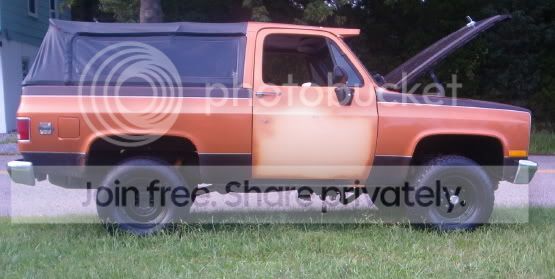
CK5
Register an account today to become a member! Once signed in, you'll be able to participate on this site by adding your own topics and posts, as well as connect with other members.
alrighty, I'm here...... ask any body questions of me you wish sir... kinda jumped to the end here, sorry...


Oooh goody! :bow:

So I've basically got 4 types of prep work that I will have to deal with on this build.

1. New panels with a black primer coat already sprayed on by the manufacturer.
2. Fresh, BARE metal that needs to be brought all the way through to final paint.
3. Combo of the first two (like my bedsides)... Mostly black primer coat, but some fresh metal where I shortened and re-welded them back together. So I'll need to take those areas from bare metal into final paint but also blend-in with the black primer that's already on most of the panel.
4. Fresh metal that's been heavily douched with Ryoken Green already.....like my boxed frame for example. There might be spots that I'll take back to bare metal for tweaking, maybe some ALL METAL for some aesthetic smoothing of some areas... But needs to end up in final paint building up from the RG base that's there now.

:thinking:

I figure starting with the bed floor is a good place to practice with a new DA and some 3M Gold paper to knock down welds, smooth the metal...add fillers, prime and blocksand. This is probably my opportunity to buy a decent HVLP gun as well for shooting good quality primers, sealers and maybe repaint my engine with a quality, catalyzed paint (since the rattlecan paint is already flaking off). I don't think a $600 gun is necessary for that kind of work since I will not paint this truck myself in the garage. A gun of that price/quality is certainly overkill.

I'm ready to learn about primers and sealers and I'm willing to spend the money for the "good stuff". But I want to make sure that as I bring this truck from bare metal into final primer (for a real body shop to spray for me) I want to insure that the products I use will be compatible with the final type / brand of paint that will get used for the basecoat/clearcoat.


That's a big list of questions, but if you're willing to start with the steps that will move me along on the bed floor and help me practice new techniques, that would be a great first step! :)


-G
 
I'll just ask you not to do any practicing on real truck parts. Get some cardboard, old refrigerators, or other stuff (maybe the wheels?) to practice painting on first. Nothing is worse than sanding off messed up paint to just spray it again. Small stuff can be sandblasted clean again, but bed floor isn't so easy.
 
ok, I'll poke thru a couple here..

the black is EDP primer.. it's "ok", we would leave it at the collision shop and just douche fill primer over sanded EDP.. for time sake... a rig like this, I'd more than likely strip it off...


as I've alluded to many times in here, keeping feather edges to a minimum is always good.. trying to prime over a "palamino pony" as I call it can potentially lead to various failures...

go raw with bodywork areas, do your grinding, fill work, than strip everything else, final sand with some 180ish... rg your raw around the filler areas... come back and scuff that.. fill prime it all... glaze putty as needed.. wetsand.. re-spot prime.. prep.. paint..


as I mentioned, I like devilbiss finish lines for a decent priced economy setup... not a SATA, but spray nice, rebuildable, etc..

being your running RG, I would look at a 2 part uro fill primer like duponts 2k.... I love it for the price.. covers and fills great, sands super nice and takes paint well...

as I mentioned, all metal has it's place.. it's pretty old tech, we where using that stuff in the mid 80's.. it's nice over seams, and deeper stuff, but I generally like a skim coat of standard fillers over the top for coating adhesion purposes.. and don't be afraid of modern muds, huge strides in the tech over the last 25 yr's...

depending on the project, I often keep 2 fillers on hand... if I've gotta fill something that's a 1/4" deep, I like a standard filler, it has the strength, albeit it may get a pinhole here and there... a lightweight filler is nice for very thin skim coating as it's creamier, sands real nice, fills pinholes, etc.. super common to do an initial fill with regular, than go over with a lightweight to fill any minor low spots and pinholes...

glazing putty post primer will be for any sand scratches left in filler after primer... filler should be 36 grit and final leveling with 80.. than prime... a bit of RG getting on the filler is no big deal, but don't actually prime the filler with it, just raw... fill prime over all of it.. than glaze the mud areas...


heavy RG is ok, just gives you some more to make sure you have a good sanded etch... always remember a rule of bodywork.. you want your sanded etch to be the grittiest it can be, that will be filled by the following coating.... if your RG is thick enough to 320, or 280 sand it, as opposed to a course scuffpad (equal to about 400, 500 grit) do it... realistically, a fill primer like 2k, will bite nice into a 220 grit.. and fill that VERY easily... the issue you'll run into is, 220ing the RG, will more than likely blow thru in many spots...

sand at your discretion...


ok, Kai just woke up... fetch time... back in a bit.....
 
ok, post breakfast puppy nap....

I forgot to mention.. when it comes to sealers, it's best to run the paint manufacturers recommended one from their line... but that can be put on top of any uro primer like nason, etc...

I generally don't run them.. mainly for economy reasons and doing my work in the LAB™....... it's usually best to shoot a sealer in a booth just prior to paint, as the majority of them are non-sanding......
 
ok, post breakfast puppy nap....

I forgot to mention.. when it comes to sealers, it's best to run the paint manufacturers recommended one from their line... but that can be put on top of any uro primer like nason, etc...

I generally don't run them.. mainly for economy reasons and doing my work in the LAB™....... it's usually best to shoot a sealer in a booth just prior to paint, as the majority of them are non-sanding......


So will a urethane primer resist rusting while I'm still getting things completed in the shop?

My only experience is with the rattlecan grey primers which totally absorb water and let rust start underneath. I think my truck had a paint/primer called "K200" (?) on it when I first bought it in 2001. Not sure whether it's considered a primer or a sealer, but it never rusted even without a topcoat after all these years. :dunno:

Looks like I'm going to be spending some money on new tools and consumables today! :haha:


-G
 
any catalyzed primer is impervious to water.. lacquer primer is the only thing that takes water in... you can leave it sitting outside for a year and the only thing that will happen is it will begin to chalk up a bit as it has no UV protection.. if that where the case, you just sand it a bit to get to fresh material...
 
any catalyzed primer is impervious to water.. lacquer primer is the only thing that takes water in... you can leave it sitting outside for a year and the only thing that will happen is it will begin to chalk up a bit as it has no UV protection.. if that where the case, you just sand it a bit to get to fresh material...

Cool. :waytogo:

I feel some real motivation and progress coming on!!!


-G
 
I use lesnol base and matrix primers at the shop.

I just finished my bronco, lesnol/matrix.

Ryokan covered everything I could think of, I really like the factory e-coat(Edp) but matter of preference,
I left my hood for the bronco out when it was In slick sand( tac based, super high build) and it absorbed something or someone moved it with greased hands, I fought that thing tooth and nail my first coat of base. Hindsight I should of put a epoxy primer over it before leaving it to sit.

There is a product called quick shot I believe. It's body shop safe, but basically a arerosal can of gloss simulator, spray it on body work and see how it looks. Works really nice, sometimes things feel good and quick shot is just a nice way to be sure, really nice if your not use to feeling bodywork.

I'm excited to see some progress in the way or prepping for final.


imagehost
 
I'm excited to see some progress in the way or prepping for final.


You and me both. :saweet:

I am actually somewhat amazed that this thread is as popular with people as it is.... seeing a project in raw metal, or a combination of raw / RG / rusty, etc is not a particularly flattering way to show a build project. In my mind, I know how it's going to look someday, so I can visualize it that way and see past the "reality" of how it looks now. It's a pleasant surprise that SO many other viewers can actually see it that way also... or at least are willing to trust that the end-result is going to be better than what the pictures show now....

It was brought to my attention again recently that I have a habit of being optimistic about future progress, so I'm reluctant to keep making predictions for this summer but I'd really like to be able to get to a point where I could get some of the metalwork 100% finished up (either the body mods, or the cagework) so that I could get it rust-free and into a primer coat (all ONE color!!).

I spend a lot of time watching the ICON videos on YouTube, and Jonathan Ward is actually very generous with the information he shares about how his company does the entire process of building (from start to finish). From those videos I know that I need to get ALL of the metalwork on the truck completed first... that includes stuff like the fenderwell relocation, modifying the bedsides, finishing the cage, etc. but also things like fully plumbing the fuel system, cooling system, running the exhaust, drilling all the holes for electrical bulkheads (EFI, stereo, etc) so that essentially I know EXACTLY where everything will connect, and there are no surprises due to a missing bracket or panel, etc.

Once all of that is done, the body can be separated from the chassis and the final finishing can begin on BOTH parts.... Ideally, this would happen just before the snow flies here in New England. If I could send the body off to the paint shop for the winter (aka: body shop jail) and get the frame into final paint.... I'd have all winter to noodle around with the reassembly of all the suspension, brake lines, fuel line, air lines, electrical harnesses, installing fuel tank, engine, etc.... and I could have a complete, rolling chassis that was 100% finished by the time the beautiful orange Blazer tub was delivered back to my house!!! :saweet: Then I could spend most of next spring/summer joining the two back together, and doing the myriad remaining details for the interior, electrical, gauges, seats, carpet, glass and stereo... as I moved into Winter 2016, I might be running/driving but then again I might not. In any case, the motivation at that point should be sky-high since everything would be in vibrant, final paint..... and it's going to be hard not to want to spend every waking moment out in the garage trying to finish up those details.

I expect Charlie (aka "Danger") will be out-of-his-mind with excitement during that time period as well! :) Right now things are just a bit too "abstract" for him to be very excited.... he knows there's a "monster truck" in the garage but it really doesn't look anything like what he knows a monster truck to be.


(I'm sure that a year from now, someone will dig up this post and remind me that I'm nowhere close to finished the way I dreamed I would be! :haha: )


-G
 
in a perfect world, you FULLY build the rig... and I mean FULLY. everything installed, mounted, working. than blow it all apart for refinishing.. that way every screwhole, etc that will be needed, is there when you go to refinish.. as opposed to trying to do fresh installs, etc with new paint... I used to do it on all the 50's, 60's hotrods for my bosses at the resto shop.

in reality, you have to find the right tipping point, if at all, when/how to do that..... I have never actually done it on my own stuff.. the closest being the K5.... but even that was a huge compromise in when things where refinished in relation to others.... and technically, the tub never came off the frame.. sorta...
 
Fully build and do drive it several times.

I've known a couple guys who built awesome cars. Everything done except paint. Starting driving em to make sure it was all good. Then just kept driving them. I don't know if any of em ever got painted
 
Seriously though I would start talking to body shops. You can usually find a guy who does it at home for way cheaper and quicker with the same quality, but it takes a while to search those guys out.

If you do end up taking it to a shop you need to take note if what cars they have and make an excuse to go in there. See if any of the cars are moving.

Knowing a couple guys that own places there is a massive difference in body shops.

So yah if your even optimistically 6 months out you need to start shopping for your paint job
 
Seriously though I would start talking to body shops. You can usually find a guy who does it at home for way cheaper and quicker with the same quality, but it takes a while to search those guys out.

If you do end up taking it to a shop you need to take note if what cars they have and make an excuse to go in there. See if any of the cars are moving.

Knowing a couple guys that own places there is a massive difference in body shops.

So yah if your even optimistically 6 months out you need to start shopping for your paint job


Maybe it's naïve (or just wishful thinking) but I'm really just looking for a shop to shoot the sealer coat, final color and clearcoat on the truck so that it can be done in a high-end, downdraft paintbooth by someone who paints cars everyday and knows the process like the back of his hand. :thinking:

I feel like the majority of the cost of a quality paint job is the labor to get the panels rust-free, aligned properly and gapped... then primed, sanded, and cross-blocked for about 200 hours until everything is laser-straight and perfect. Those hours add up to big $$$, and I think that with the help of experts like Paul.... I can probably get it figured out and use my own "free" labor instead.

The upside is that the truck won't have to spend NEARLY as much time at a body shop, so I won't feel like it's being help hostage or getting neglected by them. Perhaps this is wishful thinking... and maybe a lot of shops don't really want to even deal with a vehicle that wasn't prepped by them. Lots of risk that the bodywork wouldn't be as good, the materials used were poor... and the end result won't look good, might peel or fail and the shop just doesn't want to have their name associated with a project like that. That's part of the reason I was so curious about "compatibility" of certain brands of fillers, primers and sealers.... it seems like if I stay with high-quality "mainstream" products, most bodyshops would be comfortable working with me to pick up the project where I leave off.... :dunno:


-G
 
For alot if body shops it's not how much time it's gonna take them, it's how much time it takes them to get to it.

Hence my suggestion for finding a guy who does it after work. Just because it's a home based shop doesn't mean it won't have a nice booth.
 
keep in mind Greg.....

you would really be best figuring out exactly what paint/color your going with and buying it all now... whether that's talking to a bodyshop to see what they like to use, etc,is up to you.. it may be advisable... if you find a great shop, and already have gals of stuff they are unfamiliar with, it may ruffle some feathers...

your gonna wanna be trimming out your parts as you do final installs before sending it off to paint... doors, fenders, hood, yada... much much more of an ordeal to have the shop do jambs, etc at the end...

that way they can just mask it off, close all the doors, etc, shoot sealer, base and clear... trimming panels is the right way to do it...


blackwall1.jpg
 
I'm on board with the build it, drive it (if possible) then finish body work, then teardown for paint. Pauls guidelines are absolute for bodywork and paint process. I might add that going over your body prep plan with your painter would get you both on the same page for him to take over the truck at a certain point in the process.
 
2016.04.08 - !!! UPDATE - NEED A SOURCE FOR LASER OR WATERJET CUT CAGE PLATES....!!!

I'll bet someone here knows a place that can do a very high-quality cage plates to save me a TON of time.... :deal:

Counting it all up, I'm going to need about 32 plates cut, with holes drilled and corners radiused.... and I really don't feel like spending 40 hours standing in front of my 20" Apex Sander to get this done.

Basic dimension is 4" x 4.25" with 4 holes (3/8") at each corner...and radiused at the corners as well.


Easy-peasy for a shop to write up a program and blast them out of maybe 3/16" mild-steel plate. I can provide a detailed drawing if necessary.

Who do you know that can do it... online sources? Small fab shops? Anyone?


:ears:


-G
 

Latest Posts

Top Bottom