CK5
Register an account today to become a member! Once signed in, you'll be able to participate on this site by adding your own topics and posts, as well as connect with other members.
Not sure what you mean by "shackle", but if you can shift the seat forward a bit more and put the rotation axis at the back of the seat so the front of the seat rotates downward (instead of pivoting the back of the seat up from an axis at the front like stock), you may gain enough to room. Not sure if that makes sense without a picture.

Basically this..... for the front seatrail mounts:

IMG_2996e.jpg


It's attached with a pivoting bushing under the seat. The rear of the seatrail is disconnected from the rear transverse tube with some kind of latch... then the entire seat "flops forward" on this front mount.

The boomerang shape allows it to clear the front transverse tube as it swings forward... which maximizes the length of the shackle (6" between red "+" marks on diagram) and increases the "effect" of the flip forward more than having the pivot directly on top of the transverse tube (where it could only be about 4" long).

Make sense? :dunno: :thinking:


-G
 
Just out of curiosity have you examined the flip fwd that's factory on the blazers. My 77 and 80 were identical hinge on the front and hook in the back to lock it down.
 
Just out of curiosity have you examined the flip fwd that's factory on the blazers. My 77 and 80 were identical hinge on the front and hook in the back to lock it down.

Don't think I've ever seen it...

-G
 
I have a friend who does upholstery.

He says the memory foam seats are basically crap. Break down fast and are hard to work with.
 
Because non factory seats ruin the whole look of an interior.

Martin
He can't ruin the interior, his vehicle doesn't have one.
 
CLOSER AND CLOSER.......


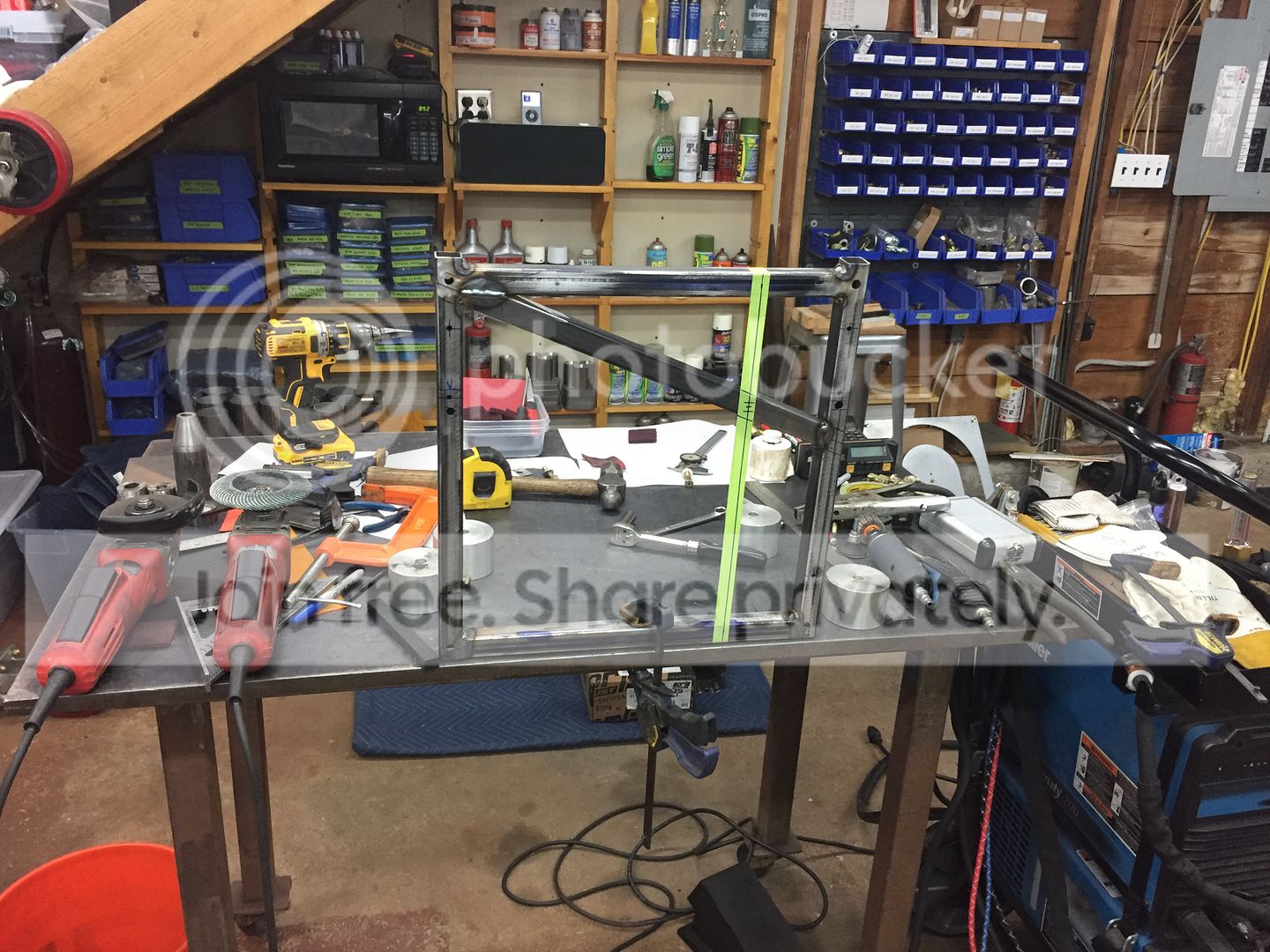
Spent some more time on the seatrail conundrum and working on a better way to hang the inside rail while still staying out of the center tunnel and transfercase areas.

The best solution was to build an offset seatrail mount so that the inside rail could land in a more realistic spot (on the transverse tubes) and leave enough room for a sheetmetal cover for the transmission / transfercase tunnel.

One problem with the idea is that the seat cushion does not stay in the same place when someone is actually sitting in the seat. That cushion is displaced downward by at least an inch, so if the new seat track mount was run parallel to the first one (but 4" more inboarded) the passenger would totally feel that bar through the foam while seated. (Kind of like that awful metal bar that is under the mattresses in a fold-out couch!) :)

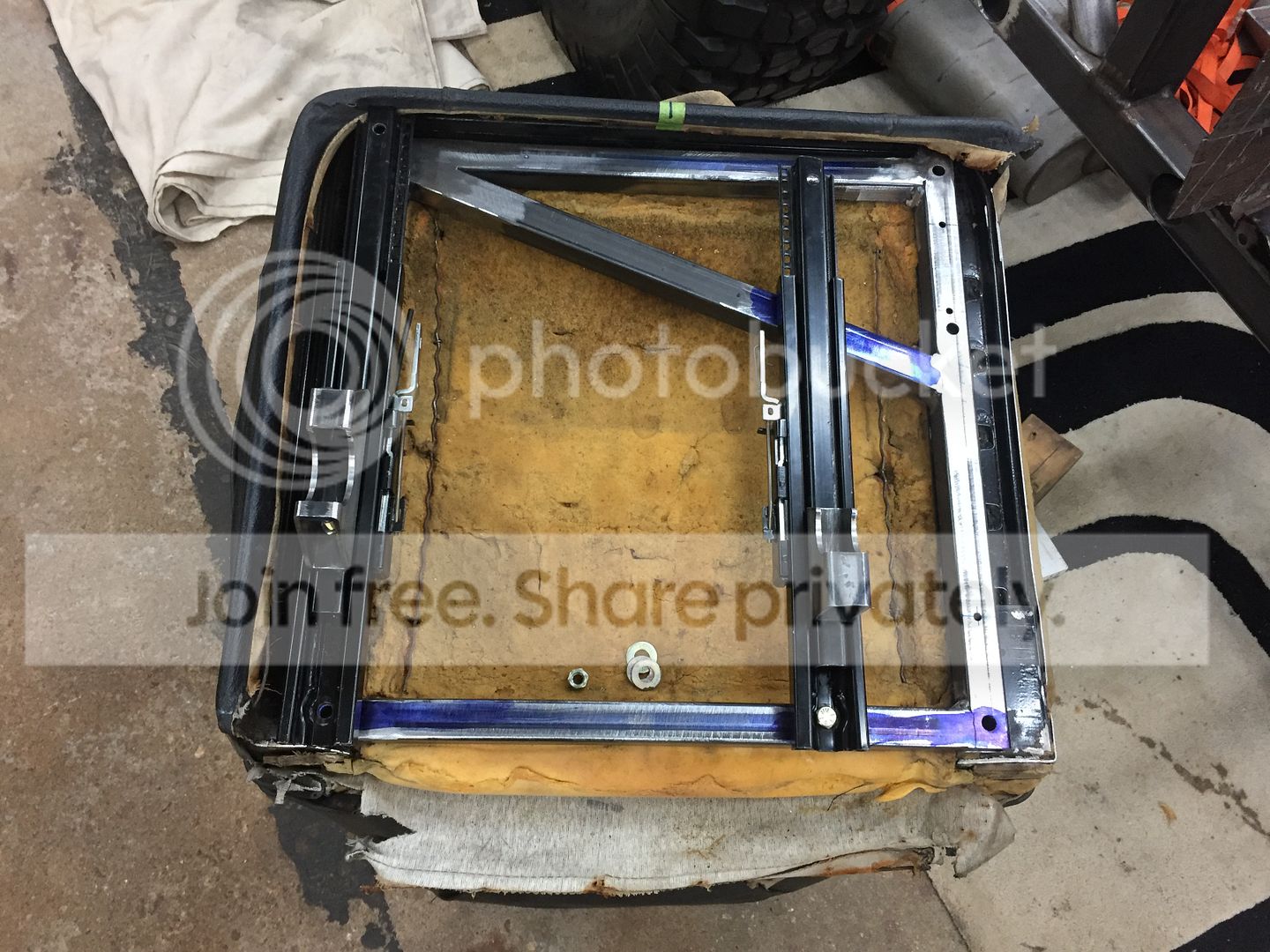
So, the idea was to find a way to support that rail strongly, but to stay out of the seating area as much as possible. Going with a diagonal bar allows the "butt" area of the seat to be unobstructed, and moves the bar closer to the knees where there would be a lot lower concentration of weight... so the odds of feeling unusual lumps from above should be minimal.

IMG_3009.jpg


Here you can see the effect of moving the seatrail inboard, and how that diagonal bar provides a landing spot for that one bolt location that needs it.

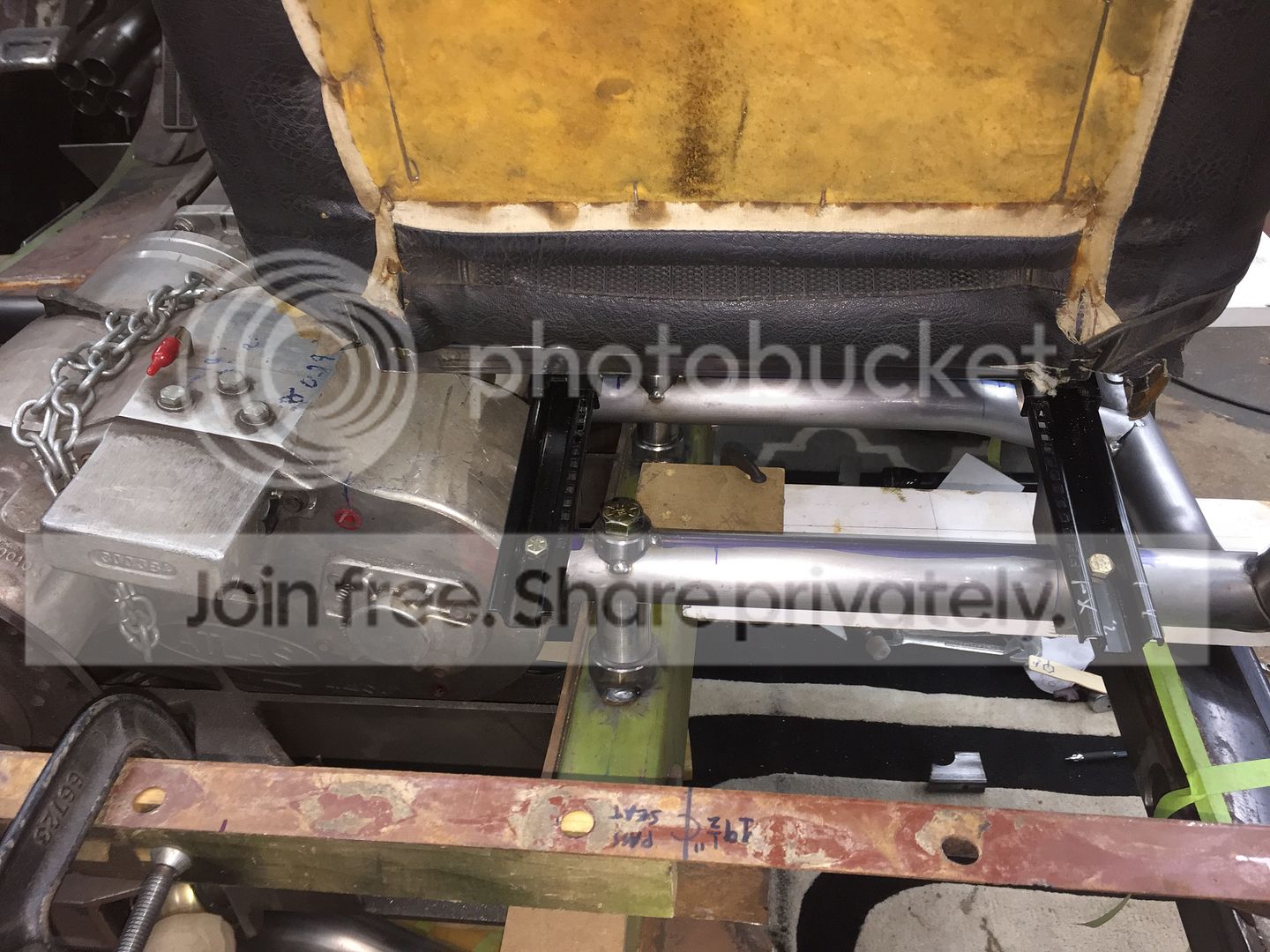
IMG_3011.jpg


When mounted back into the truck, the effect is much nicer than before. There is LOTS of extra clearance now between the seat track and the Atlas box ( I guess the term "LOTS" is all relative!) so there will enough room for sheetmetal enclosures to start closing off the interior bits from the underneath bits. :)

IMG_3014.jpg


With a final design for the rear mounts, it was possible to take more accurate measurements directly off the seat and locate it's position relative to the outer rollcage bars and the transverse bars... and design a new forward-pivot setup to allow the seat to move forward AND tilt (if desired) to really maximize the space behind the seat for ingress / egress.

IMG_3018e.jpg


Now it's off to locate some bronze shoulder-bolts (oops! I meant bushings) to make up durable and smooth pivots... then some fabrication for mounting tabs and front "shackle" mounts to render this drawing in mild-steel. :waytogo:


-G
 
Nice plan, if I were you I would order some regular steel sholder bolts, it will be stronger, lighter, and cheaper. I don't think you want to be sitting on bronze bolts if there is any sort of accident. Then just press in the bronze flange bushings that are super cheap for the shoulder bolt to pivot in. That way if you ever get any slop you just press out and in new bushings and you are like new again. You can find all that stuff from McMaster and have it in a jiffy.
 
Nice plan, if I were you I would order some regular steel sholder bolts, it will be stronger, lighter, and cheaper. I don't think you want to be sitting on bronze bolts if there is any sort of accident. Then just press in the bronze flange bushings that are super cheap for the shoulder bolt to pivot in. That way if you ever get any slop you just press out and in new bushings and you are like new again. You can find all that stuff from McMaster and have it in a jiffy.

Oops... right. I was thinking bronze shoulder bushings not bolts. ;)

-G
 
To be honost it's not like it's getting pivoted all the time I would just use steel shoulder bolts with steel bushing or even delrin bushings
 
I'm thinking ball bearings and gas struts to pop it forward automatically when the lever is pulled. I'm thinking of using something like that.
 
I'm thinking ball bearings and gas struts to pop it forward automatically when the lever is pulled. I'm thinking of using something like that.

I don't know about the gas strut idea, but I definitely want to play around with an assortment of long springs of various strengths to add the perfect amount of "assist" to slide the seat forward. The Sparco tracks don't have any kind of springloading and they are pretty stiff now and don't slide very easily. (Could just be the "newness" and might get a little looser over time). :thinking:

Ideally, I'd like to be able to stand at the open door and grab the bar to unlatch the tracks and have them slide slowly forward on their own to the forwardmost position....without SLAMMING forward from too much spring pressure. Being able to slide the seat one-handed like that frees up the other hand to release the tilting latch so that the seat can be lifted forward. Getting lots of extra ingress / egress room is good.... but the whole thing has to be very easy to operate, so that any of my passengers could do it themselves.

-G
 
With the track handles infront of the seats, are you and your passengers going to be able to adjust the seat while sitting. Without stuffing their face into the dash or steering wheel?
 
I don't know about the gas strut idea, but I definitely want to play around with an assortment of long springs of various strengths to add the perfect amount of "assist" to slide the seat forward. The Sparco tracks don't have any kind of springloading and they are pretty stiff now and don't slide very easily. (Could just be the "newness" and might get a little looser over time). :thinking:

Ideally, I'd like to be able to stand at the open door and grab the bar to unlatch the tracks and have them slide slowly forward on their own to the forwardmost position....without SLAMMING forward from too much spring pressure. Being able to slide the seat one-handed like that frees up the other hand to release the tilting latch so that the seat can be lifted forward. Getting lots of extra ingress / egress room is good.... but the whole thing has to be very easy to operate, so that any of my passengers could do it themselves.

-G


Struts can be nice when they have the gas dampening to control the motion. I guess a spring could do it too.
 
If all of us that keep up on this build would go spend a week at Greg's house (at the same time) we could have his rig built and done by the end of that week. Greg would have plenty of time before Moab to work out any "kinks" and get things working as they should. :waytogo: Of course this is all relative to Greg actually owning enough cash to make it happen in a weeks time. :rotfl:
 
Top Bottom