CK5
Register an account today to become a member! Once signed in, you'll be able to participate on this site by adding your own topics and posts, as well as connect with other members.
I may have to cut a hole through the center of my rear crossmember to make that work, but I'll take another look at it tonight... :waytogo:

-G
With how high you are trying to keep the tank, my guess is that the filler would be too low sitting behind the plate. Either you won't be able to get the tank all the way full, or the angle would be too shallow and make it painfully slow to fill. Also would have to worry about spillage when you get this thing on an angle too.
 
I wouldn't put the filler behind the tail light.

How many busted up tail light have you seen on wheelers. And most of em seem to happen on just a jaunt up to the hills. I think the chance of rearranging the tail light area is enough to discourage me from putting a filler there.
 
I wouldn't put the filler behind the tail light.

How many busted up tail light have you seen on wheelers. And most of em seem to happen on just a jaunt up to the hills. I think the chance of rearranging the tail light area is enough to discourage me from putting a filler there.


Hmmmm....... and how many rear bedsides have you seen that remain "pristine" on full-size Blazers??? :haha:


Just playing devil's advocate here. I'd guess that neither spot is particularly stellar at protecting the filler cap/neck.


-G
 
Yah but the chance of a hole still being there after the bedside gets smashed is good.

You hit the tail light area and it's more than likely gonna become smaller.

Trust me I ran a very precise ongoing experiment with my blazer on how much it took to smash that hole shut. When the bedside fell off once, by dang if that filler neck was still able to fit a gas nozzle in it.
 
Just a quick question..... What are you going to put between the tank and frame to keep it from rubbing a hole....?

I was going to suggest gluing a piece of rubber across the entire surface of the tank wing. Then sinch it up tight with however you were going to.
 
This fuel system research is starting to hurt my brain....

NPT vs SAE fittings... Single pump, dual pump, LPH, GPH, blah, blah, blah.


The Holley in-tank system looked pretty good, but it was expensive and used NPT fittings... to get a dual (redundant) pump setup would cost over $1000. :yikes:

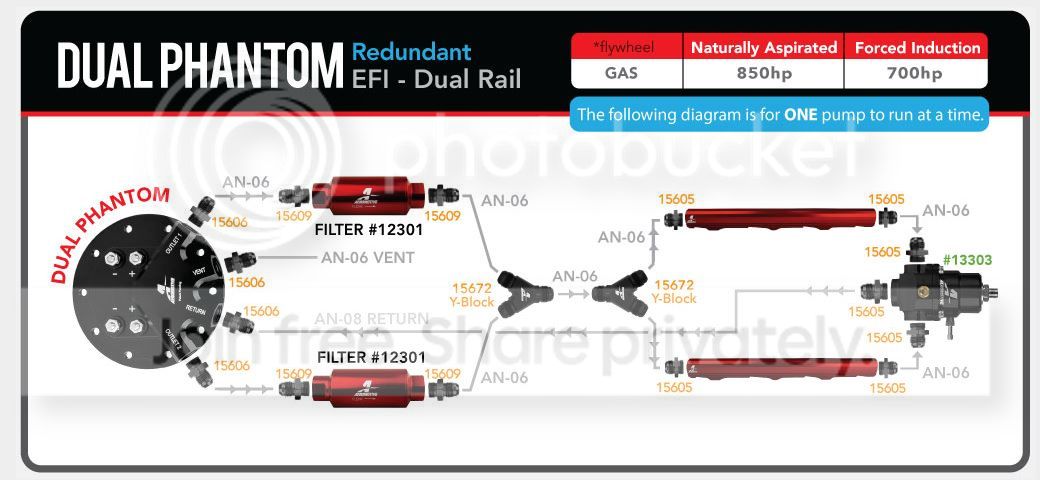
Aeromotive seems to have a more elegant 2-pump solution:

AeroDual.jpg


If I'm reading it right, it's got 2 pumps on a common hanger, and you can switch between them as a "failover" setup if a pump ever fails in the middle of nowhere. I like that part. Also, it seems to use the preferrable SAE (o-ring) style fittings and the pumps have plenty of margin to support my current motor with room to grow in the future if I get the HP-bug.

I obviously won't be running dual fuel rails... so that part of the diagram gets a lot simpler... just a simple fuel line coming off the first Y-splitter?? :dunno:


-G
 
I've always ran aeromotive, always been happy.

Run the one line off the split to rail and return back out of the regulator. You can do the regulator before or after, I like before, makes for a cleaner fuel rail setup, but some swear by after, GM designed systems both ways.
 
Can't speak to the design of the fuel system, but ...

Having spent a ton of time recently with hydraulic fittings, I must concur that NPT sucks donkey balls. O-ring is far superior, no taper and no sealing. Also read up on proper torquing, wet vs dry. I'm using steel fittings, mostly SAE to JIC, which are remarkably like SAE to AN (except AN is often aluminum and have more precise tolerances.) They take a surprising amount of force to properly tighten. Also IIRC you'll want a set of the aluminum flat wrenches to do the AN fittings without galling the crap out of them.

-- A
 
Can't speak to the design of the fuel system, but ...

Having spent a ton of time recently with hydraulic fittings, I must concur that NPT sucks donkey balls. O-ring is far superior, no taper and no sealing. Also read up on proper torquing, wet vs dry. I'm using steel fittings, mostly SAE to JIC, which are remarkably like SAE to AN (except AN is often aluminum and have more precise tolerances.) They take a surprising amount of force to properly tighten. Also IIRC you'll want a set of the aluminum flat wrenches to do the AN fittings without galling the crap out of them.

-- A
I have a torque chart I found some where for the JIC fittings because I always felt like I wasn't getting them tight enough. I do think the specs I found were tighter than I was going by feel.
 
Aeromotive makes quality stuff so I wouldn't be afraid of them at all. I know people who have ran their pumps for 15 years, still going.

Yes you would be correct, a simply fuel line off the first Y splitter into the throttle body rail(s), and then the regulator after the rail(s). The regulator after the rails is better because it puts the restriction after the engine instead of before to better maintain a constant flow to the engine. Also, all fuel is constantly moving in the line through the fuel rail with the regulator after the rail, so it keeps up with changing demand easier, although at 50 psi its usually not a problem. If you put the regulator before the rail then the moving fuel bypasses the rail and you are left with static fuel in the rail until the regulator opens after the pressure drops after the flow increases. Both options can work, but the regulator after the rail is better for a performance setup.

You could simply run one fuel filter after the Y, the only downside to that is, if one pump ever grenaded itself, it could pump the debris over to the other pump, wouldn't make it to the engine, but could potentially damage the other pump when it started up.

As you know I definitely like SAE fittings vs NPT, especially with gasoline and even more so with gasoline at 50 psi. It tends to find its way through an NPT fitting if there is one.

Be careful looking up torque specs for JIC fittings, although many times the fittings are interchangeable and have the same 37 degree contact angle, most aftermarket race fittings are aluminum, and a lot of times JIC fittings are steel, so the torque specs may not be the same. Aluminum takes less pressure to seal and will strip out or deform easier.

Depending on how much the aeromotive setup is you could build your own with two walro pumps at $125 each, each are good for 720 NA hp. They sell weld on female SAE or male AN ports, However, that may be a lot of hours of work just to save a few(hundred?) bucks.
 
You are correct. I believe the table I found had specs for both steel and aluminum.
 
2017.02.06 - UPDATE! - STAINLESS BEER COOLER INSTALLED...!!!

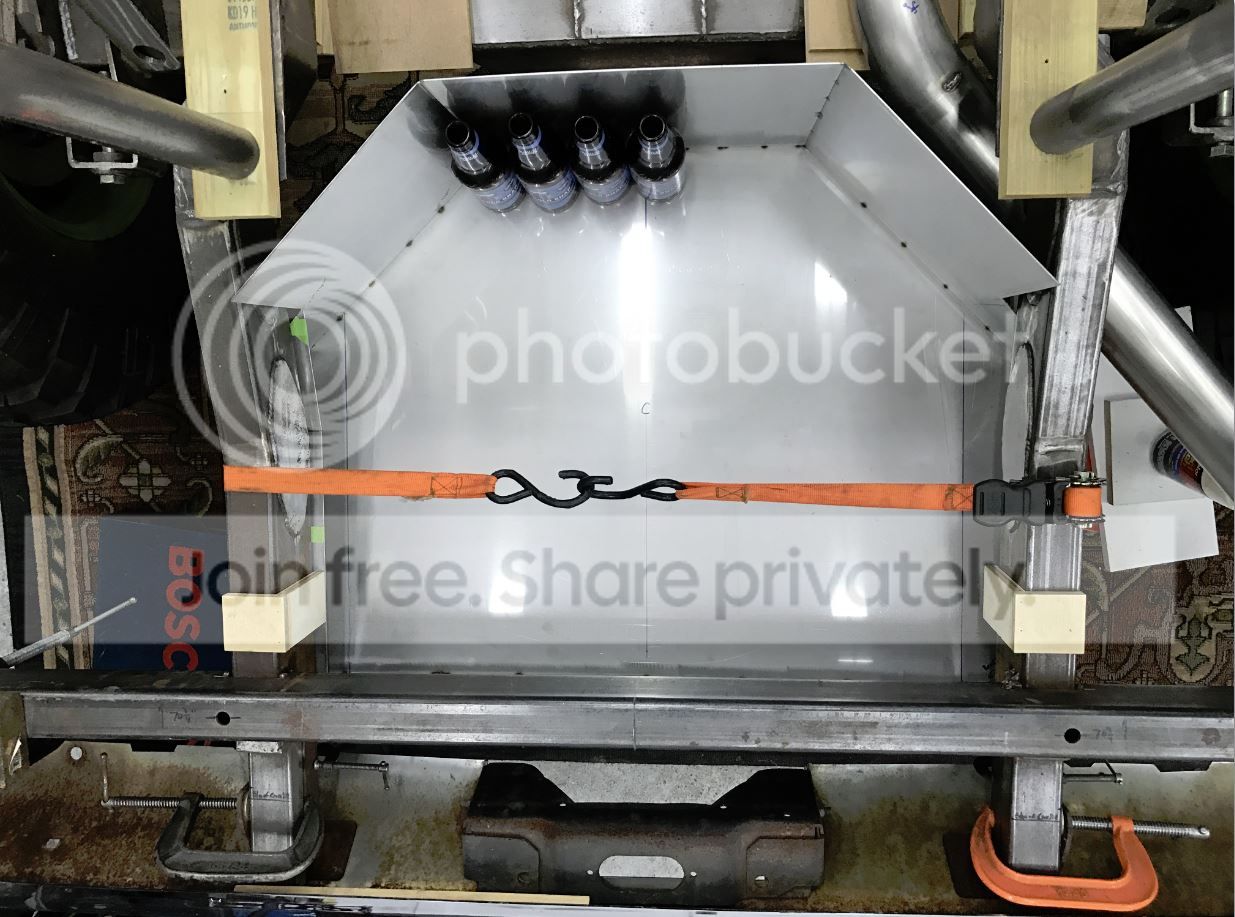
New parts arrived in the shop, so it made sense to clear off the workbench to make room by installing the partially completed fuel tank into the truck. It was a good opportunity to double-check the dimensions and look for any obvious issues with fitment or tank sizing. It all looked pretty spot-on! :waytogo:

IMG_5065e.jpg


@NorCal69 was quick to point out that it looked like a pretty terrific beer cooler, so a few beer bottles were installed just to give the tank a better sense of scale for the photos...

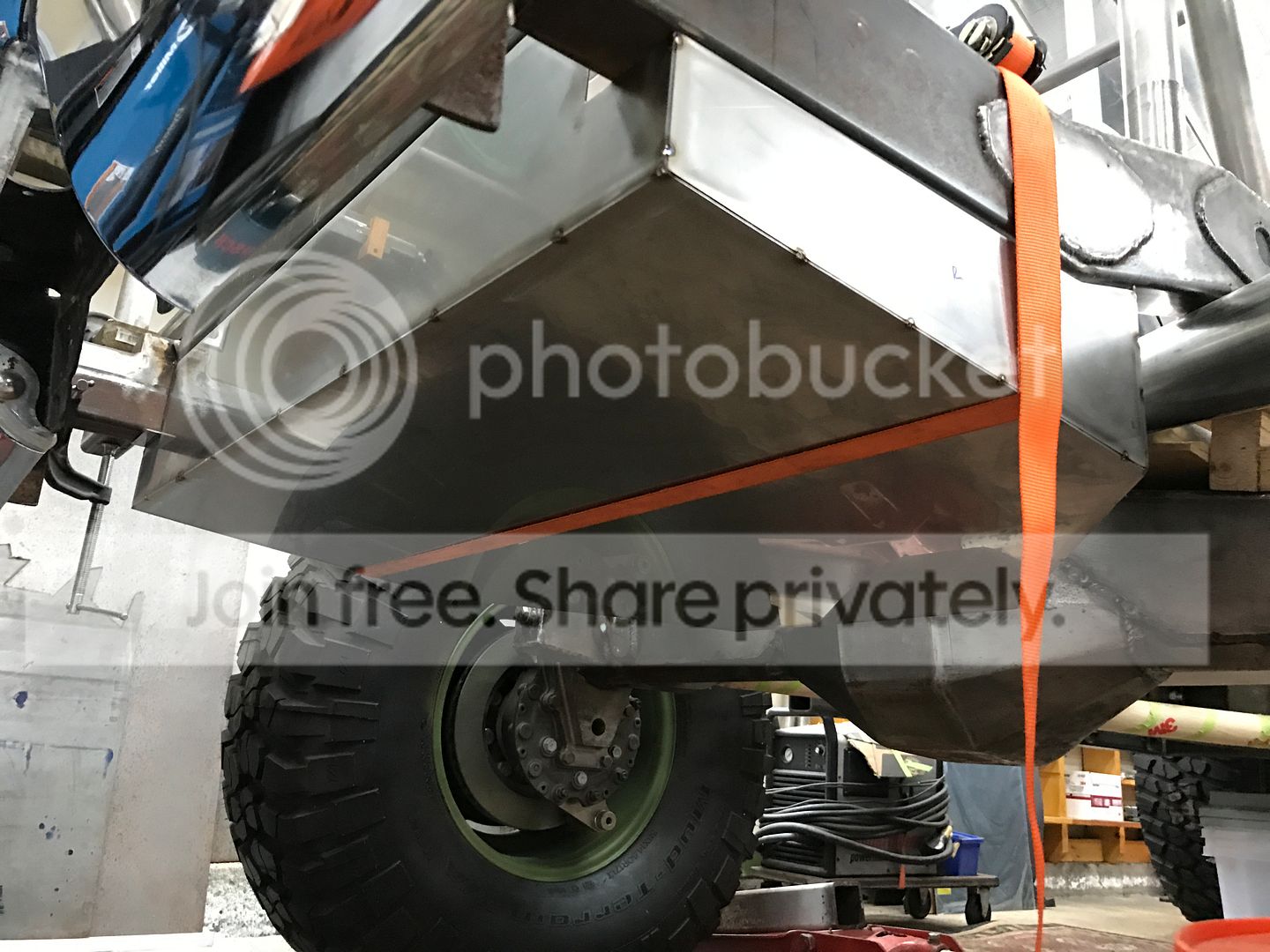
It was also a good time to photograph the underside taper and compare it to the final position of the bumper to make sure there would be enough room for a skidplate to transition cleanly from tank to bumper without any rocks getting hung-up in between. (It looks clear!). It also shows the way the tank "kickouts" work to simplify the eventual strap system that will secure the tank to the frame. Even with a single ratchet strap, the tank can be easily held at the correct height, and depth...

IMG_5047.jpg


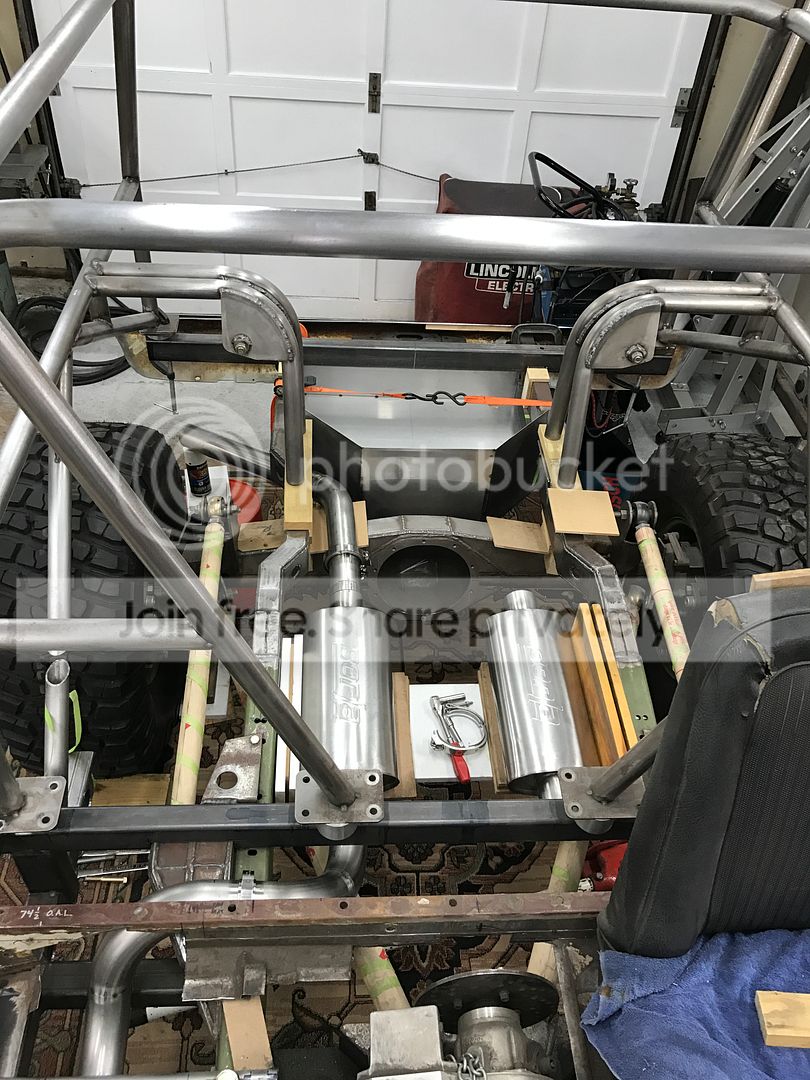
A final shot shows the effect of the 45-degree tapered rear sides of the tank, and how they will ultimately allow the dual exhaust to make it's way back to the rear corners (JUST LIKE STOCK!) :haha:

IMG_5057.jpg


With all that safely mounted and secured, it was time to open up the "new" stuff that arrived in the shop on Sunday afternoon.

IMG_5040e.jpg


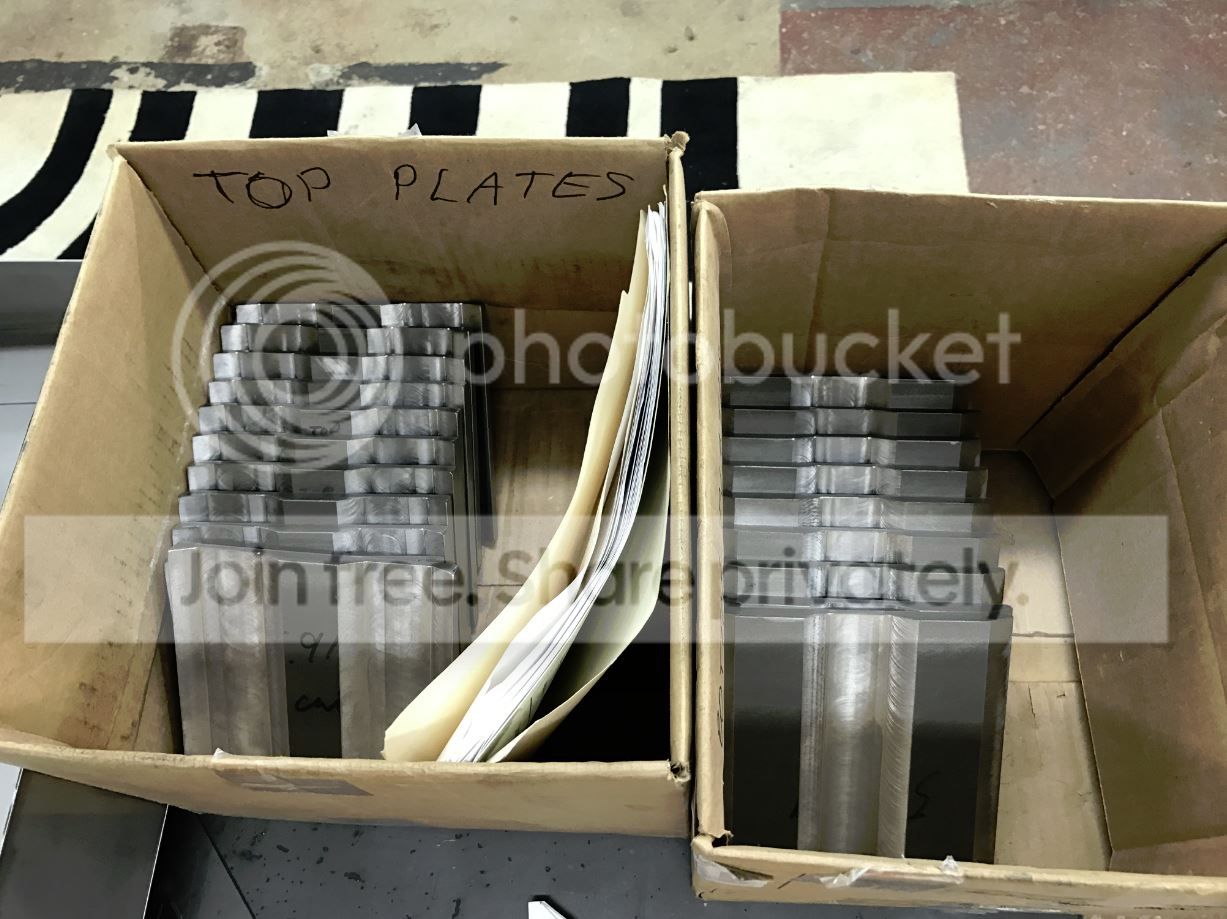
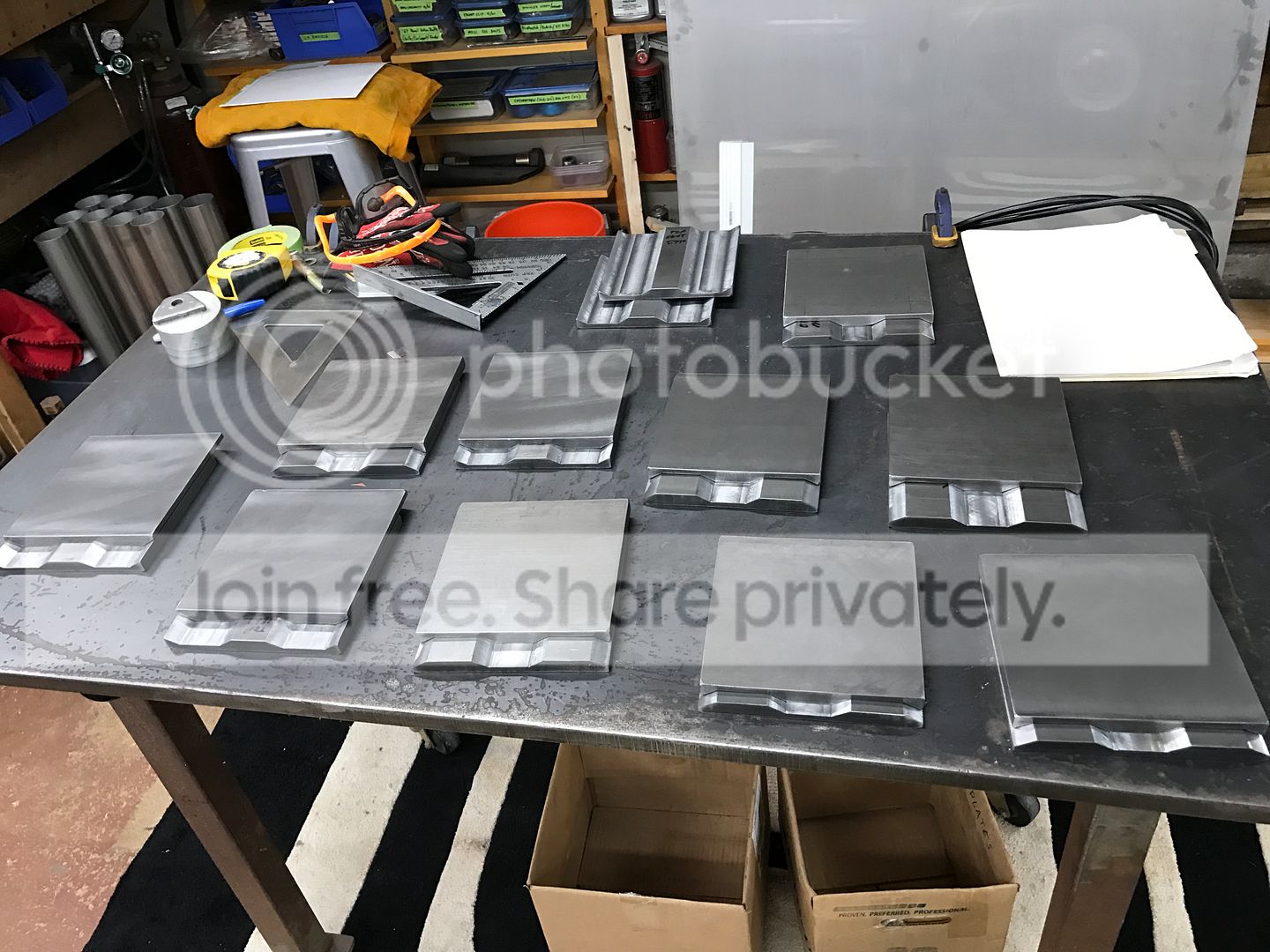
The complete set of cage plates were dropped off for installation!!! :saweet: It was a real struggle due to a number of machine issues, and difficult work schedules but I'm happy to have the parts in my shop so that the rear bedfloor can be prepped for final installation!

IMG_5061.jpg


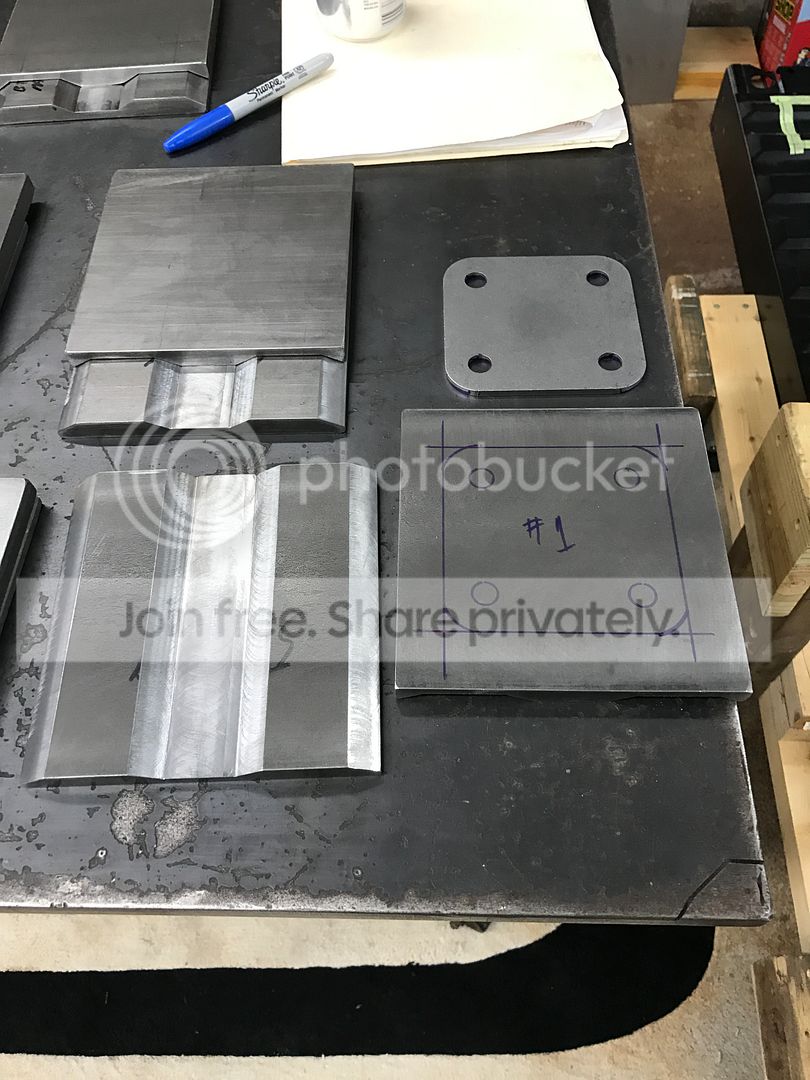
As you may remember, these plates create a solid mounting point for the rear cage as well as the rear strut hangers, while allowing the cage to be fully removeable if it ever needed rework or repairs. So the process of transferring the cage shapes and hole patterns will now begin.

IMG_5066.jpg


FUN STUFF!!! :)


-G
 
Does that mean that the tank project is on hold for the time being?
 
Does that mean that the tank project is on hold for the time being?

I'm going to try to keep it running in parallel.... I have been studying the fuel pump componentry lately and will need to place an order for that stuff before I can finish the tank anyway. I need a filler neck too.

Believe it or not, I'm also going back to redesign my frame-side upper link mount brackets to tie them in more with the rockslider support tubing (square tubes) so that I can get a little more room for the exhaust to travel OVER the framerails (from the torsion box) back to the more conventional between-the-framerails configuration. Right now, the exhaust fits, but its really tight and I'm concerned that it will either rattle or transfer too much heat to the adjacent floor / step-up panels.

Obviously, once I drop the new bedfloor down onto the frame it's going to be a real hassle to do anything exhaust / fuel line / fuel tank-related..... so I want to make the most of the acess I've got now while it's still easy. :)


-G
 
I'm going to try to keep it running in parallel.... I have been studying the fuel pump componentry lately and will need to place an order for that stuff before I can finish the tank anyway. I need a filler neck too.

Believe it or not, I'm also going back to redesign my frame-side upper link mount brackets to tie them in more with the rockslider support tubing (square tubes) so that I can get a little more room for the exhaust to travel OVER the framerails (from the torsion box) back to the more conventional between-the-framerails configuration. Right now, the exhaust fits, but its really tight and I'm concerned that it will either rattle or transfer too much heat to the adjacent floor / step-up panels.

Obviously, once I drop the new bedfloor down onto the frame it's going to be a real hassle to do anything exhaust / fuel line / fuel tank-related..... so I want to make the most of the acess I've got now while it's still easy. :)


-G
Check into the Bosch 044 pumps. We've great luck with them and I think they will do what you need. The Aeromotive stuff is nice for sure but I don't know that you need to spend that kind of $$ for everything. When we were doing the race car we tried to get over to AN fittings as fast as possible. We invested heavily in the conversion fittings from either NPT or O-ring to AN then ran normal AN pushlock type stuff.

Intank pumps are nice but I'm not at all against external pumps so long as they are mounted within the bottom few inches of the fuel tank or better yet below it. Flooded suction is your friend.
 

Latest Posts

Top Bottom