CK5
Register an account today to become a member! Once signed in, you'll be able to participate on this site by adding your own topics and posts, as well as connect with other members.
Should there be a concern of burning up the motor then?


Shouldn't be as long as the DC electric fan motors are designed to run at a lower voltage than straight 12v's.

I've been running my single electric fan on a 2-speed system (high/low), with no apparent ill effects for 2 years now.
 
...but keep in mind that lowering the voltage, will raise the amperage.

I understand the feed wires will need to be able to handle the extra amp load of both fans. When running in series, doesn't the amperage flow through each individual load decrease?
 
I understand the feed wires will need to be able to handle the extra amp load of both fans. When running in series, doesn't the amperage flow through each individual load decrease?


Rule 1: The total current in a series circuit is equal to the current in any other part of the circuit.

Rule 2: The total voltage in a series circuit is equal to the sum of the voltage across all parts of the circuit.

Rule 3: The total resistance of a series circuit is equal to the sum of the resistance of all the parts of the circuit.
 
Last edited:
The total current in a series circuit is equal to the current in any other part of the circuit.

True, but the total resistance of a parallel circuit is lower than an equivalent series circuit according to Ohms law. I = V/R

In english, the total current decreases as the resistance increases.

For example:
A single fan at 12v with 100 ohms resistance (for simplicity sake) will flow 0.12A of current. (12/100=0.12)

Now add another fan in series with the first:
Each fan now shares 12v (each will now see less than 12v) and the total circuit resistance increases to 200 ohms. The total circuit therefore sees 12v / 200 ohms = .06A

Now run the same two fans in parallel:
Each fan gets a full 12v and the total circuit resistance is decreased to 100/2=50 ohms.
12v / 50 ohms = 0.24A total. (0.12A is drawn from each fan and is the same as running a single fan)

Maybe we're saying the same thing. The wiring to support 2 fans running in parallel needs to be twice as big as the wiring would need to be if only one fan was connected. But each fan will still consume the same amount of current and therefore no concern for burning up the motors is needed.
 
In 'either' series or parallel circuits, the larger the resistance, the smaller the current drawn.
 
Good to see good old Ohm and Kirchoff being put to use. :waytogo: :D

Brian's math is correct. Two fans in series will draw less current that one (more resistance). Two fans in parallel will draw more (less resistance) - assuming a purely resistive load.

I agree with the last three posts, I think you're both on the same page.
 
2009.06.28 - UPDATE! NEW SHEETMETAL AND BENDER CALIBRATION

I had an entire glorious day in the shop yesterday. :waytogo:

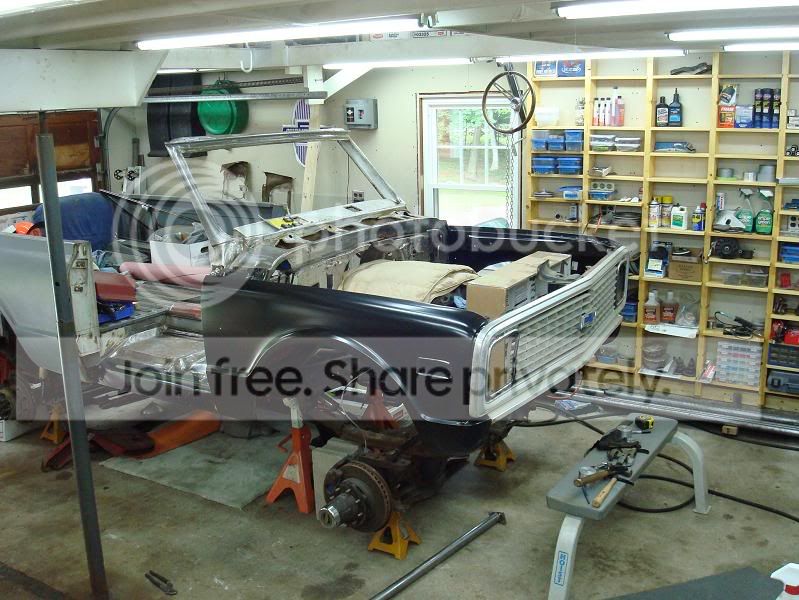
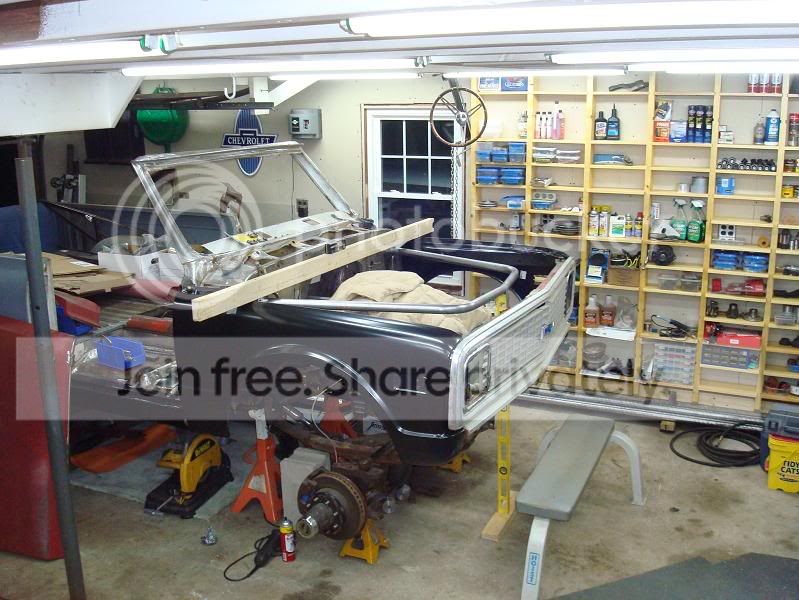
The weather was even a bit sunny at times, the humidity was low and since the shop was finally clean it was time to swap out my "mock-up" rusty fenders for some fresh sheetmetal. I cut and seperated the hood from the fenders, stacked the hood in the corner to be re-used, but the fenders will only live on as fenderlip donors.

DSC01636.jpg


There were a couple of reasons for this change. First is that I want to work with the final parts just in case the dimensions are slightly different, and also being able to do engine cagework is a lot easier with the hood removed...

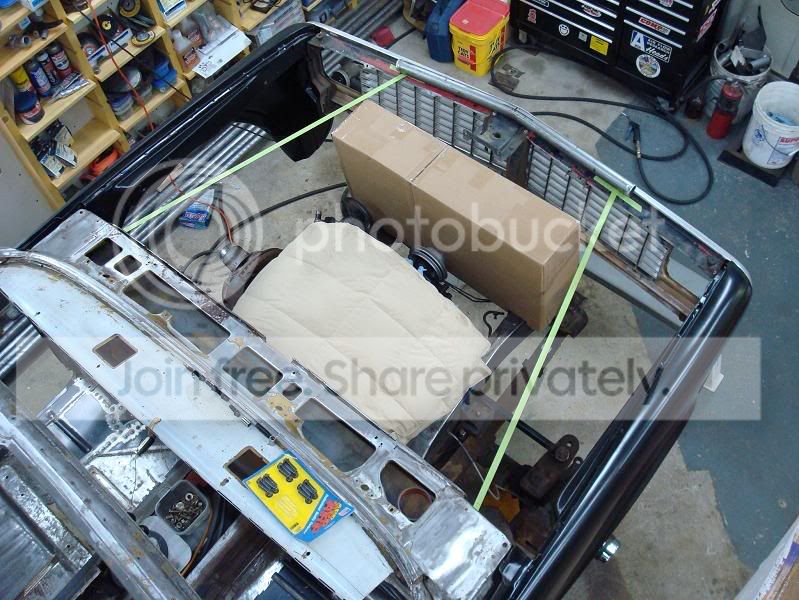
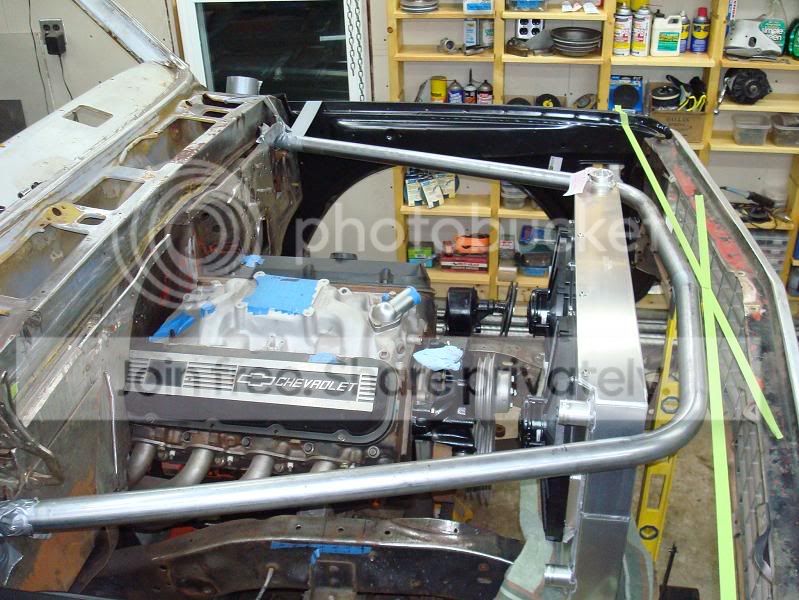
Speaking of which, here is a quick rendering (in 3M green tape!) of a couple of the cage bars. Since I've gotten rid of my old fiberglass hardtop, it is now possible to view and take photos of the truck from above. Finally, some new camera angles for you guys!

DSC01641.jpg


The cardboard box is my new Ron Davis radiator setup....do you like it? :D I needed to confirm that I could squeeze the dimensions closer to the pulleys without hitting the integral fan/shroud setup. Since the radiator is supposed to arrive either tomorrow or Tuesday, I can probably ditch the cardboard soon. I don't really trust it 100% to tell me what's going on...especially since it's sitting on the upswept part of the front framerails. A small change in position makes a big change in hood/engine clearances.

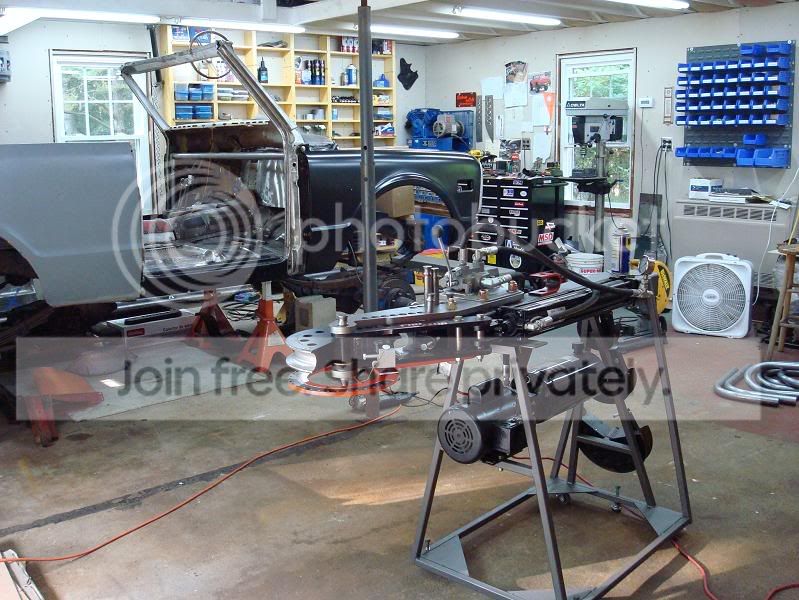
With the basic structure in place, I knew that there was no point in trying to stall any longer....I absolutely HAD to start bending some tube! :saweet: Unfortunately, I still hadn't finished all the calibration of the BendTech Pro software with my final bender arms/ hydro setup...so that was going to need to happen next. You can't bend precisely, unless you know some specific things about your centerline radius (CLR), calibrated centerline radius and "bend offset location". The software comes with good instructions to do all this.... the only thing I had to do was commit enough tubing (ie. completely waste lots of tubing) to get the measurements I needed. After a couple of hours, I had this....
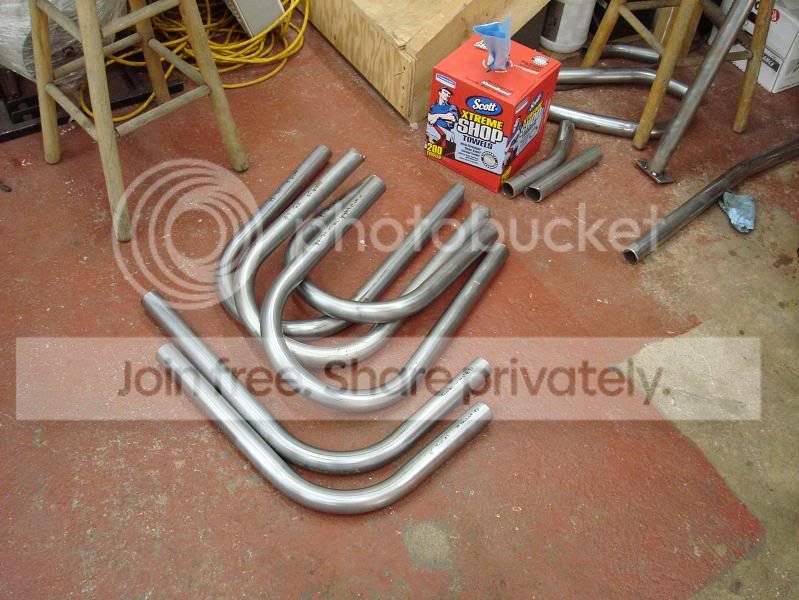
DSC01640.jpg


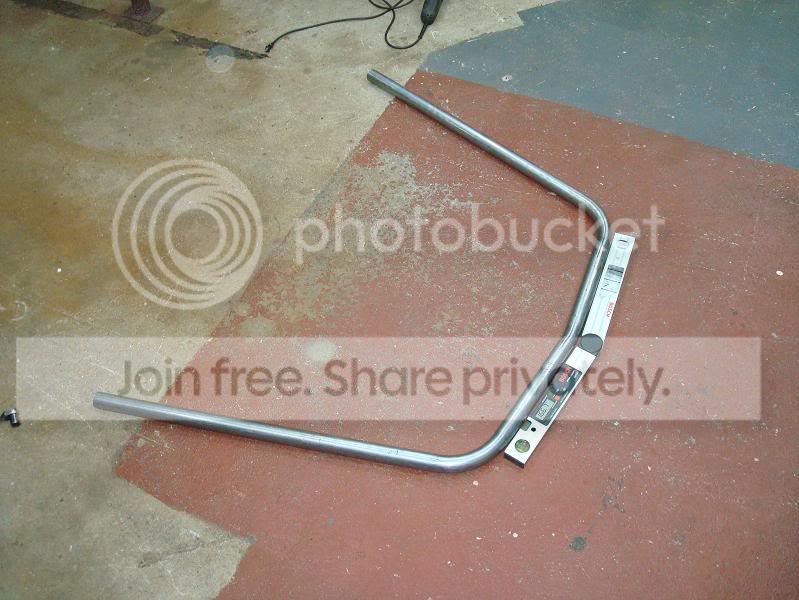
The biggest challenge with any kind of bending is a phenomenon called "springback". The tubing stores energy as it's being bent and when pressure is released from the bender the tube will "un-bend" itself a certain number of degrees... in my first attempt bending a 180* hoop (using 4 degrees of springback compensation) the final bend only came out to 175.5 degrees. The degreewheel indicator only has marks to -4*, so I needed to accurately scribe some additional marks to get to 9.5* and 10.5* of springback compensation before I finally hit a perfect 180* bend. Hence, the rather large and expensive pile of "almost 180" bends in that pile.

The next calibration step is figuring out how much material is lost when doing a 90* bend. This seemed like it should be a no-brainer since I'd already determined that a 180* bend needed 10.5* of precompensation. However, when I bent the 90 that way, I ended up at 93.5* (overbent! :mad:)... so after some fiddling around I re-calibrated the bender to 7* of precompensation and got a perfect 90!

I'm not sure why the bender has two seperate amounts of springback for 90 and 180 degree bends, the only thing I can figure is that drawing such a stiff DOM material to 180 gets harder as it's bent somehow. :dunno: Fortunately, I now have correct precomp numbers for both, and I will probably never bend anything in my cage to 180 anyway...

Here's a parting shot of the manspace at the end of the day:

DSC01643.jpg


From here, I just need to plug all my "findings" into the BendTech Pro software and then re-teach myself how to design some simple parts.... then I can bend up that engine compartment hoop to go around the radiator and back to the firewall on both sides. The software will make things WAY faster, with less wasted tube and I'm looking forward to that.



:usaflag:
 
Last edited:
awesome.... nice to see you having some fun!

I'm finding notching to be by far the most time consuming process in this whole thing... what method do you like? gonna use wrappers?

I'm just spending quality time with the chopsaw, die grinder with carbide burrs, my table sander, etc... not using the holesaw notcher much......
 
I find perpendicular notches are easiest using the chop saw method. We have a good sized cold saw at work with a very accurate degree ring. My boss had some railing he wanted built and was complaining the other shop had the notcher. I grabbed a piece of pipe and showed him the "chop saw method"...

He'd never seen that or heard of it, so it earned me some brownie points. :D

For the angular notches the hole saw notcher works great to about 50 degrees.

The hardest notches IMO are the ones coming into a rad at an angle. Those are just tedious.

Greg, I'm gonna go out on a limb and say the 180 has more springback because there is a larger section of bent area storing more stress.

Rene
 
Ryoken,

I own a holesaw notcher but don't find it useful very often. Most notches up until now have been the old-fashioned way...cut, test, adjust, grind, measure, mark, repeat.

Rene,

I'm sure you're right about the springback phenomenon, I was just surprised to find that there were two different values... when effectively means that I probably need to use a different correction factor depending on how radical each bend is going to be in the cage. I'll probably tape a little "cheat sheet" to the bender for future use...


:usaflag:
 
To bad the radius isn't smaller on all those test "U"'s you made.. Could have been used for front shock hoops. I would have bought 2 from you..
 
To bad the radius isn't smaller on all those test "U"'s you made.. Could have been used for front shock hoops. I would have bought 2 from you..

That's actually the smallest possible radius you can get for a 1.75" tube believe it or not. When I bought the dies from ProTools I made sure to always buy the ones with the tightest CLR (centerline radius). The only way to get a tighter hoop is to go with a smaller diameter tube.

The photo might be a bit deceiving too, those hoops have an internal spacing of 10.5". If I were to use my 1.5" die instead, the inside measurement would be more like 7-1/2" to 7-3/4".


:usaflag:
 
2009.07.06 - UPDATE! - FIRST YOU CRAWL, THEN YOU.....CRAWL, I GUESS...

There was a significant amount of trepidation leading up to tonight's bending exercise I'll guess it was due to all of the money and effort spent getting the hydro bender built, and buying the Bend-Tech PRO software and trying to learn that too... my expectations were getting pretty high, and I was concerned that it might end up being a big disappointment.

I set up a fairly basic 3-bend hoop in the software...checked and rechecked all my measurements, and then there was nothing to do but to commit another 10 feet of DOM to find out if my preparations were correct.

DSC01645.jpg


As it turns out, my fears were unfounded! :saweet: The bends were all "in plane" with no twisting whatsoever, and the final product was VERY close to what I'd designed. The only adjustment was a small re-bend of the center bend to add a bit more springback than I'd originally estimated. The marks on the tube and the POB bracket made it easy to get things reloaded perfectly before adding a couple extra degrees to it.

Here's an early shot of the hoop going into position...

DSC01648.jpg


It's not easy trying to hold a 20Lb stick of DOM in place by yourself (yep, I still need more friends! :D) so a little duct tape was employed to get me in the ballpark.

After a while, and some fine tuning... I got to this:

DSC01656.jpg


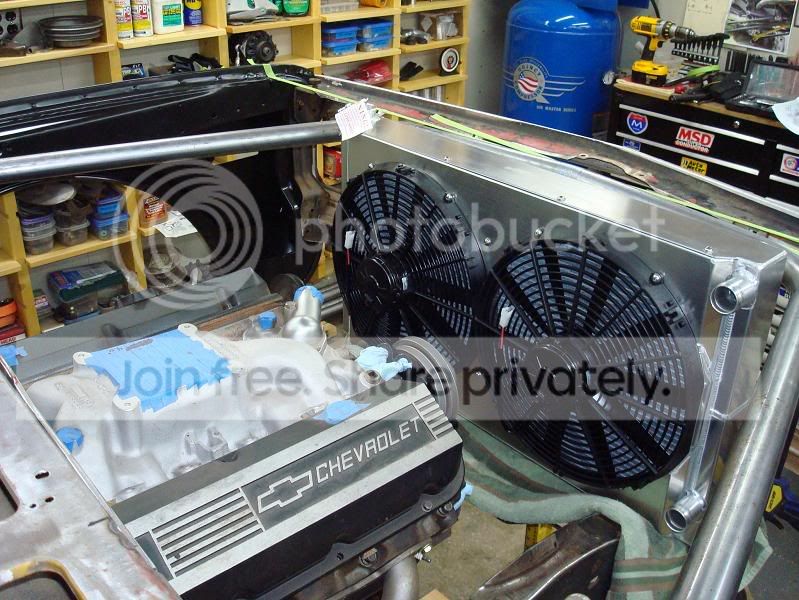
I'll be honest, I was a bit amazed at how precisely the radiator fit into the inside radiuses of those bends. There is very little wasted space.

Here's a different angle showing the fans (the ones that draw 80A at full-song!)...the workmanship of the Ron Davis stuff is rediculously nice. Photos don't even do it justice.

DSC01658.jpg


Next steps will be to built the firewall plates to mount this hoop permanently, and then extend it to the a-pillar structure to integrate it to the main cage components.

Overall, it was a very satisfying night in the shop! :woot:


:usaflag:
 
Last edited:
Greg, i'm sure you are planning on welding the "engine cage" in place but i might suggest that you build plates to make it removeable from the passenger cage for future front end related work such as engine removal. Basically build a plate that will bolt to/through the firewall and meet up with the passenger cage on the opposite side of the firewall.
 
Yep, that center bend was totally intentional... about 13 degrees, which is the taper that the aluminum grille already has. It's not going to look very "1st Gen" with all the skins removed, but there's no rule that says it has to look boring either!

Scotty, I didn't explain it well but that hoop will attach to the firewall with staked plates (and bolts) so that it can be removed if needed (or damaged). No sense designing myself into a corner and trapping my engine under a mountain of tubes! :D


:usaflag:
 
Yep, that center bend was totally intentional... about 13 degrees, which is the taper that the aluminum grille already has. It's not going to look very "1st Gen" with all the skins removed, but there's no rule that says it has to look boring either!

Scotty, I didn't explain it well but that hoop will attach to the firewall with staked plates (and bolts) so that it can be removed if needed (or damaged). No sense designing myself into a corner and trapping my engine under a mountain of tubes! :D


:usaflag:

:thumb:
 
Looking good Greg, but what's up with the power steering pump pulley? Looks way outta whack in the pic.
 
Top Bottom