CK5
Register an account today to become a member! Once signed in, you'll be able to participate on this site by adding your own topics and posts, as well as connect with other members.
Not the greatest pic, but that is all 1/4" stuff I welded at work using a similar shield gas that you are (a 92/8 mix). that was welded at 27.5 volts and approx 260 amps with .045 wire. It just hums, and you gotta move faster...

Don't feel limited when you're experimenting with heat/feed. You have the perfect gas mix to get into a "spray transfer".

I hear that a lot hear where I work where the welders are using spray transfer with a low CO2 content, it sounds completely different, just hums along pretty quiet, unlike the short cirtcuit transfer we are used to with the frying bacon sound. However, I don't think most home shop welders are capable of enough voltage for spray are they? I don't think my MM211 is, when the amperage is high enough for thicker material, say 150 A, it only goes up to about 23 volts.

Although I am not sure what welder you have Greg? By the way, I think with Rene and Kert giving you advice on welding, you should have all the help you need that's for sure!
 
My machine goes up to 28.5V

Not sure how you figure out amps from that?

-G
 
Not sure that you can figure amps like that. The wire feed speed will come in to play as well as the ground that the part is getting and so forth. Almost need a meter right on the machine which is what I have or a digital clamp amp meter around the ground cable to see what kinda amps you're putting down.

Good question though, I've never needed to figure amps on a welding machine.

Personally I dont' much care for spray arc.
 
My machine goes up to 28.5V

Not sure how you figure out amps from that?

-G

I was just looking in my e-manual at the specifications, mine has this chart below...I believe most(all?) MIG machines are CV, constant voltage. So the voltage is set and the wire speed determines the amperage. However, the more power you take for amperage the less you have for voltate, you only have so many watts available and you can't have all of both.

Personally I dont' much care for spray arc.

The guys use spray arc at work for really thick stuff. But I think it's very limited on what orientations you can weld in right? You can't weld spray arc upside down if I remember right?(probably because gravity doesn't work that way) I've never welded spray arc, just seen it done and read about it. I guess short circuit is much more versatile for the stuff we weld and where we have to weld it.

MM211 W.JPG
 
The stack of dimes is just smoke and mirrors and is actually a great way to get tiny areas of undercut. Not a huge factor, but can be enough to make a test plate fail when you're trying for your certs.

Spray transfer that hums is kinda cool, but in reality if it's humming you don't have enough wire speed. Generally 99% of home machines don't have enough balls to make it happen anyways.
 
I've done spray transfer with my lincoln 250 with 90/10 and .035. It is more of a whoosh sound than a hum :)
 
Update on the weld strength testing....

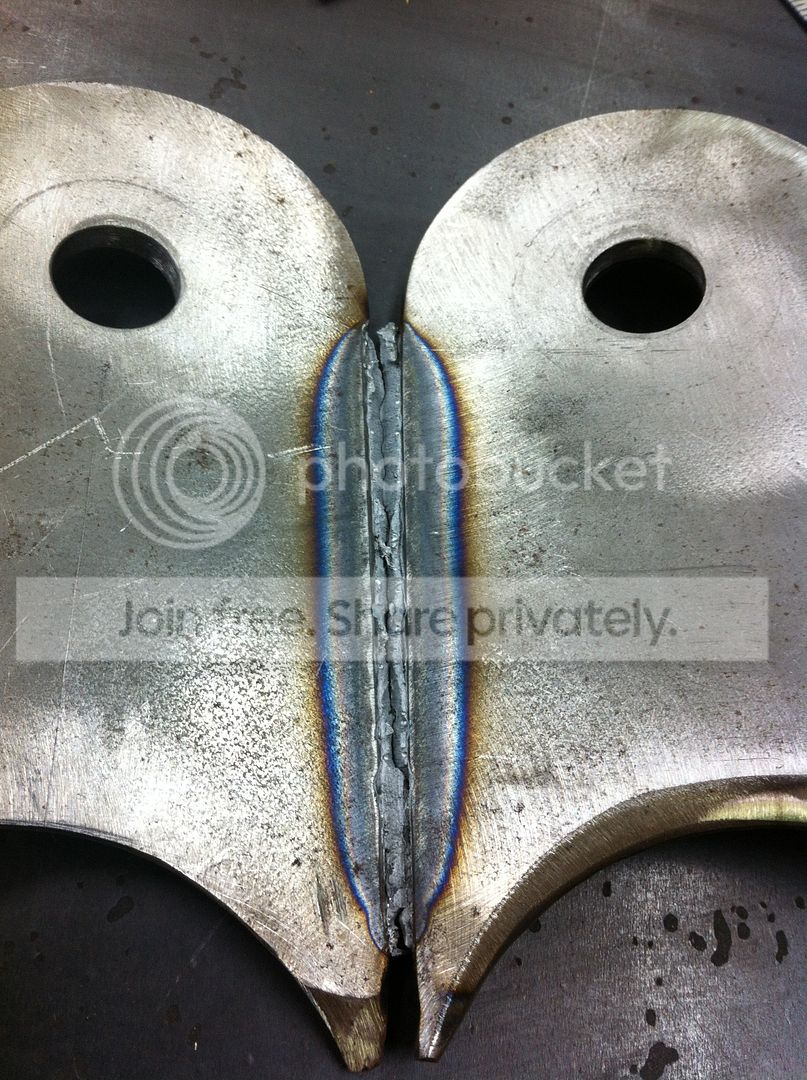
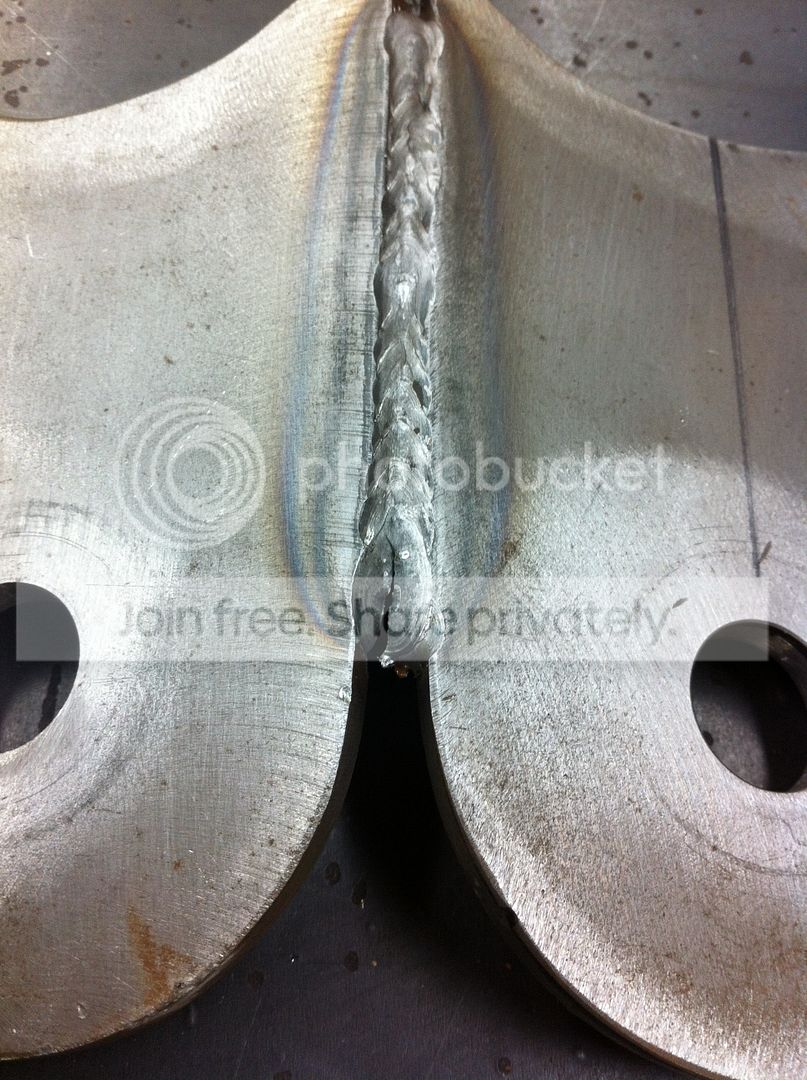
I put the original weld test sample in my 20-ton press to force a failure on the part. I couldn't get it to budge with a hammer. After bending it the way Rene suggested I was able to cause a failure:

Inside view

b51360b5.jpg


Outside view

c96be0d6.jpg


My guess is that this is the desirable failure mode. There is no cold lap, and the tear runs right down the middle of the weld. From the top side, there is a small tear at the very end of the weld, probably a result of poor fill on my initial weld.

-G
 
2012.06.10 - UPDATE! - BROKEN WELDER PARTS... :(

Bad news this morning.... I was on the verge of doing some new weld samples to fine tune my machine and technique, but something went wrong when I reassembled the nozzle to the gun after a good cleaning and fresh tip. The nozzle became inexplicably fused to the diffuser and I could not separate them again. I'm guessing some crud got wedged in the threads but the end result was that I ended up destroying the nozzle and diffuser in the process of taking them apart. Once apart, I noticed that I was using an .045" liner, so I swapped that out for a .030" one... But since there is no place locally to buy welder parts on a Sunday, I was SOL.

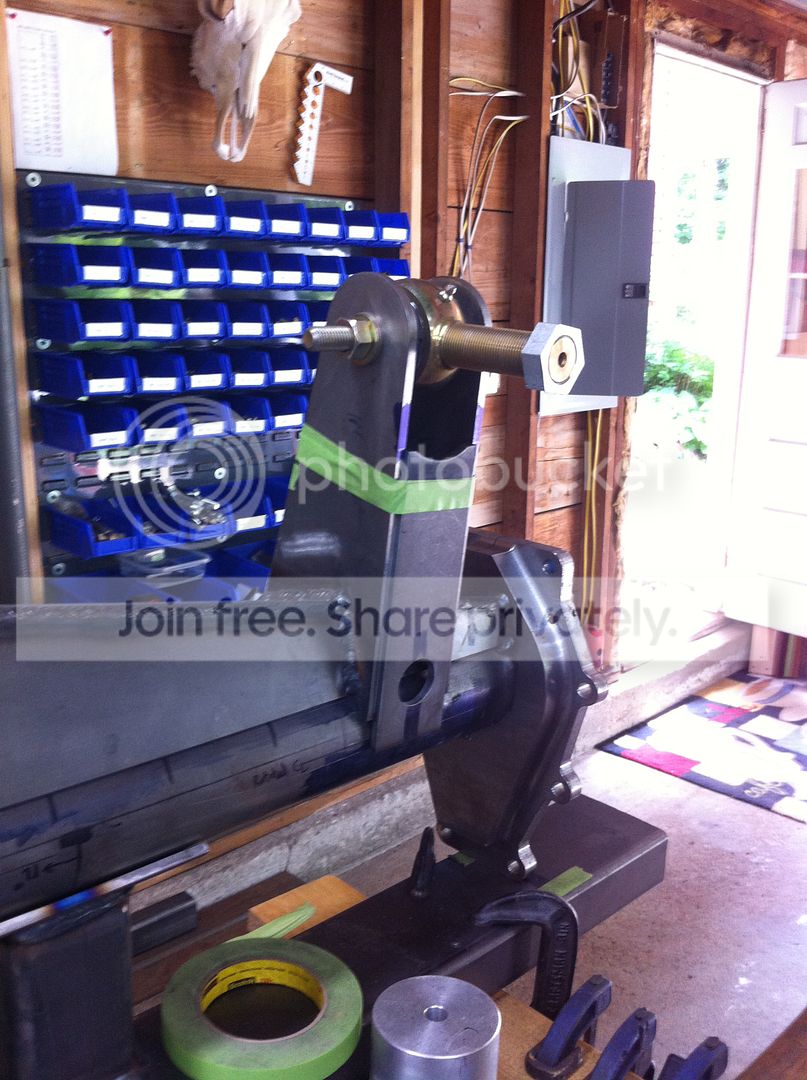
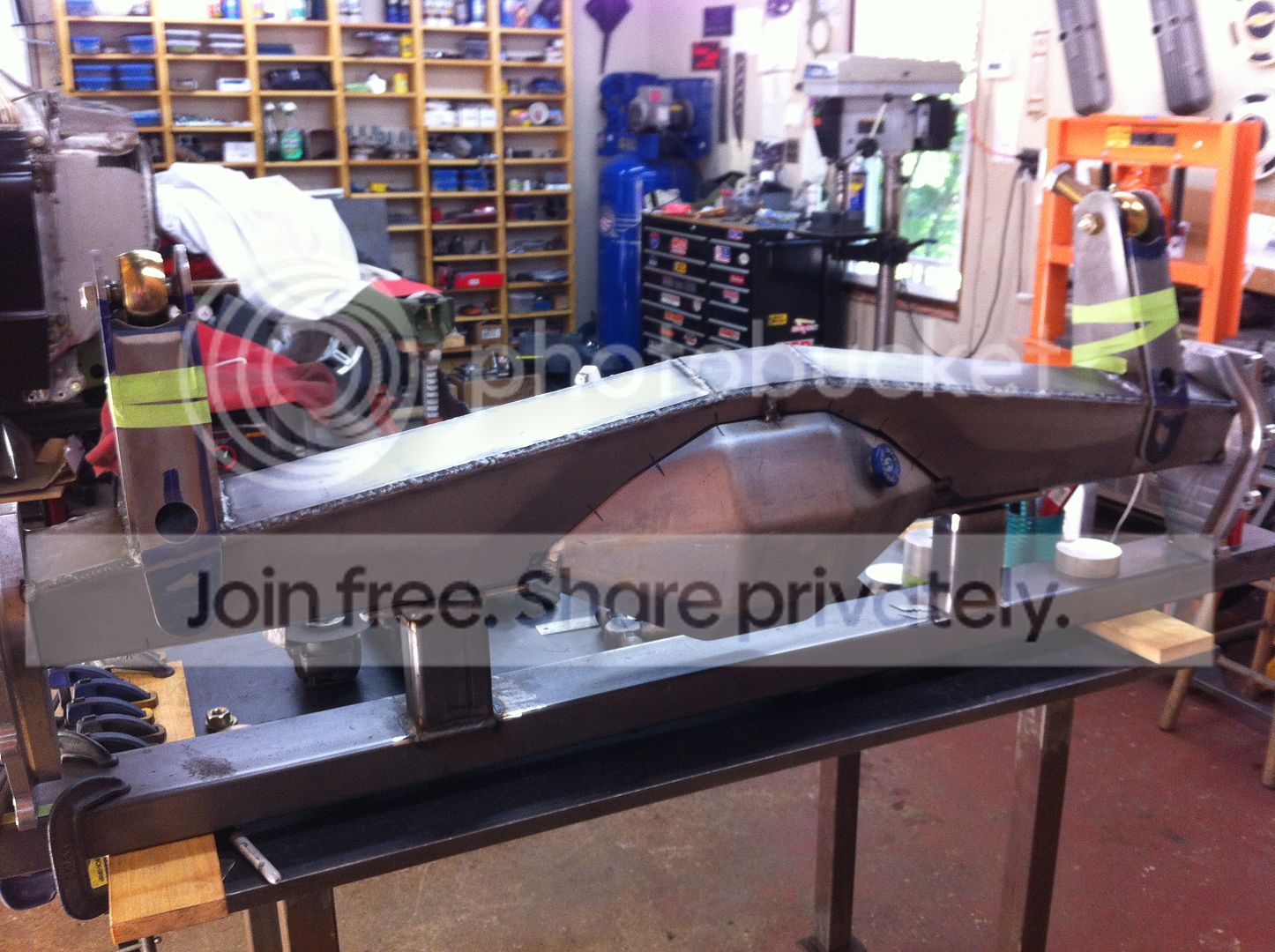
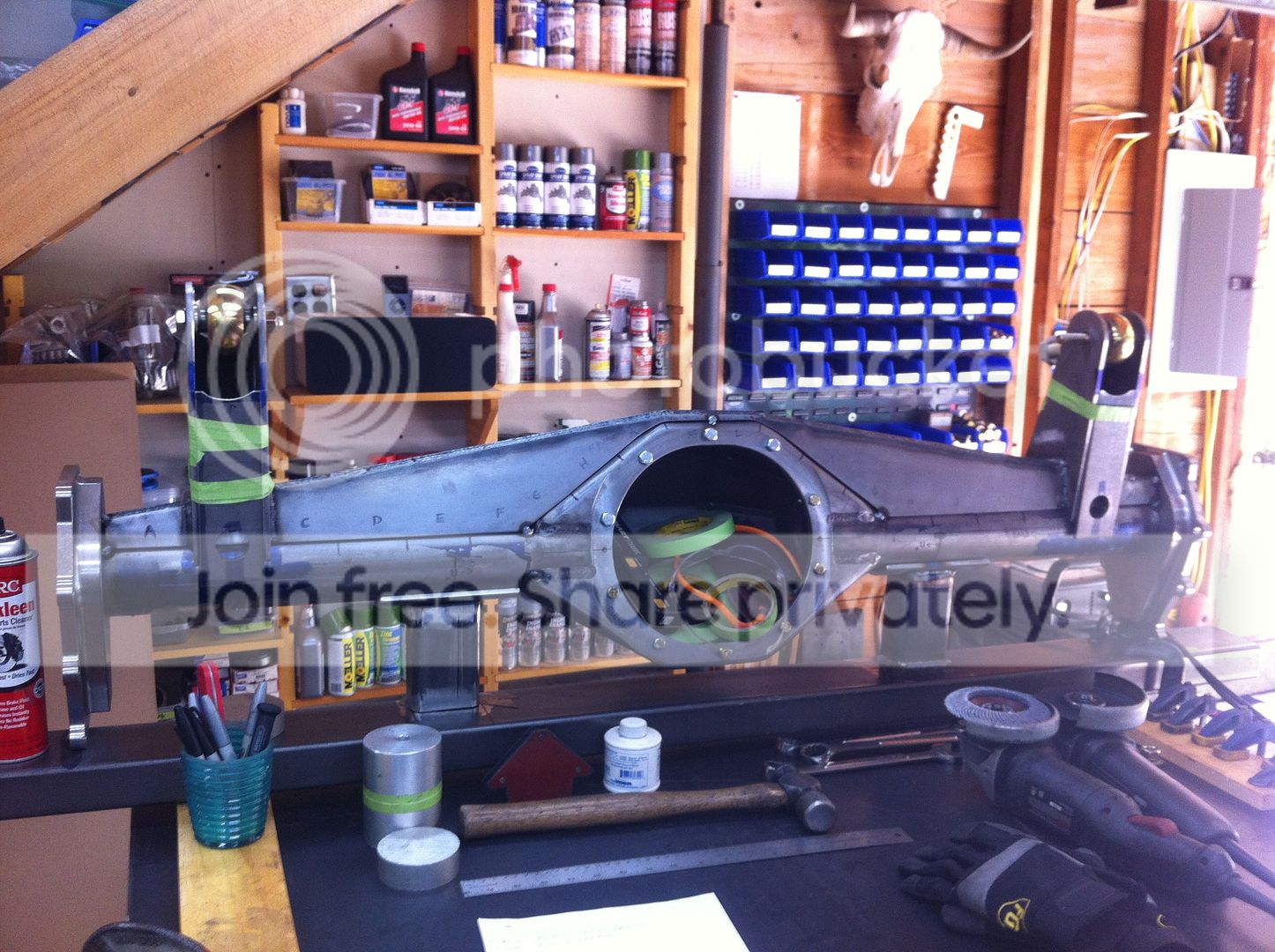
I decided to salvage the day by at least making up the braces for the upper link mounts...that will save me some time next weekend when I am working hard to get the axle re-installed under the truck.

A few pics. (probably blurry, I'll have to edit and add better ones tomorrow!)

Front plate with drain hole...

7128b403.jpg


Rear plates with drain holes...

6b0601ae.jpg


Finished for the day, with my green tape "welding" everything into position. :)

3f6b2912.jpg


Not bad progress really, but I was frustrated that I couldn't tack anything into place during my fitments.

-G
 
nice tape storage....cool stuff Greg, I've been picking up some more tips with the welding school in progress!
 
Update on the weld strength testing....

I put the original weld test sample in my 20-ton press to force a failure on the part. I couldn't get it to budge with a hammer. After bending it the way Rene suggested I was able to cause a failure:


My guess is that this is the desirable failure mode. There is no cold lap, and the tear runs right down the middle of the weld. From the top side, there is a small tear at the very end of the weld, probably a result of poor fill on my initial weld.

-G

These pictures look fine. If those plates bent flat without breaking off, you should be good to go. Wouldn't hurt to go slower, or make a second pass so the weld is at least as thick as the brackets. Kind of hard to see in the pics, so I may be off again. Carry on. :waytogo:

There are tons of online welding videos and instruction, and the equipment manufacturers have good websites also. I don't get to practice near enough to stay proficient, and am learning TIG now. It's not near as hard as it's made out to be, but would be much slower for what you are doing. This guy has some interesting videos, and sends out a weekly-ish email video link. I like it because it gets me thinking about welding regularly, instead of my infrequent garage time.

http://www.weldingtipsandtricks.com/
 
Well I can't say from experience since I never did myself, but I believe from what I saw, the TIG is almost the same as oxy acetylene, except with less fire, and more controled welding.:dunno:
And Greg, I think you got it good, now start welding your axle before you boy graduates and leaves the house.:doah:
These pictures look fine. If those plates bent flat without breaking off, you should be good to go. Wouldn't hurt to go slower, or make a second pass so the weld is at least as thick as the brackets. Kind of hard to see in the pics, so I may be off again. Carry on. :waytogo:

There are tons of online welding videos and instruction, and the equipment manufacturers have good websites also. I don't get to practice near enough to stay proficient, and am learning TIG now. It's not near as hard as it's made out to be, but would be much slower for what you are doing. This guy has some interesting videos, and sends out a weekly-ish email video link. I like it because it gets me thinking about welding regularly, instead of my infrequent garage time.

http://www.weldingtipsandtricks.com/
 
And Greg, I think you got it good, now start welding your axle before you boy graduates and leaves the house.:doah:

It wasn't for a lack of trying yesterday... I was just having one of those frustrating days. The welder problems got me irritated, then I went to do some sanding with my big disc grinder and the first pass I made toward the outer edge ended up catching a small flap of the abrasive that wasn't stuck down 100% and put a tear in the abrasive which caused the whole thing to become unbalanced and useless. Anyone who's used a large disc grinder like this knows that a defect like that means you're throwing that abrasive sheet away and starting over with a fresh one..... Of course, I went to install a new one and discovered that I only had one disc left. :doah: Time to re-order before I have another "one of those days"...

-G
 
Running a larger liner isn't a bad idea, it prevents clogging and limits feed issues...we used to run .062 liners in all the guns, and we most commonly used .045 wire.
 
Good to know Rene.... I'll run the new one and see if I end up regretting it. I can always pick up a larger one if it starts messing me up.

Ordered the replacement parts (Qty 2 ea) from the local AirGas shop today, so I'll have spares if this ever happens again. Still need to reorder the 20" abrasive discs (McMaster Carr) and maybe I'll get some "offical" .010" shims from them as well for setting the correct gaps on my heims?? :thinking:

Does anyone use Glyptal inside their axle housings? I've seen it used on engines in the lifter valleys... my understanding is that it helps create a smoother surface to help the oil flow back to the pan, and may also help seal the porosity of a cast-iron part. Not sure if it would add value on a steel housing or not, but I'd be willing to give it a try if it has some benefit.


-G
 
Does anyone use Glyptal inside their axle housings? I've seen it used on engines in the lifter valleys... my understanding is that it helps create a smoother surface to help the oil flow back to the pan, and may also help seal the porosity of a cast-iron part. Not sure if it would add value on a steel housing or not, but I'd be willing to give it a try if it has some benefit.


-G

You're out of F'ing control dude.

Weld the damn thing up, install gears, axle shafts, brakes etc and peel the F out.

WOW.:thumb::haha:
 

Latest Posts

Top Bottom