CK5
Register an account today to become a member! Once signed in, you'll be able to participate on this site by adding your own topics and posts, as well as connect with other members.
Aluminum links? You sir just don't know when to stop and we love that about you :bow:
 
Is that bushing going to ride on the threads of that bolt or is the bolt long enough for both bushings to be on the shank?
 
Is that bushing going to ride on the threads of that bolt or is the bolt long enough for both bushings to be on the shank?

I definitely don't want the threaded area to be inside those bronze bushings... I tried to buy a bolt that would be long enough that the unthreaded portion alone could utilized as a load-bearing surface.

Good eye! :waytogo:

-G
 
Have you thought about using a cylinder pin instead of a bolt? Do you plan on machining a spacer sleeve to go between the bushings so the clamping load doesn't bind?

P0058190.jpg
 
Never seen something like that before.... Do you have a link to a place that sells them?

-G
 
yup, they are all over our travellift in the marina too...
 
go to a CAT, John Deere, Case, etc dealer or someplace that has backhoe and such. I have some old excavator pins laying around that I have replaced but they are like 2"-2.5" or so diameter and like 14-16" long. I just did a John Deere backhoe a few weeks ago and those are like 1.5" diameter pins but they already got scrapped. Some of the pins have a grease provision too.
 
So conceptually how do they work?

I'm imagining that they slide into an existing DOM sleeve from each end and are the attached to the bucket or accessory with bolts though that flat plate?

Is it relying on the precision of the sleeve as the only tolerance or is there some kind of bearing in there? What controls lateral movement...? It seems like it could be pretty sloppy (1/8"+/-) which in a backhoe probably doesn't matter much.

As I revised the monolith design further (another 4 hours last night) the available space is getting really tight. Not sure I could use something like these unless there are much smaller versions.

:thinking:


-G
 
Last edited:
It's esentially a wrist pin. Threre are several different designs for tollerances. Lateral movement is controlled by selective thrust washers. One downside of a wrist pin is the machining requirements. But that also gives you to ability to set tollerances to the thousanths. You can also design it with less "stick-out" than a common bolt

your anti-squat bracket moves, what? 10 to 15 degrees? I don't think you will need a fully bushed bore for that much movement, especially since it will be stationary mostly. you will need to have atleast a .50" sleeve on either side in the bores in your x-member for pin. you will want your thrust surfaces machined. and you could get away with just using thicker wall DOM as the bore for your bracket.

The "ear" on the one I pictured is nothing more than a retainer tha prevents the pin from walking out or turning in the bore. that is just one design. there are also fully sunk pins that are retained by plates, snap rings, collets, and such.

You can look at backhoes, skidsteers, dozers, and any other heavy equipment and get ideas for mounting styles. Different brands have different styles. You can also have a pin built to your specs and your size. I can get you more info off line if you want.
 
So here's the latest from last night......

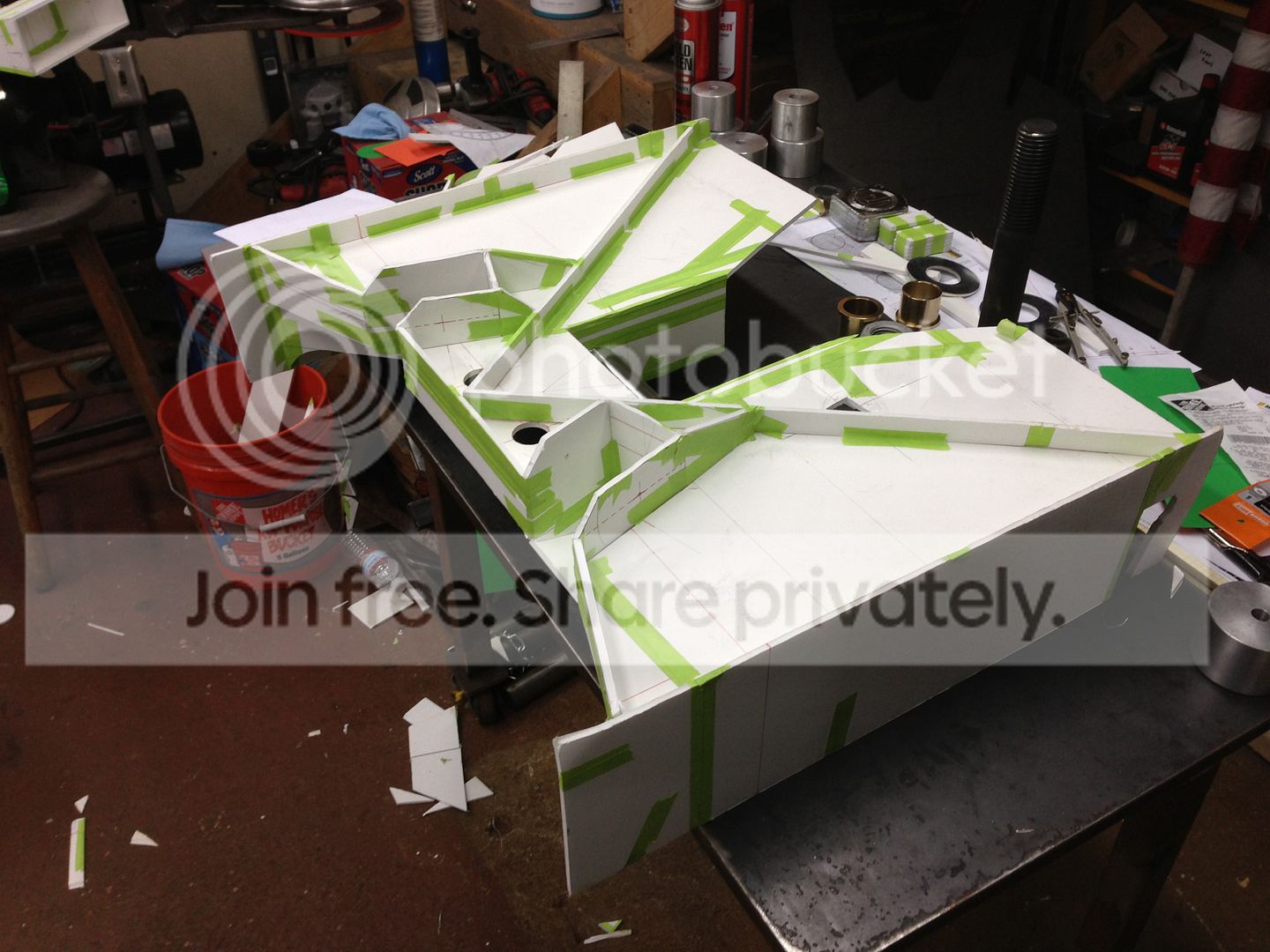
The underside of the crossmember was getting really "clunky" looking with a lot of bracketry hanging down and stealing the bellypan clearance that I've been fighting hard for YEARS to preserve. So almost all of it was cut down to no more than 1" tall (which aligns it with the factory framerails again). The two front heims are at 26" centerlines (vertically) so 1/2 of each heim will stick down below the framerail, but nothing can be done about that... however I can severely limit how much "other" stuff is allowed to.

IMG_7218.jpg


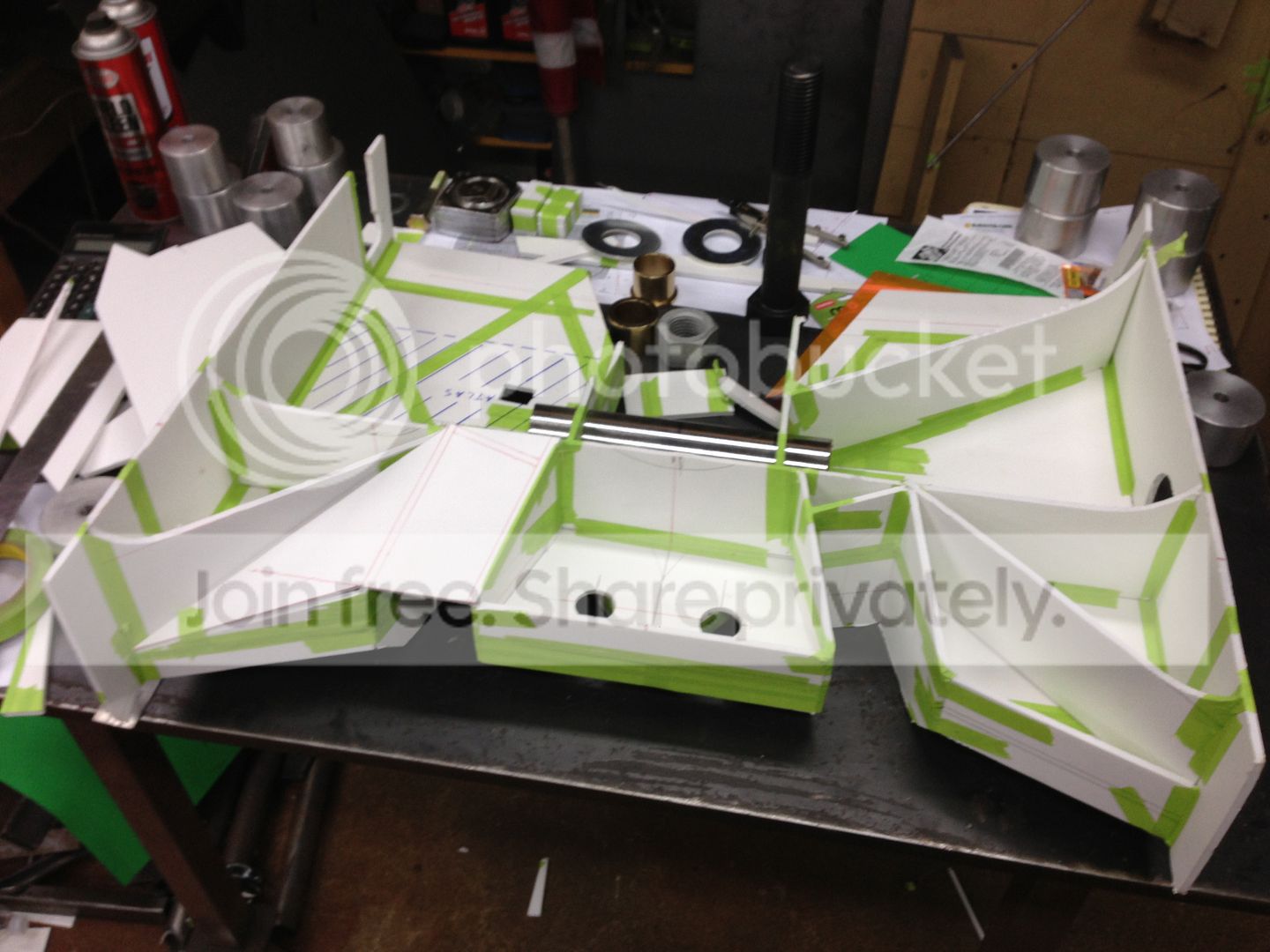
From the top view you can see the evolution of the monolith as I try to create a honeycomb-type structure to support all of the diagonal loading that will be applied by the front and rear links and heims. (I apologize for the blurry photo, this was the best angle I had to show it). Instead of making each piece as tall vertically as possible (my first iteration) now I am trying to normalize the heights of the various components so that I can drop an upper plate across large sections of the honeycomb and weld them down to lock everything together. This is evident on the front link mount pocket where I now have a diagonal plate running up to the first longitudinal brace.

IMG_7216.jpg


Ultimately, the biggest challenge is the area that is marked in blue lines (ATLAS). That area is almost 100% blocked by the transfercase, so even though I really want to put some diagonal bracing in that area, there is almost no space to sneak it in.... maybe a 1" tall vertical spine of 1/4" plate... but that's about it. On the underside of that area, I do already have a diagonal spine there, but I'd really prefer to have something more substantial up top that more closely matches what's going on on the driver's side of the monolith.....

More thinking....more foam core shopping. :thinking:


-G
 
Rather than a manual crank or lever to adjust the rear link mount have you thought about using a short throw hydraulic cylinder powered by the power steering pump? You could run a solenoid valve block and not have to run lines into the cab.
 
Rather than a manual crank or lever to adjust the rear link mount have you thought about using a short throw hydraulic cylinder powered by the power steering pump? You could run a solenoid valve block and not have to run lines into the cab.

I had thought about some sort of hydraulic solution, but I'm not kind of expert in that stuff. I put a powerpack on my tubing bender and hooked up a few hydraulic lines and a control valve, but that's about the extent of my knowledge.

The thing I did like about a hydraulic solution is that it would probably work nicely to absorb and kinds of shock-loading that occurred while the truck was in motion... with a fully manual device I could envision the lever would be wiggling around a bit in reaction to the forces acting on the opposite side of the pivot (the heim/links end).....


-G
 
Last edited:
instead of a lever could do a large threaded deal with a turn knob poking through the floor and you crank it up/down.
 
Yep.

That was another one of the ideas I had..... or a multi-notched or multi-hole gate with a locking pushbutton knob (kind of like what you see on some riding lawnmowers to set the mowerdeck height)... although that would only give me a few discrete settings instead of the infinitely-adjustable feature I was bragging about earlier in the discussion. :D


-G
 
or a complex hydraulic system with some sensors and a display that shows current AS% at that setting... :rolleyes:
 
I'm detecting a hint of sarcasm there, but yes.... I've already planned to have some kind of sensor incorporated so that I could send AS% info to a gauge on the dash somewhere.

-G
 
I just had to re read a few pages to even understand that crazy ideas that you came up with.. very interesting and will be one hell of a thing to see work! keep at it!
 
So let be the naysayer.

While kind of cool that you could do that. I really don't think that it is anything that will actually help you wheeling.

I also don't like the fact that it can move, cause well it can move. I have seen my fair share of broken ( very well built) link mounts. Sometimes its just crazy to see something break like that.

So while cool from an experimental and knowledge aspect, I think its just adding another break point. Which even with all the cool stuff you have done you haven't really added to many additional break points on this rig and have actually eliminated a few of them with the mog axles.

I just see it as another break point that won't really help much with actual wheeling

Carry on :D
 
Top Bottom