CK5
Register an account today to become a member! Once signed in, you'll be able to participate on this site by adding your own topics and posts, as well as connect with other members.
So the struts will have different upper mounting points?

If so, Will this make a difference (from one side to the other) in their dampening?:dunno:

jim
 
So the struts will have different upper mounting points?

If so, Will this make a difference (from one side to the other) in their dampening?:dunno:

jim


Nope...

I should have started building the strut mounts on the drivers side. I would have seen the interference sooner.... the passenger side is just a lot easier access because of the way the truck is parked in my garage. So I usually start there unless there is an obvious reason not to.

Ultimately, whatever I end up doing to make the drivers side work correctly will then be duplicated on the passenger side as well. Not surprisingly, that means I'll be throwing some brackets I just built into the scrap pile. :doah:

I spent a few hours in the garage tonight and didn't even get dirty.

764D734B-7023-49EF-B7DA-574C8BE51A10-949-0000015AC33FD00D_zpsb8b14286.jpg


I decided to start drawing up my new "monolith" crossmember. It will be one massive assembly that will hold the lower links for both the front and rear axles.... My link designs have them landing very close to each other anyway so it seems like the right way to go.

-G
 
Last edited:
You know, as more pieces start falling into place, this thing is starting to look like a truck again...

That must be a good feeling!
 
You know, as more pieces start falling into place, this thing is starting to look like a truck again...

That must be a good feeling!

Absolutely! A couple of fenders and a hood will be a dramatic transformation. :waytogo:


-G
 
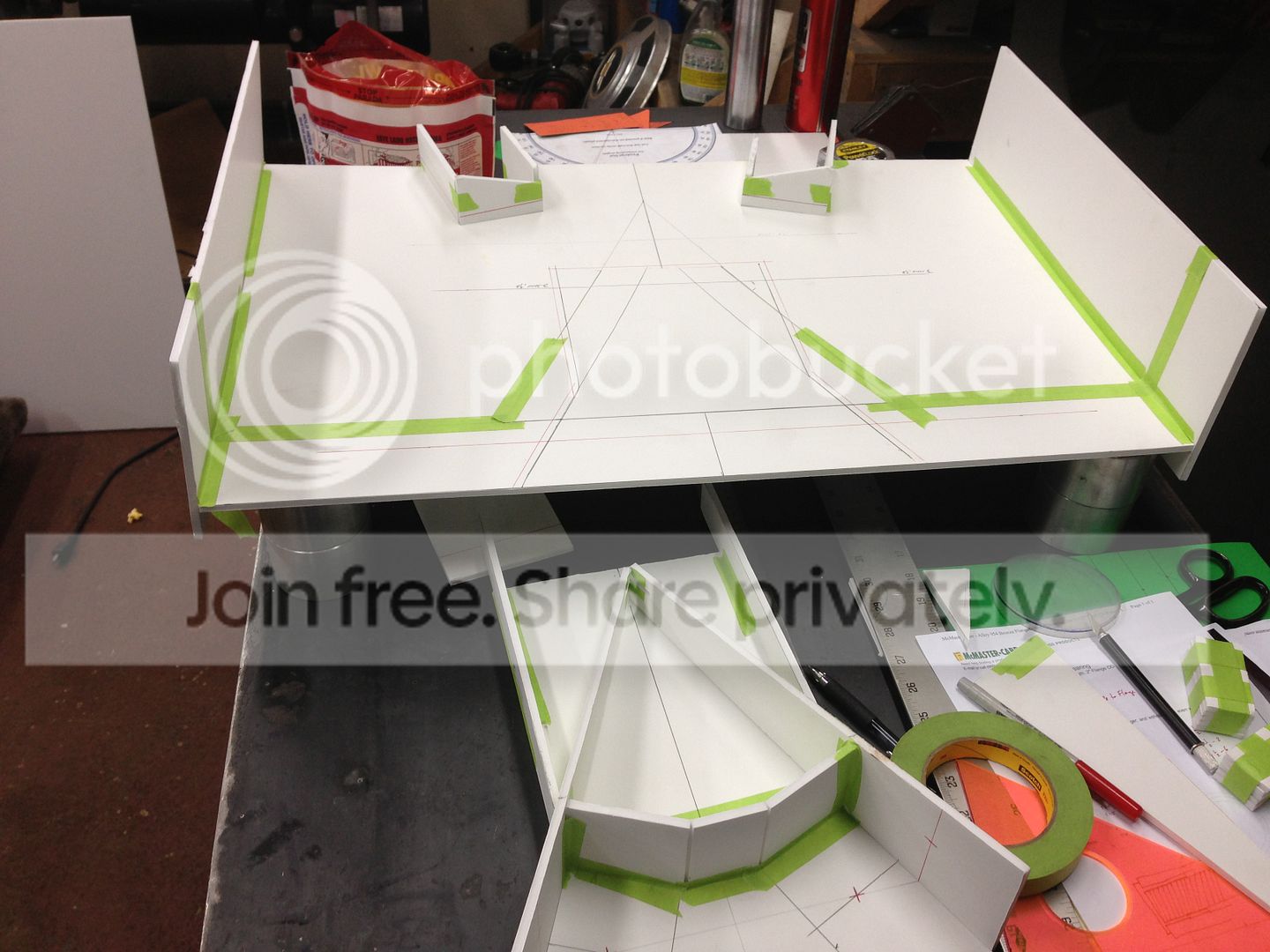
Presenting......THE MONOLITH!!


9ADE703D-8DA9-4712-9BDB-A8830A31097A-1317-000001ADCEA24925_zpsbcd690e3.jpg


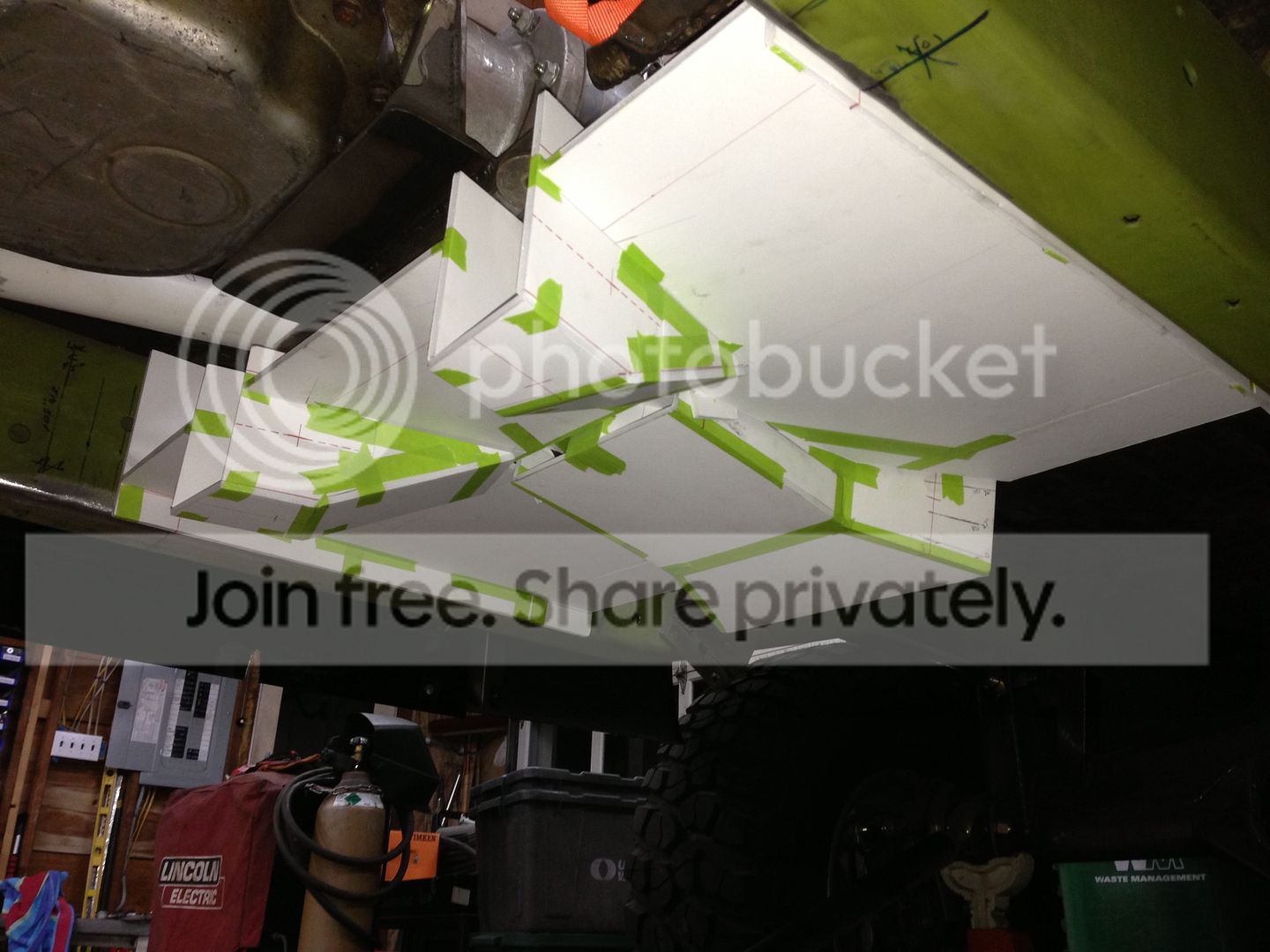
My foamcore rendering of the new monolithic crossmember. This will incorporate the front link hangers (at a 12" heim-center spacing) as well as the rear links (at a 6" heim-center spacing).

In this image you are looking at the underside of the crossmember (the side that will face the ground)

The initial idea is to locate the primary plate of this crossmember 1" higher than the frame so that I can install a flat skid plate across the bottom of the truck and effectively carve-out a 1" gap between the skid plate and the crossmember. The idea is to prevent all hard impacts from rocks from being directly transmitted to the crossmember... And ultimately up into the Atlas and 4L80E...

The foam core is great for this type of mockup. It cheap, and light and I can go through revision changes quickly and cleanly with a sharp knife and some tape. Once it's finalized, I simply cut the tape at the edges and each piece becomes a template for cutting out the parts from 1/4" plate.

I'm trying like hell to get things figured out so I can get this built on Sunday..... Its supposed to be a sunny day (if you get my drift). :wink1:


-G
 
Last edited:
Looks mighty stout, you might need some extra hands to lift it up in there:waytogo:

For now it's easy.... I can do it one-handed, and tape it into place with the other! :haha:

This crossmember has been weighing on my mind (pun intended) for quite some time now. From a design and mechanical engineering perspective it is CRITICAL that I build this correctly.... for function and for safety. The loads being driven into this part from both the front and rear axles are positively massive and a failure of this part would be bad news..... very bad.

It's one of those times when I regret not having a degree in mechanical engineering, or access to some kind of finite-element analysis program to see where the weak points are going to be. Most of what I'm doing is just using common sense to imagine where the forces are being concentrated (at the converging points of the links) and then try to predict how those forces will attempt to propogate through the part and distort/deform it. As I add more bracing and gussets hopefully I will become more confident about the design..... it's still too early in the process and it would never actually work with the few simple shapes I've created so far (even if it was built out of steel!) :D


-G


ps. One of these days you and I are going to need to have a long talk about building a 4L80E for this project. :whistle: :deal:
 
Last edited:
The foam core is great for this type of mockup. It cheap, and light and I can go through revision changes quickly and cleanly with a sharp knife and some tape. Once it's finalized, I simply cut the tape at the edges and each piece becomes a template for cutting out the parts from 1/4" plate.

-G
Great idea. We use foam core for the business so that would be handy for me to use.

You always have such clever ideas.
 
Hope you are saving all those plans with measurements for some fool with a first gen that might want to borrow the design. :dunno:. I am thinking links and coils when I go Dana 60 front.


You could say that..... :D


56ECA3E4-670B-44E4-8A65-78BE55747B9F-1654-00000264CB958564_zps6745d0cc.jpg


E52148F6-65A4-4823-ADAB-F63D1A438216-1654-0000026500A67A6F_zpsf5bc14b6.jpg


That folder is about 2" thick and filled with every part template that I've made.... Unfortunately, most of it would be completely useless for 1-ton axles. The axletubes would be about 4.5" lower than mine so you end up building enormously tall brackets off the axle to try to replicate my link positions. It would definitely look goofy even if you could figure out a way to do it.

-G
 
2013.10.02 - UPDATE! - ANTI-SQUAT?.....SURE, WHATCHA WANT?


More good progress on the monolith last night.

As I did my test fitting, it became clear that the rear link hanger needed to move back about 3" further than I'd originally planned. Not a big deal... so I stretched the entire crossmember (by taping on more foamcore) and came up with a new cutout shape for the rear hanger in the process.

Here is it on the workbench:

IMG_7093.jpg


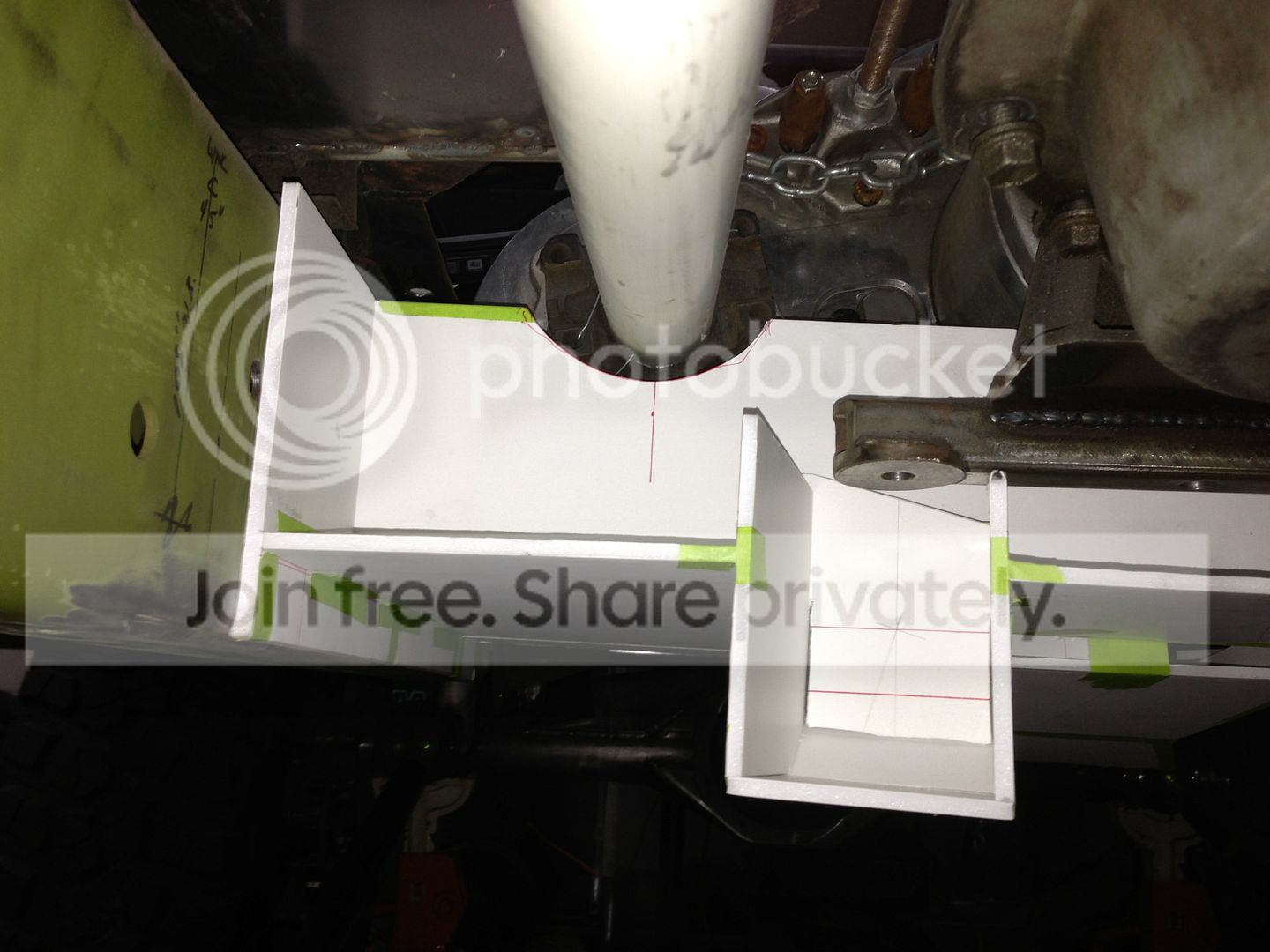
Part of the process was also to try to come up with some prelimnary bracing for the crossmember so that it wouldn't sag in the middle. I taped-in a nice 5" tall vertical support that runs the full width of the crossmember which worked nicely, except that it hit the underside of the front driveshaft output and the underside of the Atlas where the planetaries are housed.

IMG_7106.jpg
.

A couple of quick notches took care of those interferences. At the same time, I also discovered that the new, longer crossmember was hitting a large 3/4" through-bolt on both sides of the frame. This bolt is the anchor bolt for my beefy rear upper link mounts (the ones that mounted outboard of the frame on both sides). This means that the final design of the monolith will actually have a through hole to match and I will be able to run the bolt through both sets of parts and "lock" them both together, forming a larger and stronger stucture. I like that. :waytogo:

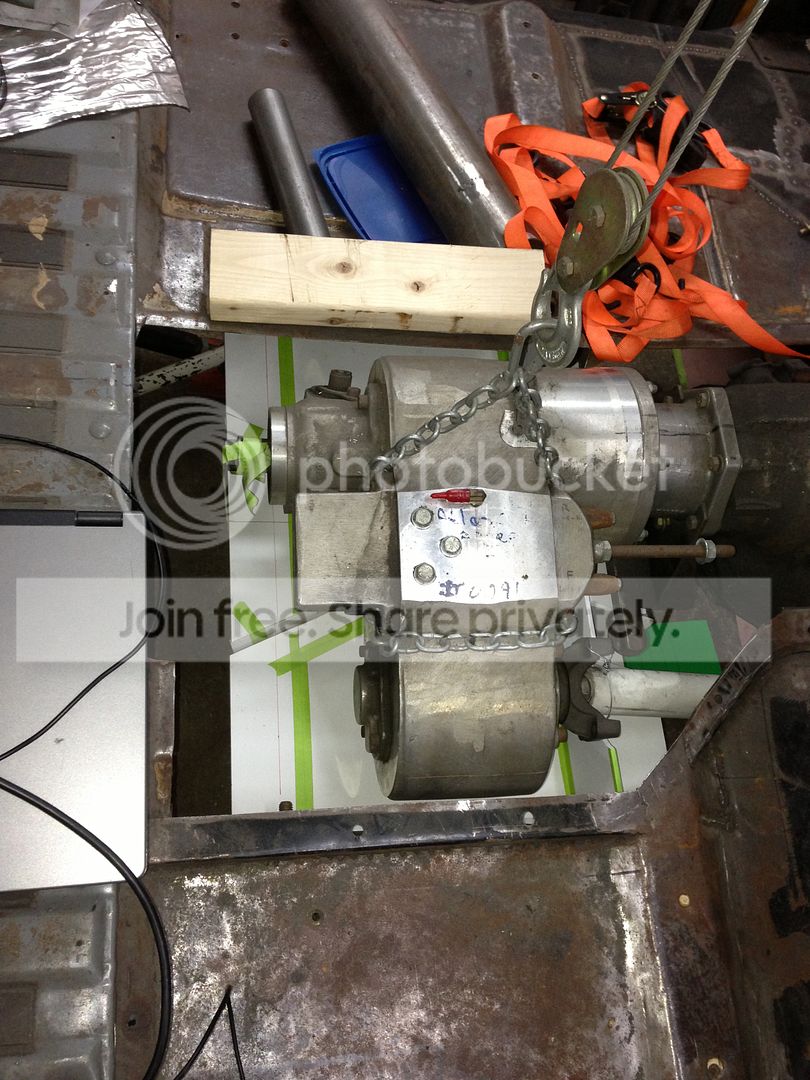
Once I finished those tweaks, the crossmember could be installed up into position fully. Here is a shot from the transmission tunnel that gives a good sense of just how large this part is, and how much area it covers.

IMG_7117.jpg


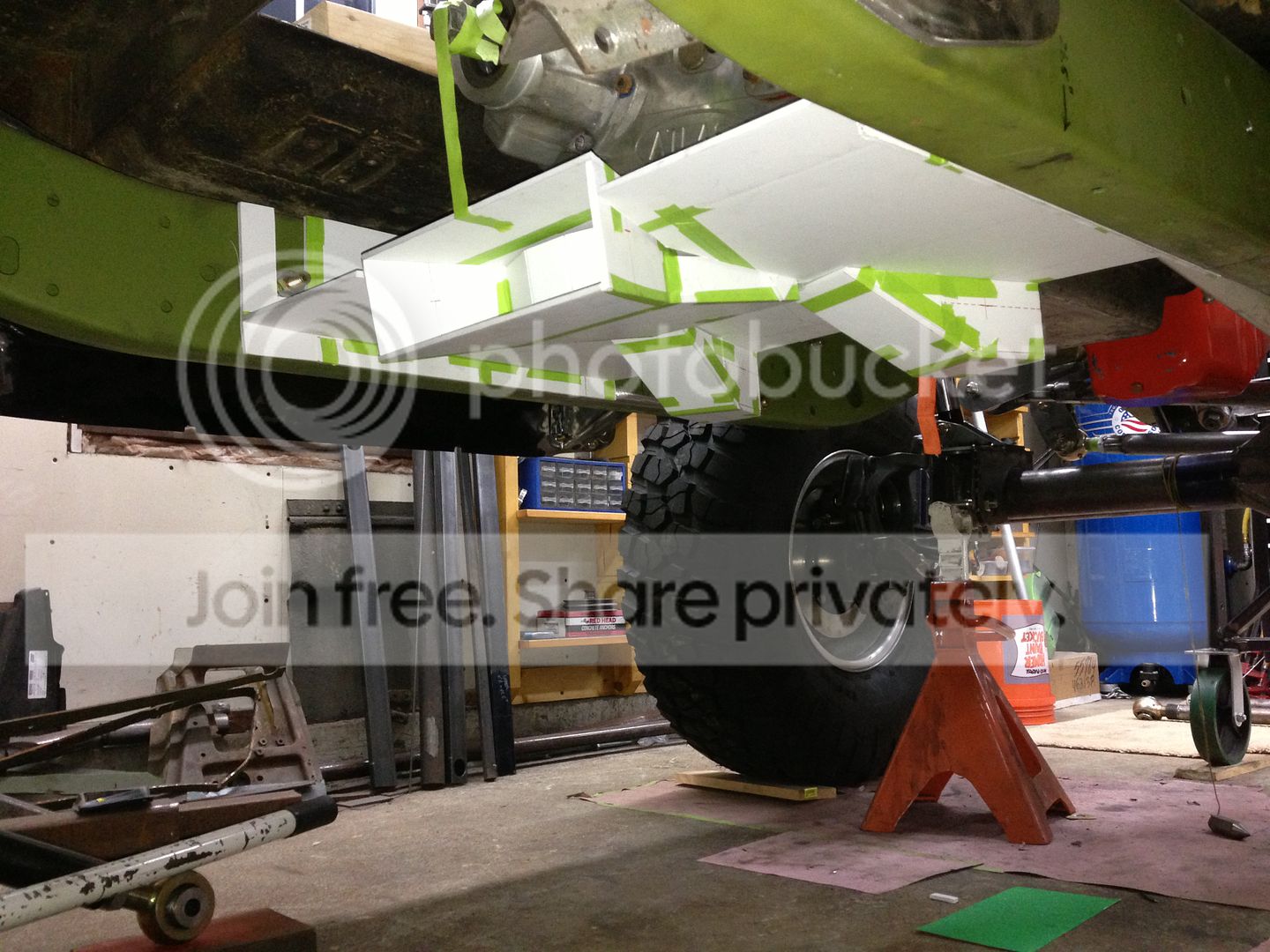
Now for the fun part..... Here's a shot of the crossmember from the rear of the truck (passenger side) facing the front of the truck. This gives a good overall sense of the part as it has evolved over the last couple of nights.

IMG_7110.jpg


Some of you have probably been looking at these last few shots and are wondering why the rear hanger appears to be a separate unit from the monolith and not simply tacked-on like the front hangers..... :dunno: I can explain.

About 3 years ago, as I was working on the rear suspension design for this truck I was trying to come up with a good, low anti-squat (AS%) value with my design.... 75% A.S. seemed like a good target based on what I'd read and learned, but I also noticed as I played with my 4-link calculator that I could very easily change that value (and pretty dramatically) just by changing the vertical position of my frame-side lower link mounts by a few inches.... in fact, I could drop my AS% down to 46% by lowering the mount by 1" and could raise the AS% to over 100% by raising the mount by only 2" from my target value.

As I thought about it, the idea came to me that instead of having a few different sets of mounting holes that would allow me to unbolt and move the links for fine-tuning, it would be MUCH more awesome if there was a way to adjust my AS% "on-the-fly" with some sort of lever or crank inside the truck. In this way, I could experiment with different AS% values on the trail in real-time. If I was trying to climb an obstacle and was getting too much "hop" (an indication of a high AS%), I could simply stop.....crank the AS% down maybe 10% or 20% and then try the obstacle again! :waytogo: That sort of real-life experimentation and capability on the trail was just too exciting a challenge to ignore, so I've been mulling over how I would accomplish it cleanly (and safely) for a long time now.

The answer turned out to be quite simple. The converged links area (the triangular shaped part of the assembly) is built with a pivot roughly 8" back from the heim centerline (toward the front of the truck) so that both of those heims and their assocated bracketry are free to move up or down a few inches. Look closely at the following photo and you can see the markings on the bracket for different settings:

IMG_7103.jpg


My initial height (as shown in the photo above) for those heims is set at 26" off the ground, which gives me a working AS% value of 64%. But since I have a few inches of travel to work with, I can also achieve the following values as well (and all values in-between):

25" = 46% A.S.
26" = 64% A.S.
27" = 84% A.S.
28" = 105% A.S.

It's generally accepted that anything over 100% A.S is pretty useless since it causes excessive suspension "hopping" so I didn't see much value in building the pivot for higher values. Likewise, I'm not sure that A.S% values into the 20% - 30% range are all that useful either, so I set my range to accomodate the A.S. values between 50% and 100%.

So basically, the foamcore template that I tested last night accomplishes that goal. The rear hanger has swing 3"+ of vertical swing without interference to the Atlas so I will be able to set my rear AS% to any value I want, whenever I want. :woot:

The next challenge is the pivot iteself. Obviously, I am taking loads from two heims that are each fastened with 3/4" bolts and concentrating those forces into a single pivot point. That bolt is truly the "kingpin" of the rear suspension and CAN NOT be allowed to fail. My plan is to install a 10" long, 1-1/2" diameter bolt through a secton of DOM tubing that's been sleeved with bronze bushings at either end. There will be a small amount of room between the bolt and the sleeves, so I should also be able to install a grease zerk and keep the whole thing well-lubricated and keep debris and water from finding it's way in.

Once that's built, the final step will be to build a long lever off the opposite side of that pivot so that I will have good leverage to move those links from an in-the-cabin control of some kind... I've got some ideas in my head but that will have to wait for another day when I can cut up some more foamcore....

My short-list for the weekend:

- Pick up a couple more sheets of 1/4" flat steel
- Purchase a nitrogen bottle and regulator to pressurize the ORIs
- Hope that my bolt/bushing order from McMaster-Carr arrives on Friday like they claim.


-G
 
Last edited:
Greg I don't see your idea working unless you're king kong or something. You would be trying to move the link bracket with a lever arm from inside the truck which means being able to move/lift the weight of the truck by hand. Please correct me if i'm wrong but that is how it appears to me.

You could for sure accomplish this though using a hydraulic cylinder.
 
Greg I don't see your idea working unless you're king kong or something. You would be trying to move the link bracket with a lever arm from inside the truck which means being able to move/lift the weight of the truck by hand. Please correct me if i'm wrong but that is how it appears to me.

You could for sure accomplish this though using a hydraulic cylinder.

I am pretty sure he was thinking hydraulic or mechanical leverage.
He can even do motorized with all thread or whatever they call the system they use with scissor jacks.
 
Greg I don't see your idea working unless you're king kong or something. You would be trying to move the link bracket with a lever arm from inside the truck which means being able to move/lift the weight of the truck by hand. Please correct me if i'm wrong but that is how it appears to me.

You could for sure accomplish this though using a hydraulic cylinder.


"Give me a long enough lever, and I'll move the world..." :D


The truck is being held up by the struts, so it's not like I'm really "lifting" the weight of the truck per se.... The links are establishing the location of that axle under the truck and are fighting to keep the portals from rotating either forward or backward (portals don't like to balance with the axletube above them, they'd prefer to let the axle swing and hang below the wheel centerline).... there are some pounds pushing on those links for sure, even as the truck sits at rest on my garage floor, but to an uneducated guy like me those forces seem manageable.

The lever that is actually used to move the pivoting-heim bracket is going to be at least twice as long as the pivot on the heim end (~ 16" vs. 8", like a really offset see-saw) so immediately I've got some good mechanical advantage working for me.

The loads from the suspension are mostly being driven into my new 1-1/2" pivot point and stop there. The mechanical engineering guys will correct me on this but I think of it as a sort of "force vector"... the angle of the lower links determines the vector of how force is being applied to that pivot. If the pivot is set at the IDENTICAL angle to the lower links, then 100% of the forces go directly into the pivot point, and nowhere else.

However: once I start fiddling around with the bracket and raising or lowering it, I am creating a slight "skew" between the lower link angle, the heims, and the new large pivot point. That difference in angle IS creating a force that will be translated to the lever inside the truck. We are talking about maybe 1* or 2* of angularity though..... so when you calculate how much force is REALLY acting on the adjustment lever, it would seem to be almost insignificant. :thinking:

In the worst case, the idea is a total failure and I simply weld the whole thing solid at 26" (64% A.S.) and call it good. :D


-G
 
Last edited:
Greg why not just make a bracket with multiple bolt holes? You might not be able to change on the fly but it'd allow for suspension fine tuning. What ever happened to KISS?
 
Greg why not just make a bracket with multiple bolt holes? You might not be able to change on the fly but it'd allow for suspension fine tuning. What ever happened to KISS?

.....and what is so complicated about this??? :dunno:

Egyptians used levers thousands of years ago to build the pyramids. I'm not exactly breaking new ground here.


The problem with multiple mounting holes (for me at least) is the lack of resolution for tuning. Imagine you have heims with 3/4" bolts.... to create a bracket with multiple holes (and adequate strength between them) you'd probably want at least 1/2" of material between each hole. So your center-to-center spacing is sitting at 1-1/4".

For my existing suspension design, that means that each mounting hole will change my A.S. % by something like 25% per interval..... not exactly "fine tuning" IMHO...... Being able to use a long lever (especially if it was built with a threaded adjuster) would give me infinite resolution and the ability to dial-in a very specific amount of A.S. depending on what I wanted at that exact moment. (64%....68%....71%..... whatever is desired)

Additionally, a pivoting hanger will only hang down low when it is set that way by the driver. A fixed, multi-hole bracket will ALWAYS hang down low, even when the lowest setting isn't being utilized.


I figure this is worth a shot. It's really NOT that hard to implement and it may prove to be a more elegant and precise way to do suspension tuning later on.


-G
 

Latest Posts

Top Bottom