CK5
Register an account today to become a member! Once signed in, you'll be able to participate on this site by adding your own topics and posts, as well as connect with other members.
Sometimes it really frustrates me not being local to some of you guys. Just cause I would like to just look at the problem. Not just pics.

So Greg. How about wheel spacers. Get your tires out a touch which will help protect the body while wheeling. It will give more room for the struts. Which will give more room for the seat. Also it will allow the opportunity to learn new skills making the fenders look stock while still covering the wheel wells.


Boy wouldn't THAT be nice... :waytogo::bow: I'd love to bang a few ideas around in-person. I'm amazed at how much you guys "see" just from a few photos that I post up, I can only imagine how much easier it would be if you could actually walk around the truck in 3-dimensional space and see things from every angle.

Wheel spacers are already going to be pretty substantial as a result of the "stock 8-lug white wheel" project. Since I'm getting more backspacing than I can really use, I have to machine some pretty thick spacers to get things at about the same overall track widths that the H2 wheels had.


:thinking:


-G
 
2015.05.19 - UPDATE! - REDEMPTION !!!!


I finally was able to shake off the Sofa King bracket problems this weekend and come up with a new "proper" lower strut mount... :waytogo:

The process started with a few measurements. The rear axle is angled upward toward the transfercase at a 12* angle, and knowing that I also intended to rake the strut forward by 8* (mostly for aesthetic symmetry to match the front axle) the overall angle for the bracket and bolt needed to end up at 20-degrees.

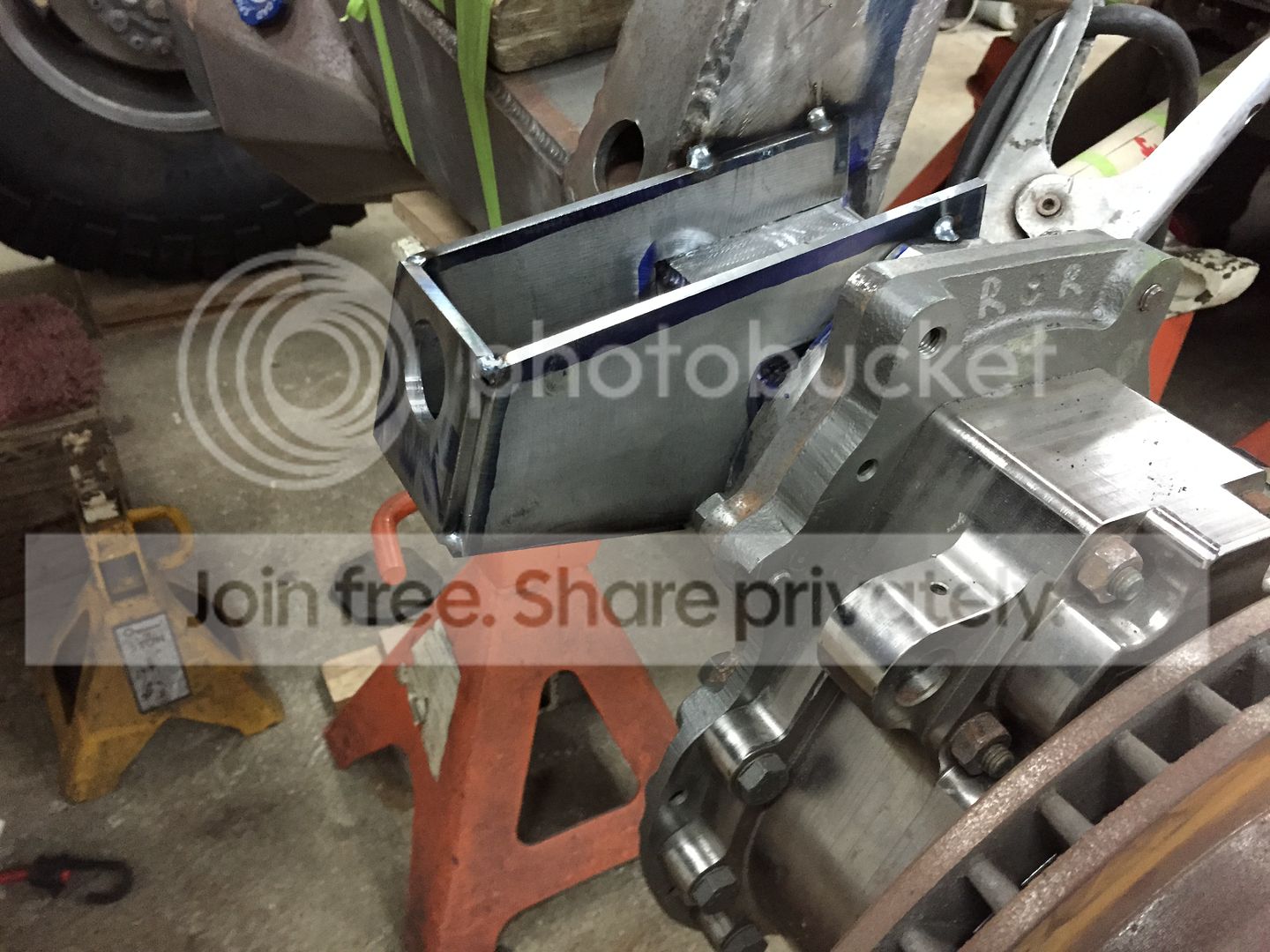
As with many of the solutions I've seen for a lower shock mount, this means that the "nut" side of the bolt ends up very close to the axle housing and you have to build a small access pocket for the nut, and leave enough room to get a wrench in there later on to torque it down...

This is what I ended up with (side view):

IMG_4473.jpg


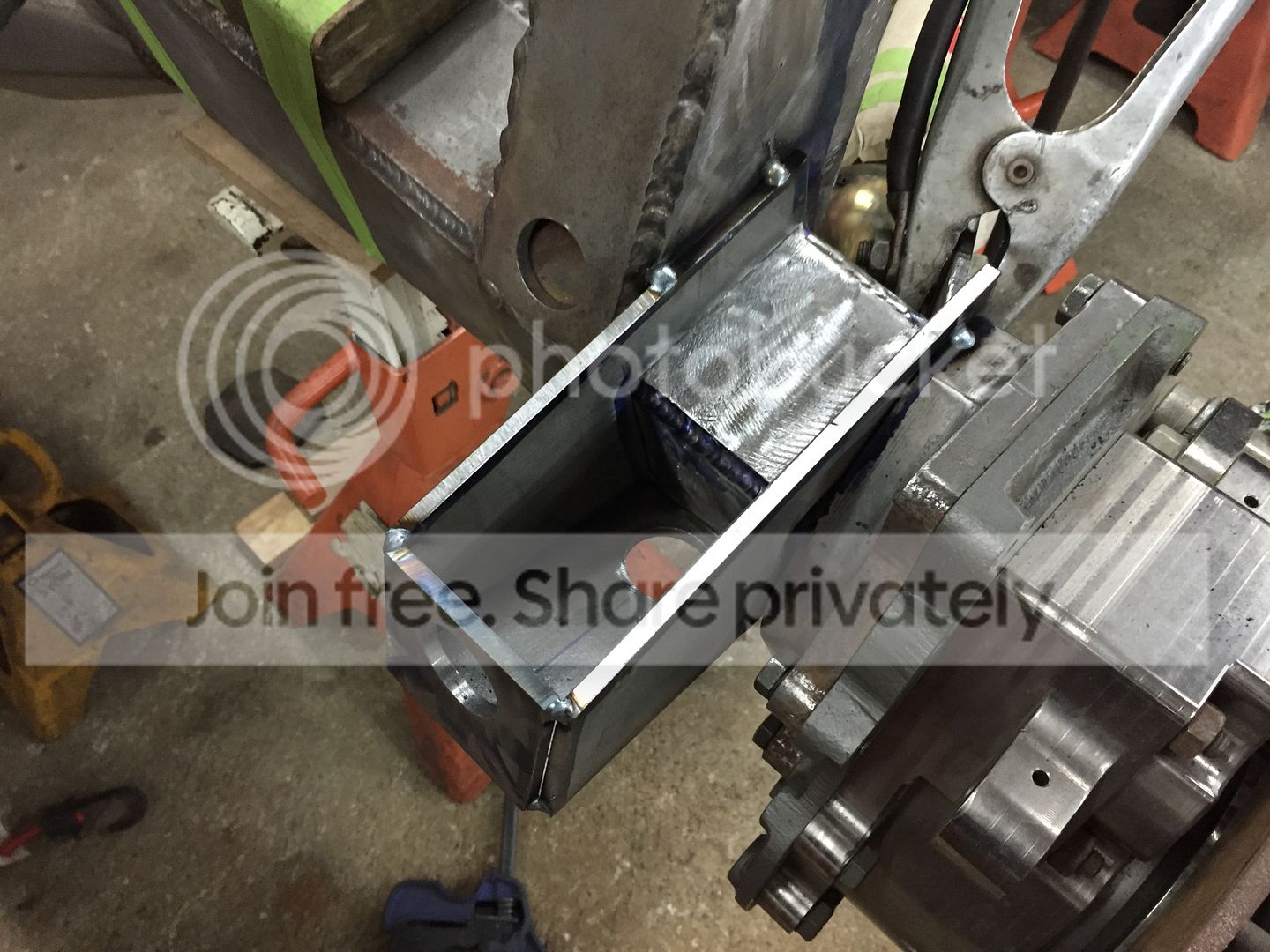
....and a shot from above to show a few other details:

IMG_4478.jpg


I drilled out a couple of 1-3/8" holes... one in the bottom of the sloped lower plate (for drainage) and another one to hold the 1-3/8" DOM slugs that I've grown accustomed to using when I build my strut mounts. The heavy walled DOM acts like an additional spacer around the strut and insures that the body of the strut doesn't collide with the mounting area under heavy articulation. About an extra 1" of DOM added to the small misalignment spacers (provided by ORI) usually ends up perfect.

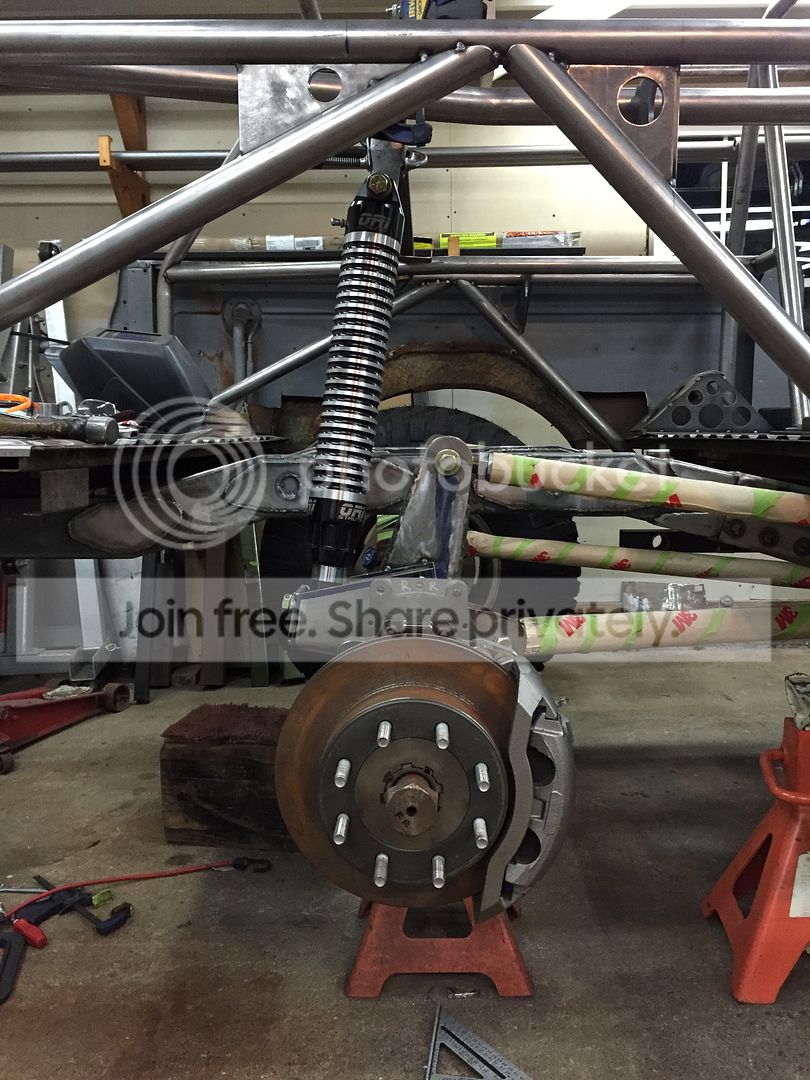
Here's the payoff with the strut angled forward 8*...

IMG_4481.jpg


You can sort of see the bolt in there, but the main thing is that it's 100% perpendicular to the strut so there won't be any issues with running out of misalignment.


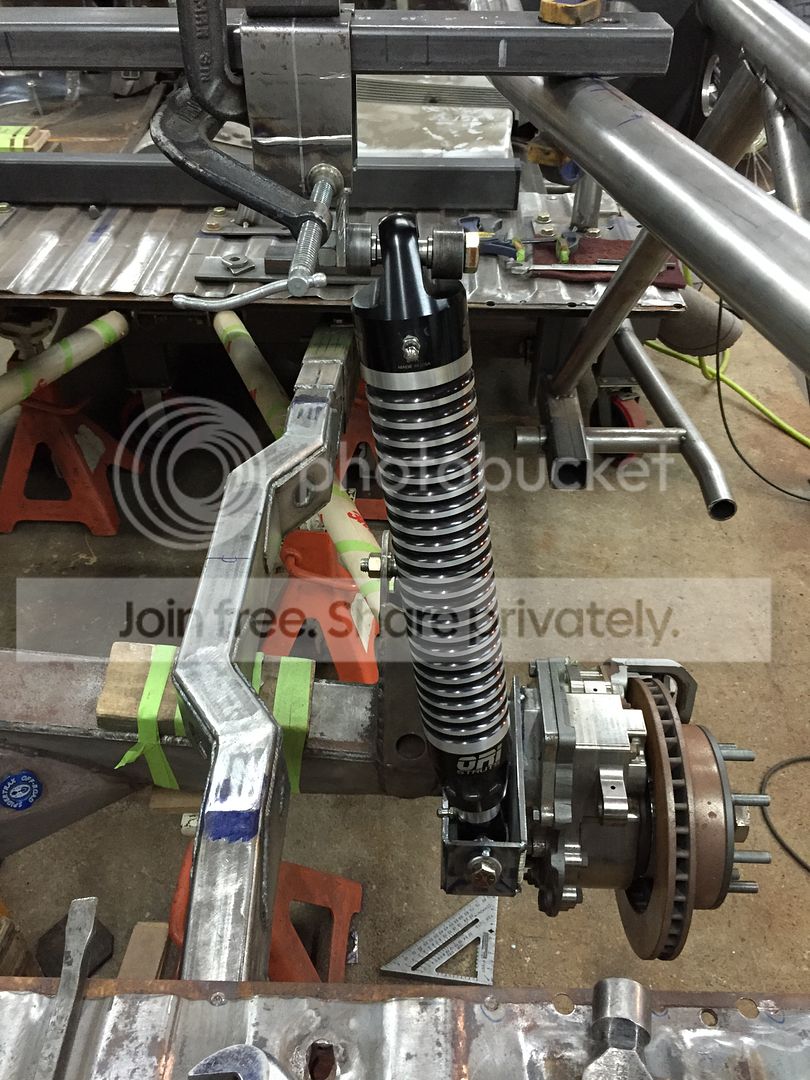
Here's where it's getting tricky... I now need to figure out the installed angle for the lateral position of the struts (leaning inward toward each other at the top mount). I want to keep the strut as upright as possible so that I don't lose a lot of effectiveness, but I also don't want to make the same mistake as last time where the tire sidewall kept hitting the strut when it articulated.

In this shot, I'm playing around with between 8 - 10* of angularity for the lateral positioning.

IMG_4487.jpg


From what I've researched, it seems like a lot of guys use a similar value for forward rake and lateral angle (10* and 10*, or 15* and 15*, etc). That's just about where I am in that photo so I'm basically in the ballpark.... in the back of my mind, I keep remembering that the rear seat still needs to fit back there so I'm trying to get away with the bare minimum for lateral angularity.

I could gain a LOT of seat space by angling the entire strut backwards at the top (toward the rear bumper)... which would look really goofy, would probably also create some bizarre damping rates due to the relationship to the arc of travel of the rear links, and I'd get a chance to build the lower mount for a 3rd time!!! :D I've seen Jeep guys do it that way, and it definitely seems to be for convenient packaging of the shocks. It's just not clear to me how much suspension performance is lost by doing it that way. :dunno:


-G
 
Any plans on a shakedown run before final bodywork/paint/assembly? With all the great work you have done, it would be nice to make sure nothing crazy starts happening before its "finished"
 
Nice C clamp. I must have bought mine at the same place. :D


The strut looks a lot lower than before. Which I like. IIRC you were about even with the bed rail at one time. That should make for a nice hidden mount package this time around. :waytogo:
 
Any plans on a shakedown run before final bodywork/paint/assembly? With all the great work you have done, it would be nice to make sure nothing crazy starts happening before its "finished"

That's going to be the final test of my patience as a builder.

The experts say that the truck needs to be completely built and running BEFORE any of the final painting, plating and finish work happens. It's going to be awfully hard to get the truck functional and drivable and THEN deliberately take every last nut and bolt back apart to do all the finish work before reassembly.

You're right though....there's no way to know if something will rub or bind until you actually test it, and if everything is painted and pretty it's going to be a lousy feeling.


-G
 
Nice C clamp. I must have bought mine at the same place. :D


The strut looks a lot lower than before. Which I like. IIRC you were about even with the bed rail at one time. That should make for a nice hidden mount package this time around. :waytogo:


Yeah, the "S-shaped" handles are what the PROs all use! :haha:

The lower mount used to be on top of that upper link mount bracket, which is why it was so tall originally. The Sofa King bracket (1st version) dropped it to just about even with the top of the truss.... and Sofa King #2 dropped it probably another inch below that.

The struts are DEFINITELY not going to show above the bedrail anymore, but they'll be easy to see with the tailgate down! :D


-G
 
If I could stand the look of it (which I'm pretty sure I couldn't) I could rake the rear struts backward at the top so that they followed the rear seatback angle and wouldn't encroach on the seat space quite so much. Not sure..... that might also create some odd dampening effects as well being that it's not really lined up well with the arc of the rear axle travel anymore. :dunno: :thinking:

-G

I could gain a LOT of seat space by angling the entire strut backwards at the top (toward the rear bumper)... which would look really goofy, would probably also create some bizarre damping rates due to the relationship to the arc of travel of the rear links, and I'd get a chance to build the lower mount for a 3rd time!!! :D I've seen Jeep guys do it that way, and it definitely seems to be for convenient packaging of the shocks. It's just not clear to me how much suspension performance is lost by doing it that way. :dunno:
-G

Rig is looking great Greg, love the new frame rail clearance, and nice job implementing it with the old new frame. :D

As for the shock dampening, there could be some discussion as to being perpendicular to the ground vs perpendicular to the links, theoeretically vertical at ride height or full compression will give you the most dampening for the same shock settings. And angled slightly will lose some dampening, how much is dependent on the angle, but can be easily calculated with the angle from vertical. Just take the cosine of the angle from vertical. So for 15 degrees from vertical, cos is .966, so you are getting 96.6% of your available dampening. Or to calculate the loss of dampening:

Dampening loss = (1-cos(angle))*100, so (1- cos(15))x100 = 3.4% loss. If we chart the angle from vertical, it looks like this...

Angle = % loss
5 = 0.4
10 = 1.5
15 = 3.4
20 = 6.0
25 = 9.4
30 = 13.4
35 = 18.1
40 = 23.4
45 = 29.3


Now, with that said, angle alone shouldn't matter if you angle it back vs forward, however, what does matter is that when you angle it back vs forward it affects how the shock angle changes throughout the suspension travel.

The closer the shockle angle is to perpendicular to the control arm angle at ride height, the less the shock angle will change through the travel. If you lean it forward, you will notice more angle change through the travel, as the suspension compresses the angle will increase, decreasing your dampening at full bump, which is not really what you want, but can work just fine if the dampening is set right, although it is only completely possible with sometype of bypass shock to increase dampening in certain travel ranges.

However, if you angle it back slightly, you will see the angle change is nearly nothing throughout the travel, since the axle moves back as it moves up, and moves forward as it moves down, which maintains a relatively consistent angle. This maintains a more consistent dampening rate from droop to compression.

Leaning it forward actually decreases dampening under stuff with more angle at compression. Now if the angle is small it won't matter much as you can see from the chart, but if the angle is 20 degrees or more it really starts to increase drastically.

So to answer your question, in the rear, it really can be beneficial for the suspension to angle the shock back, and because of that I think it looks just fine angled back.

The real issue with that is the front, where you would have to angle it forward to produce those results, and angling the front shock forward really does look pretty dumb I think, so most people just keep the angle low and not worry about it.
 
Last edited:
Another thing to consider, anytime you angle the shock, although you do decrease dampening, you can add to the travel. A 16" shock angled can produce more travel than 16", but you need to set the dampening higher to make up for it.
 
However, if you angle it back slightly, you will see the angle change is nearly nothing throughout the travel, since the axle moves back as it moves up, and moves forward as it moves down, which maintaines a relatively consistent angle. This maintains a more consistent dapening rate from droop to compression.

Leaning it forward actually decreases dampening under stuff with more angle at compression. Now if the angle is small it won't matter much as you can see from the chart, but if the angle is 20 degrees or more it really starts to increase drastically.
Thanks for showing that with math folkenheath. I was thinking it but was unsure of myself so I didn't post. :whistle:
 
Rig is looking great Greg, love the new frame rail clearance, and nice job implementing it with the old new frame. :D

As for the shock dampening, there could be some discussion as to being perpendicular to the ground vs perpendicular to the links, theoeretically vertical at ride height or full compression will give you the most dampening for the same shock settings. And angled slightly will lose some dampening, how much is dependent on the angle, but can be easily calculated with the angle from vertical. Just take the cosine of the angle from vertical. So for 15 degrees from vertical, cos is .966, so you are getting 96.6% of your available dampening. Or to calculate the loss of dampening:

Dampening loss = (1-cos(angle))*100, so (1- cos(15))x100 = 3.4% loss. If we chart the angle from vertical, it looks like this...

Angle = % loss
5 = 0.4
10 = 1.5
15 = 3.4
20 = 6.0
25 = 9.4
30 = 13.4
35 = 18.1
40 = 23.4
45 = 29.3


Now, with that said, angle alone shouldn't matter if you angle it back vs forward, however, what does matter is that when you angle it back vs forward it affects how the shock angle changes throughout the suspension travel.

The closer the shockle angle is to perpendicular to the control arm angle at ride height, the less the shock angle will change through the travel. If you lean it forward, you will notice more angle change through the travel, as the suspension compresses the angle will increase, decreasing your dampening at full bump, which is not really what you want, but can work just fine if the dampening is set right, although it is only completely possible with sometype of bypass shock to increase dampening in certain travel ranges.

However, if you angle it back slightly, you will see the angle change is nearly nothing throughout the travel, since the axle moves back as it moves up, and moves forward as it moves down, which maintains a relatively consistent angle. This maintains a more consistent dampening rate from droop to compression.

Leaning it forward actually decreases dampening under stuff with more angle at compression. Now if the angle is small it won't matter much as you can see from the chart, but if the angle is 20 degrees or more it really starts to increase drastically.

So to answer your question, in the rear, it really can be beneficial for the suspension to angle the shock back, and because of that I think it looks just fine angled back.

The real issue with that is the front, where you would have to angle it forward to produce those results, and angling the front shock forward really does look pretty dumb I think, so most people just keep the angle low and not worry about it.

Ouch, now my brain hurts.....
 
Ouch, now my brain hurts.....


Simple version: If you mount a shock 100% parallel to the axle it will be 0% effective.... as the shock gets more vertical, it gets increasingly effective.

Not quite a linear relationship (45* shock angle does not equal 50% effectiveness) so if you want to know the real effect of angling a shock you have to do some math. :D


BTW -> Thanks Heath! I knew the concept already...but had forgotten how small the change in effectiveness REALLY was at small angles. :waytogo:


-G
 
I figured you knew the general idea Greg, just showing specifics. Ideally you would set the shock angle vertical at full stuff, and then it would be angled back at the top slightly at full droop. However, as you can see, if you keep the angle at 15 degrees or less its pretty negligable anyway, so don't waste too much time on it.

With that said, I wouldn't be afraid to angle the shock back if it gives you more seat room is what I was really trying to say, its probably ever so slightly better than angling it forward.
 
I figured you knew the general idea Greg, just showing specifics. Ideally you would set the shock angle vertical at full stuff, and then it would be angled back at the top slightly at full droop. However, as you can see, if you keep the angle at 15 degrees or less its pretty negligable anyway, so don't waste too much time on it.

With that said, I wouldn't be afraid to angle the shock back if it gives you more seat room is what I was really trying to say, its probably ever so slightly better than angling it forward.

Hmmmm....... what I really hear you whispering is:

"Pssst......throw yesterdays work away and build a 3rd set of lower strut mounts!"


DANG! :doah:


-G
 
Simple version: If you mount a shock 100% parallel to the axle it will be 0% effective.... as the shock gets more vertical, it gets increasingly effective.

Not quite a linear relationship (45* shock angle does not equal 50% effectiveness) so if you want to know the real effect of angling a shock you have to do some math. :D


BTW -> Thanks Heath! I knew the concept already...but had forgotten how small the change in effectiveness REALLY was at small angles. :waytogo:


-G
I know the concepts... Just hadn't read it explained so well and mathematically :doah:
 
And just think, If you angle them back a little,


you get to explain all of this to everyone who looks at it says it won't work that way. :whistle:

I had to do that frequently until coil overs and bypasses became standard.
 
And just think, If you angle them back a little,


you get to explain all of this to everyone who looks at it says it won't work that way. :whistle:

I had to do that frequently until coil overs and bypasses became standard.


To be honest, I already took measurements of the stock rear seat and looked at the rear seatback angle... it was around 20* IIRC.

If I lay the struts back at ~20*, they will run parallel to the seatback and there's a chance that the seat can just drop into place in front of the struts instead of being aggressively chopped and narrowed.

By the time I put the wheeltub back in place, and cover most of the area with the tire/wheel.... there's not going to be a whole lot of "strut" showing in the side profile of the truck anyway. I guess you'd still be able to notice it when peeking in from the tailgate side, but perhaps not enough to worry about. :thinking:

-G
 
I'm not saying don't do it. Just saying the uninformed are going to try to educate you.

If you were building a go fast ride, I would say the leaning back would be a little weird. But for a crawler, no issue at all.
 
If I lay the struts back at ~20*, they will run parallel to the seatback and there's a chance that the seat can just drop into place in front of the struts instead of being aggressively chopped and narrowed.
-G
According to Heaths math that equates to a 6% loss in effectiveness, or the scientific term "negligible". :D

Also, aren't his calculations based on degrees off of the link angle? If your 20* is based off of level then the actual effective angle is even less, right?

More seat! :thumb:
 
Hmmmm....... what I really hear you whispering is:

"Pssst......throw yesterdays work away and build a 3rd set of lower strut mounts!"


DANG! :doah:


-G

It's your truck, I am just giving you more info to make another decision. If you prefer it leaned forward for asthetics then go for it, if the angle is small it won't really matter and you might get a fraction of an inch more travel.

But if you really want more seat room, the first lower set you had might work fine with the shocks leaned back if you still have them?

And just think, If you angle them back a little,


you get to explain all of this to everyone who looks at it says it won't work that way. :whistle:

I had to do that frequently until coil overs and bypasses became standard.

Bypasses come standard now? I want a set! :D Just kidding, although if/when I do build another rig I am pretty sure it would include bypasses. You convinced with with the ride in your rig Wade!

According to Heaths math that equates to a 6% loss in effectiveness, or the scientific term "negligible". :D

Also, aren't his calculations based on degrees off of the link angle? If your 20* is based off of level then the actual effective angle is even less, right?

More seat! :thumb:

Actually those calculations are from vertical assuming a straight up and down motion with the suspension, which is actually an arc, so their is some assumed error there. This is why the front/back can make a small difference since the arc changes. What actually matters is the amount of vertical axle/wheel travel compared to the amount of shock travel for the same movement.

Also, it is not necessarily a bad thing, you can compensate with more spring(or pressure in Greg's case) and more dampening. With 20 degrees of angle the shock moves about 6% less travel than the axle travel, and therefore you can compensate with 6% more air pressure and dampening, with the benefit of 6% more wheel travel. Now, this is not exact because of different travel arcs but it gets you close enough for comparison purposes. For the rear suspension I would rather have it 20 degrees back than 20 degrees forward. But if I could choose any angle I might choose dead vertical at full compression and let it angle slightly back at the top under ride height and droop. However, packaging constraints usually involve a slight angle.

If you had a long wheel base and were going for max travel you could install the shocks at more angle and use stronger springs and dampeners and get more travel out of the same shocks. What would really makes more of a difference is if you moved the lower shock mount to the control arm, then you have the ratio of control arm length to worry about. However, thats also how they get massive travel, like 2 foot or more, and in short blazers that would mean a driveshaft angle of 75 degrees. Ok, so I am exaggerating there.
 
Last edited:
Gotcha. I love seeing the math behind this stuff. I get the concept generally but seeing the math helps it make a lot more sense to me.
 

Latest Posts

Top Bottom