CK5
Register an account today to become a member! Once signed in, you'll be able to participate on this site by adding your own topics and posts, as well as connect with other members.
Catching up here. On the headers....why 1 7/8" inch primaries instead of 2"? FWIW, mine have a 3/8" flange.

AJ,

There was no real magical answer. The GM 502 documents said to use a 1-7/8" primary tube (36" long) into a 3.5" collector, and 3" exhausts all the way out.

I only have iron heads, not fancy aluminum ones like you! :waytogo:


-G
 
15 minutes left on MPS and waiting for your submission. If not, we wished you could have joined us. We had a new co-judge...then fumes dropping in after the first half to lend a hand. A new scoring system for myself and everything. Anyways....


From the entire MPS Crew. :thumb:


Happy 7th Anniversary to the Wife and You. :bow: :waytogo: :pimp:


ps... you were right, a backboard and something to aim at helped a lot. Scores were much higher today. :D
 
For the tank/fuel cell, go with aluminum. I have a 45 gal aluminum tank with baffles and an in tank pump. It works great, the pump is nice and quiet and even when filled up all the way, there is no bowing in the aluminum. The tank is really light when empty. With your tank being up higher and having a little less capacity, you should be more than fine with aluminum.

I would just carry a second fuel pump but not install it in the tank. I´m going to build a trap door just above the tank, so in case the pump does go, it is very easily replaced with the spare one. Since you´re going to redo the entire floor anyways, a trap door should be easy to french in.

Blazer is looking great! Can´t wait to see it all done!
 
You guys are awesome! :bow:

Thanks for giving me such a prominent seat at the MPS event. It was fun watching over all of the shenanigans in your driveway today.


-G

Ps. Mike, when you get drunk you throw like a girl! :haha:
 
2015.06.16 - UPDATE! - BABY STEPS...


Now that I've decided to get the engine running, I spent some time ordering up parts that I'll need for the custom header build.

Originally, I wanted to use the cool LEGO-type modeling kits from icengineworks.com but as it turns out, they don't even offer a kit in the 1-7/8" diameter that I need, and even if they did... by the time I purchased the modeling kit and the special cutting dies (which require a bandsaw that I also don't own!) I'd be into them for around $1400!!!! :yikes: And that's just to get the design figured out... I still need to buy all of my stainless tubing, flanges and collectors on top of that.

So I went a different route. I went to Cone Engineering (as recommended) and purchased a simple "builder kit" of 1-7/8" mild steel and their much more reasonably priced angle cutting fixture ($25). This will allow me to basically replicate the icengineworks.com modeling package by creating small sleeved tube sections myself, and giving me the flexibility to turn and rotate them as needed to fit in the available space. I'm looking forward to making this little "DIY Kit"... it's going to be fun, and pretty simple I think.

I also went to stainlessheaders.com and picked up a set of BBC head flanges in 304 Stainless (3/8' thick) and with the correct square-ish port shape to match my iron heads.

Once that stuff arrives (hopefully by next weekend) I can start cutting and figuring a few things out.... and getting some much-needed practice with my new TIG machine. :waytogo:

So while I'm waiting, I decided to get back to the steel wheel/hubcap project since there are a few potential issues I need to remedy before things get too much further along in this build.

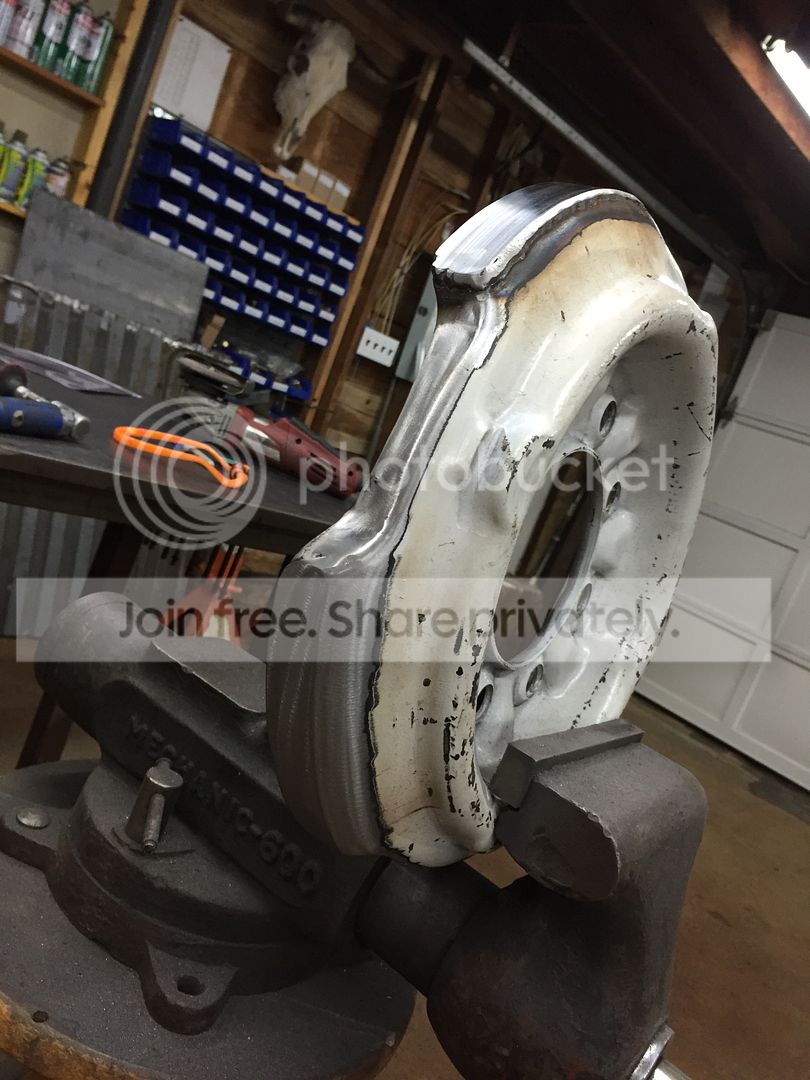
Here's one of my current 16.5" OEM pressed centers with the extra mounting flange material welded on, then CNC'ed down to the proper dimension...

IMG_5023.jpg


As you can see there is some "blending" that needs to occur to hide that extra material that was added. In that photo you can see that the lower flange is blended, and the upper one still has a hard square edge all around it that needs to be flapwheeled and rounded over to match.

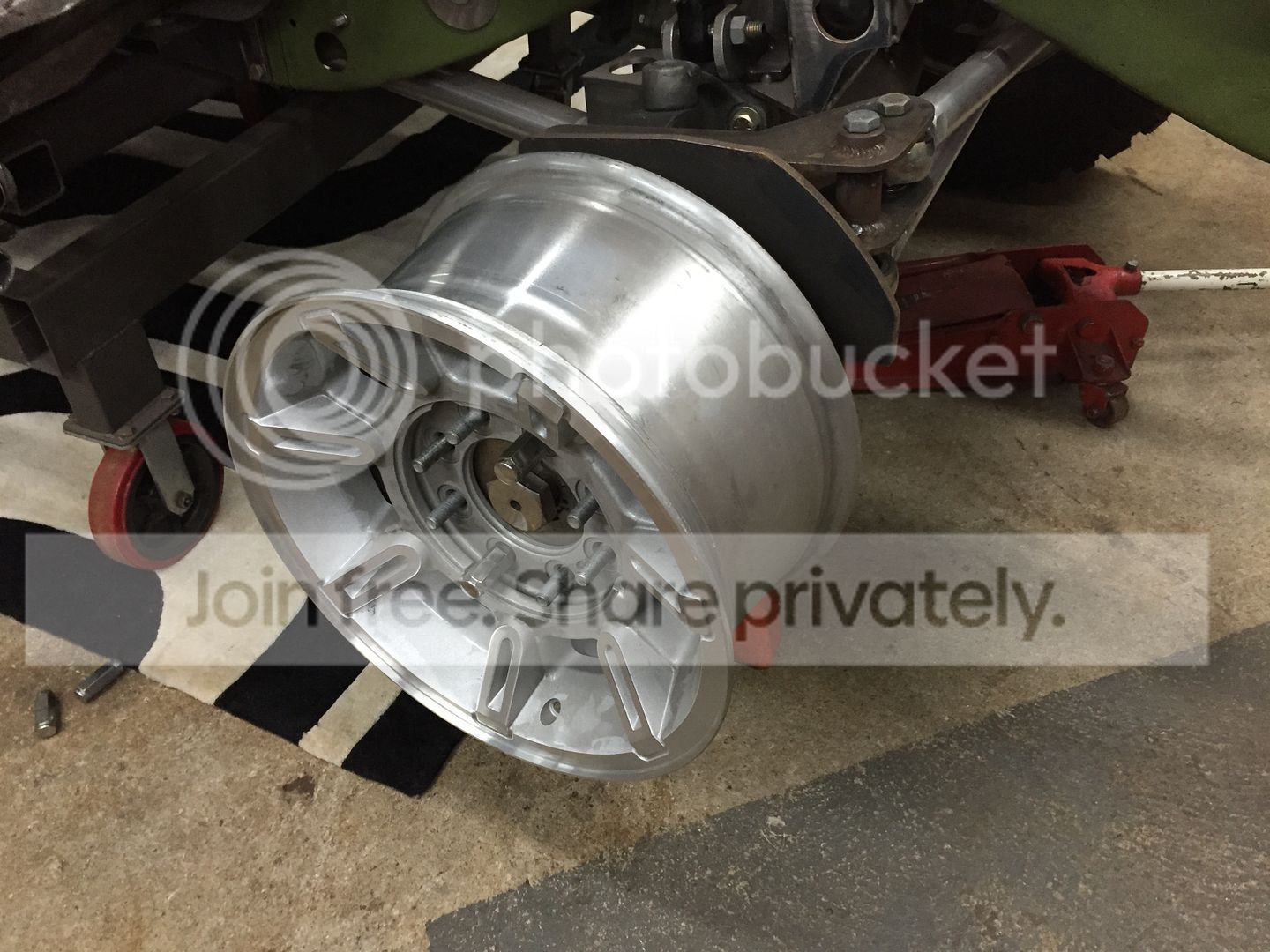
The biggest challenge remaining with the steel wheel project is the crazy amount of backspacing that the dropped valley 17" hoops create. Here's a photo of an H2 wheel to show what 5.56" of backspacing looks like on my axle:

IMG_5026.jpg


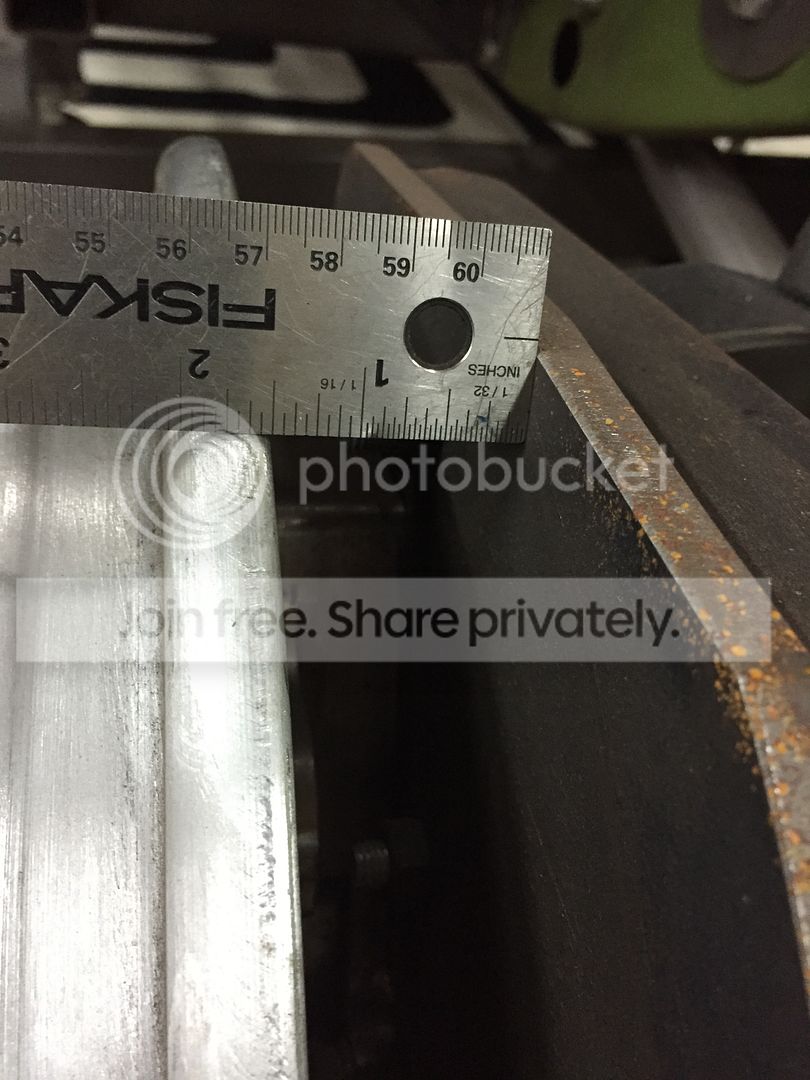
The clearances all look pretty good around the steering arm components.. there is 1.5" of space between the outer wheel flange and the steering plate. The problem is that the inner tire sidewall bulges out a LOT more than that, so that 1.5" spacing is about the smallest amount that will still allow the tire to spin without rubbing. (Note: This requires the use of a 3/8" wheel spacer)


IMG_5025.jpg


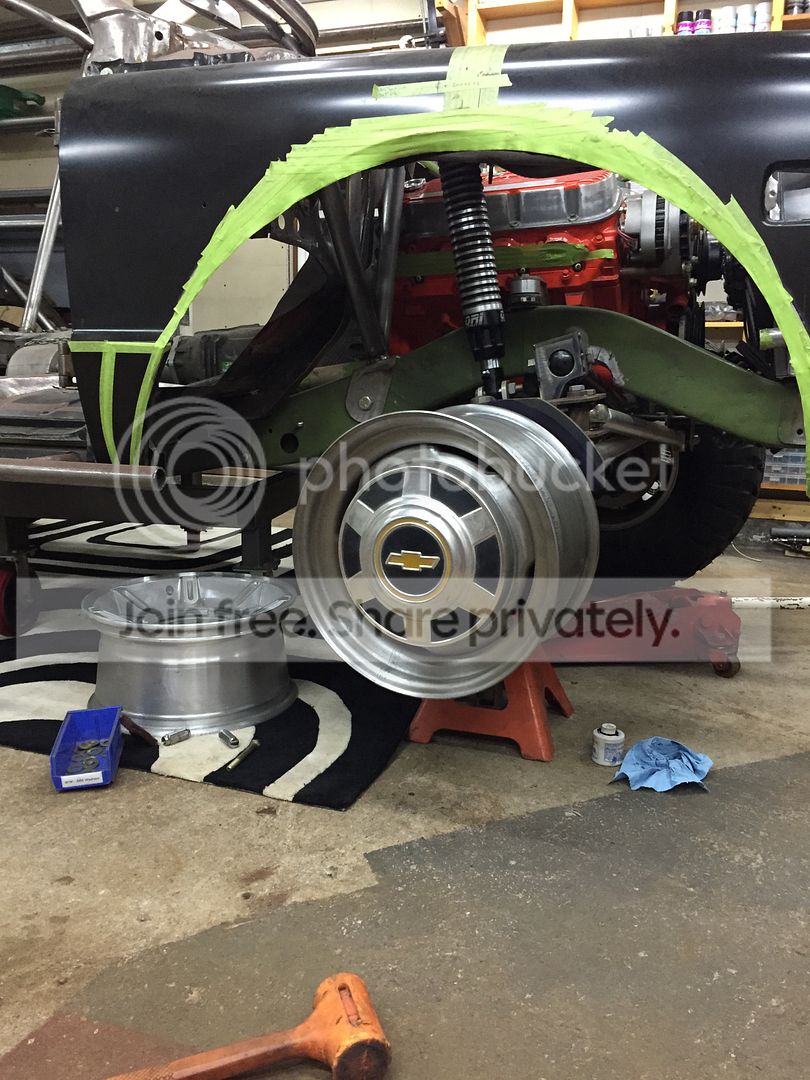
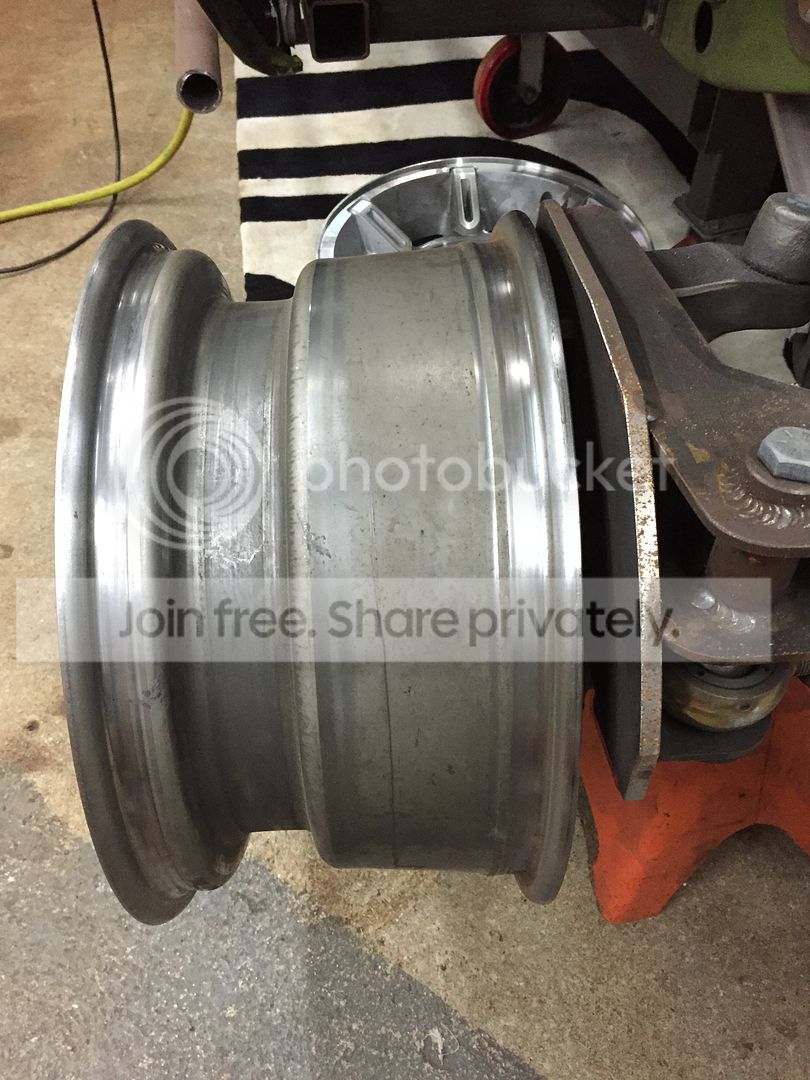
By comparison, here's the steel wheel:

IMG_5033.jpg


I increased the thickness of the wheel spacer from 3/8" to a full 1"... and still lost a full INCH of clearance around the steering plate area.

IMG_5029.jpg


The tire is definitely going to rub with that setup! :doah: So my options are to replicate the backspacing of the H2 wheel (which requires an almost 2" thick wheel spacer behind the wheel!!!) or use a 1" spacer which will pull the track-width of the truck in by 2" total, and will also require me to modify the steering plate areas until the sidewalls don't rub anymore.

I think I'm going with "Option #2".... Being able to get a narrower track width will be especially helpful on the front axle, since I already have a CRAZY swing path of the wheel/tire due to the portal boxes. This should reduce the craziness and may even allow me to be a bit less aggressive with my front fender clearancing since the tire won't stick out as much. My original design had the tire sticking out roughly 2" beyond the fender arch at all four corners. This new setup will keep them within 1"....


-G
 
2015.06.16 - UPDATE! - BABY STEPS...


Now that I've decided to get the engine running, I spent some time ordering up parts that I'll need for the custom header build.

So I went a different route. I went to Cone Engineering (as recommended) and purchased a simple "builder kit" of 1-7/8" mild steel and their much more reasonably priced angle cutting fixture ($25).

....

I also went to stainlessheaders.com and picked up a set of BBC head flanges in 304 Stainless (3/8' thick) and with the correct square-ish port shape to match my iron heads.

-G

The wheels are going to look nice Greg.

However, I am a little confused, why did you order stainless flanges and yet mild steel tubing? I would think you would do all one or the other.
 
The wheels are going to look nice Greg.

However, I am a little confused, why did you order stainless flanges and yet mild steel tubing? I would think you would do all one or the other.

Heath,

The mild-steel is just to build a DIY version of that icengineworks.com kit.

You've seen this thing, right?

Hedder_lead_lg2.jpg


Basically, I'm just going to use mild-steel to make those small segments, and sleeve them with a smaller tube so that they can be pressed together and rotated around to make the shapes I need. I figure for the cost of $300 in mild steel tubing, I'll get the $1400 tool... and get some valuable experience cutting and fitting tube, and maybe even a little TIG practice as well. :waytogo:


-G
 
Yeah I've seen those, they are way out of the price of people like us who maight make a couple sets of headers in our lives. But for someone who does it every day it might be worth it. But what I am questioning is, in the time it takes you to make the tool, couldn't you have made the headers?

Also, how are you going to shape the round tube to match the square flange you ordered? Is the circumference the same as the perimiter? Because if not and the metal has to be expanded it will be difficult to do and make look good without the dies.
 
Curious to see the angle cutting tool, I use a band saw haha.

Good plan with the tubing, mild is cheap and guilt free. Don't forget to time the tubes as they go into the collector, you want them in the collector so they fire in a circle. I find they sound better that way, I've always been told they perform better but no data to prove it other than it sounds better.

Don't get crazy with tac welds either, you want the tube to flange tac to be accessible enough to cut. You will end up tacking the whole header together, marking the tubes to flanges then cuting the header flange and collector off. So you have 4 seperate tubes, Weld all the tubes, re assemble line up the makes, check collector and pull it back off, weld the 4 tubes together on the collector end. Fab a cone or flat plate for the center of the 4 tubes, re attach the collector tack it. Check placement. Tac it Mount the header flange to a thick piece of material/table. All the bolts in and tight. Then weld the flange And collector I use a thick piece of 2x4 tubing, it has my bolt pattern in and is tapped for 3/8 bolts. Yet to have a header that leaks or anything but straight.

A set of headers usually takes me a day worth of fitting, and a half day of welding. Practice a lot with stainless you want a shiny weld, if it's dull and grey you are to hot. To hot makes stainless extremely brittle, they will crack and break
 
That's good advice classic. Thats pretty quick to make a set of headers in 1.5 days, you must have it down.

I think the angle cutting fixture is just a jig to mark the cut, you still need the bandsaw to cut the tube. I use my little Milwaukee portaband mounted on a SWAG offroad table.
 
... But what I am questioning is, in the time it takes you to make the tool, couldn't you have made the headers?

Also, how are you going to shape the round tube to match the square flange you ordered? Is the circumference the same as the perimiter? Because if not and the metal has to be expanded it will be difficult to do and make look good without the dies.


It's anyone's guess which strategy would take less time! :haha: I could certainly see myself pissing away a LOT of time trying to build headers directly on the truck (in stainless) and getting really irritated and wasted a lot of time. I think that spending a couple of hours building some templating bends will be time well-spent in the long run. :thinking:

stainlessheaders.com has some good videos on their site showing the mock-up process and how to do the fitments. They had a good detailed explanation showing how to fit the round tube into the "squarish" port head flanges, and how to then "dolly" them from the inside to get rid of all the gaps and get a really tight, sharp fitment.

There's a chance that I'll have to use a carbide bit to open up the header flanges slightly to account for the wall thickness of the tubing, but from what they said to me on the phone, it should be minimal and won't take long to get perfect.


-G
 
2015.06.16 - UPDATE! - BABY STEPS...

So while I'm waiting, I decided to get back to the steel wheel/hubcap project since there are a few potential issues I need to remedy before things get too much further along in this build.

Here's one of my current 16.5" OEM pressed centers with the extra mounting flange material welded on, then CNC'ed down to the proper dimension...

IMG_5023.jpg


As you can see there is some "blending" that needs to occur to hide that extra material that was added. In that photo you can see that the lower flange is blended, and the upper one still has a hard square edge all around it that needs to be flapwheeled and rounded over to match.

The biggest challenge remaining with the steel wheel project is the crazy amount of backspacing that the dropped valley 17" hoops create. Here's a photo of an H2 wheel to show what 5.56" of backspacing looks like on my axle:

IMG_5026.jpg


The clearances all look pretty good around the steering arm components.. there is 1.5" of space between the outer wheel flange and the steering plate. The problem is that the inner tire sidewall bulges out a LOT more than that, so that 1.5" spacing is about the smallest amount that will still allow the tire to spin without rubbing. (Note: This requires the use of a 3/8" wheel spacer)


IMG_5025.jpg


By comparison, here's the steel wheel:

IMG_5033.jpg


I increased the thickness of the wheel spacer from 3/8" to a full 1"... and still lost a full INCH of clearance around the steering plate area.

IMG_5029.jpg


The tire is definitely going to rub with that setup! :doah: So my options are to replicate the backspacing of the H2 wheel (which requires an almost 2" thick wheel spacer behind the wheel!!!) or use a 1" spacer which will pull the track-width of the truck in by 2" total, and will also require me to modify the steering plate areas until the sidewalls don't rub anymore.

I think I'm going with "Option #2".... Being able to get a narrower track width will be especially helpful on the front axle, since I already have a CRAZY swing path of the wheel/tire due to the portal boxes. This should reduce the craziness and may even allow me to be a bit less aggressive with my front fender clearancing since the tire won't stick out as much. My original design had the tire sticking out roughly 2" beyond the fender arch at all four corners. This new setup will keep them within 1"....

-G

Greg,

No chance of flipping the wheel ring around and getting rid of the wheel spacers since the centers are already out?
 
That's good advice classic. Thats pretty quick to make a set of headers in 1.5 days, you must have it down.

I think the angle cutting fixture is just a jig to mark the cut, you still need the bandsaw to cut the tube. I use my little Milwaukee portaband mounted on a SWAG offroad table.

Makes sense, it can be a pain to mark a accurate line.
 
Greg,

No chance of flipping the wheel ring around and getting rid of the wheel spacers since the centers are already out?

I can take another look at the numbers, but it seems like the drop-valley is too aggressively offset to one side.... flipping the hoop and doing a "reverse" wheel would create a massive "deep dish" look. IIRC the B.S. ends up only being around 2.5" - 3.5"


-G
 

Latest Posts

Top Bottom