CK5
Register an account today to become a member! Once signed in, you'll be able to participate on this site by adding your own topics and posts, as well as connect with other members.
for those of us unfamiliar...Rene' what is HAZ?

HAZ is "heat affected zone". It's basically identified by the area of discoloration around a weld. When you have a large HAZ around a weld, it's indicative of a LOT of heat pouring into the weld and means that you are more likely to have warpage once everything cools. For sheetmetal, you want to keep the HAZ as small as possible, while still insuring that the weld has full penetration.

As Rene said, the trick is to "go in hot" with the weld so that the weld is completed quickly. The longer you dwell on a weld, the more heat you end up pouring into it....and the larger that HAZ becomes. :waytogo:


-G
 
Put a 1/4" thick chunk of copper behind the gap section you need to weld. It won't weld to/stick to the steel and will keep all of your puddle right where you want it. Works with mig, tig, etc.
 
OK.... a few quick new photos from last night:

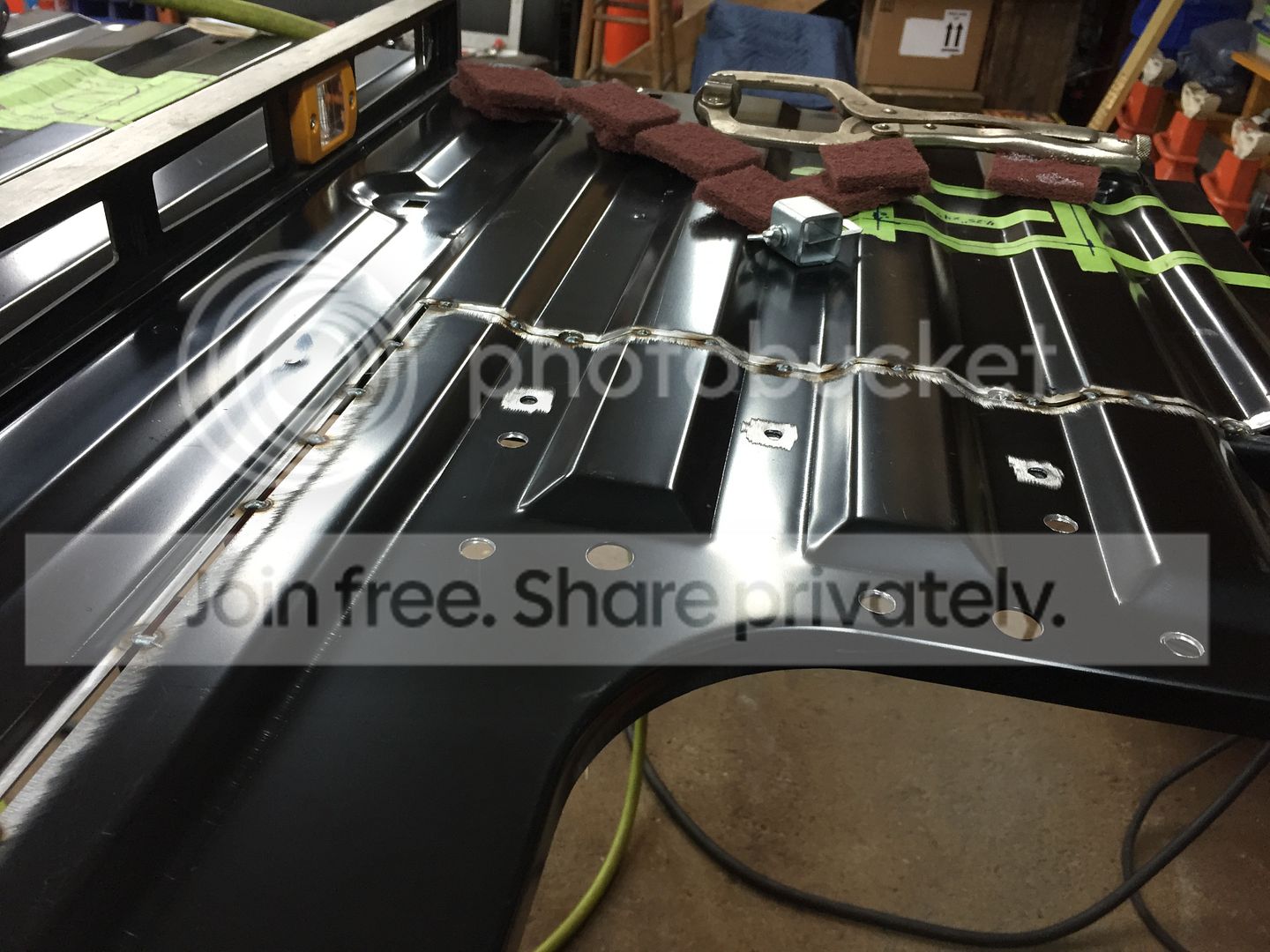
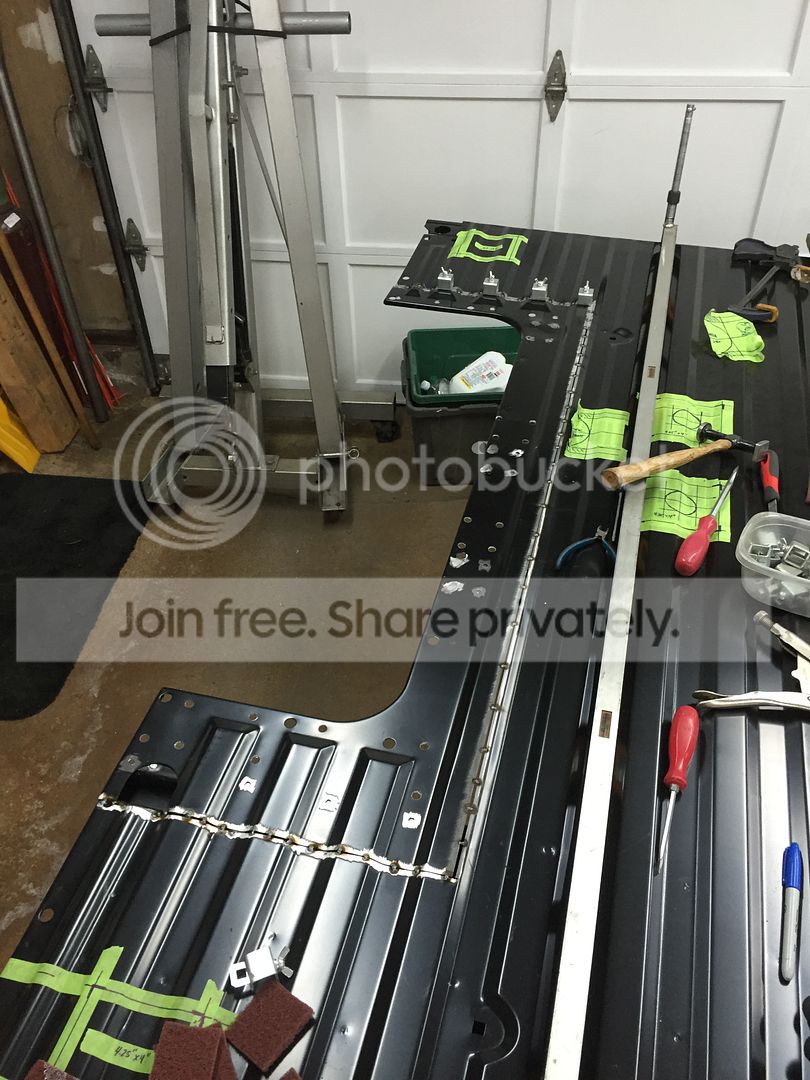
I cleaned up all the sharp edges from the cutting process on both the bedfloor and the patch panel and then transferred the location of the cross-sills to the patch part, drilled new plugweld holes and cleaned off the black paint around those areas..... also cleaned off the paint along the edges of all the larger weld sections. When it came time to get the fitment 100% perfect I ran into a bit of a dilemma. The gaps ended up being really nice, and the outside edges lined up perfectly between the bedfloor and the patch panel... but the convoluted transitions were a little "off". It turns out that the stamping itself is just slightly different from one side of the floor to the other. Since it was more important visually to have the convoluted sections in perfect alignment, I clamped down the patch panel using those as my reference, and just let the gaps (and overhangs) do whatever they needed to do....

You can really see from the reflections in this photo that the pattern carries really well across the gap between the two parts.

IMG_9261.jpg


From a bit higher, you can see the alignment in the reflections as well...

IMG_9255.jpg


Unfortunately, here's the "gap" I'm left to deal with:

IMG_9265.jpg


On the outside edge of the panel, the patch now extends out about 1/8" beyond the bedfloor too. So I'll have to either cut/weld that to correct it, or possibly try to hammer/dolly that outer flange to move it into alignment. :thinking:


-G
 
OK.... a few quick new photos from last night:

I cleaned up all the sharp edges from the cutting process on both the bedfloor and the patch panel and then transferred the location of the cross-sills to the patch part, drilled new plugweld holes and cleaned off the black paint around those areas..... also cleaned off the paint along the edges of all the larger weld sections. When it came time to get the fitment 100% perfect I ran into a bit of a dilemma. The gaps ended up being really nice, and the outside edges lined up perfectly between the bedfloor and the patch panel... but the convoluted transitions were a little "off". It turns out that the stamping itself is just slightly different from one side of the floor to the other. Since it was more important visually to have the convoluted sections in perfect alignment, I clamped down the patch panel using those as my reference, and just let the gaps (and overhangs) do whatever they needed to do....

You can really see from the reflections in this photo that the pattern carries really well across the gap between the two parts.

IMG_9261.jpg


From a bit higher, you can see the alignment in the reflections as well...

IMG_9255.jpg


Unfortunately, here's the "gap" I'm left to deal with:

IMG_9265.jpg


On the outside edge of the panel, the patch now extends out about 1/8" beyond the bedfloor too. So I'll have to either cut/weld that to correct it, or possibly try to hammer/dolly that outer flange to move it into alignment. :thinking:


-G
I would suggest buying another new floor section and starting over again (might as well).
OK.... a few quick new photos from last night:

I cleaned up all the sharp edges from the cutting process on both the bedfloor and the patch panel and then transferred the location of the cross-sills to the patch part, drilled new plugweld holes and cleaned off the black paint around those areas..... also cleaned off the paint along the edges of all the larger weld sections. When it came time to get the fitment 100% perfect I ran into a bit of a dilemma. The gaps ended up being really nice, and the outside edges lined up perfectly between the bedfloor and the patch panel... but the convoluted transitions were a little "off". It turns out that the stamping itself is just slightly different from one side of the floor to the other. Since it was more important visually to have the convoluted sections in perfect alignment, I clamped down the patch panel using those as my reference, and just let the gaps (and overhangs) do whatever they needed to do....

You can really see from the reflections in this photo that the pattern carries really well across the gap between the two parts.

IMG_9261.jpg


From a bit higher, you can see the alignment in the reflections as well...

IMG_9255.jpg


Unfortunately, here's the "gap" I'm left to deal with:

IMG_9265.jpg


On the outside edge of the panel, the patch now extends out about 1/8" beyond the bedfloor too. So I'll have to either cut/weld that to correct it, or possibly try to hammer/dolly that outer flange to move it into alignment. :thinking:


-G
 
Nice work Greg, even with the big gap on one edge. Should be easy enough to cut a larger patch later. Not the most fun but would work out fine.
 
Nice work Greg, even with the big gap on one edge. Should be easy enough to cut a larger patch later. Not the most fun but would work out fine.

Yeah, we'll see. I have one of those copper welding spoons (like Shady was referring to) that I can use as a "backer" for the really big gaps and I'll see how that works. It's been a couple of months since I did any real amount of welding, so I need to get my mojo back.

Last night I finally unpacked my new Speedglas and tried it out. WOW!!! What a nice wide-open field of view and great sensors... the auto-dimming worked perfectly and when it switched back to normal mode I had plenty of light and clarity to work on the panel with the visor down. I didn't have to play that whole visor-up / position-part / visor-down / weld / visor-up / check-weld game.


-G
 
I can't do auto darkening, i end up bobbing my head up and down with mask down waiting for somthing to happen.:screwy:

Use the spoon and go slow one tac at a time, turn the wire speed up a little bit and build off the previous tac.

We've all done it haha
 
I can't do auto darkening, i end up bobbing my head up and down with mask down waiting for somthing to happen.:screwy:

Use the spoon and go slow one tac at a time, turn the wire speed up a little bit and build off the previous tac.

We've all done it haha
Glad I'm not the only one who can't operate the auto hood
 
Lay some filler rod between the tacks in that large section, then weld tacks over it.. Not sure how it will work, but it works in my head.
 
Lay some filler rod between the tacks in that large section, then weld tacks over it.. Not sure how it will work, but it works in my head.

I don't have any filler rod for mild steel....all I've got is the 304 / 308? for stainless TIG.

Probably could cut a VERRRY thin slice of the old floor to use in those gaps.... just enough to keep the MIG wire from "shooting-the-gap" so the backside of the weld doesn't end up looking like a walrus mustache!!!! :haha:


-G
 
I was gonna say that but thats a bunch of work to get it that thin, not to mention the razor like properties after the cuts are made. Steel filler rod is cheap, plus you will need it eventually on something, cage perhaps.
 
I was gonna say that but thats a bunch of work to get it that thin, not to mention the razor like properties after the cuts are made. Steel filler rod is cheap, plus you will need it eventually on something, cage perhaps.

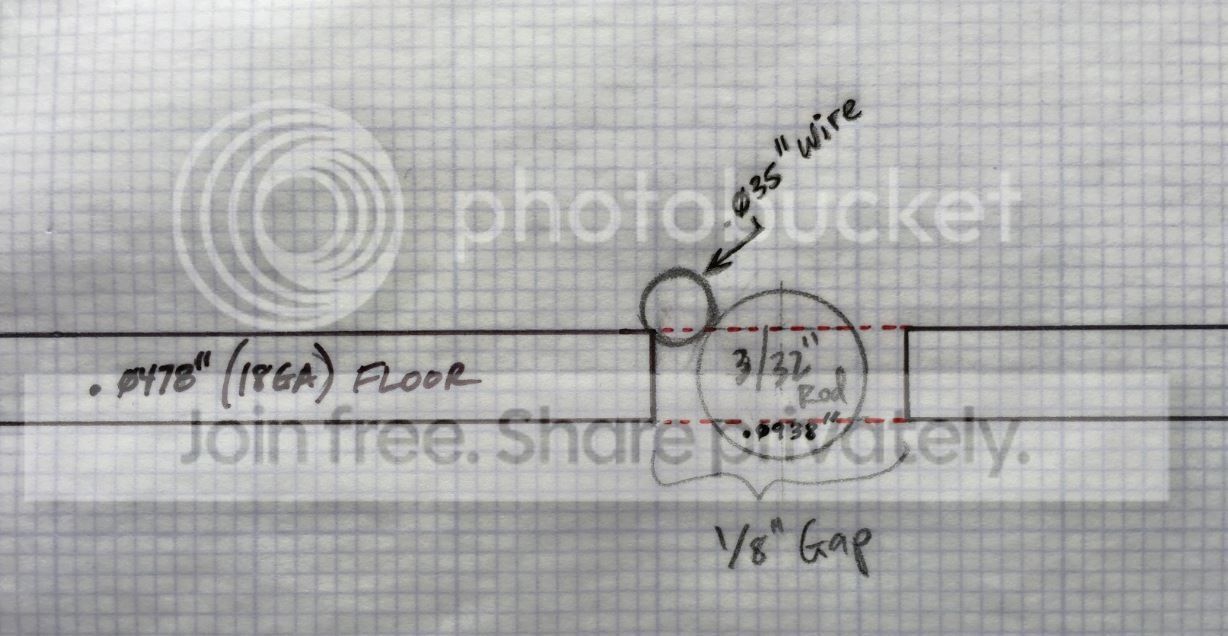
Hmmmm..... so say the gap is 1/8", do you jam an 1/8" filler rod in there of go with something slightly undersize like 1/16" or 3/32"?? :dunno:

Presumably, since it's round, it sits above the top of the floor (and below it) so you've got some material to grind off when you're done welding and it probably all blends-in really nice....

Sounds interesting. I may run over to the local AirGas at lunchtime and see what they've got for filler rods.


-G
 
I have never done it but I would undersize it to minimize the build up ontop of the rod. Like I said before, it works in my head, I am not sure how it will work in the real world.
 
If the gap is only 1/8", the copper spoon should be fine. I've filled in short distances of 3/16-1/4" gaps on sheet metal using Rene's technique on one corner of a previous tack and then alternate to the other edge of the gap when I get back to that spot. Takes a while but comes out reasonably well without burning through it. The trouble with the "thin strip" idea is that the heat will burn through that strip really fast without a larger metal surface area to soak the heat away when you tack it.
 
If the gap is only 1/8", the copper spoon should be fine. I've filled in short distances of 3/16-1/4" gaps on sheet metal using Rene's technique on one corner of a previous tack and then alternate to the other edge of the gap when I get back to that spot. Takes a while but comes out reasonably well without burning through it. The trouble with the "thin strip" idea is that the heat will burn through that strip really fast without a larger metal surface area to soak the heat away when you tack it.

Brian,

That's why I'm kind of intrigued by the idea of using round filler rod.

The rod just gives you more material in the gap to absorb heat without blowing through, and it seems like you might end up with a more solid weld (with fewer pinholes) than just trying to bridge-the-gap with weld. :thinking:

EDIT:

Here's the idea (drawn to scale)...

9309e.jpg


-G
 
Last edited:
I must have missed it... why did you just cut up your new floor?
 

Latest Posts

Top Bottom