CK5
Register an account today to become a member! Once signed in, you'll be able to participate on this site by adding your own topics and posts, as well as connect with other members.
Sometimes it is by far the best idea to make ingress and egress of mud and dirt easiest. It's just not possible to seal most of it up. Besides much easier to paint the inside when making many holes


I will make it so...


-G
 
Dimples should be on the priority list to talk about before powder coat.

Just sayin....
 
2016.04.21 - UPDATE: GAS TANK: ALUMINUM OR STAINLESS???

Before the new bedfloor goes in, I really want to get a gas tank designed. The entire process will be SOOO much easier working with a nice open area and not having to do it all from underneath.

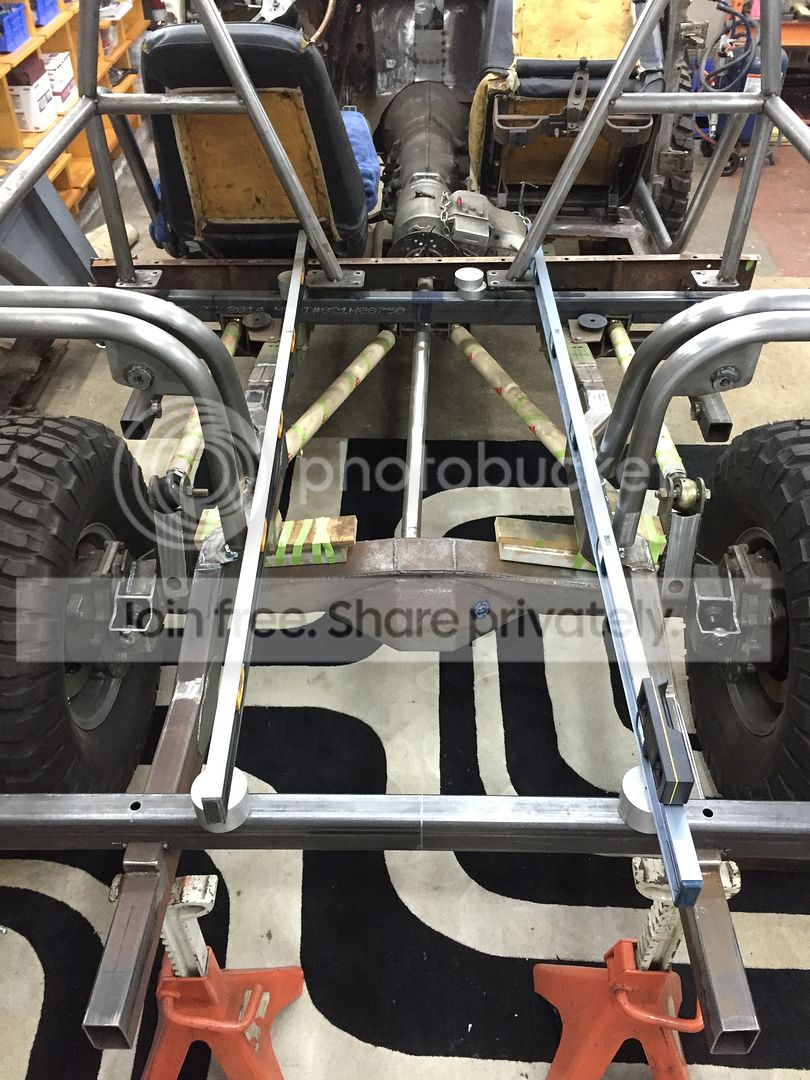
Here's the rear area I'm working with....

IMG_9679.jpg


The stock tank was only 20 gallons which was a laughable amount of fuel for a truck that only got ~7MPG. Even if I can improve that to 10MPG on the highway with a carefully tuned EFI system, I still want to be carrying a much larger fuel payload... realistically, no less than 30 gallons is acceptable.

A few goals for the project:

  • NO low-hanging tanks behind the rear axle. This is a classic spot to get hung-up on rocks, and it kills the departure angle. Ideally I want the tank flush with the underside of the framerails so that I can put a nice flat skidplate across that area and never worry about getting "turtled" on a rock, or damaging a tank and losing all my fuel on the trail somewhere!
  • As much capacity as I can get... 30 Gallon minimum
  • Must not encroach up into the bedfloor. No bedmounted fuel cells..
  • Build it myself so I can get a LOT of practice with my TIG welder. :)

So this is where I get stuck. What material do I use? :dunno: The common materials are stainless or aluminum. But what thicknesses are considered appropriate for a fuel tank application? I am sure that aluminum needs to be a lot thicker to give equivalent strength to stainless, and I'm not sure what grade of aluminum or stainless is most appropriate. I also need to figure out how to properly baffle the interior of the tank.... this will serve the obvious purpose of keeping fuel near the pickup (I am planning to use one of those new Holley Hydramats, BTW) but will also add some needed strength to the large spans of metal that this tank will have so they don't sag or balloon when filled with 200+ Lbs of fuel. :yikes:

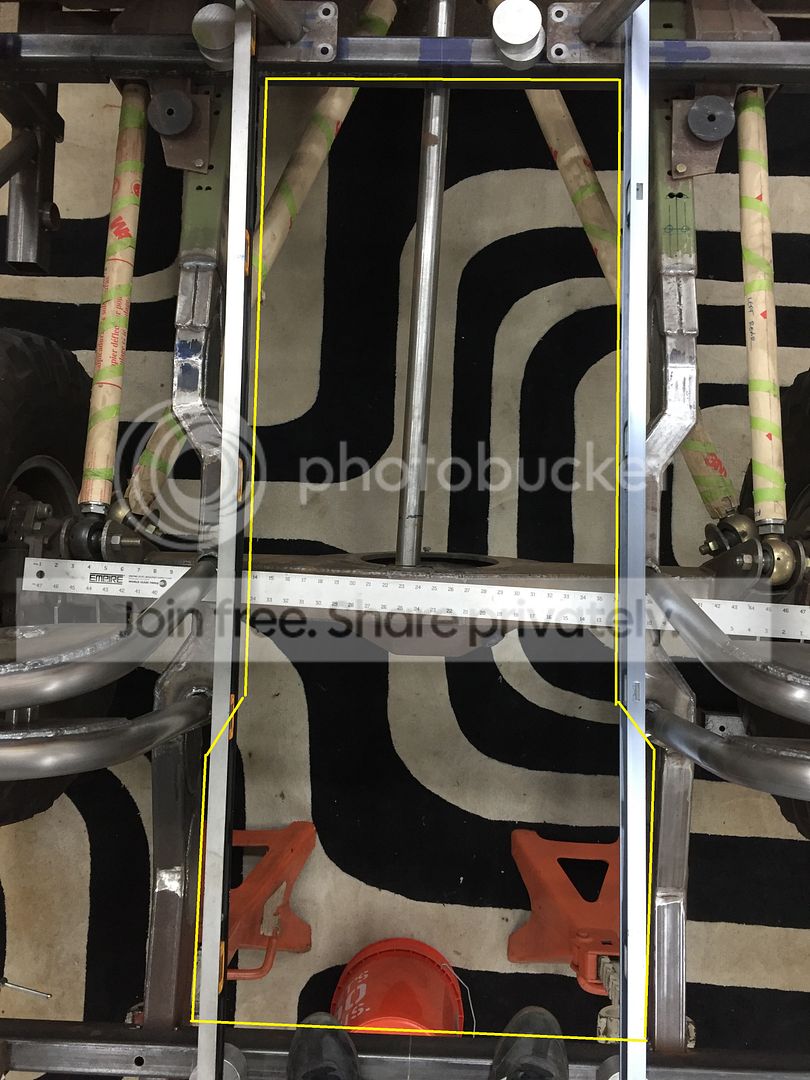
My first attempts to find usable space yield the following design: (in yellow)

IMG_9689e.jpg


Yeah....that's a monster of a tank! It's about 8" deep at the very back of the frame (to keep it flush with the lower framerail) then transitions to about 4" deep as it passes over the axle (for clearance) to the other cross-sill. The width is 28" at the very back, but it needs to taper inward to follow the lateral "notch" in the framerails to about 23"... I haven't decided if I want to flare it back outward to gain more capacity, or just leave it at 23" all the way to the cross-sill near the front seat area. Overall length of the tank (using all the space between those two cross-sills) is 61"... If I build it this way I end up with 36 Gallons. (8464 cu in)

That 61" length is why I'm so concerned about "sagging" of the tank. That's a LOOOOONG unsupported span of metal with a lot of weight pressing down on it from fuel... so I want to be sure that I've got good interior bracing from the baffles to keep it stiff.

What sort of clearance seems reasonable for a fuel tank vs. surrounding framerails? I figure that the frame won't really twist much given that it's fully-boxed with a stupid-amount of cagework holding it in place...so I'm thinking maybe 1/2" of space all the way around is adequate. :thinking:


-G
 
How deep do you need it to be for your sending unit? It seems awful shallow.

Martin
 
I've always used aluminum, the biggest thing with a tank of that size out of aluminum is the frame work to hold it, you want a really well built frame out of thicker material, and want to avoid having to much of the tank unsupported. I had a aluminum cell in my class1 car, I didn't support the tank well enough and blew out the corners of the tank, resulting in gas pour out of the car, and splashing all down mine and my codrivers arm.

Now, with a tank that long you need to either have a sump in bottom of it, or you can drop in a sump, they have doors that open in but not out, so fuel goes in but can't go out.

Baffles inside the tank are important to, you need to slow the fuel down so it doesn't try and push the corners open. At 7.5lbs a gallon, it has a lot of power.

My last tank I built out of .120, it was for my c5 corvette powered Hotrod, and went around the transaxle and between my frame rails, I built a sump box for the inside of it as I only had 3" of ground clearence. .120 was over kill but with the size of the towers on either side I didn't want to much flex. It was cut with a Waterjet, pretty much the only way to cut aluminum IMO.


image hosting websites
 
Obviously I'm no expert, but it seems to me that with a tank that long, if it's less than mostly full you are going to have problems driving on severe angles any time the sending unit is on the uphill side.

Would it make sense to turn it into 2 tanks so the fuel can't flow so far away from the pick ups?
 
Obviously I'm no expert, but it seems to me that with a tank that long, if it's less than mostly full you are going to have problems driving on severe angles any time the sending unit is on the uphill side.

Would it make sense to turn it into 2 tanks so the fuel can't flow so far away from the pick ups?


I think it all comes down to the design of the baffling and location of the pickup...

Here's a link to that Hydramat:


-G
 
Interesting problem with the hydramat from Holley. Your baffles won't be able to attach to the bottom. Just to the sides and top.

The bottom will need to be open. Hence I would probably build the bottom out of thicker material than the sides and top.

Other issues for a center mounted tank is filler neck and proper venting to be able to fill it.

Also remember there needs to be some room for expansion. Gotta be some one here who knows how much you need .

I think with a tank that long I would not put a single opening in line with another. All the openings need to be staggered in order to slow fuel slosh. On the baffles don't just do a t joint. Bend a flange on the baffles then you have alot more surface area on the edges of the tank.

Senders are easy you can get universal ones to match your gauge. That will work with whatever heights.
 
My baffles were half circles where they met the tank, the tank had slots cut in it, baffles had tabs that fit in slots so the top of them could be welded with the lid down. Same thing on bottom but had some issues once I pressure tested, top was fine bottom I had to weld some strips over the area as they cracked. Next one I will probably break them and flange the bottom weld the flange and be fine
 
Last edited:
Top Bottom