CK5
Register an account today to become a member! Once signed in, you'll be able to participate on this site by adding your own topics and posts, as well as connect with other members.
I was gonna say thanks alot bragging about your warm weather. Whining about how much time you HAD to put into your aluminum links........But hey at least no bucket picture........... then I continued to scroll and there it was. :confused1: I have seen them lurking in the background in other pics but nooo, just had to use em didn't you. o_0 Just can't leave well enough alone.
 
Do you have your hydromat yet? Seems like you'd want to make your baffle area match the footprint of the hydromat you end up using. Also, don't you want your pump in the lowest point of the tank? Unless I'm missing something, it doesn't do you any good to know there is more fuel in the tank, if it's below the pump anyway.

Yeah, I was looking at the Hydramat options....they have a lot of sizes and shapes....some square, some "X" shaped ones. I also need to understand how to attach it to the Aeromotive pump setup that I want to make sure it's going to fit as expected. The hydramat is designed to be mounted to the floor with studs in each of the 4 corners of the mat so that it doesn't shift around. Normally you use their magnet-mount system, but obviously that's not going to work on this tank.

Heath had mentioned that the sump really should go near the back of the tank, even though it's slightly higher there. On steep climbs that's where the fuel is going to be anyway... and with a full return-style EFI... the fuel is going to be constantly pumping back into the bafflebox too. There will be a few small drainholes in the baffles (at the very bottom) to allow the fuel levels to slowly equalize, but I think the objective is to make sure that the fuel moves very slowly between those different compartments, otherwise it will drain out of the baffle box and defeat the whole purpose of it. :thinking:

I want to run fuel lines next... that's another project that will be 1000% simpler to do before the bedfloor is installed. A lot more learning to do there also. I've never bent stainless fuel lines before, though I do have a bending and flaring set that I bought a long time ago... they might be adequate, but then again, they may only work well for softer tubing metals... I'll have to get some tube and starting figuring that out before too much longer.

Then: Add all the convoluted cage plates the bedfloor while it's still out of the truck. Then raise the upper rollcage out of the way, slide the bedfloor into place with a few strong neighbors and the sheetmetal can start going back into place!!! :saweet:


-G
 
I get having the pump towards the back for steep uphill climbs, and acceleration, but the back of your tank is quite a bit higher than your front, and most of your driving is going to be on flat ground, most importantly when you are driving back from the trail presumably low on fuel. When sitting on flat ground, how much fuel is below the pump if it's at the back?
If you have the pump in the lowest point it'll always have the fuel, and the baffle system will keep it there during the hill climbs.

Of course the hydramat changes everything. Maybe if you went with a style like this:
16-102orthoren[583x].jpg


Maybe have a cutout in the side to side baffle that will let the longer leg of the hydramat lay under it and stick down into the lowest part of the tank?
 
I think since you are leaving your tank angled you should put the sump in the middle. That way at least half the fuel that's lower will still be accessible on flat ground. It's kind of a compromise since the back is not the lowest part. I would of made the front half of the bottom flat with the back half angled up for clearance. But that wouldn't meet the Greg standards of cosmetic compliance, so a flat angled bottom shifts the ideal location. But I would definitely not put it in the front of the tank just because that's the lowest part, because it won't be where the fuel will be under throttle when you need the most fuel the quickest.

In summary, with your angled bottom, the back will be the best under throttle(when you need the most fuel), the front will be the best for max fuel capacity and cruising. So the middle may be the best compromise.
 
Last edited:
I just saw this...

Thanks Heath!

So in that last photo..... the back of the tank (toward tailgate) as at the bottom of the photo, and the axle-side is at the top. I'm thinking about running two panels front-to-back at the same width as that axle-side middle plate (14" wide).... then running a wall between them around 1/2 way in between (approx. 12").

That should give me a pretty good sized baffle area for the fuel pump and I suppose I could put the fuel sender in the other compartment (toward the axle) since it's a little deeper anyway... and will give me a more accurate measurement of remaining fuel. :thinking:

-G

So to add to my previous post, I would run those two walls front to back as you suggested, I was going to say a little narrower but matching the angle works just fine. I would make the baffle walls about half the height of the tank with an upside down L bend at the top of them (a ~1/2" bent rib to keep them stronger).

However, with your tank bottom shape I would put two lateral walls surrounding the sump in the middle of the tank.

I agree with @ashman on the sending unit. Unless your pickup can reach the extra fuel, you won't want it to seem like you have a couple more gallons when the engine is going to run out before that. So you can put the sending unit wherever you want, but the bottom of it (the empty point) shouldn't be any lower than your fuel pickup point on level ground. So basically don't make the sending unit any longer than your fuel pump assembly if they both install from the top surface.

If you order stainless tubing, look for the "double annealed" stuff, its softer and should bend and flare easier (although still harder than regular steel lines). Should come in a roll. It doens't make a lot of sense to me because annealed is annealed and once should be enough, but whatever they call it, its easier to work with than harder stainless or imported junk.

3/8" line will be plenty big with your high pressure in tank fuel system.
 
Last edited:
FYI:

To anyone who has more spare time today than me.... the tank taper is 12.5" tall on the deep end, and 10.5" tall on the shallow end. (Roughly 5.5* taper)

With some simply trig, you can figure out the volume of fuel that can fit into that small triangular sliver of space.... I'm guessing it's maybe 1/2 gallon if the longitudinal baffles were set 12" or 14" apart :dunno:


-G
 
I didn't know there would be homework! :(

well, if my calculations are correct, at 12" apart it's 1.07 gallons, and 1.25 gallons at 14" apart.
 
I didn't know there would be homework! :(

well, if my calculations are correct, at 12" apart it's 1.07 gallons, and 1.25 gallons at 14" apart.

Tank is 24" front-to-back.... not sure if that was obvious already.... ???


-G
 
ok, then it is more. I calculated 20.73" front to back using the 2" side of the triangle and 5.5*.
 
ok, assuming the length of the bottom of the tank is 24":
12" apart = 1.24g
14" apart = 1.45g

Still, it's a pretty sweet 28.5g tank. :)
 
ok, assuming the length of the bottom of the tank is 24":
12" apart = 1.24g
14" apart = 1.45g

Still, it's a pretty sweet 28.5g tank. :)


I added those "kickouts" back into the original 30G "simple" design as a hedge against just such a smartass comment!!!!! :haha:


-G
 
UPDATE!!

So, the next frontier is going to be getting a better understanding of fuel lines, fittings, methods and manufacturers.....

I've been compiling a list of ideas and as Donald Rumsfeld called them "the unknown, unknowns"..... which are the hardest things to anticipate. I don't even KNOW the extent to which I don't know things, so it's hard sometimes to even ask the correct questions... :doah:

Anyway.... I'm partway through the process and I'll write a lot of it down here in a sort of "stream of consciousness" to help organize my thoughts and maybe solicit some feedback.


For the fuel system, I want to run as much hardline as possible. It will help to cool the fuel better than rubber hose, and it will be cleaner-looking once installed. I don't want to use steel because of rust issues, aluminum might work well but I've been told it's still not as good as stainless. Stainless is a hard metal, so unless it's been annealed it won't bend well and will be almost impossible to flare without splitting, etc.

EARLs sells straight lengths of T304 stainless through Summit, etc. 2 ft, 4ft, 5ft, 6ft, 8ft. I'd rather buy straight lengths and not have to deal with trying to straighten it. It's almost impossible to get it to look good without a special straightening tool, and by the time you buy/make a nice tool to do it, you could have just paid the premium price for the straight tube in the first place. :)

Fittings / Flares:

NPT sucks - Avoid at all costs.
AN is a 37* flare that works well
SAE is a 45* flare that also works well
AN & SAE are NOT interchangeable, so it makes sense to pick one and use it throughout

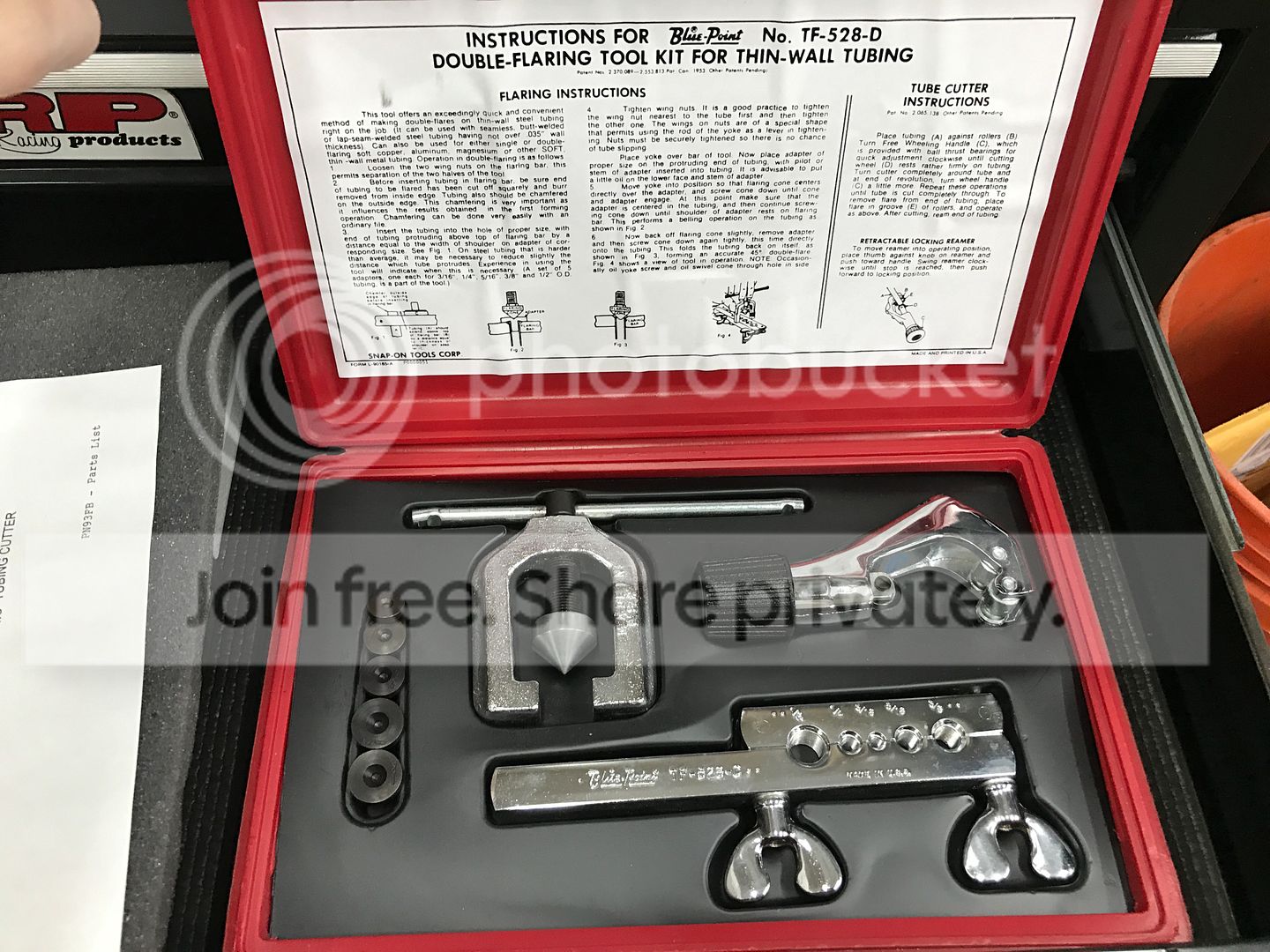
I have a flaring set that I bought many years ago from Snap-On, but honestly I don't know how well it works for the kinds of flares I will be doing:


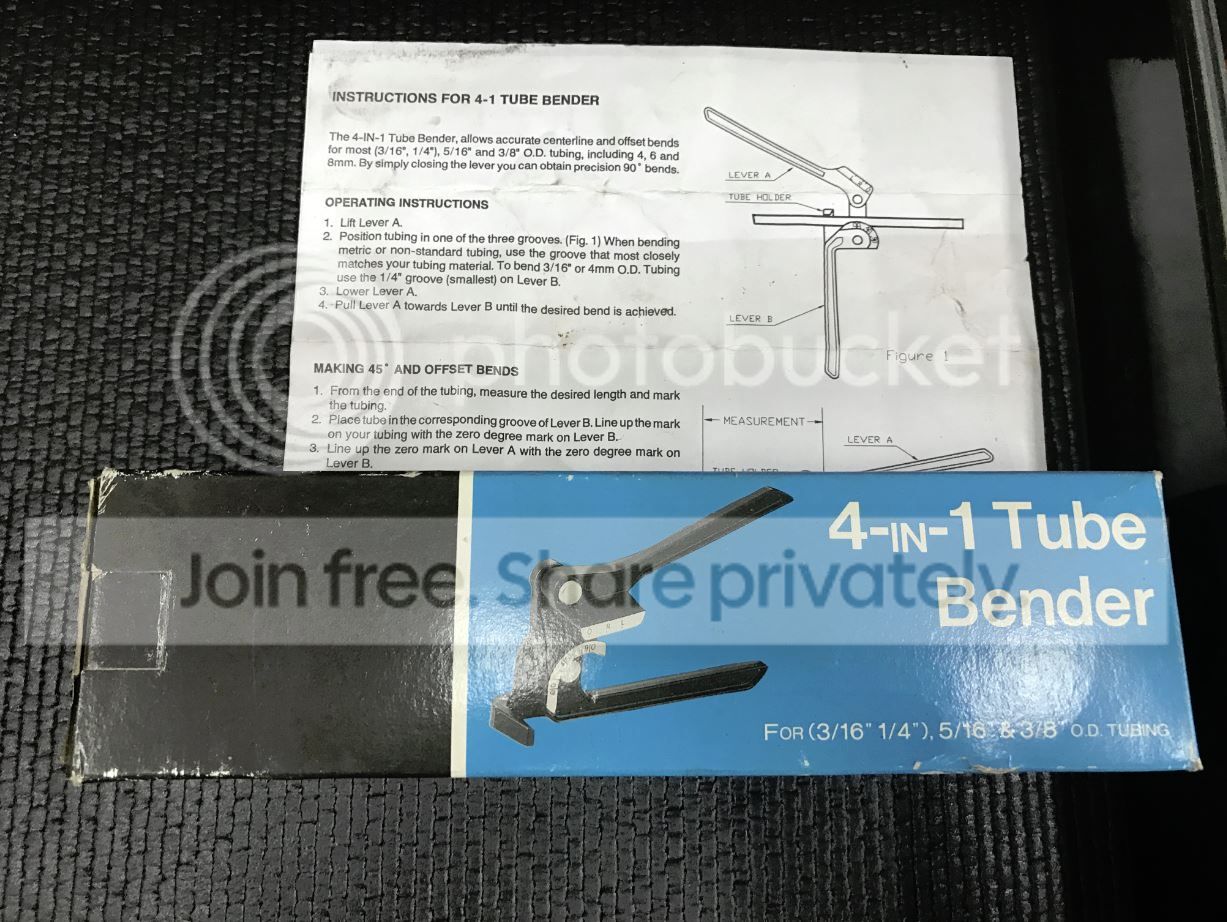
I also bought a tubing bender way back then, which looks to be very "Light Duty" and I'm not sure I'd trust it to do a quality job. I need to research and find something more appropriate:


Fittings:

Aeroquip makes nice fittings
Fragola was also reccomended as a quality choice that might be a bit cheaper.
I want to avoid the "carnival look" of traditional red/blue anodized fittings and will focus on black or silver colors only
Fittings come in aluminum (commonly) but are apparently available in stainless as well.
The aluminum ones might be more fragile than the stainless but apparently there is no issue using aluminum fittings with stainless tube (ie. corrosion, electrolysis, etc)
There are supposedly some fittings out there that are quick-disconnect style that allow for removal of the hose without losing fluid. These could be really cool to use for service items like a framerail mounted fuel filter where it might be desirable to remove the canister to replace a filter, and not lose a ton of gas on the floor in the process... :thinking:

Clamps:

I want to find some nice framerail clamps to hold the tubing. EARLS makes a nice simple double-tube clamp that might be able to attach to the frame with a tapped hole and small stainless bolt.


Hoses:

Looking for black, fabric-covered hose options to keep the look subtle... not interested in stainless braided hose.
Apparently there are different qualities of hose depending on the internal liners used. Some are more impervious to the additives in our crappy pump gas (MTBE, Ethanol, etc) than others, so I need to be careful to choose wisely. I don't want to have to worry about a "replacement schedule" for rubber fuel lines in my truck. I'd rather buy something good and run it for another 50 years! :)


Accessories:

I may be able to get away with my current flaring kit, but I may want to get something different depending on the fittings and materials I use (unknown unknowns)
Will also need things like Aluminum "soft jaws" for my bench vice for holding fittings, Aluminum wrench set, new tube bender, etc. To get quality bends and fitments of the hose ends.
Not sure how much a crimper costs, but maybe there's a way to buy just the crimping dies and somehow use the hydraulic power of my existing bender and adapt it for use on that? :dunno: I built a flarehole adapter for my ProTools bender and that worked awesome.


Anyway, that's the current dilemma. Feel free to chime in with ideas, comments or links to materials that might help me get this all sorted out.

In the meantime, I will keep fitting up cage plates to the bedfloor and keep moving along on smaller projects while I wrap my head around all this fuel-system related stuff. :)

-G
 
Stainless flaring sucks.

So I've heard.... the annealing is supposed to soften the metal substantially to make it easier, but I'm concerned that it also requires a high-quality flaring tool with a lot of leverage to do it well.
They make handheld hydraulic flaring tools for around $300 IIRC. Not sure if that's the secret or not. :dunno:


-G
 
Greg, the flaring tool you have should do the trick just fine. I would use all Earls hose and fittings, they have the black hose you want and you can get fitting in either aluminum or steel as well. I would also suggest you run 1/2" fuel feed line and if using a return system I would then run a 3/8" return line. I have bent stainless line before and it's not as bad as people make it out to be. The bender you have should also work. Keep in mind another "trick" is to use V pulleys of different sizes to help you make bends as well if needed.
 
This. http://www.eastwood.com/professional-brake-tubing-flaring-tool.html and
http://www.eastwood.com/37-deg-flare-die-set-for-25304.html

Or the master cool flaring stuff. This will make your life and this process a thousand billion times better.

As far as AN stuff earls has several levels of stuff. Never put it on my own rig but I have used plenty on others.

Best thing to do is make a plan like your doing and I tend to eliminate as many fittings as possible.


Or you could make your life easy and use copper nickel ( cunifer) line
 
I have had that same Snap On flare kit forever and it works great for AN stuff. The Fragola stuff is nice too, fwiw they have a pretty good selection of black fittings.
 

Latest Posts

Top Bottom