CK5
Register an account today to become a member! Once signed in, you'll be able to participate on this site by adding your own topics and posts, as well as connect with other members.

'83 K10 SB "L1TSBFIBBC" build

Thanks everyone, after all that work, it feels good to know people think I did a good job at it.

How the heck did you learn to do all of that! Talk about sweet!:waytogo:

You did this in your driveway?:bow: Wow!!

I learned it from a lot of research, reading, past experience, trial and error, and, "I learned it by watching you!".

And I should clarify this, the first lift, with the 3/4 ton axles, 6" leaf springs, shackle flip, crossover, TH400/NP205, etc was all in the parking lot of my apartment in 2003. But shortly after that I moved back to IL, and then two years later to MI, and both of those places I have had some sort of a garage to work in where my truck would fit in. Not very much room, but at least it's a garage I can pull the truck into and leaf it on jackstands etc while I work on it. In the apartment I had to have it back in it's own wheels every night.

One of the tools I wish I really had but don't have any room for in my garage in MI is a bench vise. A vise would make many things so much easier. Instead of clamping parts with a c clamp and grinding on them on the ground, I could grind on them in the vise standing up! Also, pressing things like u-joints and wheel studs would be so much easier with a vise too. C-clamps only go so far.
 
Last edited:
Based entirely on observation and a couple suspensions I have built for other folks. You are entirely correct the front end will not go down just cause the rear axle is trying to roll out from under the (raise) the rear of the truck.

If you crunch the numbers it would seem to make very little difference on the climbing ability of a truck and alot of it boils down to what you like. I did a suspension for a guy and he loved how the back end of a rig would squat under power. So we went low on his numbers.

But based on real world experience and observations seems the higher antisquat numbers in the back help the truck climb a bit better.

I am honostly not sure why it works like this I have some ideas about why but I don't know if they are valid or not. Alot has to do with the truck being at an angle but gravity is still pulling you straight down. It doesn't change with the angle of your truck so your true weight distribution is changed because you have essentially made the truck shorter. My math skills are lacking right now (but I am working on that) to prove this but it is just a theory.

Thanks for the info Eric, that makes sense. I like the vehicle to launch without squating or lifting. Since the truck is sitting pretty high compared to a drag car, and is a lot heavier, I think if I had to er to one side I would say I would rather have a little bit of squat on the truck than for the back to raise up. I think it will help with the weight transfer to the back on say, a sand drag. However, I would like to set it up so it just launches without squatting or raising, just the right of amount of anti squat to procude that on flat ground. I think that will give me a good all around suspension, but I am just guessing there, I have no offroad experience with 4 links. This is where i need advice.

About the math and why it may work, math has always been one of my strong points. I don't use calculus or Diff Eqs much anymore, but trig and geometry and very helpful on all this stuff(or you can save time and do a computer model these days). You are correct, as you start to go up an incline, the Cg of your vehicle is in the same spot on the vehicle, but since you are raising the front, the Cg will raise up too. And since horizontally your vehicle is essentially shorter (you are right there too), the effective front/rear weight distribution has shifter more toward the rear now.

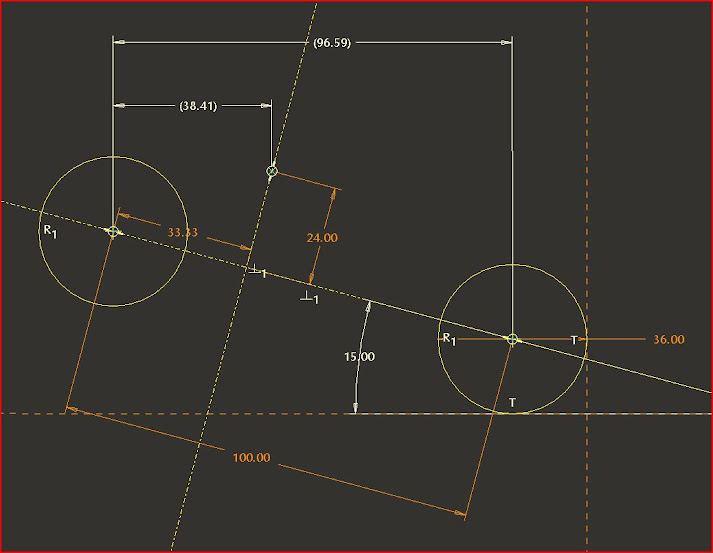
Here is a diagram of the vehicle on flat ground. 36" tires, and the wheelbase is 100 inches for simplicity, the Cg is 1/3 back from the front, and 2 ft up from the centerline of the tires just to have an example. The top white dimensions are the horizontal dimensions relative to the ground, the bottom orange dimensions are actual vehicle dimensions, on flat ground they are the same.

Hill+0.JPG


On a 15 degree incline, it starts to change...

Hill+15.JPG


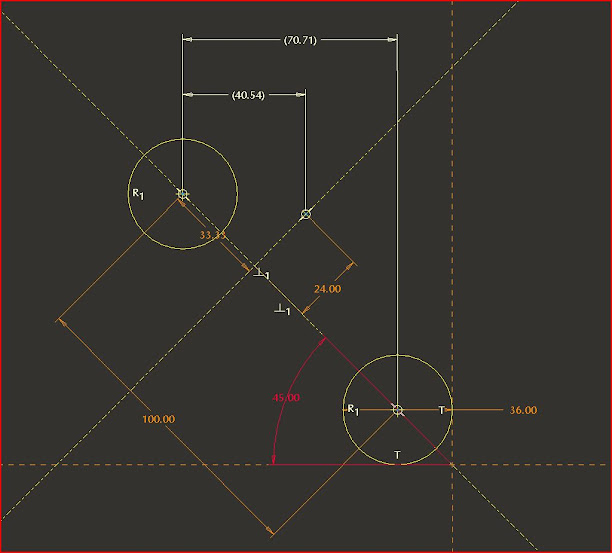
On a 45 degree incline it changes a LOT...(notice the effective horizontal wheelbase is now less than 71", and the Cg of the vehicle has moved so that it is 57% toward the rear, almost opposite of what it was on flat ground)

Hill+45.JPG


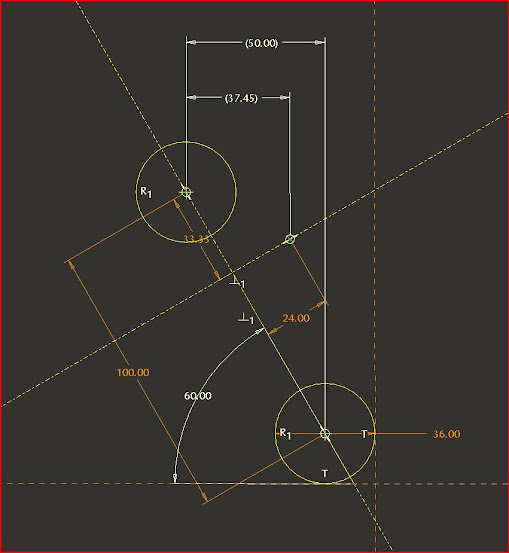
Lets get extreme and show a 60 degree incline. The Cg has moved to 75% toward the rear of the now 50% of original wheelbase.

Hill+60.JPG


Also, I was thinking about how you said that they typically climb better with more antisquat, (unless you get so much that the rearend walks under the vehicle and makes it unstable I am assuming). This may be because as you go up a steep hill, as the rearend squats it will basically act like the vehicle is climbing a steeper hill than it is. Because the Cg of the vehicle will shift even further back as the rear end squats even more up the hill, causing even less weight to be on the front tires, and even more weight to shift to the back as the front springs uncompress. So more antisquat would keep the back from dropping down, and transfering more of the weight to the rear. Is that what you are thinking?
 
Last edited:
Trans changes

Well, during the build I sold all my old frontend parts, springs, shocks, shackles, crossover, hubs, etc. Got some of my room back in the garage and a little of my money back :smile1:


So during my last wheeling trip(Bundy Hill with 76Zimmer) I was having troubles with 2nd gear. I thought for a while it was just shifting late, because it felt like it was still in 1st gear when you manually shifted to 2nd gear, and it wouldn’t leave 1st gear. 3rd gear worked fine. The trans was practically new and built like a brick sh!t house, so it didn’t even cross my mind that 2nd gear was actually busted, which turned out to be the case after further diagnoses a few days later, I thought it was just shifting late. Once I knew that it was broke, I realized it had to be either the sprag, or the intermediate clutch pack. I didn’t think it was the intermediate clutch pack because it was never slipping into 2nd, it just stopped working. Now, it could of busted the case lugs, but I still have the accumulator and a wave plate in the int, so that shouldn’t happen. Plus then I read that if that happens then you loose the pressure for 3rd gear too, so that couldn’t be it. So it was most likely the sprag. The 34 element sprag that was supposed to be good for 750 hp. I checked the fluid and it looked good, but there was a small amount of clutch material in there. I thought, that doesn’t look bad, but I would guess if I took out the sprag then I probably burned up the int band goofing around in manual 2nd the whole time. Hmmm…no time to fix it, was busy hunting and visiting family over the holidays anyway.

So in early February I removed the trans (always fun) and removed the direct drum, sure enough, the sprag turns both ways. Took it out, looks like this, not good, the sprag is stuck in the outer race and the dogbones are rolled whacky…


rolled+sprag.jpg


After some investigation I realized the drum OD was supposed to be 3.159 or larger. Mine measured 3.155 – 3.157. I bought this drum from a local trans shop during the build and assumed it was good since it looked machined all pretty and everything. So I called Jake at Jakes performance since I didn’t trust the other shop to get another one from them, and he confirmed that if it’s even .0002 under 3.159 it’s junk. So he sent me all new clutches and steels, and a new direct drum, 34 element sprag, HD int band and servo, etc. He really helped me make sure that this shouldn’t happen again. This drum measured 3.161, a lot more than .0005 bigger, more like .005.
So since I was removing the trans I thought, I have a 2005 Trailblazer now, so I don’t need to tow the boat with the truck anymore, and I want to eliminate the slower (still not slow) acceleration for the first moment you tromp on that big block. So while I had the trans out, I called Hughes and told them my info and purpose, and ended up having them send me a "tight" 10" 2800 stall converter.

10+vs+13.jpg


So I got the trans all together with new parts (parts are cheap compared to the time and labor to remove and fix the trans) and I was happy.
 
Last edited:
Trans temp addition

Since I was putting a stall converter in. I wanted to be able to monitor trans temp now. But I did not want to hack my dash all up to add a 7th gauge, as wasn’t really happy with a good place to put it. So after some research I determined the Autometer temp gauges use the same sending units for engine and trans temps. So I decided what I would do is add a second seconding unit to the trans pan, and a SPDT switch in the dash so I can flip which sending unit the gauge is reading, so my engine temp gauge can now be used to check trans temp.
Also, I haven’t been too happy with the short sweep temp gauge. Many times it will shoot way up in temp until the thermostat opens, sometimes up to 230. But the cooling fans won’t even be on yet (thermal switch in the other head at 185, and the temp gauge says the thermostat opens at 210, and I used two different thermostats, both 160 units!) I tried adding extra ground wires, and I always solder and shrink tube my connections, so it wasn’t my connections. It could be that the sending unit it is the head next to the header, but so is the thermal switch for the fans (in the other head). So I decided to upgrade that one gauge to a full sweep. Also because although all of the other short sweep gauges are pretty linear, oil pressure is in 25 psi increments(with a line halfway between each increment), volts are in 2 volt increments, fuel is in 1/4 tank increments, etc. But the water temperature ranges from 30 - 50 degree increments depending on where in the gauge you are at. The full sweep version is in 10 deg increments, with hash marks every 2 degrees, very easy to tell by a quick glance. Also, the full sweep has a built in warning light that you can program to come on at any temp you want. I like gauges AND warning lights for the critical things, because you can’t always pay attention to the gauges when you are on the throttle trying to steer.

The full sweep guage does have a 2 wire sender instead of a one wire, which is better because it it's own seperate 5V circuit independent of threaded ground, but what about switching? I called autometer and it’s still just a series resistance circuit, so you only have to switch one of the wires. Just make SURE you have solid connections because any added resistance will change the temp reading. I chose to switch the output wire to prevent 5 V from possibly shorting out if a wire ever got frayed.

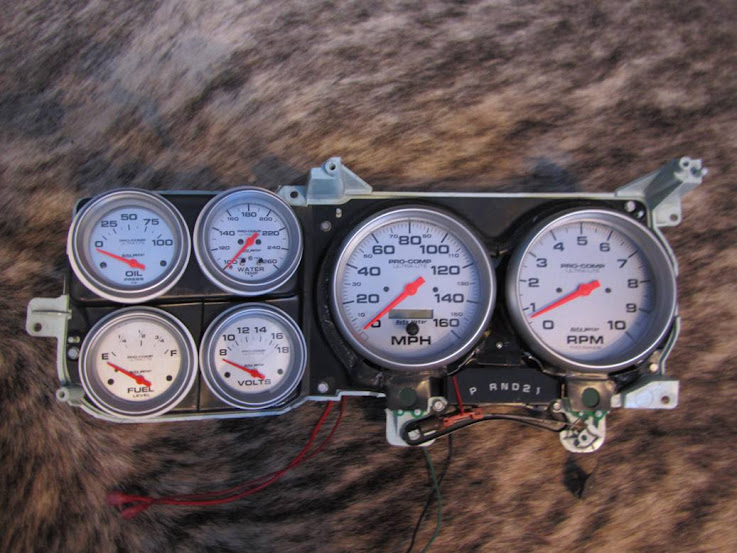
So I tore the dash apart to make the changes after running all the new wiring outside the cab for the sending units. Now you can also see how I fabbed and wired my gauge cluster back in ‘06.


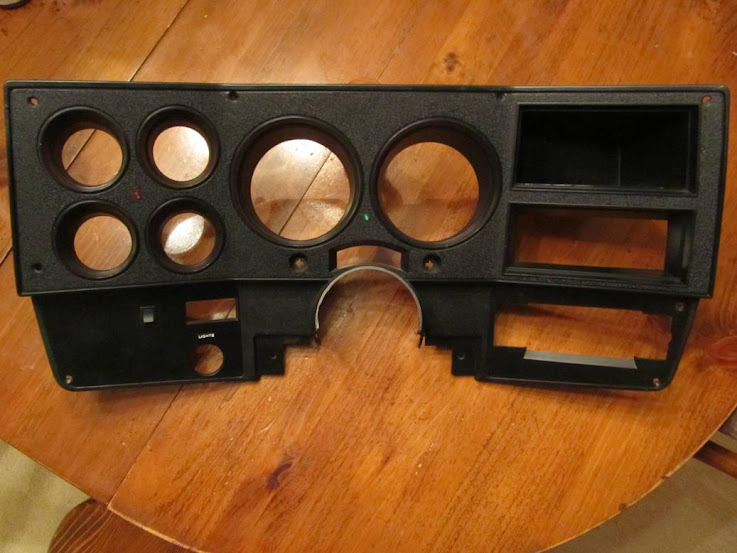
The cluster uses a METAL black trim ring around all the gauges that I drilled out to fit the gauges into. These only came in older trucks, sometime they switched to plastic, I don’t know when. I bought a parts cluster for $20 at a swap meet that had a metal ring. The smaller gauges use PVC to space them out. Because the bezel needed to have more removed from it to fit the smaller gauges, they needed to be spaced out to fit right behind the bezel. Also, I riveted the metal trim panel together between the large gauges, and bent the back down toward the bulb to reflect the light toward the gear indicator. The extra wires (red and green) are plugged into the two LEDs in the bezel, I’ll explain shortly.
cluster.jpg


cluster+top.jpg


The wiring I left a little extra on each wire in for easier connections because I hate trying to disconnect/connect tight wires, tried to keep it all neat and organized but it looks kind of messy really. You can see where I soldered the wires to the factory bulb sockets for the shift indicator bulb, and the turn signal indicators. I used a newer weatherproof multiconnector for the main harness, I just cut it out of a junk harness from a newer vehicle. Then I could solder all the wires in the truck to that, and when I need to remove the cluster, I just unscrew it, unplug it, and out it comes.

cluster+back.jpg


In addition to the metal ring, I used a little piece of angle aluminum from the hardware store to brace the larger two gauges. Excuse the blue zip ties, came in the large zip tie bundle kit and I try to use the stupid colored ones where no one can see them.


cluster+back+L.jpg


cluster+back+SM.jpg


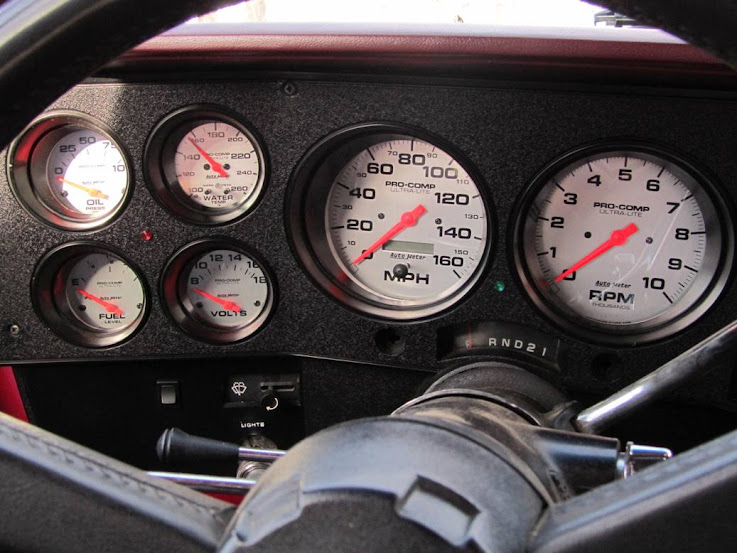
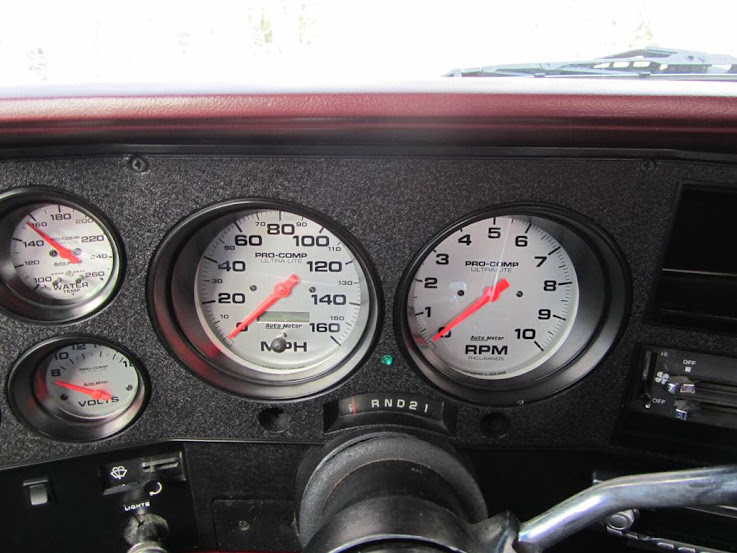
The bezel looks near factory from the front. It has two LEDs, and a switch added. The green LED is for the high beams, right between the tach and speedo. The red LED over between the small gauges has two functions. It is the brake light indicator, and also a low oil pressure warning light, it is a switched ground, so it was easy to make it work for both. The black switch is the new switch that flips the temp gauge between reading engine and trans temp.

bezel.jpg


On the back you can see where the modifications took place. For the large gauges to fit the bezel just had to have some webbing trimmed, and the gauge cups ground thinner on the outside edges. The clear plastic also has to be cut and glued to the shift indicator opening. The wires for the LEDs plug into the cluster wires before the bezel is screwed into place.

bezel+back.jpg


The small guage cups had to have some webbing removed, as well as both trim the depth more shallow, and thin the edges so the gauges would sit against the bezel. You can also see the SPDT switch for the temp gauge sending units.

bezel+back+SM.jpg


And here it is all assembled. I realized when taking the pictures, the closer you get to the gauges in the dash, the more the bezel blocks the edges, you can see them better from the driver’s seat, but I still wanted some close up shots, so here you go. Sorry about the lighting issue, didn’t want to move the truck out of the sun just to take the pics.

gauges.jpg


MPH+RPM.jpg


SM+gauges.jpg
 
Last edited:
Dam Heath, I had to replace the drum in mine too, as I went to the 34 element also, and in the Vette too. I got em from some internet site that was recommended. I need to get it measured I guess while I have it apart again for something I needed to do in there (I'll have to search my notes) Thanks for that tip.
 
Dam Heath, I had to replace the drum in mine too, as I went to the 34 element also, and in the Vette too. I got em from some internet site that was recommended. I need to get it measured I guess while I have it apart again for something I needed to do in there (I'll have to search my notes) Thanks for that tip.

At least you shouldn't have to pull the pan and valvebody just to pull the drum. I would do check it too, you can probably do it in 10 minutes while it's out, but once it's back in the working truck it's a PITA.
 
Also, I was thinking about how you said that they typically climb better with more antisquat, (unless you get so much that the rearend walks under the vehicle and makes it unstable I am assuming). This may be because as you go up a steep hill, as the rearend squats it will basically act like the vehicle is climbing a steeper hill than it is. Because the Cg of the vehicle will shift even further back as the rear end squats even more up the hill, causing even less weight to be on the front tires, and even more weight to shift to the back as the front springs uncompress. So more antisquat would keep the back from dropping down, and transfering more of the weight to the rear. Is that what you are thinking?

You know dude when I talk suspensions with alot of guys I have to pare it down to the basics I realize now you know what you are talking about.

Yes weight transfer if you are a little high on the AS numbers will be less dramatic towards the rear of the truck instead of the truck squatting a bit.

When I said push the front end of the truck down I was talking about weight transfer. So no added weight to the front really just the weight transfer is going to be kept in check somewhat.

One other thing I have observed is that if you hit a razorback and your back end is squatting down some it will really launch the nose of the truck up in the air. If your truck is closer to level it will help keep the front end down, although a big block will help too. But what I am talking about is the initial launch when you the front kicks up. You don't want it to kick up too violently and I have seen rigs with lower AS numbers kick it up pretty good. Alot of guys with coils in the front and leafs in the rear have a problem with this because the truck will tend to be lower in the back while climbing and on the throttle.

Now realize one thing too the dunes we run out here are steep, really steep. Not as long as some but definitely steep so it has more of an effect out here because of the angle that the truck is at climbing.

I know guys get really hung up on one or two aspects of what the suspension does and you know it has to be done as a system.

How does your front act now? Dive under braking, fairly neutral, alot of what you do in the rear should be done to compliment the front. Get the front and rear suspensions to work together not against each other.
 
If you ever plan to come out west here, you should bring the truck out here, you could stay at my place and I will take you out to our dunes I think you would like them, they are alot different than other dunes I have run
 
you talking St Anthony?
hmm right after BB11 in Moab?
what you say Heath?
 
You know dude when I talk suspensions with alot of guys I have to pare it down to the basics I realize now you know what you are talking about.

Yes weight transfer if you are a little high on the AS numbers will be less dramatic towards the rear of the truck instead of the truck squatting a bit.

When I said push the front end of the truck down I was talking about weight transfer. So no added weight to the front really just the weight transfer is going to be kept in check somewhat.

One other thing I have observed is that if you hit a razorback and your back end is squatting down some it will really launch the nose of the truck up in the air. If your truck is closer to level it will help keep the front end down, although a big block will help too. But what I am talking about is the initial launch when you the front kicks up. You don't want it to kick up too violently and I have seen rigs with lower AS numbers kick it up pretty good. Alot of guys with coils in the front and leafs in the rear have a problem with this because the truck will tend to be lower in the back while climbing and on the throttle.

Now realize one thing too the dunes we run out here are steep, really steep. Not as long as some but definitely steep so it has more of an effect out here because of the angle that the truck is at climbing.

I know guys get really hung up on one or two aspects of what the suspension does and you know it has to be done as a system.

How does your front act now? Dive under braking, fairly neutral, alot of what you do in the rear should be done to compliment the front. Get the front and rear suspensions to work together not against each other.

....

If you ever plan to come out west here, you should bring the truck out here, you could stay at my place and I will take you out to our dunes I think you would like them, they are alot different than other dunes I have run

Thanks for the generous offer Eric, I don't have any plans to go out there right now, but I would like to get out there someday and I will keep that in mind.

I'll keep all this in mind when I start running the numbers. I would have to do some more testing, but I haven't noticed any dive under braking, it doesn't raise up but it doesn't dive either really, stays pretty level. Although the fact that I didn't notice a difference with arm connected says the dual rate springs stops might be offsetting it too, because if it was the antitive you'd think I would notice it wanting to keep one side up when I disconnected the upper left arm. I'll have to do some more testing and pay more attention to that too. That's definitely one of the downfalls of the radius arms, the IC is stuck right where you mount the arms to the frame. I never really though about the nose up thing either with the AS numbers. Good info, although I don't see myself launching off huge dunes at high speeds though! The more info I can gather the better I can setup my rear suspension and the happier I should be with it.
 
Thanks for the generous offer Eric, I don't have any plans to go out there right now, but I would like to get out there someday and I will keep that in mind.

I'll keep all this in mind when I start running the numbers. I would have to do some more testing, but I haven't noticed any dive under braking, it doesn't raise up but it doesn't dive either really, stays pretty level. Although the fact that I didn't notice a difference with arm connected says the dual rate springs stops might be offsetting it too, because if it was the antitive you'd think I would notice it wanting to keep one side up when I disconnected the upper left arm. I'll have to do some more testing and pay more attention to that too. That's definitely one of the downfalls of the radius arms, the IC is stuck right where you mount the arms to the frame. I never really though about the nose up thing either with the AS numbers. Good info, although I don't see myself launching off huge dunes at high speeds though! The more info I can gather the better I can setup my rear suspension and the happier I should be with it.

One of the advantages of a radius arm though is it is a fairly neutral system, doesn't really have any adjustment to it but its easy to do and very reliable. A great system for a multipurpose truck like yours. Well executed on your part too.

As you know when your suspension is built as an entire system instead of two separate pieces. Alot of guys don't consider their front suspension or vice versa when designing their rear. Build both with each other in mind and it will work lots better.

Come on man coil overs and air bumps launching over huge dunes is the next logical step :D

I am rather enjoying this thread though. I fully intend to do something very similar to my Jimmy. Links front and rear but still full bodied and capable of putting some serious highway miles down with any problem whatsoever.

I had never really considered the radius arm setup until now (its not my favorite). I just may now. I will certainly be picking your brain on its driving characteristics when I get a little closer to starting on it.
 
Awesome build, and great info. Thanks for taking the time to post. Do you have any pics of the truck as it sits now with tires and wheels on (as opposed to just suspension shots)? I'd like to get an idea of the stance it has just sitting level now that you have redone everything on the suspension.
 
That is a really nice motor. I wonder what the fuel mileage is on something like that. Can you still go to the lake? lol
 
One of the advantages of a radius arm though is it is a fairly neutral system, doesn't really have any adjustment to it but its easy to do and very reliable. A great system for a multipurpose truck like yours. Well executed on your part too.
...
Come on man coil overs and air bumps launching over huge dunes is the next logical step :D

...
I had never really considered the radius arm setup until now (its not my favorite). I just may now. I will certainly be picking your brain on its driving characteristics when I get a little closer to starting on it.

Thank you, there are reasons I picked the radius arm design of all my options. :waytogo: When you are ready to link your Jimmy let me know, I can try to let you know my impressions of the way mine works. So far I like it, and would do the same thing over again, but I don't have a lot of wheel time on it yet. Although I have to admit, it was much more involved than I thought, because everything wants to collide with everything else in the front with the travel/steering/articulation combined. Which isn't really that much easier than a 3 or 4 link on the axle end. The main thing that was easier is the where the upper arms connect to the lower arms rather than the frame. So I wouldn't call it "easy", but it wasn't rocket science either obviously. I would call it simple but timeconsuming, and worth it.

And I agree, coilovers and air bumps are good for jumping, but my 60/40 weight distributrion isn't, I would probably want to move the engine back for that. And if I was going to jump it, I would also want a cage and trussed axles, and throw in some bypasses or something, which isn't going to happen. So I'll just keep it small. I probably won't put air bumps in the back, I have more room back there, and there isn't as much weight either.
 
Awesome build, and great info. Thanks for taking the time to post. Do you have any pics of the truck as it sits now with tires and wheels on (as opposed to just suspension shots)? I'd like to get an idea of the stance it has just sitting level now that you have redone everything on the suspension.

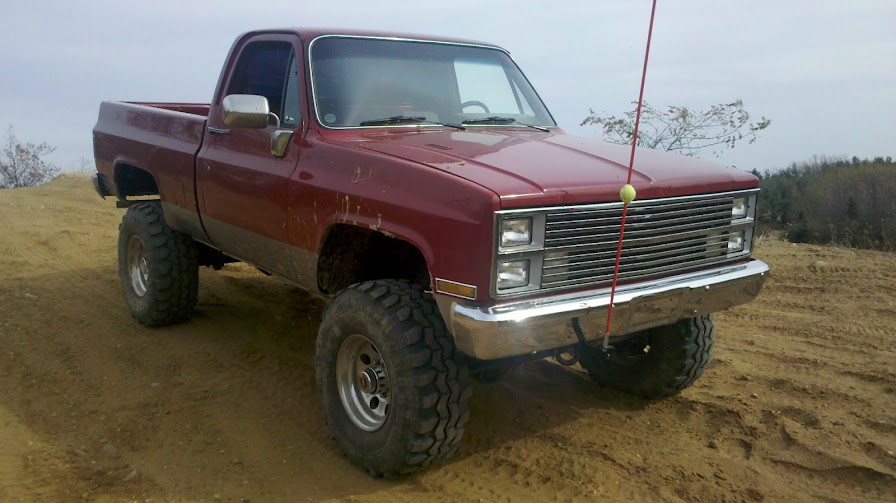
That's a good question. I realized the other day that I took all of those pictures and never took one of the whole truck! :doah: So I looked through my folders and the only one I found of the whole truck after the front coilovers is this that my wife took at Bundy...
truck.jpg
 
Last edited:
That is a really nice motor. I wonder what the fuel mileage is on something like that. Can you still go to the lake? lol

I think if you are looking for fuel mileage numbers you are on the wrong site...:wink1:

Just kidding, definitely stick around, but I probably get about as bad of fuel mileage as most of us on here driving super swampers with no overdrive, and a carb. When I swapped the small block for the big block, I went from 10 MPG highway down to 9 MPG highway. (it only get's worse from there). Not bad to get over a 60% increase in power and only a 10% decrease in mileage. But you have to remember, it still takes the same amount of energy to push a brick wall down the road, as the wind resistance and rolling resistance are the majority of your mileage. The increased pumping and friction losses of the larger engine are minor compared to the lifted vehicles we drive with big heavy soft tires.

I only drive this when I want to drive it for fun, and to and from the wheelin' spots. Gas mileage is not really my concern for toys. I drive a bone stock 6 cylinder to work every day.
 
I think if you are looking for fuel mileage numbers you are on the wrong site...:wink1:

Just kidding, definitely stick around, but I probably get about as bad of fuel mileage as most of us on here driving super swampers with no overdrive, and a carb. When I swapped the small block for the big block, I went from 10 MPG highway down to 9 MPG highway. (it only get's worse from there). Not bad to get over a 60% increase in power and only a 10% decrease in mileage. But you have to remember, it still takes the same amount of energy to push a brick wall down the road, as the wind resistance and rolling resistance are the majority of your mileage. The increased pumping and friction losses of the larger engine are minor compared to the lifted vehicles we drive with big heavy soft tires.

I only drive this when I want to drive it for fun, and to and from the wheelin' spots. Gas mileage is not really my concern for toys. I drive a bone stock 6 cylinder to work every day.

It seems everytime someone asks about my truck they ask that question. What kinda mileage that thing get. I always answer with about a day per tank. Then again my rig never travels on the road, unless its up to the beach on a nice summer day. I should put a working fuel gauge and speedo in it.
 
Top Bottom