CK5
Register an account today to become a member! Once signed in, you'll be able to participate on this site by adding your own topics and posts, as well as connect with other members.

'89 K5 The Bulldozer

1989 K5, linked, caged, backhalfed, LS3, Hero case, on 42's
Doing good. IAC counts are looking pretty good. I'm going to run the IAC position here higher than the normal recommended value as I'm at such a high altitude. I couldn't find any data to determine if that's a good idea or not, but logically it seems to be the correct move (I.E. standard value to shoot for is 60 to 80, and I'm running at warm idle of 94). If anybody has a 01-02 Fbody and can log the IAC position at an altitude over 5000' that would help prove this theory. Then when the truck goes lower than 8500' I'll be closer to the stock values.

Closed the throttle blade a bit on the 102mm TB.

Got the idle trims pretty well. Had a good start this morning at 15 degrees. That gave me some good data. About to bring the LTIT back online. One or two more logs should bring my 40 degree trims a bit lower.

Truck is idling good so far. Time to play with the follower and cracker. I'd like to get this much better. The truck doesn't move that fast at idle with the foot off the brake, but if I can get it even slower then when in double low range it will be nicer.

313790-d23fbb58591e370ddae3138c574d325c.jpg
 
Went for a long drive and got some good logs. Data looks nice and the truck feels really good. I feel confident with the idle now.

I've been meaning to play with my power enrichment tables. So that's next on the docket. Seems I have some time with this whole coronavirus thing.
 
Man, you got bucketloads of tenacity. Great work for sure. If I wasn't planning on taking my 5.3 out for the 8.1 I have I should have you look at the data on mine to dial it in better. As it stands it's pretty close as is and not worth fooling with since it's coming out.
 
Man, you got bucketloads of tenacity. Great work for sure. If I wasn't planning on taking my 5.3 out for the 8.1 I have I should have you look at the data on mine to dial it in better. As it stands it's pretty close as is and not worth fooling with since it's coming out.

Thanks man. I did some more work yesterday and found some nice power. Realistically its one of those things you could just keep playing with forever, until your tables and graphs are as smooth as sails. I also wanted to learn to tune when I started this build, and I don't want to forget what I've learned! Its fun.

The VCM Scanner from HPtuners is pretty amazing as far as diagnostics and what it can do.
 
Thanks man. I did some more work yesterday and found some nice power. Realistically its one of those things you could just keep playing with forever, until your tables and graphs are as smooth as sails. I also wanted to learn to tune when I started this build, and I don't want to forget what I've learned! Its fun.

The VCM Scanner from HPtuners is pretty amazing as far as diagnostics and what it can do.
SO after you dumped the IAC and it sorted the LTIT, did your rich condition and timing drop also clear? Does the HP platform give you BSFC or pounds/rate consumed?
Either way, great news on the progress

I'd be curious if the original IAC doesn't have a resistor in it to prevent you from tuning it yourself, so that way you pay them for the support...
 
SO after you dumped the IAC and it sorted the LTIT, did your rich condition and timing drop also clear? Does the HP platform give you BSFC or pounds/rate consumed?
Either way, great news on the progress

I'd be curious if the original IAC doesn't have a resistor in it to prevent you from tuning it yourself, so that way you pay them for the support...

Its a long response but your question is answered near the end. Figure this might help people get their heads around it.

Its tough to say, but I really think the IAC repeatability was not very good. So when the ecm commanded a position it would flow a different amount of air. You're last statement though is always possible, and brings about some thoughts I had. Why on earth the numbers for that specific component were filled in the way they were on the original pcm is just really weird. The program in the ECM with the engine/harness/throttle body package was a bone stock camaro tune, except for the IAC. It was started before it was sent to me for oil prime and to check harness function. I really can't say, and realistically it probably was a fluke, but a very weird one. Or possibly done to keep the engine rpm very low on the stand, or because of the iac?


There's a few things to keep in mind based on what I started with. That was a Gen IV engine on a custom Operating System Gen III ecm (manual Fbody segmented with an Express van). So I've got nothing to start with, no factory available engine airflow model I can work with (As the GenIV stuff does most things all differently). A great example would be commanded air fuel ratio (Lambda) vs Engine Coolant Temperature(ECT). On the Gen III it is exactly that (Lambda vs ECT), on the Gen IV it is Lambda vs Intake Valve Temperature. So you can't take much of the stuff from a standard GMPP tune (although I will reference it if possible, and if the variables are now known I can convert sometimes).

So when I first started tuning it I'm building the airflow model based on fuel trims and wideband O2 sensor for the MAF and for the Volumetric Efficiency(VE) tables. This is how Ed (ERM performance) taught me and I feel comfortable using fuel trims as it gives you a buffer, especially starting with a 5.7l program on a 6.2l engine were this will be dangerously lean everywhere!
First things first was getting the scanner setup. You have to add all your PIDs you need, then create histograms and user math to log this stuff. A good example is the VE tuning. I need to log LTFT in an RPM vs MAP pressure table. I want it to fill in values that are static and not transient (So i create functions to only store data after a certain amount of counts and within a certain range). This eliminates data being stored when passing through a cell but say off the throttle (where you would have the map and rpm but fueling would be off).

First thing I did was tune the MAF. So you turn on and off systems in the ecm to tune certain components. I don't want the VE table doing anything when tuning the MAF.

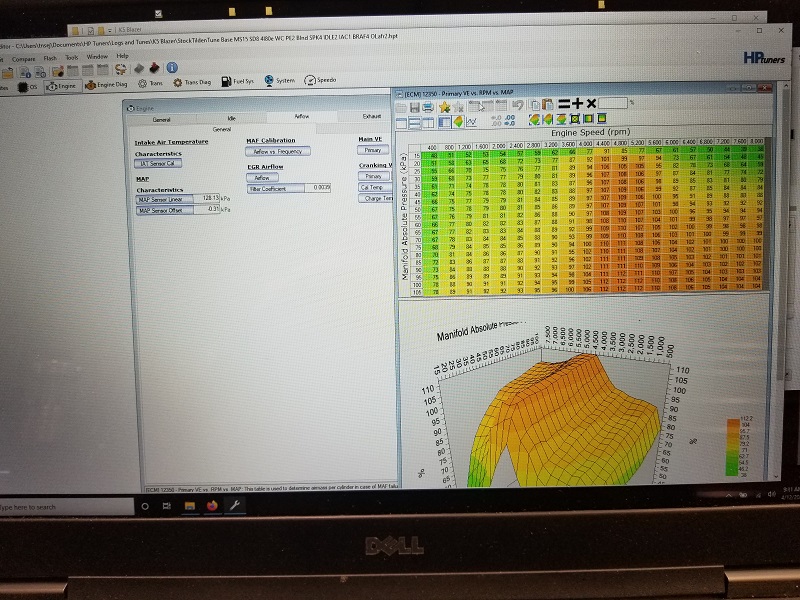
Then I started making my VE table (turn off the MAF). Here's my VE table.
full


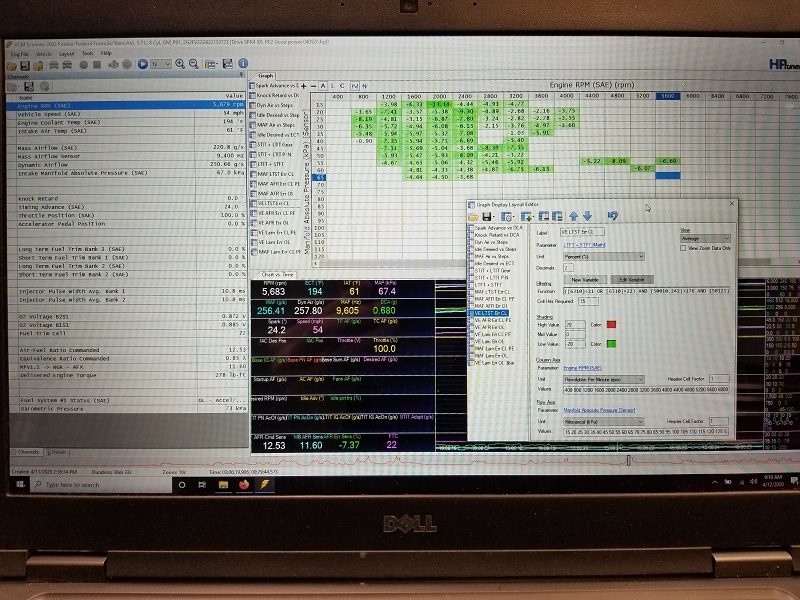
Here's a quick driving data logging to see how that table looks with fuel trims. A normal log that I would actually work off to adjust the table would be a long drive. I drive on specific roads etc to try and hit each cell in a steady state condition. Its really kind of a bitch. The below is a log that would not be a good example to tune from as my hit counts are all over the place and I wasn't trying to drive steady state. But it shows the theory of how to get this stuff in line.

You can also see on the left next to the histogram (with the green fuel trim cells) all of my other histograms. You can add, subtract and change these. The window that is open shows you my functions and how I setup the histograms. You can change al of that to whatever you want.

full


So I said all of that to show how I build the airflow model for the engine. Theoretically STIT and LTIT idle trims should fall in line with your airflow model during warm operation. So that's a check point. Same with adaptive idle timing adjustment. If things are good it will not be swinging much with a stock cam.

On a Gen III cable throttle body vehicle the ecm uses Steps vs Effective Area (mm^2) to adjust its airflow requirements. Fueling is all based off airflow in this ecm with the exception of power enrichment and a few other systems. What we don't know is how much air the IAC passage flows on the Tilden Throttle body. Its a total unknown. So first things first is to figure that out by adjusting the IAC vs Effective Area table. To do that I had to get the engine to oeprating temp, disable the adaptive idle spark, and disable the LTIT trims and adjust it until the Desired idle airflow was close to the VE tables.

You can see in this data log my Dynamic airflow model is flowing 7.45 G/Sec and my adaptive idle is calling for 6.77g/sec. This data log is not a true tuning log as you can see I have the adaptive timing still on in this photo. These numbers when it was way off were way off! Like adaptive idle airflow at 26 g/sec down to 3 g/sec as the calcs were out to lunch because of the step count. But the engine can still deal with it via timing and fueling. I tune in grams/sec but you can change all of that to whatever you want

So similar to the VE histogram you can see my STIT+LTIT P-N showing the data vs ECT at the timing advance I want in Park-Neutral. You can also see in the photo below the Base Sum AF. That is the idle airflow model math with any adders or subtractors (Fans, Air Conditioning, etc....). So its calling for 7.4 g/s, the dynamic air models are 7.45 g/sec and the desired airflow based on timing is at 6.77 g/sec at this ECT so it will pull a bit of fuel. I like safe trims, especially at the elevation I'm at.
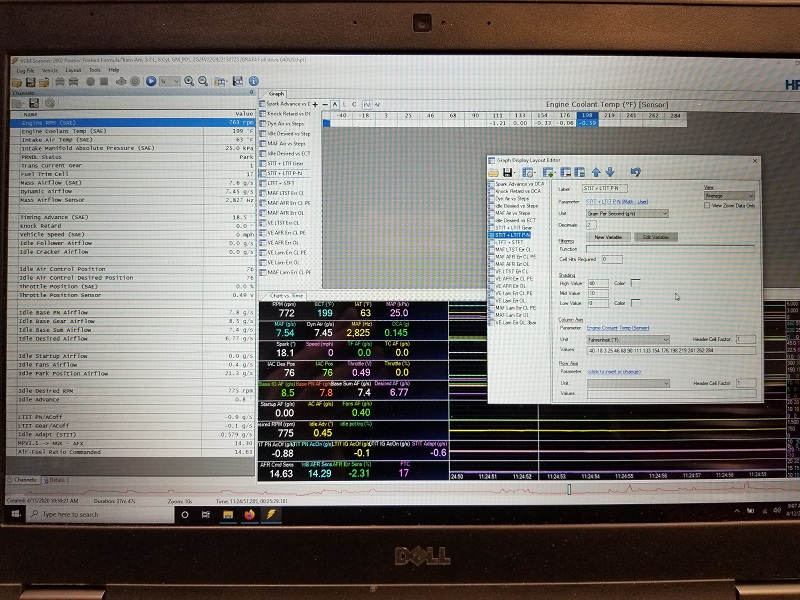
full


Now that I've got all of that out of the way. When I changed the IAC I got consistent trims at specific airflow (Even though they were way off, they were off consistently! I think the IAC was not returning to position consistently with the new, and much larger, step count). That meant I could get the airflow model correct, which brought my fuel trims in line, which then allowed the adaptive idle timing advance to not have to work so much. Before it was flowing more air through the throttle blade, and not much through the iac, but it was enough for the engine to rev higher than commanded, so the computer would close the IAC and not much would change, so then it had to pull timing to try and bring the rpm down. Its fueling is based off the IAC airflow numbers +/- adders or subtractors and base and ECT.

Once all that stuff above was done it brought all the air, fuel, and timing in line. Which now gives the adaptive idle good control over the engine.

How does this help my crawling. Well at idle, off-idle etc its super smooth. One of my major wants was to make the park to gear change as smooth as possible. Everything is amplified in double low, so making this smooth makes the truck operate very smooth for idle to off-idle transition.


Man, it feels like a just wrote an essay. Probably get an F on it... lol
 
Last edited:
Nope, you get a B+
:D

It makes sense about the airflow through the blades instead of the IAC. Unfortunately none of the rest of us were able to help you before you figured it out
 
Nope, you get a B+
:D

It makes sense about the airflow through the blades instead of the IAC. Unfortunately none of the rest of us were able to help you before you figured it out

I'll take a B+ anyday :rotfl:

Its all about learning. That's what I love about it. Trying to figure it all out. I'll say this, its crazy how much a factory ecm can deal with before driveability issues would be noticed by a driver.
 
I'll take a B+ anyday :rotfl:

Its all about learning. That's what I love about it. Trying to figure it all out. I'll say this, its crazy how much a factory ecm can deal with before driveability issues would be noticed by a driver.
From what little I've learned about Gen III/IV platform, it's pretty well thought out. There's a reason factory FI is reliable
 
Bringing this back up from the depths. About to do some fun stuff and would welcome anyone's input. Its shock valving time again. With any luck I'm hoping to make it to blazer bash this year!

I've changed out the front valving a few times now, and I'm going to be changing out the rears and fronts to try and get it better.

Things I want: I want the front to pop more and stay up. I also believe I need the front comp a bit stiffer on quick single rollers, like found here on the trails. The rear rebound feels really slow, and possibly the front. The front gets pulled in. I don't want to lose climbing ability, and I think the change may help that, atleast in the rear.

With that said I'm still trying to wrap my head fully around how they both work together (front and rear). So I'm making a drastic change. I just ran with the slider stop in the front lowered to 1" above at ride height. 2" in the rear. It muted the front alot in the rocks, and personally I don't like that. But it added quickness of handling in the rally area, or so it felt like.

Currently:
Front is full 15 on comp and full 10 on rebound. 6.5" uptravel. 1.75" preload.
Rear is 15 with a flutter on comp and 12 on rebound. 8" uptravel and 1" preload.

Bleed:
Front: 3 ports open No screws
Rear: 3 ports open No screws

Tomorrow I'm going to start with changing just rebound to this:
Front
Rebound
1.750 0.008
1.600 0.010
1.450 0.008
1.300 0.008
1.150 0.008
1.000 0.008

Rear
Rebound
1.750 0.008
1.600 0.008
1.450 0.008
1.300 0.008
1.150 0.008
1.000 0.008


So we'll try the rebound changes and see what it feels like and go from there. Hoping to get some potato camera video.
 
Last edited:
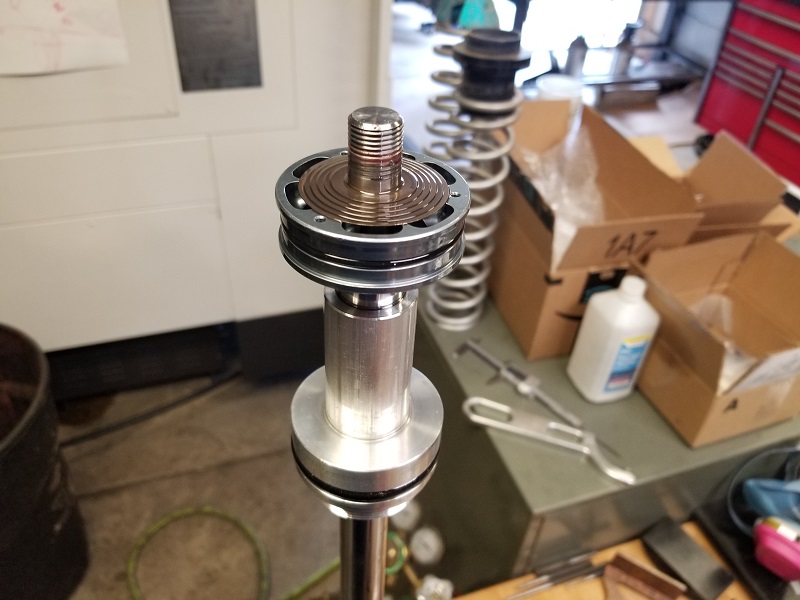
Rears going back together right now. The rears are also assembled exactly as they should be. Same when I opened the fronts originally. And the same as my last set of kings. I'd always heard reports of pistons upside down, or shims wrong etc... I've never had that happen.

Doing this also makes me wish I had a lift. Soon :)
 
Went out for a little bit yesterday. Truck felt pretty good. Better than I expected and I believe I did not go to far at all with the rebound. have a decent idea where I want to go with the valving. My thoughts are I still need to up the compression in the front, and possibly drop the rear. I want to get this is in the rocks and see how it feels.

Did not get alot of video opportunities. It was really busy out here. Quads and razors everywhere. I couldn't get up to speed alot of times, just too much traffic.

 
Eibach springs.
Front: 200/250
Rear:175/200

Unsprung corner weight loaded up. Front: 958 Rear: 825
Ok, thanks. I have 200/350 in my front right now.
Have no idea what im going to need when I do the rear haha. I need to figure out my corner weights
 
Ok, thanks. I have 200/350 in my front right now.
Have no idea what im going to need when I do the rear haha. I need to figure out my corner weights


You can figure out your unsprung weight via calculating from your existing coil springs on the truck. The rear will be different though.
Measure each spring length as its sitting on the truck and use this ((s1+s2)-(Z1+Z2))*Rate
S1- spring 1 free lgnth
S2-spring 2 free length
Z1-spring 1 compressed length
Z2-spring 2 compressed length
Rate: total Spring rate. (s1*s2)/(s1+s2)

My truck is not really a good match for a regular k5, as my truck is tube backhalfed with .040 aluminum skins and shortened 12". My front is pretty light too, its all tube, and an aluminum motor and rad. Skinned hood, no core support etc..

Personally, what I would do is get it built, and use one of your existing springs to get the unsprung weight. Then you'll know and can calculate it to figure your rates to buy based on the preload you want.
 
Last edited:
Top Bottom