CK5
Register an account today to become a member! Once signed in, you'll be able to participate on this site by adding your own topics and posts, as well as connect with other members.

'89 R3500 Crew Cab 2wd to 4wd conversion & beyond

Started out with 2wd TBI350 with SM465 to current 4wd with 454, 700r4, NP241
Makes me wonder why the 2wd's are deeper then the 4wd. I would think you would want more with the 4wd adding more stress.
 
I think it's because all of the IFS stuff hanging off the frame. There is actually a second piece of frame inside of it. Most all of the IFS bolts through the frame in that area.

20130309_111444.jpg
 
Yes that is correct, I have those pieces some place, I thought for a second about keeping them for a brace of some sorts.
 
I was going to toss them but then I decided why not and kept them in. I plan on bolting my shock towers in so I thought it would help a little.
 
Success!

I finally got the front brake lines taken care of. Boy that flare nut wrench is working well.

As I mentioned the second side was the tough one. I was able to "repair" the flare nut enough with a file (as suggested) and got the flare nut wrench on it. Of course then the brake line hose rounded off when I applied the deep socket and impact to it. I was trying to get it to loosen up with vise grips but didn't seem to have much effect. I decided to see if maybe I could get the flare nut itself to move, but there wasn't much room with the other lines in the way.

20130415_174423.jpg


As I was trying to get the wrench on in a position where I could get a turn on it, I realized it was already loose. Apparently all the previous monkeying around worked. I was able to get it off entirely by hand at that point.

So now both extended brake lines are connected.

20130416_181341.jpg


It seems like the brake lines come out a little further forward than they do on a 4wd frame; I suppose because of all the IFS stuff normally there. I'll have to make sure this doesn't mess up my suspension droop distance.

Here's what the brake line/hose looked like after I trimmed it down for the deep socket.

20130416_181251.jpg


Here you can see the remnants of the hose and the nut that was holding it in the frame from the backside.

20130416_181302.jpg


Now I need to do the rear brakeline, but I'm feeling much more encouraged with the success I've had with the flare nut wrenches. Hmm, I'm feeling like I've become a flare nut wrench salesman.... :deal: :D
 
Got the rear driveshaft in today. Cut the 1350 yoke off and welded on a new 1410 yoke.

20130417_112811-1.jpg


20130417_113709-1.jpg


20130417_125226.jpg


Not sure if the angle is quite where I want it.

20130418_174245.jpg


However, I'm not going to do anything with it at this point. There are too many mods coming up that will change things around. If I made it work today, it will be wrong again in the future.

My plan is to move the carrier bearing for the 2 piece driveshaft. I'm going to move it towards the rear axle so the shaft going down to the axle is the same length as I had it in the K5. The rear axle in the K5 was moved back 4" and where the shaft was at I didn't have trouble with it getting hit. Where the rear shaft is now, I'm afraid it will be too easily hit. It's also a 3.5" diameter shaft and I'd like to drop back to the 3" shaft like the K5 had.

Despite having added 8" of lift to the rear, there is plenty of slip on the rear axle. Here's what's available:

20130418_131516.jpg


It's technically not going to matter in the long run, but I thought it would at least be useful info for someone else.
 
Just an FYI on the slip joint, the 4wd one is 6-3/4" of spline. Mine is now sitting with 3-1/4" of spline showing. Not sure how much it actually moves though.
 
The rears dont need much in the form of slip. Since the pumpkin is centered on the tube, and very rarely does the axle equally droop/compress, it doesnt need a large amount of slip in it. Plus, most people run overloads, so that limits the rear even less. On top of that, the rear is always the stiffer spring as its always designed in a truck to carry weight. And to my non calibrated eyeball, it looks like the pinion is pointed to far up.
 
My rear drive shaft has stock splines despite having 63's in the back. When I measured it, it had basically no drop.
 
Finally got my birthday present setup to use. :D

20130419_173436.jpg


And I did something for some weekend motivation to get the truck rolling again,

20130419_180936.jpg


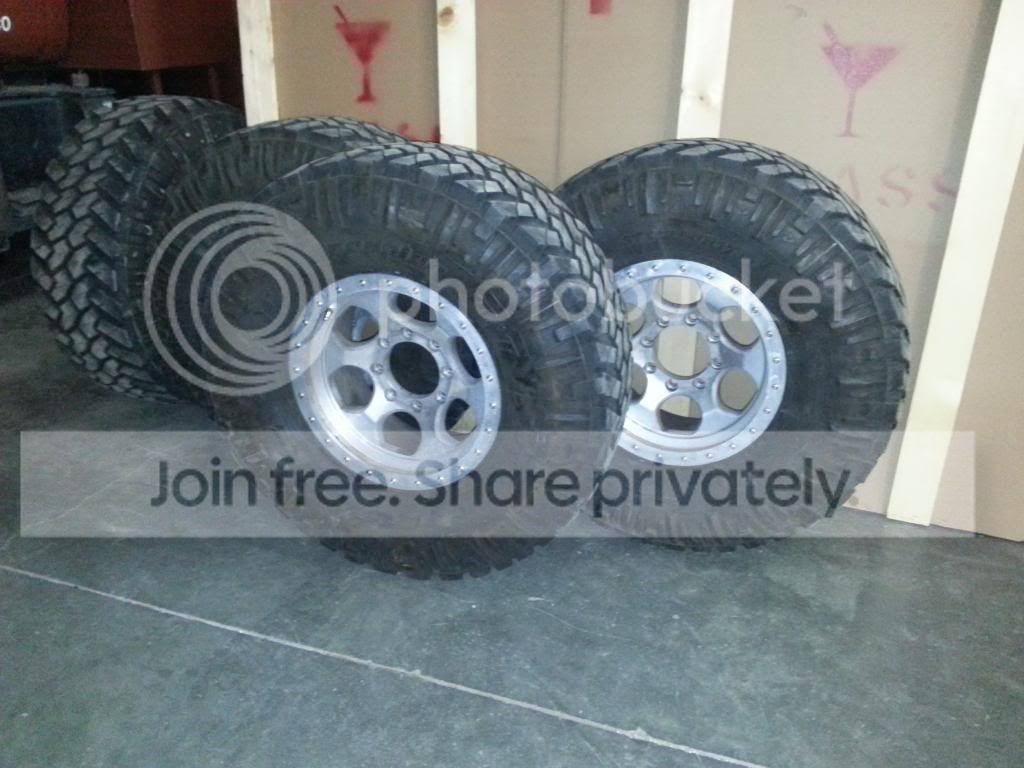
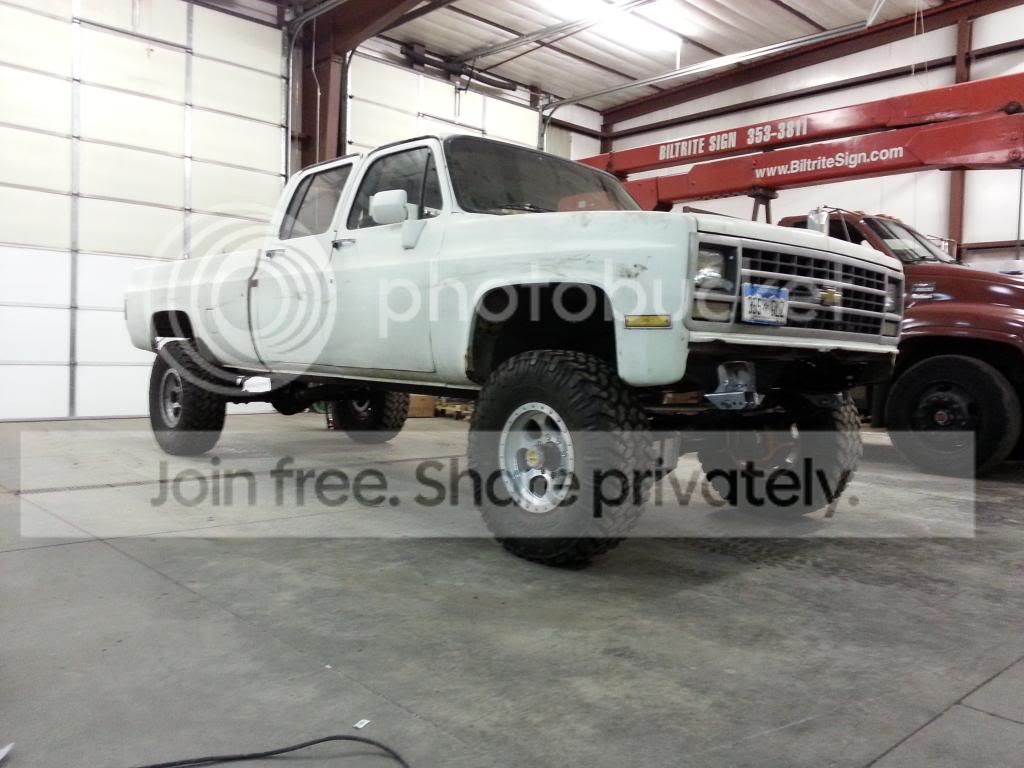
Tires are mounted! :pimp:
 
Thanks guys.

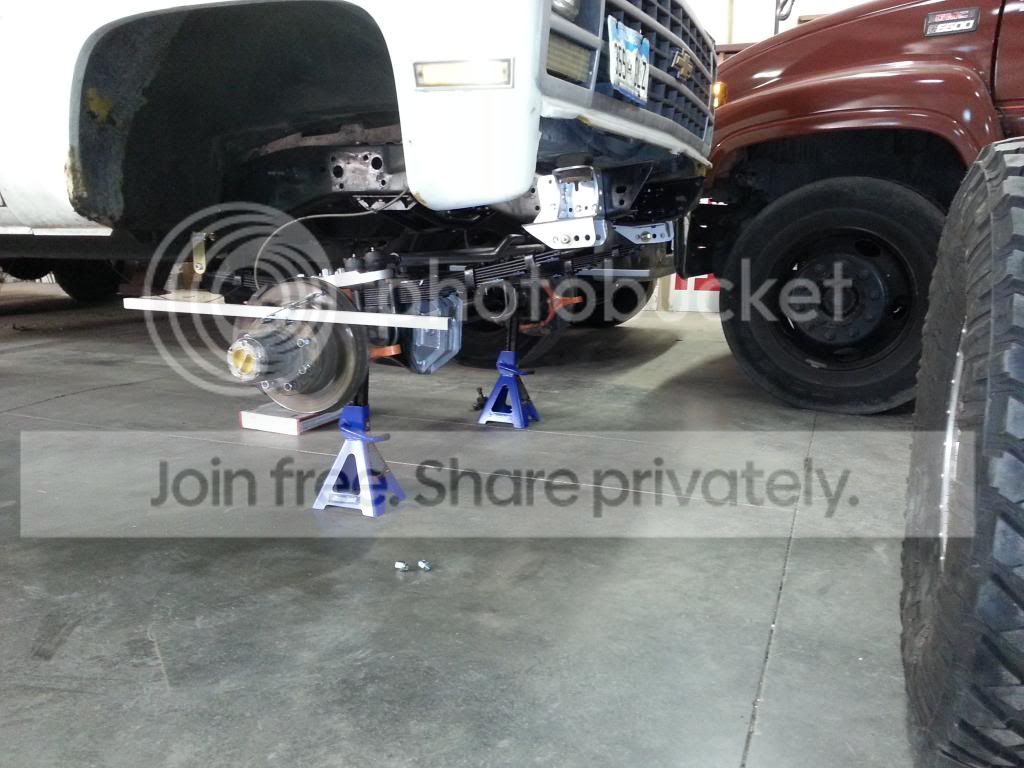
In order to get to that point I had to torque down the steering linkage. I set up the toe-in using a 1" square tube clamped to the wheel mounting surface. The tube is cut to the diameter of the tires. I leveled them and measured the distance between each end.

20130420_132227.jpg


Specs call for 1/8"-3/16" IIRC. I know the 3/16" is correct, it's the lower number I'm not as certain about.

I think the ideal way to set this is with the truck on the tires, but I wanted to set it as close as I could to begin with. I will verify with the tires mounted when I have a chance. Here's a procedure to do that:
  1. Put a piece of tape in about the middle of the tread on the front of the tire. Measure up off the ground to the center of the hub and that will tell you how high up to place the tape on the tread.
  2. Put a vertical line on the tape. Do the same for the other side. You don't have to have the tape perfectly center on the tire; I'll explain later.
  3. Now measure between the 2 marks on the pieces of tape.
  4. Roll the truck forwards or backward so the tape is now on the back of the tire the same distance above the ground.
  5. Measure between the pieces again.
  6. Subtract the 2 measurements. In all of the trucks I'm familiar with the distance at the back of the tire should be greater.
  7. I would recommend doing this at least twice to begin with before making any adjustments to make sure you have a good baseline.
  8. Repeat as necessary to get the correct toe-in.

I mentioned that the 2 pieces of tape don't need to be perfectly centered on the tire. This is because we are more concerned about having a consistent point to measure from. As long as your tape doesn't move, you'll get the measurements you need to get the difference between the front of the tire and the rear of the tire. It's that difference that's important.

The reason the above method is preferable to what I did is because rolling the truck with the weight on the tires is going to put "load" or tension on the tie-rod ends. If you think about it as you roll the truck, it's putting some outward or inward pressure on the tie rod ends.

It will be interesting to see what the toe-in measures with the tires on the ground. I'll report back and let you guys know what I find out. I'm guessing that with new tie-rod ends, the change should be less than it would be with older, more worn tie-rod ends.
 
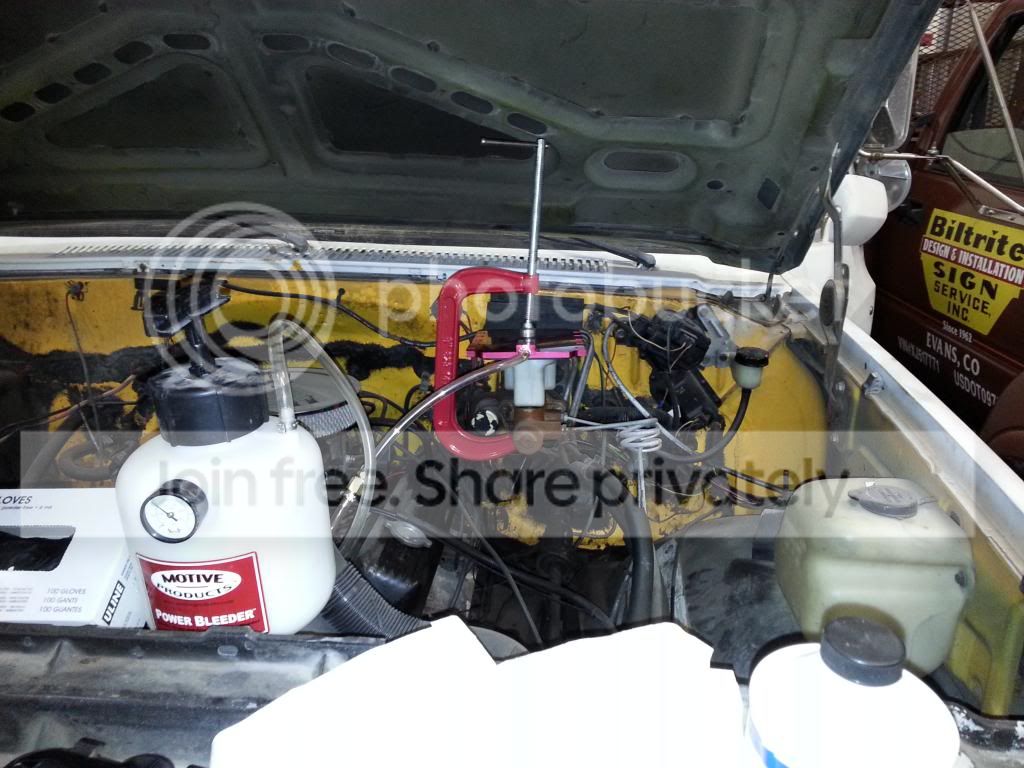
The other thing I had to do was bleed the brakes. A lot of times I'm doing this work by myself. Even if the wife is around, she won't help because she has helped me bleed brakes before and she doesn't like it at all. It's too boring and monotonous. So a while back I purchased a Motive Power Bleeder. It works really nice for solo brake bleeding.

20130420_201209.jpg


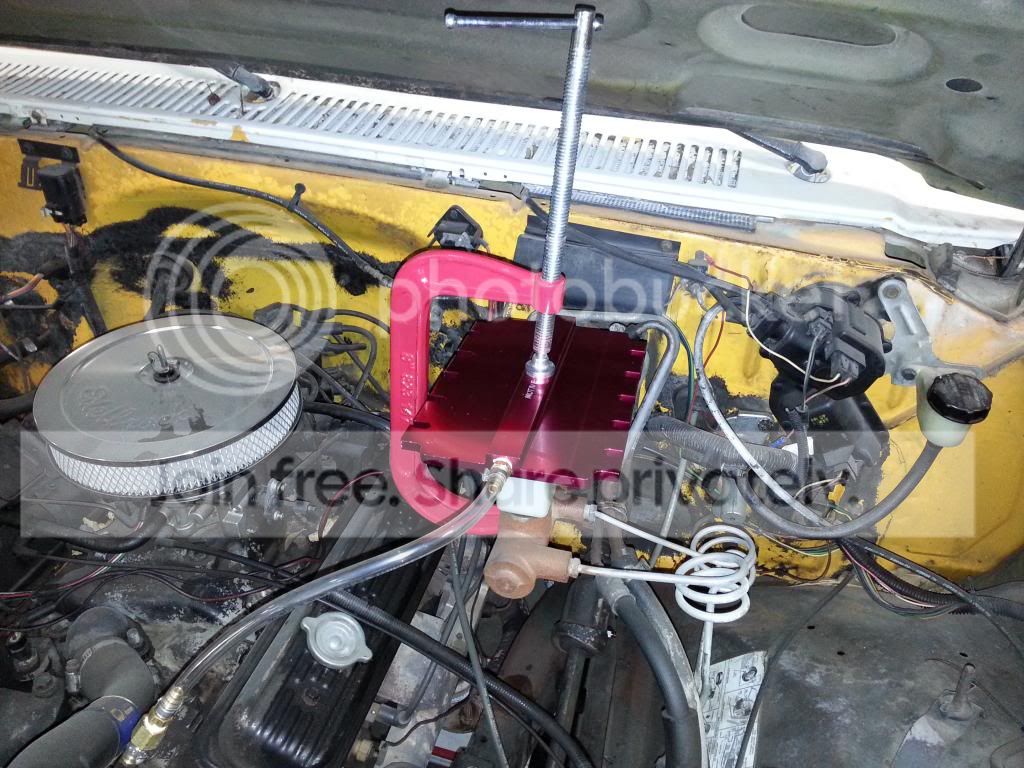
The new vehicles have simpler adapters for the reservoir cap because most of them are simple screw on type caps. In order to work on the older rectangle reservoirs, they use a big plate that will fit several sizes. It comes with some hooks and chains to tighten around the reservoir but that's a pain to install and uninstall every time you need to top off the reservoir. I just used a simple c-clamp which is something they actually recommend on the Motive website FAQ section.

20130420_201232.jpg


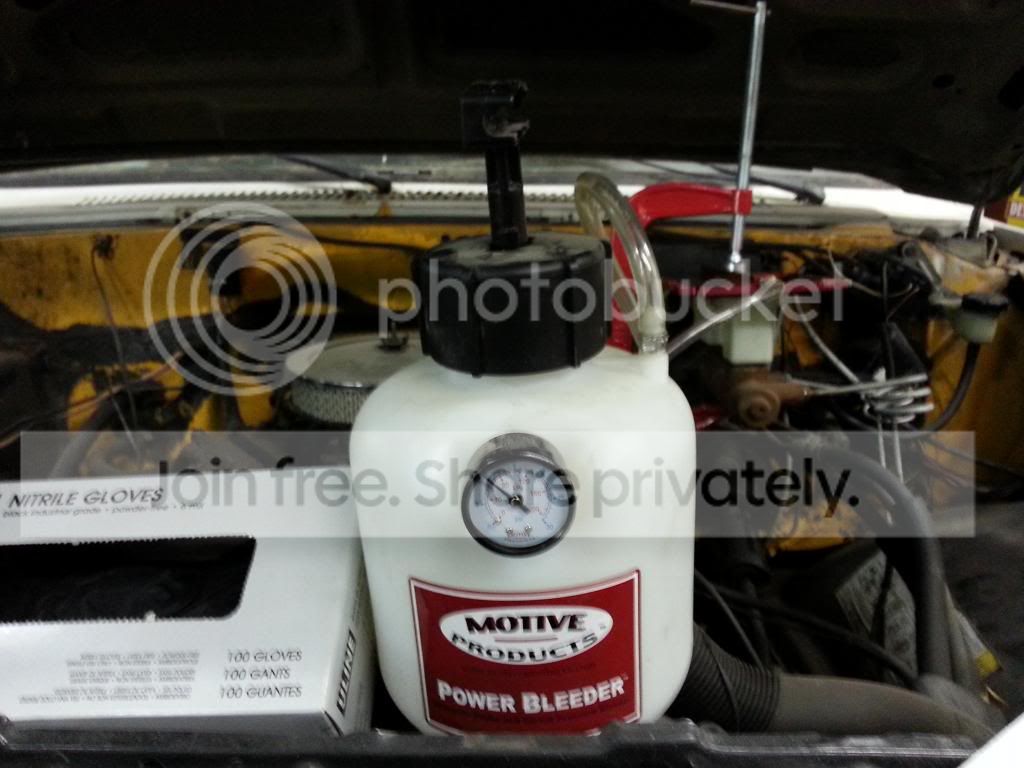
The full procedure tells you to add fluid to the Motive bottle so that as the reservoir level drops the level will be replenished from the bottle. I don't do it that way because then you need to flush all of the brake fluid out before storing the Power Bleeder. I'm lazy, so I use a dry method. Basically I just use the Power Bleeder to put 10psi pressure on the reservoir.

20130420_201251.jpg


This will reveal some leaks right off the bat, which happened to me. Once the leaks are taken care of, just put a tube on the bleeder screw and crack it to let fluid flow until there are no bubbles. I usually repeat this twice all the way around the vehicle. Start at the bleeder furthest from the reservoir and work you way to the closest. Keep an eye on the fluid level, something that is very easy with the new reservoirs.

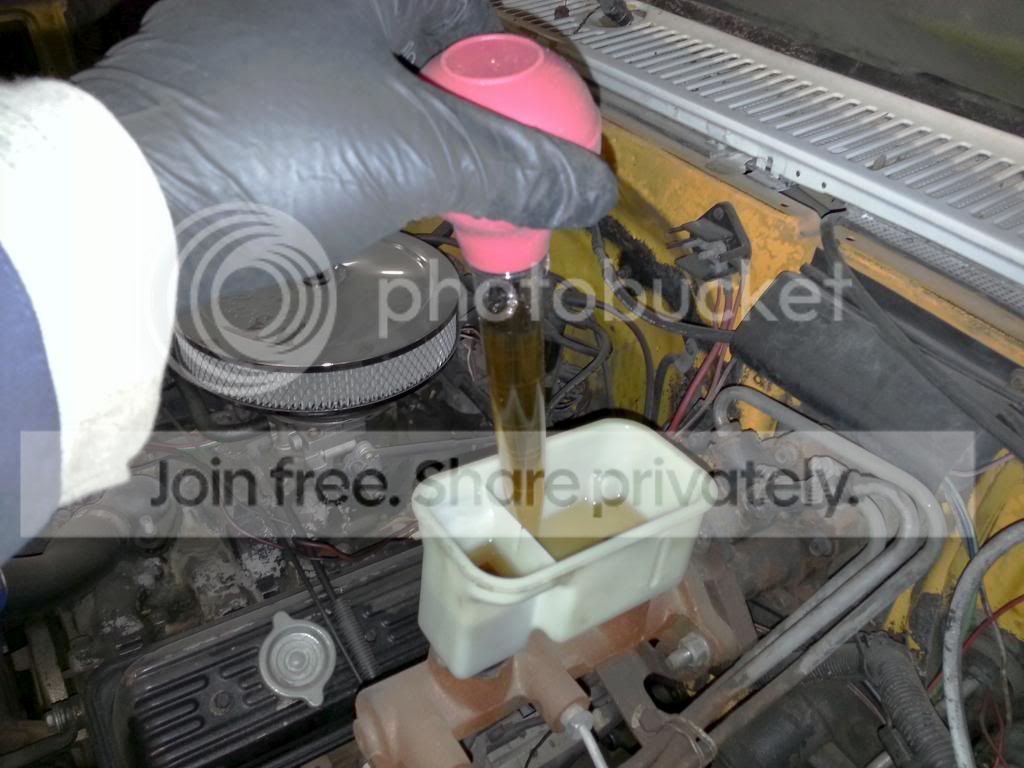
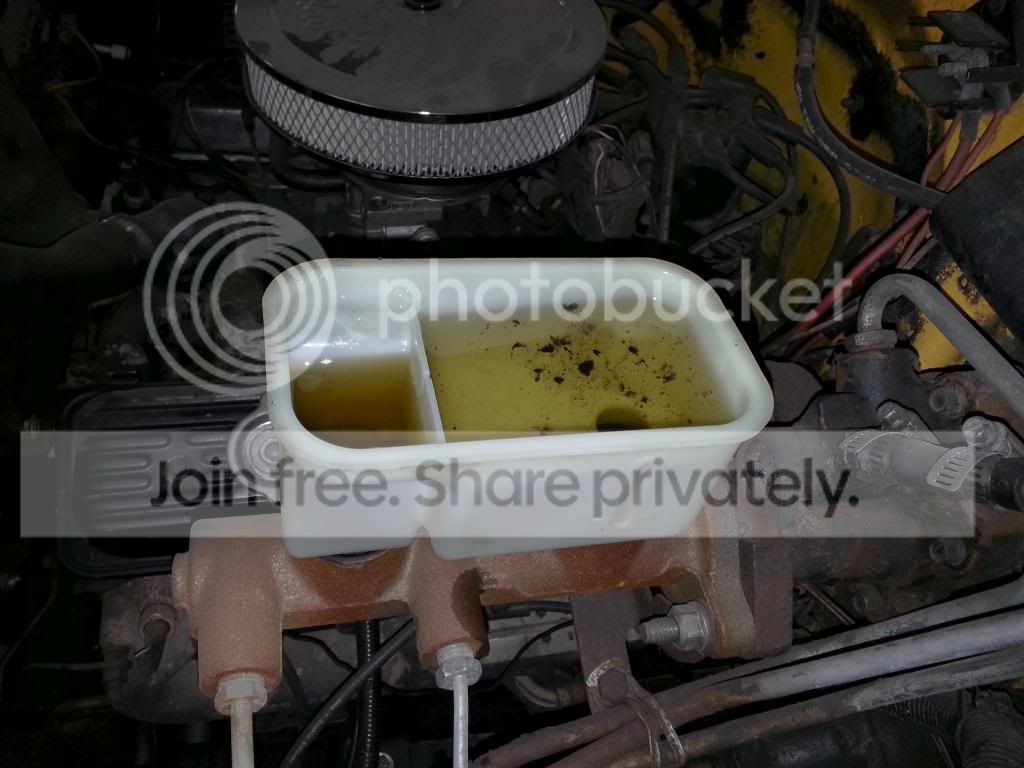
A couple of things to do before bleeding the brakes if you would like to flush the brake system as much as possible. Pull the calipers and push the pistons all the way in to push out the fluid that's essentially trapped in the caliper. The ideal way to do this would be through the bleeder so that fluid is pushed out of the system entirely. Also pull the cap off the reservoir and use a baster to suck the old fluid out of it.

20130420_175530.jpg


I made sure to suck out all of the black stuff you can see here.

20130420_181113.jpg


I'm pretty sure that's water contamination as brake fluid likes to absorb moisture. I had to refill the reservoir and suck it back out a couple of times to get the junk out. I should have taken an after picture because the fluid in there now is a much lighter color than the stuff that was sucked out.

I have one bleeder that needs to be replaced. The little passage inside it must be plugged because fluid would only flow out around the screw not through it.

I'm also worried one of my lines is still leaking. I'm going to have to keep an eye on it.
 
You can usually clean out a plugged bleeder screw with a twist drill.

Martin
 

Latest Posts

Top Bottom