CK5
Register an account today to become a member! Once signed in, you'll be able to participate on this site by adding your own topics and posts, as well as connect with other members.

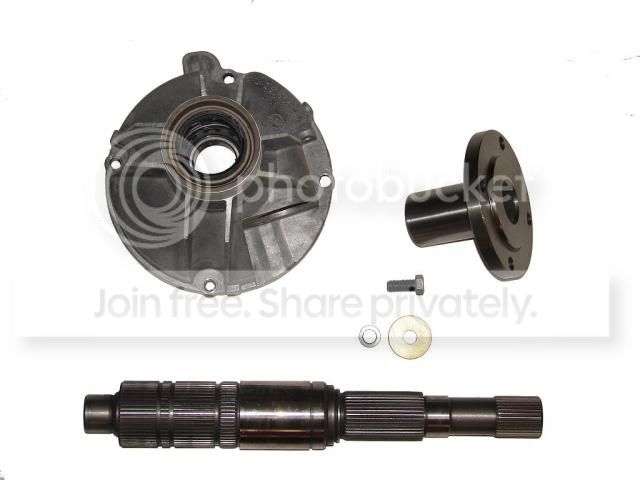
detailed SYE tech writeup on the 208

Wow!!!

I think this is the best write-up I've seen in a long time. You did an excellent job explaining the process and the photos helped a great deal. A very sincere Thank You!

I do have a few questions:

I have upgraded from a 208 to a 241 transfer case and would like to do this modification. I know GM started using the 241 in 1989 and Dodge started using the 241 in 1988.

Assuming I get a Dodge 241 T-case, do you know if this modification will work? And what (if anything) would be different?

In terms of re-orienting the cone and drilling and tapping the rear case casting, is there anything that would prevent one from TIG welding a boss and having that extra metal to drill and tap?

Thanks again.
 
I have been shopping for a rear CV driveshaft, slip yoke style.

One company I spoke with said that a 1350 CV joint has significantly more weight than the stock u-joint and that causes problems with the rear output shaft bearing.

My first impression is that since the Dodge output shaft is shorter than the GM, that in itself would cause less of a force on the rear bearing. Also, the slip yoke style positions that heavy CV joint that much further away from the bearing.

I would think (I'm not an engineer) that both of these factors would help significantly in reducing the extra forces from the 1350 style CV joint as opposed to a stock u-joint.
 
Wow!!!

:

I have upgraded from a 208 to a 241 transfer case and would like to do this modification. I know GM started using the 241 in 1989 and Dodge started using the 241 in 1988.

Assuming I get a Dodge 241 T-case, do you know if this modification will work? And what (if anything) would be different?

In terms of re-orienting the cone and drilling and tapping the rear case casting, is there anything that would prevent one from TIG welding a boss and having that extra metal to drill and tap?

Thanks again.
You can just get a SYE kit from JB conversions for the 241......Thats what I did.
 
Yes, the slip yoke will always be looser than a good fixed yoke, plus shortening your transfer case takes some angle out of the C/V joint.

You can also get a fixed yoke conversion for the 208 from Tom Woods: http://www.4xshaft.com/SYE/208TransferCaseGMDesign-32Spline.html.

P6_SYE208Cleaned1.jpg


Everybody says it's expensive at $570, but when you're up and running, it's cheaper than the JB conversions 241 kit. When you figure $400 for that HAD shaft you would buy, $100 for a good 241 case (if you can find it) and $340 for the JB Conversions kit you're at $840. Then you may also need the speedometer output housing and maybe pay to upgrade to a flange.
 
Everybody says it's expensive at $570, but when you're up and running, it's cheaper than the JB conversions 241 kit. When you figure $400 for that HAD shaft you would buy, $100 for a good 241 case (if you can find it) and $340 for the JB Conversions kit you're at $840. Then you may also need the speedometer output housing and maybe pay to upgrade to a flange.
I think I was into mine $500 with a new driveline.
 
Guys,

Thanks for the posts and the information. Tom Woods makes a SYE for the 208, but apparently not for the 241.

From looking at the JB Conversions website, their SYE is set up for an electronic speedometer, not a gear driven one.

Part of the attractiveness of the OP's writeup is cost. One can buy a used 208 or 241 T-case for $100-$150 bucks, and thats for the whole thing. Purchasing just the output shaft, yoke, and extension housing with pump would be less, and less is good.

Here's another question: With the transfer case output shaft shortened by six inches or so is it necessary to go with a CV joint, or due to the reduced angle is a conventional U-joint sufficient?

I'm still wondering if anyone has modified a Chevy NP 241 T-case with Dodge NP 241 parts to eliminate the slip yoke?
 
Guys,

Part of the attractiveness of the OP's writeup is cost. One can buy a used 208 or 241 T-case for $100-$150 bucks, and thats for the whole thing. Purchasing just the output shaft, yoke, and extension housing with pump would be less, and less is good.

Here's another question: With the transfer case output shaft shortened by six inches or so is it necessary to go with a CV joint, or due to the reduced angle is a conventional U-joint sufficient?

I'm still wondering if anyone has modified a Chevy NP 241 T-case with Dodge NP 241 parts to eliminate the slip yoke?

Yes, cost is the whole point of this method. I used the whole back half from a Dodge case and had about $150 into the conversion, including buying a Dodge 208 and having the welding done. This is because I eventually had a rear driveshaft built to mate with a standard front output flange. Otherwise, a 1350 yoke or CV flange is another $100 or so. The flange and new driveshaft can potentially cost more than the case conversion. I temporarily ran some junkyard parts for a yoke and driveshaft, costing about $50.

Whether or not you need a C/V joint is up to you. A standard C/V does not operate at a larger angle than a single joint. It is used to get rid of the vibration. My driveline was smoother with fixed yoke than slip, but I still had about 13 degrees in the U-joints. Swapping in a C/V shaft was night and day better. Remember that with a C/V shaft you point the pinion up towards the T-case, raising the rear of the shaft and taking even more angle out of the C/V.
 
I think I was into mine $500 with a new driveline.

Which is $70 less than the kit and a C/V conversion is generally more than that. So it seems to me that the better of the two depends on which T-case you are starting with.
 
Major Hyjack:

What about these guys. They make hack n' tap flanges to SYE a 208 for $185 and complete 241 SYE kits with rear driveshaft starting at $599. Anybody use them or have good/bad things to say about them?
 
Blue,

I've been trying to do some Internet research on this and I read somewhere that the case halves are not interchangable between Dodge and GM.

What did you have to do to use a Dodge rear half? I assume you also used the Dodge output shaft and "cone".

Thanks,
 
Major Hyjack:

What about these guys. They make hack n' tap flanges to SYE a 208 for $185 and complete 241 SYE kits with rear driveshaft starting at $599. Anybody use them or have good/bad things to say about them?

www.drivelinesolutions.com

www.arizonadrivelines.com

www.gloeco.com

www.driveshaftsuperstore.com


search and read and read about their customers opinions, alot of az guys have used them, some here from the board. Quick run down, friend of mine named brians grandfather started the business, built it up, made some innovative new stuff or tools.

present day, brians step dad named oscar runs the place and has flat out lied, killed the name and run off alot of customers with his actions. Ive never had a problem with my drivlines that I had previously had but many people have had a very bad taste in their mouth after dealing with them.


I think a driveline and t-case is very important piece to have reliable, I would not trust that piece of mind on someone who cant keep their word or back up their product or service.

call up high angle driveline, jb conversions, dicks, or anyone else who can give you what you need.
 
That is the kind of feedback I was looking for. I'll look elsewhere when the time comes. :waytogo:
 
A standard C/V does not operate at a larger angle than a single joint. It is used to get rid of the vibration.

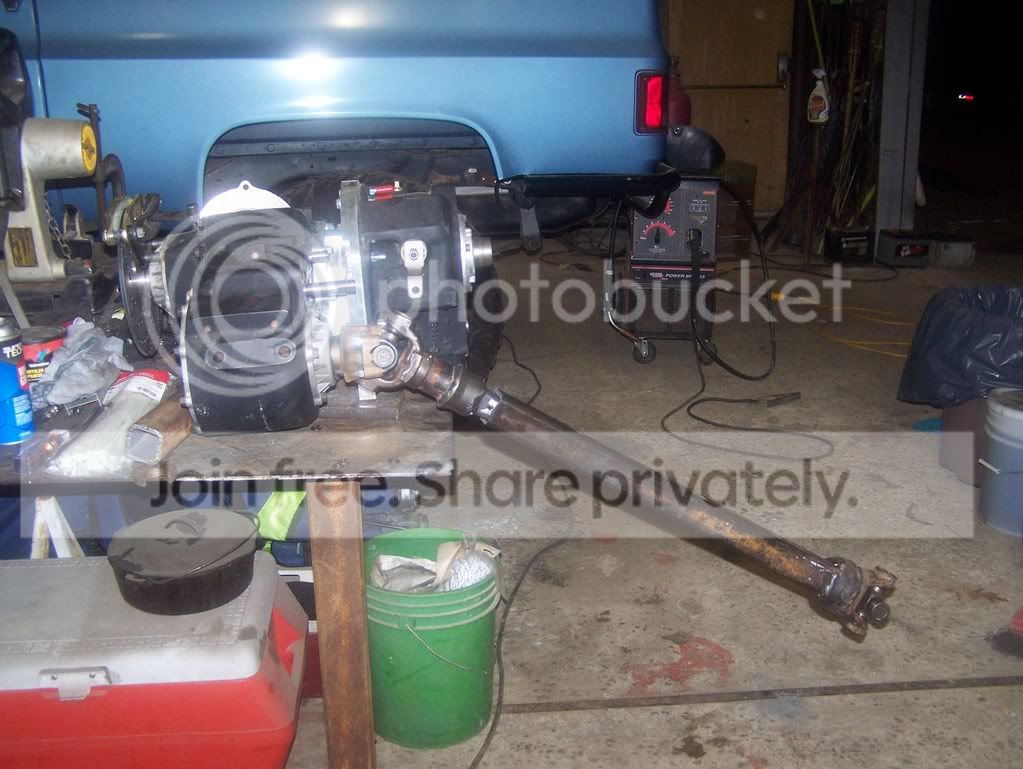
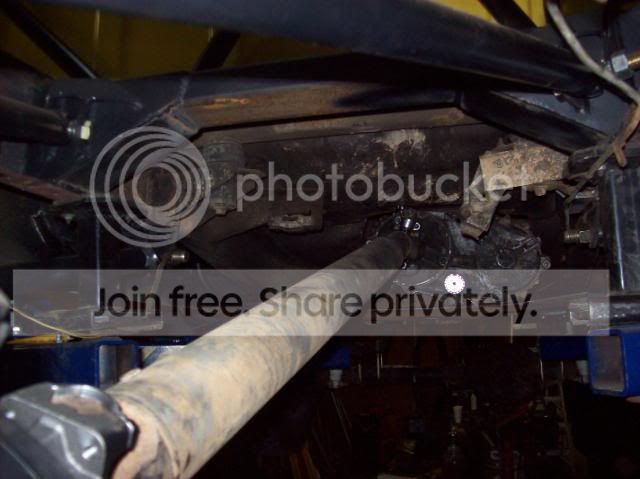
biggest missconception ever!you know how many people i talk to or see post say they need cv's to get more angle!i got into a heated argument with a buddy of mine trying to explain this and he just didnt see it...i run weld yokes on BOTH shafts...my front is square...here is a pic

100_3439.jpg


here is my rear shaft...if anyone is wondering early 90s dodge 1 tons have 1410 rear as well as 2 1/2 tons
016-1.jpg
 
Blue,

I've been trying to do some Internet research on this and I read somewhere that the case halves are not interchangable between Dodge and GM.

What did you have to do to use a Dodge rear half? I assume you also used the Dodge output shaft and "cone".

Thanks,

The case halves bolt right together. The only incompatibility is with the location of the shift rails inside. It's best if you just read my thread: http://coloradok5.com/forums/showthread.php?t=100934&
 
Blue,

Thanks for the link.

I read your original post thoroughly about three times, got a good feel for what I would be doing... and then realized your write up (nicely done by the way) was again for a NP 208 transfer case.

I have a 241 transfer case and would like to modify the 241.

I think I'll try and get a Dodge 241 rear case half, mainshaft, and "cone" and then see what makes the most sense in terms of welding/machining to get the Dodge cone and shaft in the GM NP 241.

Here's some general driveshaft questions:

To reduce or eliminate vibration, I would prefer a CV joint.

I realize that a 1350 CV is a bunch stronger than a 1310, but while some of you guys really pound on your rigs off road and need all the strength you can get, mine doesn't (and won't) but rather some mild off-road use.

What would be wrong with taking the front flange from a NP 208 (or 241) transfer case and installing it in the rear of a modified NP 241. At that point one could get a front driveshaft (with a 1310 CV) lengthened and use it in the rear?

Supersize,

Thanks for the warning, and the links to problems. I had called them about a driveshaft and bookmarked one of their sites. Thanks to you, I'll go elsewhere.
 

Latest Posts

Top Bottom