
CK5
Register an account today to become a member! Once signed in, you'll be able to participate on this site by adding your own topics and posts, as well as connect with other members.

Garage Floor - CONCRETE R&R... Need Advice.

Greg72

@MIGHTASWELLK5
Staff member
Super Moderator
Joined
Mar 5, 2001
Posts
17,071
Reaction score
5,716
Location
Austin, TX
So.... I finally am going to fix the sagging concrete apron at the front of the garage. Charlie and I rented a 90LB jackhammer and had more "fun" in one-day than I've had in a while!!
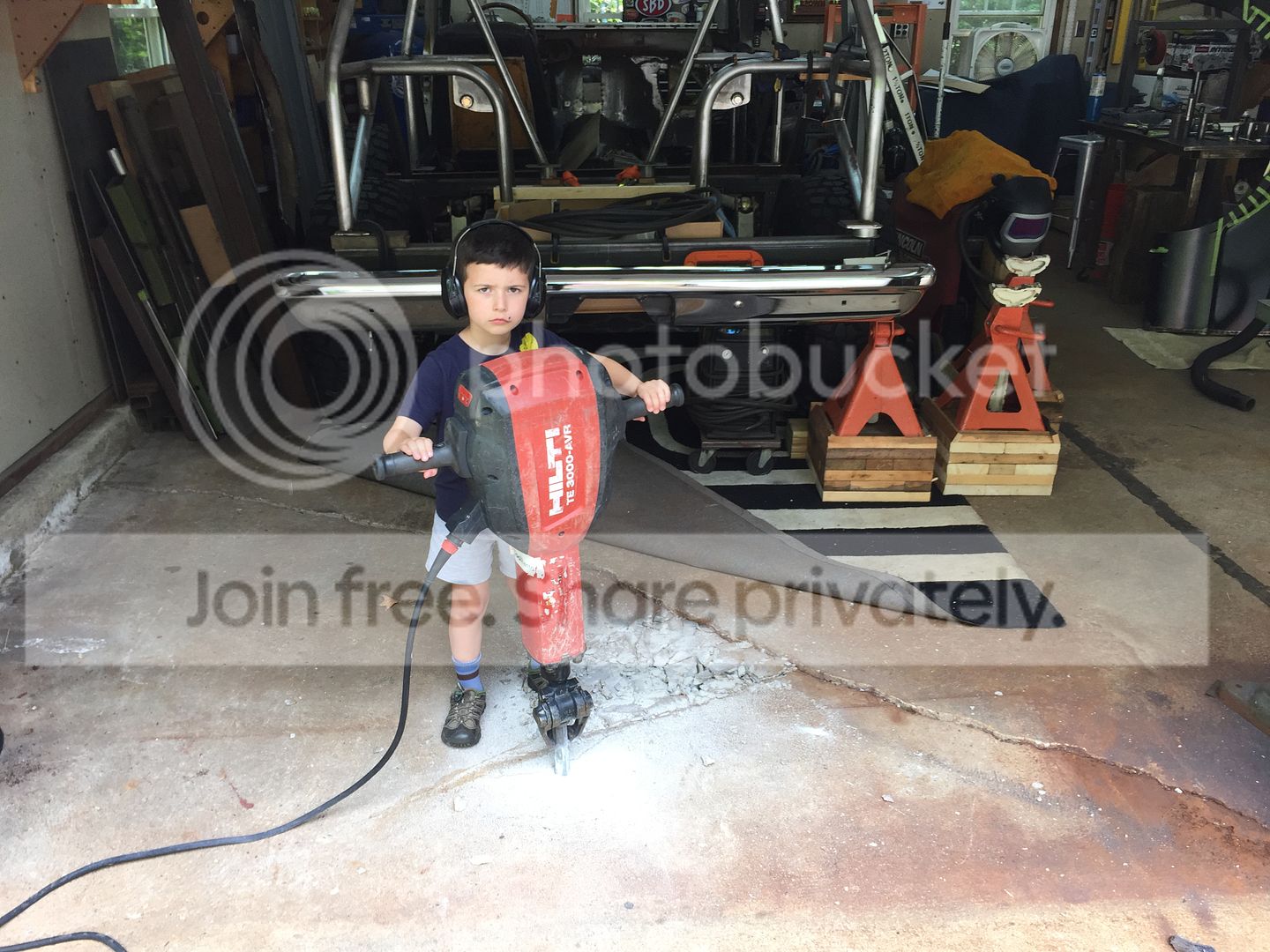
IMG_2011.jpg


The garage was built sometime in the late 50's / early 60's, and as far as I know the floor is original. It was poured with a slight angle from the back wall toward the doors (maybe 1" per 8 feet?) and there is a separate perimeter foundation that holds up the sidewalls and the spot between the rollup doors.

The base material looks like regular sand, there was NO wire mesh, or rebar... which made removal easier, but I don't think that's code anymore. Also, the cement thickness was generally about 4-5" inches thick in the pad, but almost 12" thick at the apron itself!!! :yikes:
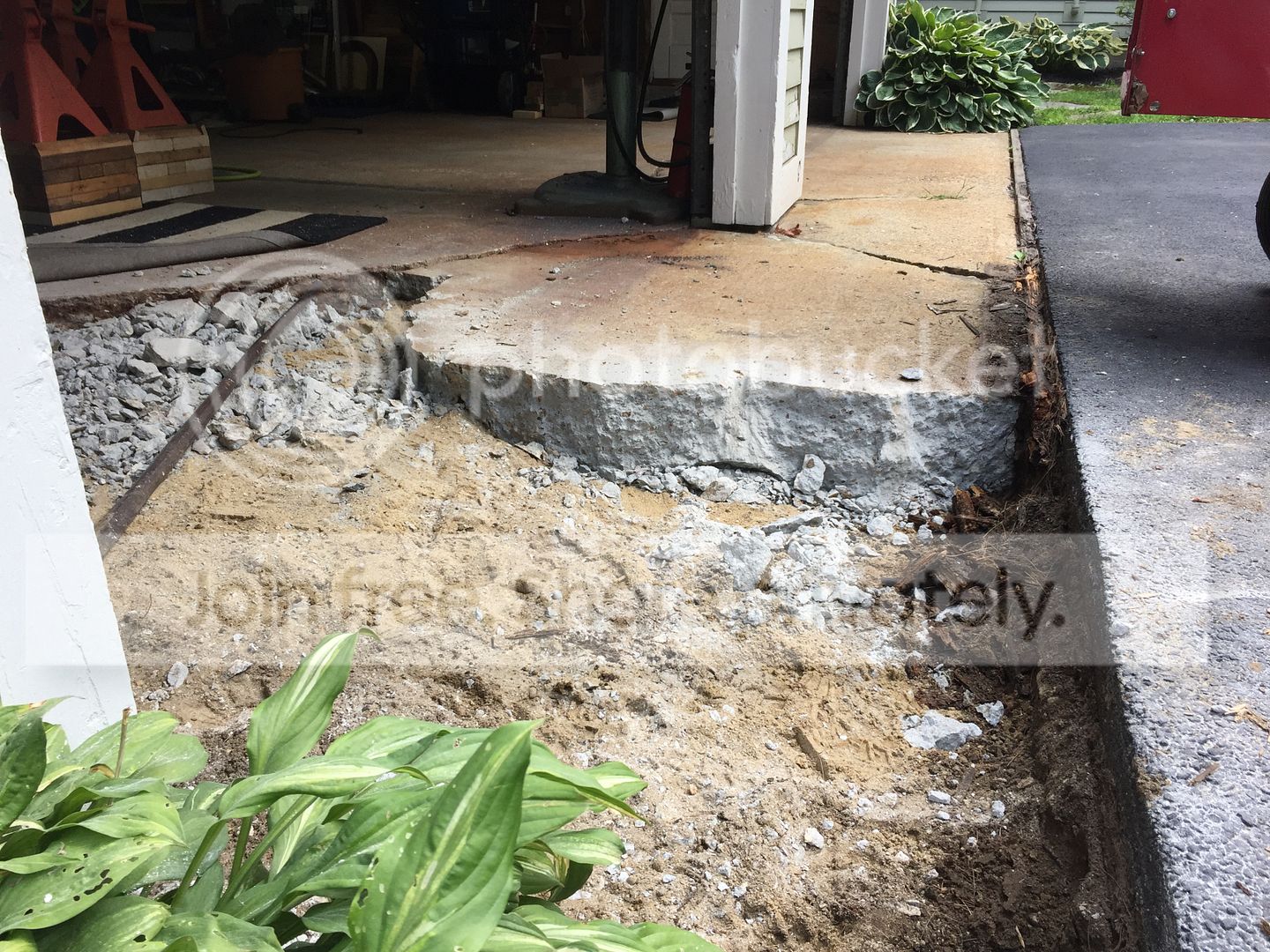
IMG_2040.jpg


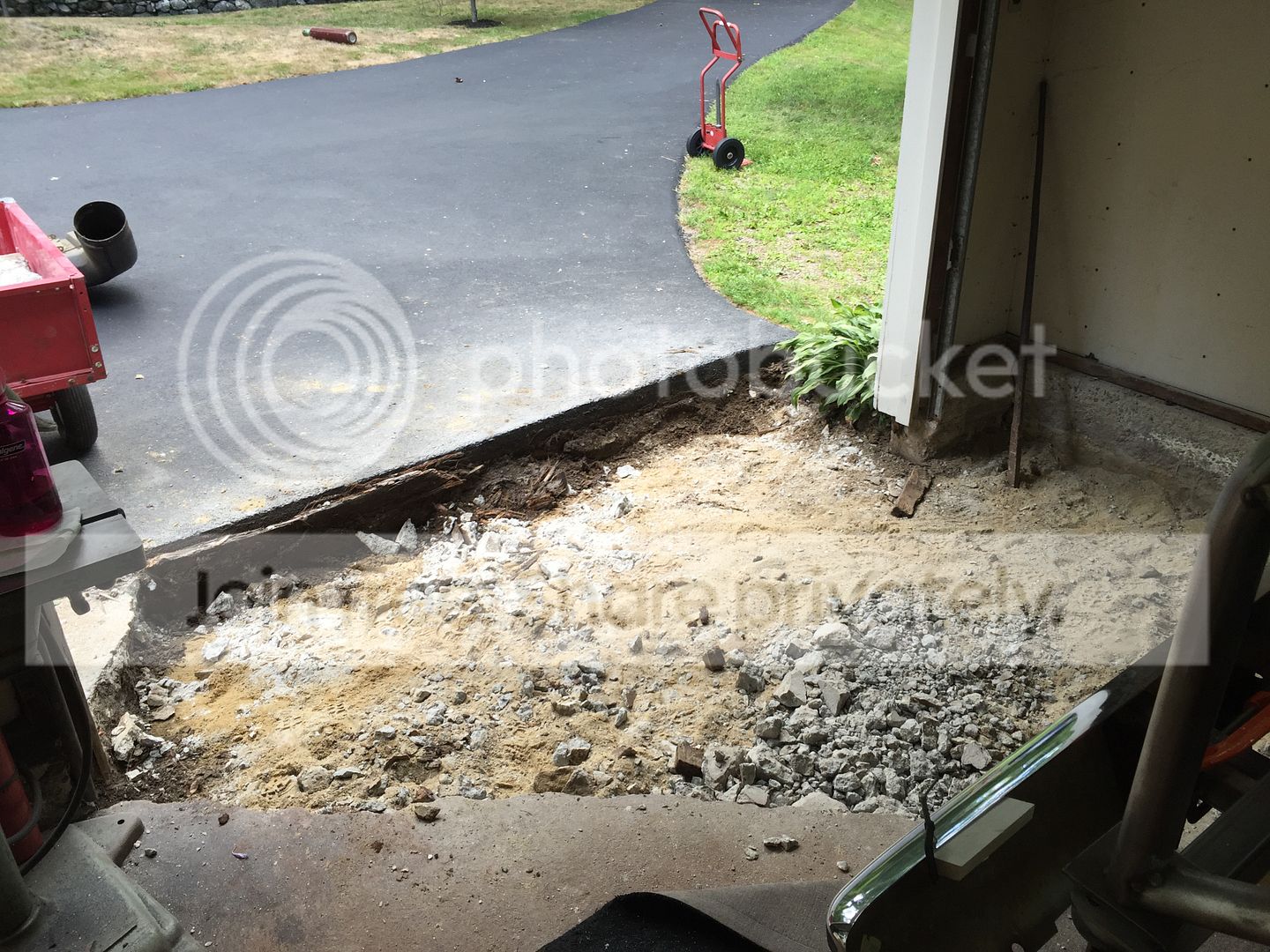
Over time, it appears that water has been undercutting the foundation and caused the pad to lose it's support. It eventually cracked about 3' inside each of the doorways. On the left side it is a long diagonal crack, and on the right side doorway it is basically parallel to the roll-up door.

IMG_2047.jpg


Here is a MSPaint, showing where the cracking is... and where I will need to repour the cement.
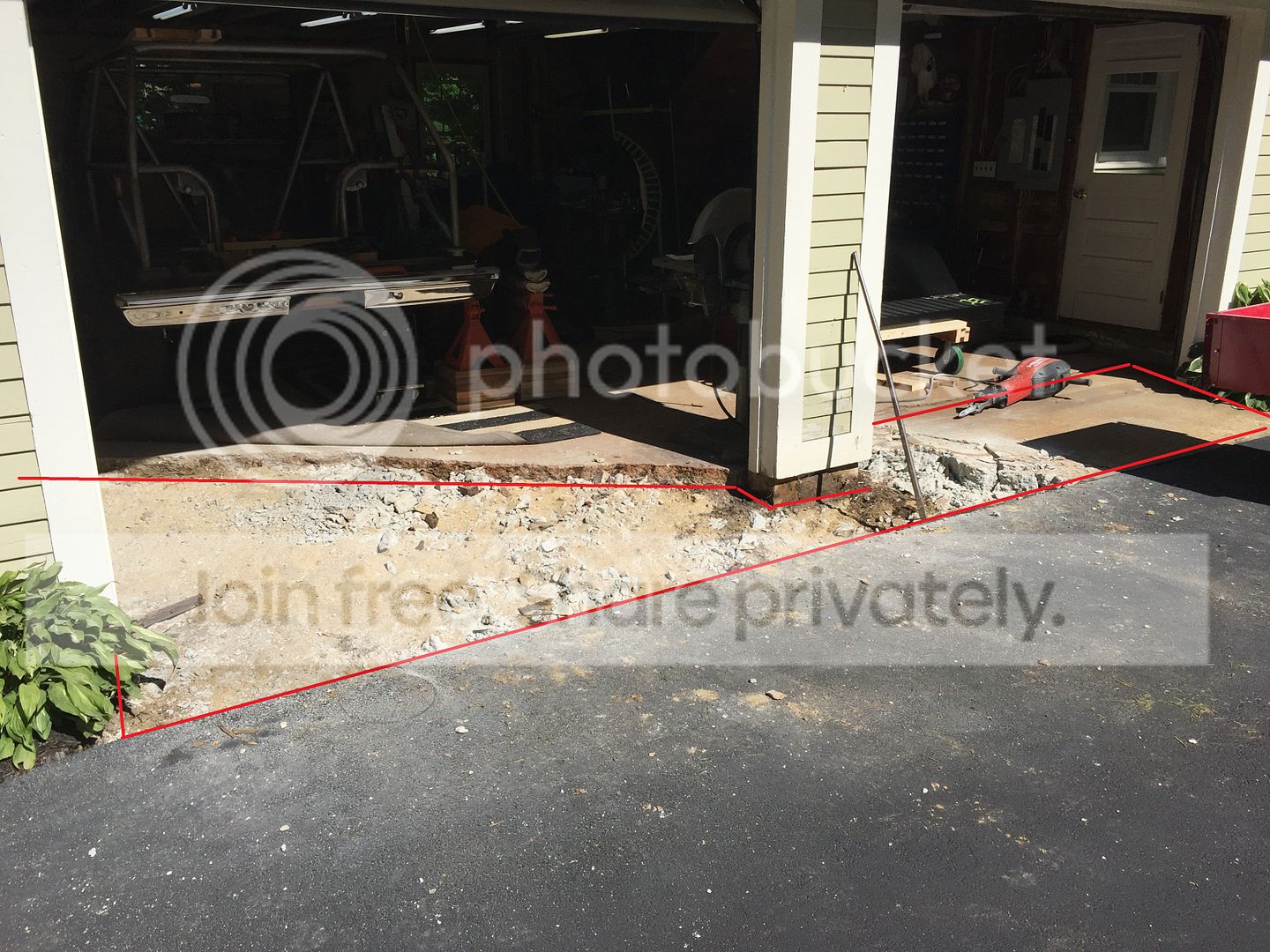
IMG_2049e.jpg


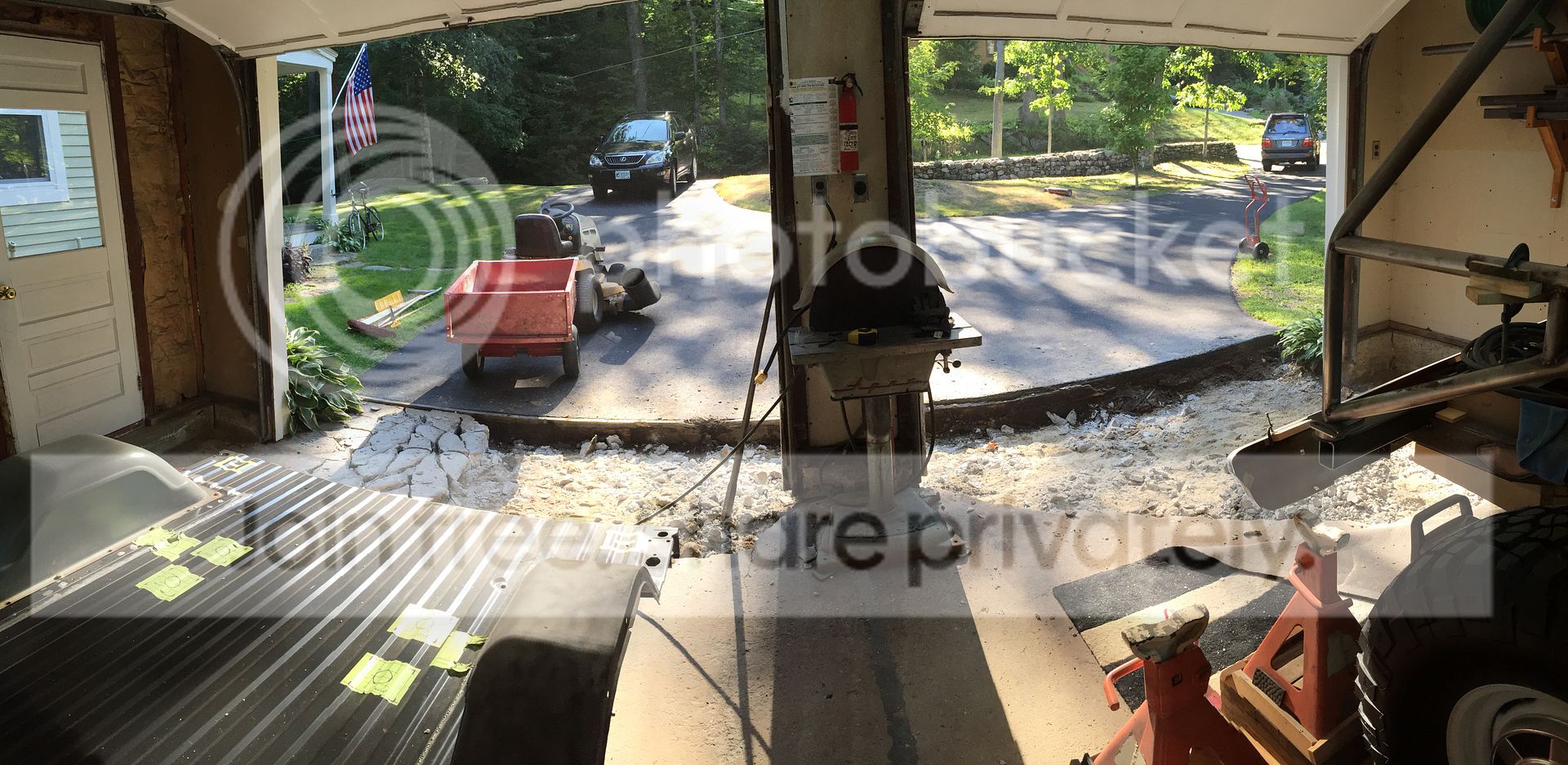
This is the "end of the day" shot showing the excavation of the concrete and the resulting space that needs to be repoured.
IMG_2054.jpg


So I have a few questions about products / methods to get this done correctly:

1. There is a 1/2" crack in the perimeter wall near the front corner of the garage (where the pad settling was at it's worst). I've now got good access from the inside/outside to inject an epoxy of some kind to keep water out and strengthen in back up. What product is good for that?

2. Should I drill the remaining concrete and run rebar into the holes to help insure that the new pad stays bonded and "locked" to the old stuff? Should I epoxy the rebar in each hole, or will it be good enough to just run the bar in maybe 4" - 6" and then pour cement over it?

3. What size rebar "grid" is correct? I want to run rebar in both directions and then space them up with dobie blocks, since that seems to be the standard method I've seen used.

4. Plastic sheeting - Do I put plastic under the whole mess before pouring concrete or no? Not sure if that adds value or not for a garage space.

5. What is that "horsehair" looking stuff that is used between the concrete and the sidewalls / asphalt to act as an expansion joint? Is that the correct material to use, or is there something better?

6. Adhesion Promoter? - Will new concrete stick to the old broken edge or do I need to prep that area to get a good bond?


I'm sure there's more, but I wanted to start soliciting feedback from guys who to concrete work, and/or understand the process since I've never done anything of this scale before. I've set a few posts in Sonotubes, etc. But everything has hand-mixed and didn't require much thought or pre-planning.


Thanks!

-G
 
So.... I finally am going to fix the sagging concrete apron at the front of the garage. Charlie and I rented a 90LB jackhammer and had more "fun" in one-day than I've had in a while!!

IMG_2011.jpg


The garage was built sometime in the late 50's / early 60's, and as far as I know the floor is original. It was poured with a slight angle from the back wall toward the doors (maybe 1" per 8 feet?) and there is a separate perimeter foundation that holds up the sidewalls and the spot between the rollup doors.

The base material looks like regular sand, there was NO wire mesh, or rebar... which made removal easier, but I don't think that's code anymore. Also, the cement thickness was generally about 4-5" inches thick in the pad, but almost 12" thick at the apron itself!!! :yikes:

IMG_2040.jpg


Over time, it appears that water has been undercutting the foundation and caused the pad to lose it's support. It eventually cracked about 3' inside each of the doorways. On the left side it is a long diagonal crack, and on the right side doorway it is basically parallel to the roll-up door.


IMG_2047.jpg


Here is a MSPaint, showing where the cracking is... and where I will need to repour the cement.

IMG_2049e.jpg


This is the "end of the day" shot showing the excavation of the concrete and the resulting space that needs to be repoured.

IMG_2054.jpg


So I have a few questions about products / methods to get this done correctly:

1. There is a 1/2" crack in the perimeter wall near the front corner of the garage (where the pad settling was at it's worst). I've now got good access from the inside/outside to inject an epoxy of some kind to keep water out and strengthen in back up. What product is good for that?

Take a better photo of this. You can fill a small void with something like nonshrink grout but caulk maybe the proper solution.

2. Should I drill the remaining concrete and run rebar into the holes to help insure that the new pad stays bonded and "locked" to the old stuff? Should I epoxy the rebar in each hole, or will it be good enough to just run the bar in maybe 4" - 6" and then pour cement over it?

Yes. 16in on center you should use a 10-12in piece of #4 rebar drilled 4-6in into the existing pad. This will stop future defection between the new and old pour. Dont waste you're time with epoxy, the slab is never going to pull away in this case so simply drill a 1/2in hole and pound the rebar in. Make sure you stay straight and centered in the existing so you dont pop the slab.

3. What size rebar "grid" is correct? I want to run rebar in both directions and then space them up with dobie blocks, since that seems to be the standard method I've seen used.

Honestly no you dont. Technically in a commercial application a 1ft on center #4 rebar matte is standard for a 4in slab. Its also very not necessary in 75% of cases and especially not in residential. And this is coming from a guy that loves tying rebar and throwing bar at things. Ive done some crazy engineered stuff with rebar but in your case other than the fact that you would be over engineering whats already still in the garage its still just overkill. What you need is to tell the concrete company you want a standard amount of fiberglass hair added to the mix and you're set, forget rebar or wiremesh.

4. Plastic sheeting - Do I put plastic under the whole mess before pouring concrete or no? Not sure if that adds value or not for a garage space.

Yes do this. Make sure you use decent plastic. This prevents the slab from whicking ground moisture up and it most crucial by the perimeter.

5. What is that "horsehair" looking stuff that is used between the concrete and the sidewalls / asphalt to act as an expansion joint? Is that the correct material to use, or is there something better?

Asphalt expansion joint. They also sell foam type. If you're abutting to wood use it, if you're abutting to a masonry foundation skip it.

6. Adhesion Promoter? - Will new concrete stick to the old broken edge or do I need to prep that area to get a good bond?

Useless in an application like this. Concrete contracts no matter what you do, its just part of the curing process so the rebar stubs are going to do the work here.


I'm sure there's more, but I wanted to start soliciting feedback from guys who to concrete work, and/or understand the process since I've never done anything of this scale before. I've set a few posts in Sonotubes, etc. But everything has hand-mixed and didn't require much thought or pre-planning.


Thanks!

-G


Good news I got here first and I do this shit for a living! :P

Also I would recommend you saw cut the existing slab in a straight line and remove some extra material. This will give you a better starting point in the future to possibly replace the rest but also because concrete likes straight lines. Jaggedness will promote cracking at the tips and ever though its never actually going to displace from doweling it with rebar it will still show. If ya got any other questions shoot.

O make sure you expand the quote. I answered under your bullets.
 
LMAO....What did you doooo? :haha:


Put down the jack hammer, Crackie. :eek:

I only have a second now so I'll stop by later and see what you get, but I'd start by saw cutting those edges inside the garage so you have something to float into. That jagged crap is going to suck to finish. I'd punch some 1/2" holes in the existing and throw some 12' #4 bar in there. Wouldn't worry about epoxy. Most don't scrub the holes and blow them out anyways.

Do you need an apron gutter? They sure are pretty easy to install now that you have everything out. Just did one not to long ago when we changed out a garage door header.

 
I pump concrete for a living. Lots and lots of brand new homes going up in my area. Everything @Stomis said is legit. Most brand new homes don't even use wire mesh on garage slabs. Rebar grid is completely unnecessary. Dowels to the old slab is a really good idea, but that is it.
 
Another thing, most of the basement/garage/driveway crews that we pump for love to swim in their concrete. They add so much water to it that it is practically self leveling. Pouring the slab too wet is begging to have to pull it back out in a few years. If you keep the estimated slump around a 6, it will still be easy enough to finish and should retain it's strength.
 
Here are the photos of the foundation crack.....


I understand the concerns about wanting to get a nice straight edge for the old cement, but I'm not sure how I can do that. How do I sawcut up to the foundation walls? I don't think I can get a sawblade close enough, and I'm going to end up with a ragged edge somewhere no matter what I do? :dunno:


-G
 
Another thing, most of the basement/garage/driveway crews that we pump for love to swim in their concrete. They add so much water to it that it is practically self leveling. Pouring the slab too wet is begging to have to pull it back out in a few years. If you keep the estimated slump around a 6, it will still be easy enough to finish and should retain it's strength.

Justin is right dont over wet it. If you add whats known as super plastersizer to it you can pour it at a 7 slump which will be beneficial for someone thats never done this before. I would also add 2% retarded so you have plenty of time to get it right.

If you dont add plastersizer to it pour it at a 5, maybe a 6.

Here are the photos of the foundation crack.....


I understand the concerns about wanting to get a nice straight edge for the old cement, but I'm not sure how I can do that. How do I sawcut up to the foundation walls? I don't think I can get a sawblade close enough, and I'm going to end up with a ragged edge somewhere no matter what I do? :dunno:


-G

The crack looks like perhaps that corner of the foundation is undermined, probably from bad compaction in that corner. Everything cracks like that for a reason and if you dig down to the footing Id be willing to bet you find either soft dirt or some footing missing. Repairing that crack really isnt going to fix anything. I would dig that corner out, dig to undermine the footing slightly and underpin it aka pour concrete under the existing footing. Then just seal the crack up with masonry "crack fix" in the concrete section at depot.


O and a good trick to getting a solid screed edge is to use the asphalt expansion just and set it level at pour height. Im not exactly a slab expert when it comes to screeding. Im more of a walls, footing, foundation, stairs, forms, etc kinda guy and I usually labor when we dump slabs. Im no good at wet screeding, which means you set a ribber of concrete to the correct height with a laser and then screed across the two ribbons.
 
I should probably also clarify that my desire is to do all the tedious prep / patch work, then have a "pro" come in and pour and finish the floor.

There is a guy locally who specializes in "small batch" concrete delivery... So I'm sure he would have suggestions for someone that could help complete this project.

I want a nice looking end-result, and I'm hoping that by doing the grunt work myself I can keep the costs down. Does anyone want to hazard a guess about what it might cost for this amount of concrete (delivered, pumped out and finished/blended? :deal: :dunno:


-G
 
I should probably also clarify that my desire is to do all the tedious prep / patch work, then have a "pro" come in and pour and finish the floor.

There is a guy locally who specializes in "small batch" concrete delivery... So I'm sure he would have suggestions for someone that could help complete this project.

I want a nice looking end-result, and I'm hoping that by doing the grunt work myself I can keep the costs down. Does anyone want to hazard a guess about what it might cost for this amount of concrete (delivered, pumped out and finished/blended? :deal: :dunno:


-G

$1, Bob!
 
Last edited:
No pump will be required if you authorize the delivery agent to drive his mixer on your driveway. That looks about like 3 yards, 4 yards max. The price will depend on minimum order requirements from the concrete batch facility. Usually, at least around here, concrete runs 130-175 per yard delivered.
 
I know its pictures and everything but Id be stunned if thats more than 2 yards. And yes the typical labor for concrete flatwork is twice material.

Concrete here is about $110 a yard before you start adding shit into it. Honestly I would just try to find someone willing to finish it and allow you to labor to help them. I wish I was closer, thats seriously a 10min thing to put down and then sit on it to put a finish on it.
 
I know its pictures and everything but Id be stunned if thats more than 2 yards. And yes the typical labor for concrete flatwork is twice material.

Concrete here is about $110 a yard before you start adding shit into it. Honestly I would just try to find someone willing to finish it and allow you to labor to help them. I wish I was closer, thats seriously a 10min thing to put down and then sit on it to put a finish on it.


A 5-hour drive to NH and a 10-minute job once you get here.... Sounds good to me! I've got a fridge full of beer once we're done. ;)


-G
 
OK, A couple more random things:

This is a standard 24' x 24' garage, so the new cement calculation is basically:

Rectangle side (right): 12' x 4' x 6" deep = 24 cu ft
Triangle side (left) 12' x 6'(avg) x 6" deep = 36 cu ft
Total Needed: 60 cu ft / 27 (cuft/yd) = 2.2 Yds.

The mudroom entrance to the house is just to the right of the garage and it's on the North side of the house. Obviously, no sunlight and tends to stay wet and in the spring when ice is melting the water pools up and eventually soaks into the basement / crawlspace areas underneath. It seems like a good time (MAW) to excavate part of that area and lay down some crushed stone and a section of perforated PVC pipe. I have a straight-shot from that area now.... I can run it under the cement pad (in the apron area) at a good downward slope and send that water way out into the side yard (to the right of the garage) which gets great sunlight and is all below grade from the garage area.

The apron area is insanely deep anyway (like 12" deep vs 4" everywhere else)... so it seems like I could easily run a 3" or 4" PVC pipe through there on some baserock, then maybe pack more stone on top of that to protect it from crushing before the new cement goes in? :dunno: I'm tempted to run a second small PVC wire chase tube as well in case I ever wanted to add some exterior landscape lighting, etc. This will be the perfect time to do it, and there really isn't a convenient way to ever get across the vast driveway apron with wires later on, so it's probably worth doing. :waytogo:


EDIT:

Is there such a thing as a concrete blade for a SawZall?? I'm still trying to figure out how I'm going to get a straight cut along that existing rough cracked edge that actually goes up to the very edge of the concrete sidewalls.... :dunno:

-G
 
They sell blades with ceramic grit that can cut things like tile,but they cut slow as a snail and dont last too long,and are pretty costly..

If you can get a circular saw where you need to cut,I'd use a masonary blade on one of those,or an angle grinder (big one,like a 9" will accept a 7-1/4" circular saw blade )..

For the cracked foundation,patching the crack probably will only help stop water intrusion,not add much if any strength..
I have used hydraulic "leak-stop" cement on a crack in my house foundation years ago,and it has held up nicely..however the crack most likely wasn't completely all they way through,I see no evidence of it on the inside of the foundation wall..

You might be able to remove that cracked part of the foundation at the corner and make it as part of the new floor pour to fix it--drill into the foundation and put rebar in the holes to pin the new part to the old..

When my dad put a full length concrete porch on our first house,part of the field stone foundation got pushed in on one corner of the house by an over-enthusiastic backhoe operator,they put plywood forms on the inside and outside of the foundation where it was missing,using threaded rods to hole the plywood in place,and added rebar,and poured both the porch and the new "wall" in one piece..

I ran a 4" PVC pipe under the driveway asphalt in front of my garage,I made the error of not burying it deeply enough,and it heaved up with frost and has buckled and cracked the asphalt--just as the guy predicted who installed the driveway..:doah:..the water simply flows right over the driveway now too,I guess the pipe either was squashed by the roller,or simply clogged up after a year or so with silt..

I'm no concrete expert,just relating what I've done,or seen others do in similar situations..
 
Just rent a demo saw, it'll make quick work of that no problem.


But hey now last I remember you were practicing your TIG skills and now you tear up half the garage floor

That Escalated Quickly 16032016164628.jpg
 
Just rent a demo saw, it'll make quick work of that no problem.


But hey now last I remember you were practicing your TIG skills and now you tear up half the garage floor

View attachment 210968


It was a strange confluence of events.

For you single guys, here's how it works for married guys (at least here's how it works for me):

To earn a "Garage Day".... you must first complete a "Honey Do" day... These are activities which are for the benefit of the entire family, or house, etc. These are simple things like: Repaint the house, remodel the kitchen, install a new roof, build a new rear deck, Hand-stack a 90-foot decorative rock wall, etc. When I spend a full Saturday on a task like this, I can usually parlay that effort into a "day off" on Sunday (Man Space Garage Day).

As many of you know, the rear deck project was finished a little while ago so I've been doing smaller tasks and trying to avoid a few doozies that are still on the "Summer 2016" Honey-Do list.

1. Demo and rebuild mud room area
2. Tear out sagging garage apron, and repour with drainage.


So.... the "Honey Do" in this case was oddly garage-related. And not really in a good way, because now my truck is completely trapped inside the garage until this task is completed. My wife is an evil genius. :haha:

Anyway.... speed is the key here. I don't want to drag this process out any longer than necessary, so as soon as I can get the "prep" work completed, I can call the pros to come do the pouring and finishing work and check this one off my list. My birthday is coming up soon, and I'd like to have FULL ACCESS to the garage area so that I can have a great play day out there!! :waytogo:


-G
 
Top Bottom