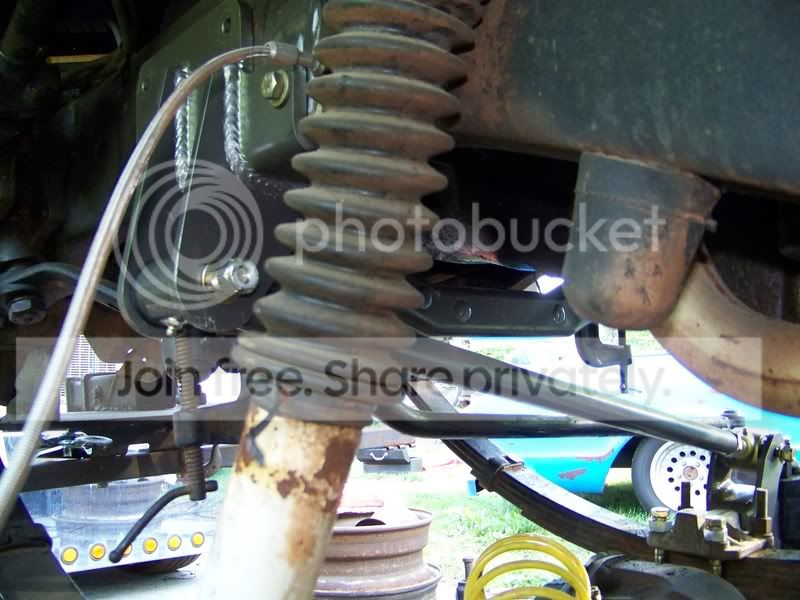
I just started the process of making my own crossover setup, but haven’t got to the point where you are yet. There is a lot to consider and here are my 2 cents after looking at your dilemma.
First is you will always have some sideways pull on the axle no matter what. The geometry of the setup may make it worse, but you cannot get rid of it. Is the force excessive in your case? <shrug> compared to what?
Every vehicle strains more to turn the tires while not moving. Sitting on a rough concrete floor with excellent traction is about the worst case (other than wedged against a rock). Again the question is: in your case, is the force excessive?
Basics first. Is the box ok? Are the ujoints seized? Are the steering knuckles binding somehow? One quick and dirty check for problems due to the kingpin bearings under load would be to put several plastic grocery bags under the front tires and try turning the wheels with the weight of the truck on them. This may help you find a problem that is not apparent when the truck is jacked up and the knuckles are more or less hanging on the upper kingpin bushings.
Keep in mind that the C on the end of the axle housing is the pivot point for the knuckle to rotate around. The axle housing has to hold against whatever force is put on the steering arm, otherwise the axle will move and the knuckle will not turn. The stock steering avoids side to side forces by pulling and pushing front to back on the axle. The front to back force is easily resisted by the left leaf spring. With crossover the steering forces wind up pushing sideways on the springs, not front to back. Plus the taller the arch on lifted springs the more leverage there will be on them and the less able they will be to resist side to side axle movement.
Gmc4cw is on the right track with this
gmc4cw said:
the reason I ask is because the pitman arm and steering arm work in opposite swings. the pitman arm swings in an arc that moves it closer to the front of the truck as it approaches full lock and the steering arm moves towards the back of the truck.
Here is a quick sketch that shows the best case and the worst case.
In the best case the maximum twisting force (torque) is exerted on the steering knuckle trying to make it turn. In the worst case there is no twisting force at all and all the force is trying to pull the axle toward the steering box. As you turn, you go from the best case toward the worst case.
What does this mean in your situation? The further left you turn, the portion of the force applied to the steering arm that is going to try to pull the axle to the left increases. At full left lock you are probably getting close to half way between best and worst case. And because your steering arm is already left of center when the wheels are straight, it makes matters somewhat worse when turning left and somewhat better when turning right. It gets much more complicated when you start thinking in three dimensions, like when the axle is all crossed up.
Anyhow, as far as your latest dimensions, it would seem like all is good when the truck and axle are level. If the full right lock and full left lock dimensions were LESS than the 40.625" centered dimension, then there would be no way it could go lock to lock. As it is you "should" be able to go lock to lock. If you can’t find any mechanical problem causing excessive bind in the steering, then you may just need a hydro assist setup (which would take some of the load off the steering box and frame) and/or a panhard bar. But what do I know, though I did stay at a Holiday Inn Express one time.

Hope you get it figured out.
BTW when you twisted the sector shaft, was the impact from the hole trying to push the axle sideways as well as turn the wheels? Were the wheels pointing straight at the time?



 - and it seems I did a test fit but seemed to not get as much turn. I have thought of the possibility that the pitman arm might be too long or short but never thought about the NWFab crossover arm being too long/short. Stick with me guys, I'll get into it this weekend.