CK5
Register an account today to become a member! Once signed in, you'll be able to participate on this site by adding your own topics and posts, as well as connect with other members.

Overkillz Dune Truggy Build

So like you can't just use a ball joint spacer and keep it cheap? Am I dumb (well on this not in real life, we know I am there)
 
496truck pretty much just laid it out... :whistle:

I see this rig rolling over, without the proper camber.

Explain why? Bump stops limiting up travel, straps limiting down travel. Kick the bottom control arm out an inch or so making the tire lean in an inch at the top (whatever type of camber you call that), and it would keep that same angle at the wheel through the whole suspension travel. Whats gonna cause a flip?
 
I haven't seen the whole conversation, but the proper way to do it would be to have the upper control arm some number shorter than the lower control arm, so at ride height the camber is vertical but as the suspension cycles up or down the top travels inward. Of course this can only happen if you angle them correctly, ideally the lower arm would be level at ride height, but since this cannot happen you may need to compromise the angles. There are many options here, you could even eliminate the upper control arm and fasten everything to the lower one, but this would create a big arc, which may not be a problem at all on the sand because as the suspension compressed (for turning) the outside tire would curve in at the top so that is what you want. Also, remember your tie rods have to be parallel and similar length as your control arms or you will get bumpsteer.

There is a lot involved in a front IFS, you don't want to just slap it together and hope it works. Also, your spring rates will change because you will most likely be mounting the shock on the lower arm somewhere, so that means the tire will have leverage on the shock and you need stiffer springs and valves. All of this is easy to calculate. And it's easy to see the arc of motion with your cad program, even with just a 2d sketch that you can manipulate in the program.

Also, you need to have proper caster too, the upper joint needs to be behind the lower joint for the steering spindle/knuckle. This forces the tire to lean back/in as you turn the tire, also changing the camber as well during the turn, this is good for handling, how much is the question. I am running 10 degrees on my axle, down to 4 or 5 is OK, but more is probably better for a 2WD sand toy, maybe even 12 degrees or so.

If they were both vertical of each other front/back (no caster), then it would handle like crap, wander all over the place, and the steering wheel wouldn't return to center when you let go of the wheel while moving.
 
Good pic of what it looks like. Notice the difference in arm lengths. That's what gets you negative camber during suspension compression, which is what helps plant the outside tire during cornering. Also notice the uniballs for upper (and I assume lower) ball joints. Great for suspension travel but probably limits the turning radius. But this is a high dollar fabricated trophy truck suspension here. I just put this up so you know what you are looking for in your suspension design, similar to what you want to accomplish.

0512001733-Copy.jpg
 
I was wrong about the angles. Picturing it wrong in my head.

Still, these guys have a good handle on the issue. Handling and components were what I was wondering about. Uniballs could work but oy, expensive.
 
Its essentially the same reason why motorcycles lean hard while cornering. They cant take the corner as fast straight up and down as they can leaned over hard. It plants their weight into the ground.
 
Kick the bottom control arm out an inch or so making the tire lean in an inch at the top (whatever type of camber you call that), and it would keep that same angle at the wheel through the whole suspension travel.

I dont think u guys are getting what im saying with this^^^^^^ :doah: . It WOULD kick the tires at an angle leaning in doing EXACTLY as you are saying with the tire applying more pressure when turning.
 
But thats not what you want all the time. By setting it up properly, you get a tire that is perpendicular to the earth at ride height, and goes negative camber when the suspension is compressed and goes positive camber when the suspension is drooped. You dont want it at a constant angle. The camber should change throughout the travel.
 
The other thing is, that with the way you described, the outside tire would get good pressure while cornering but the inside one would suck balls and lose most of its grip.
 
I suppose another thing worth mentioning is that its probably not the biggest deal in the world on a sand truck. Road racing and even off road racing, i would get it as perfect as possible. In your case, you could probably mess up pretty bad and still have fun. But might as well do some research and try to get it a little good right?
 
After watching this video, it looks like most of these vehicles camber doesn't change much at all throughout the travel.

 
Last edited by a moderator:
I have nothing to add to IFS discussion other than, parallelogram. The shape you're describing thats 4 side and like a square but isnt is a parallelogram...

Now carry on Im gonna go back and hide in my straight axle trail rig world aka my closet with my laptop :whistle:

:haha:


O btw all this math and **** makes me want to share something with you guys in context of this discussion. We have a car at work with a 3 link panhard rear that the rear is offcenter and the customer wants it fixed. My older co-mechanics brain imploded when I busted out Pythagorean theorem to come up with the new panhard length. This **** would make him short circuit lol.
 
Right, thats not the commonly desired setup. Maybe they do it that way in order to get as much travel as possible. I think if it were me i would try to do a ford style TTB kinda setup.
 
Another good read.

http://www.automotivearticles.com/123/printer_Suspension_Design_Types_of_Suspensions.shtml

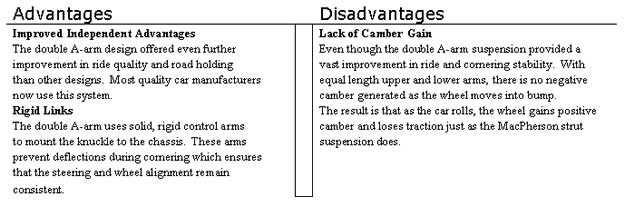
Equal length control arms,

a-arm.jpg


[FONT=Verdana, Arial, Helvetica, sans-serif][FONT=Verdana, Arial, Helvetica, sans-serif]After designing, implementing, and experimenting with the equal length double A-arm suspension it was vary apparent that all that was needed to make the double A-arm front suspension satisfactory for high performance use was to determine a way for the suspension to gain negative camber as it was compressed. (I.e. during chassis roll) The problem was solved by implementing upper and lower A-arms of different length. The resulting unequal length double A-arm suspension was born. [/FONT][/FONT]
 
Top Bottom