CK5
Register an account today to become a member! Once signed in, you'll be able to participate on this site by adding your own topics and posts, as well as connect with other members.

1970 Chevelle Malibu "400" Clone

I wonder why the Clay Smith 4.25 stroke has a split duration but all the rest are straight up. Valve Shrouding because of the smaller bore? The 4.25 stoke (with similar displacement) requires more duration for the same rpm range? Also the difference in header primary diameter suggestions seems odd.

The split duration difference doesn't make sense in my opinion. Typical applications which I will increase the duration split difference are nitrous oxide, blowers, heads with large flow numbers on the intake relative to the exhaust (LS3 rectangular port heads for example), etc. They also have a lot more lift on the intake side of the smaller bore. It would be interesting to see the flow difference with those heads on a 4.25" bore vs the 4.47" bore, I'm sure its better with the larger bore, but I would expect it to be better on both intake and exhaust, not just intake. Although you do clearance the intake in the small bore more than the exhaust at the top of the block, so it's a possibility, but it seems pretty excessive at .620/.569. I can't say I would pick those cams.

The longer stroke will want more duration for the same RPM peak, that is correct, as will larger cubes in general. However, in this case it has slightly less cubes at the same RPM, so it definitely makes no sense to recommend a larger primary tube.

As for the CDI, you really should be running a CDI box with those cams. Yes I still recommend and sell MSD, (not the streetfire), but I have to admit the MSD box in my truck is 24 years old, back in the USA. Try changing your plugs and see if the issue temporarily gets better, but looking at your plugs would tell you a lot before you change them. I would run a MSD 6AL in that with a good coil. I can get those for you and likely beat the big guy prices.

I'll check stock on the cams for you, my guy was out on a work trip until today. I do have a 9 keyway true double roller USA timing set in stock if you need one, its a Howards. I may have a Mark IV and a Gen VI version in stock, I have to check.

As for the difference with the stroke, I typically say one step up for the longer 4.25" stroke. So if you were going to get the smaller cam of those two with the 454, I would get the one step larger one with a 496, etc.
 
Last edited:
Though mine will only be .040 bigger than the 4.31 lot of afr heads are flowed on, I if there is much change. I haven't bore notched before but the block I have is already (my Camaro has a factory notch). I should build a second flow bench fixture to see the actual gains. I like to 0 deck so there is less left to notch.
 
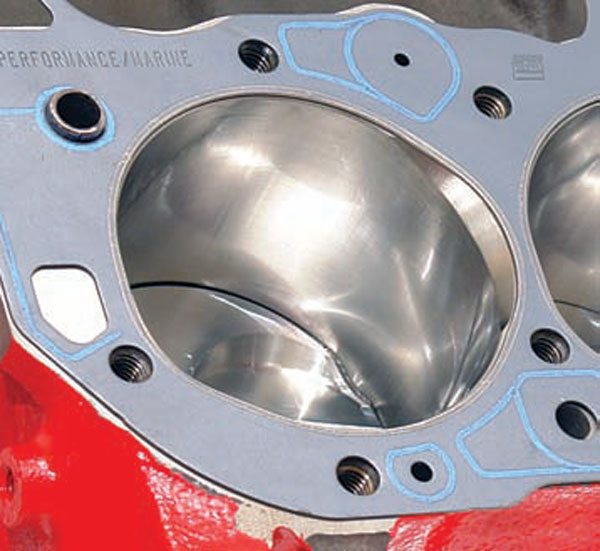
I almost always chamfer the block to the combustion chamber, just don't go too deep, stay at least .060 though away from the top ring land. It's like 10 - 12 HP easy. Here is a prime example (I think this is actually a Vizard picture coincidentally)...

When I built the last regal engine I found out if you go with a 4.600 bore then you don't need to bother... :D

8.jpg
 
Dang I’ve never heard of that. That’s cool.

Completely unrelated but the last few pages have been incredibly interesting to read.
Its kind of synonymous with big block Chevys, the valves are bigger than the bore in many instances, so the combustion chamber ends up to be an oval shape that's larger than the bore, and when the air tries to turn around the valve on the outside it hits the top of the deck. So chamfering that area gains airflow and HP.

When you get to the larger bores eventually the bore is big enough its not an issue, but that requires an aftermarket block.

As a general rule to look out for, if your head gasket isn't shaped like a circle around the bore, you should be looking at that to see if there is room for improvement.
 
I found a place guys were saying 40-50 hp and others where they say no difference. The only things I can see that would be a con have to do with cutting into the ring area or the firering.
 
To make it makes sense to do it, so I do it. Charts I have seen are up to 13 HP gain depending on RPM range.

I spoke with my guy on the cam and he is going to get back to me on both versions(Mark IV and Gen 6 core), it appears they are not in stock at this time but I am finding out lead time. He said they just got more of the smaller cam cores but not the core for that cam.

I do have both timing sets in stock, Mark IV and Gen VI. You can tell the Gen VI version has the additional clearance for the retainer plate. It still has a Torrington bearing it. Not sure if they toleranced it so it contacts the retainer plate before the cam pilot contacts the block, I would hope so. One could tell just by measuring the end play with and without the bearing in there. You most definitely wouldn't need a cam button any more.
 
So I just looked and didn't see it anywhere. What valve springs did you get your heads with?
 
this is what AFR lists.

PAC Racing #1940 1.550” OD Hydraulic Roller Dual Valve Spring, 175 lbs. on seat, .725” maximum lift, Max RPM 6500-6700

I will be disassembling and checking not only the valve job but also springs and height
 
Now I wonder where I am going to find a 950. I think all holleys need to be yellow.
 
I sent you a PM on a deal on one of these...)it's yellow, and 950 cfm.....

 
I actually have ralleys in 15x8 and 15x10 as well as some alum vette rims. Still it would be cool to have the z28 rims widened but it is hard to find anyone willing to do it.
 
Top Bottom